
vivo

Search documents
折叠屏市场回暖,华为折叠屏迎来里程碑式突破
华尔街见闻· 2025-11-19 02:28
Core Viewpoint - The foldable smartphone market is transitioning from a growth phase to a mainstream adoption phase, with Huawei leading the industry with a significant market share and innovative product offerings [2][4][10]. Market Position and Share - Huawei holds nearly 70% of the foldable smartphone market share in China as of the first three quarters of 2025, solidifying its position as the industry leader [4][16]. - In the high-end market segment (priced above $600), Huawei captures approximately one-third of the market share, showcasing its dominance in premium offerings [4][10]. - The competitive landscape shows Huawei far ahead, with its closest competitor, Honor, holding only 11.2% market share, while Vivo has 5% [9][10]. Product Innovation and Development - Huawei has introduced a diverse range of foldable smartphones, including large foldable, small foldable, tri-fold, and wide-fold models, making it the most innovative player in the market [21][30]. - The Mate X series, starting with the original Mate X, has set industry standards with its unique hinge design and continuous technological advancements, culminating in the Mate X6 and the groundbreaking Mate XT [22][27]. - The recent launch of the Mate XTs further emphasizes Huawei's commitment to innovation, featuring the world's thinnest tri-fold design and advanced user experience capabilities [24][26]. Ecosystem and User Experience - Huawei's HarmonyOS ecosystem plays a crucial role in enhancing the user experience of foldable smartphones, providing seamless integration across devices and applications [43][44]. - The company has focused on addressing user needs by offering products that combine portability with functionality, appealing to both business professionals and younger consumers [32][41]. Market Trends and Future Outlook - Despite a recent slowdown in overall market growth, Huawei's strategic focus on foldable smartphones has allowed it to maintain a strong position and set industry trends [14][46]. - The increasing acceptance of foldable smartphones among consumers, with 70.1% expressing interest in purchasing one, indicates a robust potential market [32]. - As the foldable smartphone market matures, Huawei is expected to continue leading through technological innovation and ecosystem development, driving further growth in the industry [46].


夸克将发布全新AI浏览器;微博发布首个自研开源大模型|数智早参
Mei Ri Jing Ji Xin Wen· 2025-11-18 23:16
Group 1 - Quark will launch a new AI browser that integrates with the Qianwen app, marking a strategic collaboration aimed at reshaping the internet access logic [1] - The new AI browser is expected to undergo a significant upgrade on the PC side, enhancing user experience and privacy considerations [1] Group 2 - Weibo has released its first self-developed open-source large model, VibeThinker, which focuses on enhancing capabilities in complex mathematics and competitive programming [2] - The current version of VibeThinker is experimental and not optimized for daily chat interactions, indicating its targeted application in high-intelligence scenarios [2] Group 3 - Several smartphone manufacturers, including Xiaomi, OPPO, and vivo, have paused their procurement of storage chips due to low inventory levels and rising prices from suppliers [3] - The inventory for some manufacturers is reported to be below two months, with certain DRAM stocks dropping to less than three weeks, prompting a reevaluation of procurement strategies [3]

夸克将发布全新AI浏览器;微博发布首个自研开源大模型
Mei Ri Jing Ji Xin Wen· 2025-11-18 23:14
Group 1 - Quark will launch a new AI browser that integrates with the Qianwen app, marking a strategic collaboration aimed at reshaping the internet access logic [1] - The new AI browser is positioned to enhance user experience and privacy considerations, moving beyond traditional browser functionalities [1] Group 2 - Weibo has released its first self-developed open-source large model, VibeThinker, which focuses on enhancing capabilities in complex mathematics and competitive programming [2] - The current version of VibeThinker is experimental and not yet optimized for daily chat interactions, indicating its targeted application in high-intelligence scenarios [2] Group 3 - Several smartphone manufacturers, including Xiaomi, OPPO, and vivo, have paused their storage chip procurement due to low inventory levels and rising prices from suppliers [3] - The inventory for some manufacturers is reported to be below two months, with certain DRAM stocks dropping to less than three weeks, prompting a reevaluation of procurement strategies [3]

存储芯片价格疯涨50% 手机电脑出货承压洗牌加剧
Zhong Guo Jing Ying Bao· 2025-11-18 13:19
Group 1: Market Outlook - The global consumer electronics market is facing challenges due to rising storage prices, leading to downward adjustments in production and shipment forecasts for smartphones and laptops for 2026, with expected declines of 2% and 2.4% respectively [1] - TrendForce indicates that inflation continues to disrupt consumer market performance, and the strong upward cycle of memory prices is increasing overall production costs, which will force terminal pricing to rise, impacting the consumer market [1][5] - If the imbalance between supply and demand for memory worsens, there is a risk of further downward adjustments in production and shipment forecasts [1] Group 2: Procurement Strategies - Reports suggest that several smartphone manufacturers, including Xiaomi, OPPO, and vivo, have paused storage chip procurement due to rising prices, with some manufacturers having DRAM inventory levels below three weeks [2] - Industry analysts believe that pausing procurement is unlikely as manufacturers would not want to forfeit market share, and instead, they may raise terminal product prices to cover rising component costs [2][3] Group 3: Cost Impact - The price increase of storage chips is expected to raise the overall BOM (Bill of Materials) cost of smartphones by an additional 5% to 7% in the coming year, following an 8% to 10% increase already observed [5][6] - The rising costs have already been reflected in the pricing of new smartphone models, with brands like vivo and OPPO increasing prices compared to previous generations [3][5] Group 4: Financial Performance - Transsion Holdings reported a revenue increase of 22.6% year-on-year in Q3, but its net profit declined by 11.06%, indicating that rising supply chain costs are impacting profitability [6] - Xiaomi's Q3 financial report showed an increase in both revenue and net profit, but also noted a rise in smartphone sales costs due to increased prices of core components [6] Group 5: Market Dynamics - The current market dynamics indicate that high-end smartphones can absorb cost increases better due to higher brand premiums, while mid to low-end models are more sensitive to cost fluctuations [6][7] - The ongoing supply tightness in memory chips is expected to lead to a market reshuffle, favoring larger brands as smaller manufacturers struggle to secure resources [7]


存储芯片价格飙升,手机厂商集体承压
Mei Ri Jing Ji Xin Wen· 2025-11-18 13:16
Core Viewpoint - The global memory chip industry is experiencing a significant price surge, particularly in the DDR5 and DDR4 segments, driven by increased demand from the AI sector and supply chain constraints [1][2][3]. Group 1: Price Surge and Market Impact - The price of DDR5 16Gb chips rose from $7.68 to $15.5 in just one month, marking a 102% increase, while DDR4 16Gb saw a rise of over 92% [1]. - Major manufacturers like Samsung, SK Hynix, and Micron have paused quotes due to rapid price increases, impacting the consumer electronics sector, particularly smartphone manufacturers [1][2]. - Tier 1 smartphone manufacturers have long-term supply agreements, preventing stockouts, but face pressure from the steep price increases, with LP4X/5X contract prices rising by 40% and UFS prices by 25% to 30% in Q4 [1][2]. Group 2: Supply Chain Dynamics - The demand for memory chips is being reshaped by AI, with AI servers requiring 8 times the DRAM and 3 times the NAND compared to regular servers [2]. - North American cloud service providers have significantly increased their stocking demands, leading to a projected supply shortage for memory chips throughout the next year [2]. Group 3: Cost Implications for Manufacturers - DRAM contract prices in Q4 2025 are expected to rise over 75% year-on-year, increasing the BOM cost for devices by 8% to 10% [3]. - Xiaomi's president acknowledged that the rising costs of memory chips are beyond expectations and will continue to escalate [3]. Group 4: Manufacturer Strategies - Smartphone manufacturers are adopting a strategy of slight price increases combined with a reduction in memory configurations to mitigate the impact of rising costs [4]. - For example, some manufacturers are downgrading RAM configurations from 16GB to 12GB without significantly affecting user experience [4]. Group 5: Challenges for Lower-End Market - The low-end smartphone market is facing more severe impacts from rising memory chip prices, leading to potential production bottlenecks and increased pressure on hardware profit margins [5]. - Smaller smartphone brands may struggle to secure resources, potentially leading to a market reshuffle favoring larger brands [5]. Group 6: Financial Performance of Companies - Transsion Holdings reported a revenue of 49.543 billion yuan for the first three quarters of 2025, a slight decline of 3.3%, with net profit down by 44.97% due to increased supply chain costs [6]. - The company is adjusting its pricing and product structure in response to rising memory chip costs [6]. Group 7: Future Outlook - TrendForce has revised its 2026 global smartphone production forecast from a 0.1% increase to a 2% decrease, indicating potential further downgrades if supply-demand imbalances worsen [7]. - The industry is expected to endure high-pressure conditions for at least another couple of quarters [7].


段永平用两个字赚了千亿
36氪· 2025-11-18 09:53
Core Viewpoint - The article emphasizes the importance of understanding business fundamentals and maintaining a grounded approach in both entrepreneurship and investment, as exemplified by Duan Yongping's career and philosophy [2][5][11]. Group 1: Duan Yongping's Background and Career - Duan Yongping is recognized for his dual success in both the real economy and investment, founding brands like Xiaobawang and establishing BBK Electronics, which later evolved into companies like OPPO and Vivo [5][7]. - After retiring at the age of 40, Duan Yongping moved to the United States, prioritizing family and personal interests over corporate ambitions, which he believes allowed for a more balanced life [7][9]. - He attributes his early retirement to the capabilities of his team, stating that he stepped back to allow younger talents to lead [9]. Group 2: Investment Philosophy - Duan Yongping's investment strategy is centered around the principle that "buying stocks means buying companies," emphasizing the need to understand the underlying business rather than focusing solely on stock price fluctuations [15][16]. - His notable investment in NetEase, where he purchased shares during a market downturn, exemplifies his belief in understanding the business model and long-term value rather than succumbing to market panic [15][16]. - He has invested in a limited number of companies over the past two decades, including Apple and Moutai, indicating a preference for deep understanding over chasing trends [16][17]. Group 3: Business Principles - Duan Yongping advocates for a "not-to-do list," which includes avoiding OEM production, not engaging in price negotiations, and maintaining integrity in business practices, which he believes helps minimize errors [13][11]. - He emphasizes the importance of doing the right things and having a calm mindset, especially in the face of temptations, to ensure sound decision-making [11][12]. - His approach to business is characterized by a focus on brand building and long-term vision rather than short-term gains, as demonstrated by his refusal to take on large orders that did not align with his company's goals [13].




“一天一个价”“涨得比黄金还猛”!内存条一个月涨价70%!业内人士:AI需求爆发所致;多款手机已开始涨价,终端厂商承压
Sou Hu Cai Jing· 2025-11-18 08:41
Core Viewpoint - The storage chip market is experiencing a significant price surge, driven by increased demand from AI data centers, leading to higher costs for end products and potential price hikes in consumer electronics [1][11][12]. Price Surge and Market Dynamics - The price of memory modules has increased dramatically, with some products seeing a nearly 70% rise in just one month [3]. - A specific DDR5 memory module rose from approximately 1000 RMB to 1679 RMB within a month, indicating a strong upward trend in pricing [3]. - The current market conditions are characterized by a lack of inventory, with many products showing as out of stock, leading to rapid price fluctuations [4]. Supply Chain and Manufacturer Impact - Chip procurement is becoming increasingly volatile, with prices changing daily and significant increases noted in the cost of storage materials [4][5]. - Major manufacturers like Samsung and SK Hynix are benefiting from this price increase, reporting substantial revenue and profit growth [7][8]. - The financial performance of storage module manufacturers has also improved significantly, with companies like Jiangbolong and Bawei Storage reporting revenue increases of over 50% [8]. Consumer Electronics and Pricing Pressure - The rising costs of storage components are expected to lead to increased prices for smartphones and laptops, with estimates suggesting a 5-15% increase in retail prices [9][10]. - Several smartphone manufacturers have already begun raising prices, citing increased storage costs as a primary factor [10]. Future Outlook and Demand Trends - The demand for storage products is expected to remain strong, particularly due to the ongoing growth in AI and data center requirements, with projections indicating that this trend will continue until at least the end of 2026 [11][13]. - Analysts predict that the fourth quarter will see further price increases for DRAM and NAND flash memory due to limited supply and heightened demand from cloud service providers [12].

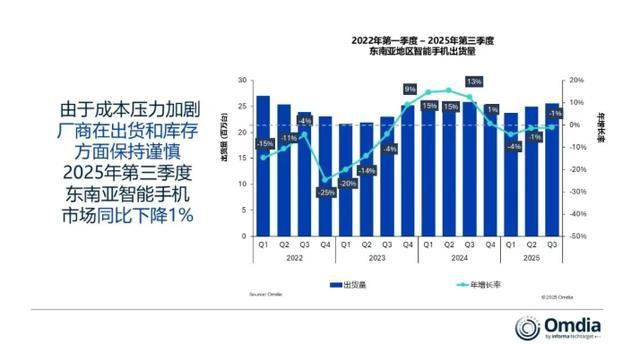
Omdia:2025年第三季度东南亚智能手机出货量下降1%
Huan Qiu Wang Zi Xun· 2025-11-18 08:16
Group 1 - The Southeast Asian smartphone market is projected to decline by 1% year-on-year in Q3 2025, with shipments reaching 25.6 million units, marking the third consecutive quarter of decline [1][3] - Entry-level smartphone shipments are experiencing increased volatility, making management more challenging, yet they remain a key factor in market share rankings [3] - OPPO and vivo are focusing on value rather than volume, while Honor and Xiaomi are increasing shipments to enhance brand penetration, with Honor's Q3 shipments doubling compared to the same period in 2024 [3] Group 2 - After a sluggish first half of 2025, manufacturers are expected to adopt more aggressive strategies in the second half, including the early launch of new products, due to healthier inventory levels [3] - Rising material costs driven by increased memory and storage prices will significantly impact low-priced devices, especially in a price-sensitive market where over 60% of smartphones are priced below $200 [3] - Manufacturers will need to balance competitive pricing with adjustments in selling prices, reductions in hardware costs, or cuts in marketing expenditures to protect profit margins [3]
曾与华为、小米争锋,年销4000万台的巨头,如今靠百元机在老年机市场求生!头部手机厂商也瞄准了3.29亿“银发冲浪者”
Mei Ri Jing Ji Xin Wen· 2025-11-18 07:27
今年"双11",手机仍是竞争最激烈的产品品类,各大手机厂商均在"双11"之前就做足准备。此刻,谁是此次较量的最终赢家成为市场关注焦点。京东发布 的手机竞速排行榜显示,苹果、小米、vivo位列前三,包揽品牌销量累计榜前三。在智能机"厮杀"的主战场之外,飞利浦、天语等主打功能机业务的手机 品牌也跻身TOP10。 每经记者|王晶 每经编辑|程鹏 黄博文 品牌商与消费者双向奔赴、全民狂欢的"双11"电商节在全网热度中徐徐落幕。 智能手机的普及,曾让功能机一度退居"老人机"赛道。如今,这片最后的阵地也正面临来自智能终端的渗透与重塑。 李大爷的手机又坏了,家人匆匆在电商平台下单,买来一台百元左右的"老人机"——功能极其简单、字体大、音量高、待机时间长。熟悉智能设备的张大 姐则花两千多元买了部智能手机,能刷短视频、视频通话、扫码支付…… QuestMobile(北京贵士信息科技有限公司)指出,截至2024年9月,银发人群(通常指60岁及以上的老年群体)月活用户约3.29亿,人均月使用时长高达 129小时,相当于每天网上"冲浪"超过4小时,其中短视频、社交、资讯、电商等位居使用时长前四位。同时,2000元以上中高端智能机的使 ...


手机产业链全线走低 多家手机厂商暂缓存储芯片采购 存储涨价或冲击手机出货量
Zhi Tong Cai Jing· 2025-11-18 07:19
Core Viewpoint - The mobile industry chain is experiencing a significant downturn, with major companies like Q Technology, GoerTek, and BYD Electronics seeing substantial stock price declines due to a recent halt in storage chip procurement by several smartphone manufacturers [1] Group 1: Market Performance - Q Technology (01478) shares fell by 7.12%, trading at HKD 9.91 [1] - GoerTek (01415) shares decreased by 4.8%, trading at HKD 27.36 [1] - Hong Teng Precision (06088) shares dropped by 4.64%, trading at HKD 4.93 [1] - BYD Electronics (00285) shares declined by 3.24%, trading at HKD 32.9 [1] Group 2: Supply Chain Dynamics - Since the second half of 2025, the global storage chip industry has entered a rare uptrend, leading to increased costs for complete devices [1] - Major smartphone manufacturers like OPPO and vivo have low inventory levels, with some DRAM stocks below three weeks, causing hesitation in accepting price increases of nearly 50% from suppliers [1] Group 3: Forecast Adjustments - TrendForce has revised down its production shipment forecasts for global smartphones and laptops for 2026, from a growth of 0.1% and 1.7% to declines of 2% and 2.4%, respectively [1] - There is a risk of further downward adjustments in production forecasts if the imbalance in storage supply and demand worsens or if the increase in terminal prices exceeds expectations [1]
