
利差交易

Search documents
法兴银行:债券在人气脆弱之际提供安全价值
Xin Lang Cai Jing· 2026-02-27 06:36
法国兴业银行利率策略师在一份报告中称,股市人气脆弱和地缘政治局势不明朗为债券的安全价值提供 了支撑。在此背景下,他们维持德国国债相对于互换的长仓。在欧元区政府债券领域,法国兴业银行坚 持持有三至五年期债券和互换以获取利差,但建议不要在当前水平上增持这些交易。这些策略师预计, 欧元区长端利率的波动将继续大于收益率曲线的前端和中端。 ...

法兴银行:欧元区政府债券市场表现平静,缺乏动能
Xin Lang Cai Jing· 2026-02-13 12:55
Group 1 - The report from Société Générale indicates that the Eurozone government bond market lacks momentum, with narrow yield spreads and low volatility [1] - Investors are engaging in carry trades, seeking signals in this low-noise market environment [1] - Seasonal factors may lead to underperformance of peripheral country bonds, but this situation is not expected to last long [1] Group 2 - Political events have historically been a source of volatility for Italian government bonds (BTP), with the upcoming constitutional referendum on judicial reform in March being closely watched [1] - The company anticipates that there will not be significant political shocks, and any market reactions should be viewed as short-term noise [1]
瑞郎避险与利率双轮驱动 震荡格局待破局
Jin Tou Wang· 2026-02-09 02:49
Core Viewpoint - The USD/CHF currency pair remains a focal point in the forex market due to its dual characteristics of being a safe-haven asset and a carry trade, influenced by the interplay between the US Federal Reserve's monetary policy and the Swiss National Bank's interventions [1][3]. Fundamental Analysis - The interest rate differential is the primary driver of the USD/CHF exchange rate, with the Fed's interest rate decisions directly impacting the USD/CHF dynamics [1]. - A resilient US economy may delay Fed rate cuts, strengthening the USD and pushing USD/CHF higher; conversely, weak US data could lead to earlier rate cuts, putting pressure on the USD and causing the exchange rate to decline [1]. - The Swiss National Bank's policy stance is crucial, as excessive appreciation of the CHF could harm Swiss exports and inflation, prompting the SNB to intervene and potentially support the USD/CHF [1]. Risk Sentiment - Global geopolitical conflicts, financial market volatility, and recession expectations can quickly trigger a rebalancing of funds towards safe-haven assets [2]. - When risk appetite improves, the CHF tends to weaken against the USD, while heightened risk aversion leads to increased demand for the CHF, which can suppress the USD/CHF exchange rate [2]. Technical Analysis - The USD/CHF pair typically exhibits a range-bound and oscillatory trading pattern, with clear trends being relatively rare [2]. - Key support and resistance levels are critical for mid-term trading strategies, with a focus on high-selling and low-buying approaches before any breakout occurs [2]. - Short-term indicators such as moving averages, RSI, and MACD can assist in identifying market strength and potential reversal signals, enhancing the probability of successful trades [2]. Summary - The USD/CHF exchange rate is influenced by the combined effects of Fed policies, SNB interventions, and global risk sentiment [3]. - Monitoring US inflation and employment data is essential for understanding Fed policy direction, alongside observing SNB statements and global financial risks [3]. - The USD/CHF is likely to remain in a range-bound pattern until a significant shift in interest rate expectations or risk sentiment occurs, which could lead to a breakout and a new trend [3].
法国兴业银行:挪威克朗受有吸引力的政策利率提振
Xin Lang Cai Jing· 2026-01-23 15:05
Core Viewpoint - The report from Société Générale's Kit Juckes indicates that the Norwegian krone has strengthened against the euro, reaching a seven-month high, supported by the Norwegian central bank's decision to maintain the policy interest rate at 4.0% [1] Group 1 - The Norwegian krone is expected to benefit from carry trades, where investors borrow in low-interest currencies to invest in high-interest currencies [1] - The euro has dropped to a low of 11.5251 Norwegian kroner, with speculation that if the exchange rate falls below 11.40, it may trigger intervention from relevant parties to reverse the trend [1] - The Norwegian central bank has stated that it is not in a hurry to cut interest rates due to persistently high inflation, although it still anticipates one to two rate cuts this year [1]

意大利和西班牙10年期国债收益率差触及多年低点
Xin Lang Cai Jing· 2026-01-16 08:09
Core Viewpoint - The yield spread between peripheral Eurozone countries' bonds and German bonds has narrowed, reaching historic lows for Italy and Spain since 2008 [1] Group 1: Yield Spread Data - The yield spread of 10-year Italian BTPs against German bonds dropped to as low as 59 basis points [1] - The yield spread of 10-year Spanish bonds against German bonds decreased to 39 basis points [1] Group 2: Market Outlook - Jefferies' economist Mohit Kumar expresses optimism regarding the performance of Italy and Spain relative to Germany [1] - The favorable environment for spread trading is expected to dominate the credit bond and peripheral country markets in the coming months [1] - Jefferies maintains a bullish position on government bonds from peripheral Eurozone countries and anticipates the yield spread between Italian and German 10-year bonds to converge towards 50 basis points [1]
高盛闭门会-全球跨资产2026展望-超配股票Alpha机会增加中国亮眼-金发姑娘各种多元化看好黄金
Goldman Sachs· 2026-01-16 02:53
Investment Rating - The report suggests an overweight position in equities while maintaining neutral allocations in bonds, commodities, and cash, with a low allocation to credit [2] Core Insights - Despite high market valuations, macro fundamentals are expected to support the current levels, and high valuations alone do not constitute a bearish signal [3] - Economic growth in 2026 is anticipated to be diversified, driven by fiscal policy, regulatory easing, and AI penetration, while political and geopolitical risks should be monitored [4] - The importance of diversification in asset allocation is emphasized, particularly in the late economic cycle, with a recommendation for alternative strategies and diverse investment styles [5][6] Summary by Sections Economic Outlook - The macro outlook for 2026 is positive, with strong performance expected in the first half, but potential slowdown in the second half. Growth will be more diversified, supported by fiscal policy and AI integration [4] Market Valuation - Current valuations are high, with the S&P Shiller PE ratio at its highest level since the tech bubble, but macro factors support these valuations, indicating that high valuations alone do not signal a market downturn [3] Asset Allocation Strategy - The asset allocation strategy for early 2026 favors risk assets, particularly equities, while maintaining neutral positions in bonds and commodities. Credit is underweighted due to low credit spreads [2] - The report highlights the need for selective and cautious approaches in spread trading and credit investments, recommending an overweight in equities to navigate the current economic environment [7] Sector and Regional Trends - Different regions are driven by various factors, with the U.S. led by technology, while value stocks are recovering in Europe. The report notes a balanced dynamic across sectors, creating opportunities for alpha generation [8] Commodity Market Outlook - The commodity market is expected to see a divergence in returns, with gold projected to rise to $4,900 per ounce by year-end, while Brent crude oil prices are expected to decline to an average of $56 per barrel [18]
巴菲特3480亿抄底日元?全球金融将迎巨震!
Sou Hu Cai Jing· 2025-12-23 13:26
Core Viewpoint - Berkshire Hathaway is reportedly planning to shift $348 billion in cash into yen assets, which could significantly reshape the global financial landscape, especially with the anticipated interest rate hikes by the Bank of Japan [2][3]. Group 1: Economic Logic and Data Support - Berkshire's cash reserves have reached $347.7 billion, facing declining yields on dollar assets amid a Fed rate cut cycle [3]. - The Bank of Japan is expected to raise its benchmark interest rate to 0.75% by December 2025, with predictions of at least one more hike to 1.0% in 2026, creating an attractive arbitrage opportunity for Buffett [3]. - The anticipated narrowing of the US-Japan interest rate differential is expected to lead to a strengthening of the yen, providing a dual benefit of interest and currency gains for investors [3][4]. Group 2: Investment Strategy and Market Impact - Buffett has already invested in Japan, with Berkshire holding $23.5 billion in shares of Japan's five major trading companies, yielding significant returns [4]. - The potential influx of capital into yen assets could trigger a domino effect on global liquidity, impacting US equities and emerging markets as the yen strengthens [5]. - The Japanese bond market may see a rise in yields, increasing financing costs for US government and corporate entities [5]. Group 3: Implications for Ordinary Consumers - The appreciation of the yen may lower the cost of Japanese imports, potentially reducing inflationary pressures domestically [6]. - However, the cost of travel and shopping in Japan will increase for those holding foreign currencies, while overseas investors in yen assets may benefit from currency gains [6]. - Changes in global interest rates could lead to adjustments in domestic bank deposit rates, affecting savings returns for ordinary consumers [6]. Group 4: Investor Strategies - Investors are advised to focus on Japanese financial stocks, consumer leaders benefiting from yen appreciation, and sectors related to yen-denominated debt [7]. - Fixed income strategies should shift away from long-term US bonds and emerging market dollar debt towards short-term yen bonds or high-grade RMB credit bonds [7]. - Caution is recommended in commodity and cryptocurrency markets, as rising global interest rates may exert downward pressure on prices and liquidity [7]. Group 5: Wealth Preservation for Ordinary People - Diversification of assets and avoidance of high leverage are crucial for ordinary consumers amid potential market volatility [8]. - Maintaining a cash reserve of 10%-20% is suggested to capitalize on market fluctuations [8]. - Entrepreneurs should be wary of tightening global liquidity and prioritize stable cash flow business models to reduce reliance on external financing [8].


日元急跌引担忧!日本高官急发警告,空头却在“准备度假”
Jin Shi Shu Ju· 2025-12-22 04:13
Group 1 - The Japanese government is concerned about the recent one-sided and sudden fluctuations in the foreign exchange market, particularly after the Bank of Japan's monetary policy meeting, indicating a potential need for intervention if the yen continues to weaken towards the 160 level [1] - Following the Bank of Japan's decision to maintain interest rates, the yield on the benchmark 10-year Japanese government bond rose by 7.5 basis points to 2.095%, the highest level since February 1999, while the 2-year bond yield increased by 3 basis points to 1.12%, the highest since 1997 [1] - Nomura Securities reports that Prime Minister Fumio Kishida is becoming aware that the continuous depreciation of the yen could impact his political stability, suggesting that Japanese authorities may be close to taking strong action [4] Group 2 - Market participants acknowledge the possibility of further interest rate hikes but do not fully accept a rapid or aggressive rate increase path, indicating a cautious approach to trading the yen [5] - Speculative positions in the dollar-yen pair have been affected by the U.S. government shutdown, with data showing a significant decline in long positions on the yen, approaching neutral levels [5] - Analysts believe that while the Japanese Ministry of Finance can temporarily halt the yen's decline by selling dollars, this strategy may not be sustainable, especially without a shift towards a more hawkish tone from the Bank of Japan [5]
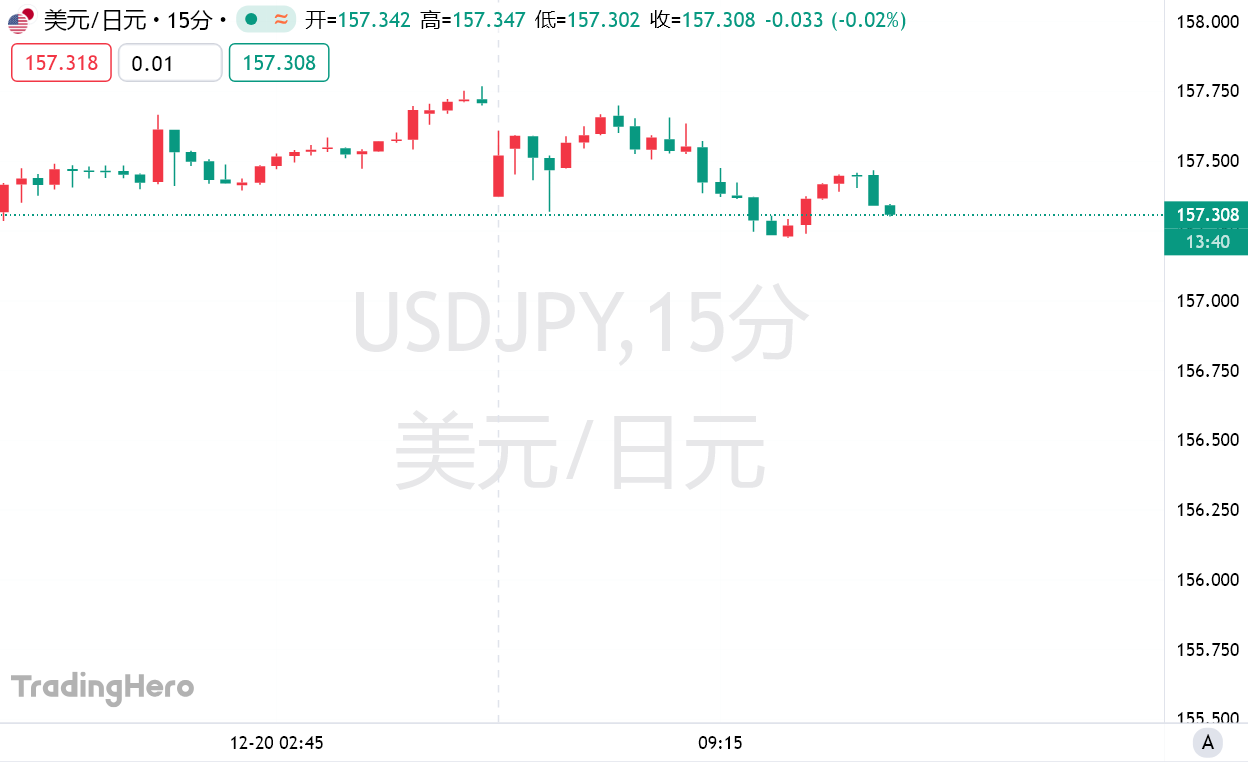
全球市场“地震”倒计时!日本央行30年来最大加息,你的钱包准备好了吗?
Sou Hu Cai Jing· 2025-12-19 03:45
Core Viewpoint - The Bank of Japan is expected to announce a 25 basis point interest rate hike, raising the rate to 0.75%, marking the highest level since 1995, which could trigger significant global market impacts [1][2]. Group 1 - The era of cheap yen is coming to an end, as global investors have borrowed over $1 trillion in yen at near-zero costs to invest in high-yield assets like U.S. Treasuries and stocks. The rate hike will significantly increase the cost of these trades, potentially leading to a "liquidation" scenario [4]. - Japanese investors are the largest overseas holders of U.S. Treasuries, with approximately $1.2 trillion in holdings. As Japanese bond yields become more attractive, there is a risk of substantial capital returning to Japan, raising concerns about demand for U.S. Treasuries on Wall Street [4]. - The market has largely priced in this rate hike, with a 94% probability of its occurrence. The real market impact will depend on comments from Bank of Japan Governor Kazuo Ueda regarding future rate hikes, which could amplify or mitigate the market's reaction [4].

【UNFX财经事件】降息推动美元走弱 流动性释放强化黄金在4250上方的稳固性
Sou Hu Cai Jing· 2025-12-12 03:49
乌克兰方面与美国官员就修订后的20点和平框架展开沟通,使市场避险情绪略有减弱。一旦和平进程出 现实质性推进,黄金作为避险工具的吸引力将有所下降,限制短线涨幅。 美国股指整体维持强势,但科技板块因博通与甲骨文的回调而承压。标普500与道指继续刷新历史高 点,纳斯达克则在大型科技股走弱的影响下轻微回落。市场对美联储流动性改善保持积极预期,但AI 产业链盈利兑现速度的争议让科技股波动加大。 黄金走势仍保持在强势区间。关注4245至4250美元一线的压力,以及下方4200美元的关键支撑。若金价 能够在降息与流动性释放的支撑下站稳4250美元上方,后续有望测试4277至4300美元区间。若科技股带 动风险偏好回暖或乌克兰局势进一步降温,则需观察金价在4200至4170美元区间的支撑表现。短线策略 宜围绕事件驱动、利率预期调整与资金面变化合理控制节奏。 周五亚洲时段,黄金继续在高位运行,盘中逼近每盎司4275美元。美联储宣布降息、美元走弱以及就业 数据疲软,使宽松预期快速升温;同时,美联储加大短期国库券购入力度,阶段性缓解融资压力。尽管 科技板块的调整令美股表现分化,但利率与流动性两条主线均对金价构成支撑。地缘局势的缓和 ...