
地方政府债务化解

Search documents
2026区域经济盘点系列之一:2026化债重点或包括经营性债务
HUAXI Securities· 2026-03-27 12:30
1. Report Industry Investment Rating No information provided in the report. 2. Core Viewpoints of the Report - In 2025, all provincial - level regions had positive GDP growth, with 18 provinces outperforming the national average. Most provinces saw an increase in general public budget revenue and an improvement in fiscal self - sufficiency. However, most provinces also had a significant increase in local government debt balances and an upward trend in government debt ratios. Only five provinces managed to reduce their urban investment interest - bearing debts [1][11]. - In 2026, both the central and local governments emphasize "taking multiple measures to resolve the operational debt risks of local government financing platforms". The central government has entered a new stage of "unified management" for debt resolution, and local governments have achieved positive results in resolving implicit debts and reducing the number of financing platforms in 2025, and have set clear goals for 2026 [3][32]. - Given the ongoing debt - resolution cycle and the attention paid to resolving operational debt risks, the default risk of urban investment bonds remains low. There are still some provinces' urban investment bonds with certain cost - effectiveness, but currently, the overall yield of urban investment bonds is low, and trading is needed to increase returns [4][42]. 3. Summary According to the Directory 3.1 Ten Strong Provinces Contribute Over 60% of GDP, Only Five Provinces Achieve a Reduction in Urban Investment Interest - Bearing Debts - **Economic Aspect**: The top ten provinces' GDP totaled 85.5 trillion yuan, accounting for 61% of the national economic aggregate. All provincial - level regions had positive GDP growth, with 18 provinces having a higher GDP growth rate than the national average of 5.0%. Tibet ranked first in GDP growth for three consecutive years. Chongqing's GDP exceeded Liaoning's in 2025 [11][12]. - **Fiscal Aspect**: Most provinces' general public budget revenues increased, and the revenue growth of major economic provinces rebounded. The growth rate of general public budget expenditures slowed down significantly, and the fiscal self - sufficiency rate of most provinces increased. The tax revenue ratio of half of the provinces increased [11][17][21]. - **Debt Aspect**: With the continuous implementation of the debt - resolution policy supported by "6 + 4" trillion yuan of local government bonds, the local government debt balances of most provinces increased significantly. All provincial - level regions' government debt ratios increased. Most provinces' urban investment interest - bearing debts (mainly operational debts) still increased to varying degrees, and only five provinces achieved a reduction [11][28][29]. 3.2 How Does the Central Government and Each Province View Debt Resolution in 2026? - **Central Government**: The central government emphasizes "taking multiple measures to resolve the operational debt risks of local government financing platforms", enters a new stage of "unified management" for debt resolution, continues to regard "resolving existing debts, curbing new debts, and promoting the transformation of financing platforms" as important tasks, and emphasizes the real transformation of financing platforms [3][32][36]. - **Local Governments**: In 2025, local governments achieved positive results in resolving implicit debts and reducing the number of financing platforms. In 2026, many provinces follow the central government's instructions and mention taking multiple measures to resolve operational debt risks. Some provinces also set goals for resolving implicit debts, debt management, and financing platform exit [3][40][41]. 3.3 Which Provinces' Urban Investment Bonds Still Have Cost - Effectiveness? - Short - term urban investment bonds (within 1 year) can be downgraded to an implied rating of AA -. Provinces such as Guizhou, Shanxi, Zhejiang, Gansu, Shaanxi, Guangxi, Shandong, and Yunnan have an average yield of over 2.1% and can be focused on. - For 1 - 3 - year urban investment bonds, they can be downgraded to implied ratings of AA and AA(2). Provinces such as Guangdong, Hubei, Anhui, Hunan, Jiangxi, Henan, Sichuan, and Chongqing have an average yield of over 2% and a large bond scale. - For urban investment bonds over 3 years, it is recommended to focus on AAA and AA + implied ratings in developed regions. Currently, the overall yield of urban investment bonds is low, and trading is needed to increase returns. If it is predicted that the yield will decline, high - elasticity entities can be preferentially invested in to earn more excess returns [4][42][45]. 3.4 Appendix: Debt - Resolution - Related Content in Government Work Reports and Fiscal Budget Execution Reports - **2025 Work Summary**: Each province has achieved certain results in resolving implicit debts, reducing the number of financing platforms, and clearing arrears to enterprises [52]. - **2026 Work Outlook**: Each province has set clear goals for debt resolution in 2026, including resolving implicit debts, managing debts, and promoting the transformation and exit of financing platforms [54][55][60].
2026 年重点省份“退名单”跟踪:谁将接续退出?已退省份表现如何?
Zhong Cheng Xin Guo Ji· 2026-03-25 06:01
1. Report's Industry Investment Rating - No information provided regarding the industry investment rating. 2. Core Viewpoints of the Report - As the "package debt resolution" continues, Inner Mongolia and Jilin officially announced their exit from the key debt - resolution provinces in 2025. After the exit, the net financing scale of urban investment bonds in both regions increased, and Inner Mongolia further reduced its bond - issuing cost. The fixed - asset investment growth targets of the two regions in 2026 were significantly raised compared to the actual values of the previous year. However, the substantial improvement of investment and financing remains to be seen, and it will take time to rebuild the market's confidence in regional credit repair. There is still a wait - and - see attitude in the short term [1][9]. - Among the remaining 10 key provinces, Qinghai has met the criteria and clearly proposed a plan to exit in 2026, likely to be the next to officially exit. Heilongjiang, Ningxia, Liaoning, and Gansu are close to meeting the criteria and may follow. Guangxi partially meets the criteria, and its exit order may be in the third echelon. Tianjin, Guizhou, Yunnan, and Chongqing still have a large gap from the exit requirements [9][10]. 3. Summary of Each Section 3.1 10 Key Regions' Latest Estimation of "Exiting the List" Eligibility and Order Prediction 3.1.1 Key Provinces with Implicit Debt Ratio Below the Average of the Top 8 Non - Key Provinces - As of the end of 2024, excluding Beijing, Shanghai, and Guangdong which have achieved zero implicit debt, the average implicit debt ratio of the 8 non - key provinces with higher implicit debt ratios among the remaining 18 non - key provinces was 46.89%. Key regions with an implicit debt ratio lower than this value include Qinghai (17.15%), Heilongjiang (25.66%), Guangxi (34.81%), Ningxia (37.84%), and Gansu (45.11%) [5][12]. 3.1.2 Key Provinces with Financial Debt to GDP Ratio Below 10% - Using "the semi - annual interest - bearing debt scale in 2025 / the proportion of the semi - annual interest - bearing debt scale in 2024 to the whole - year scale" to estimate the 2025 whole - year financial debt scale and the GDP data from local government work reports in 2025, the key provinces that meet the "financial debt / GDP not greater than 10%" criterion include Liaoning (2.73%), Heilongjiang (3.21%), and Qinghai (5.54%). Ningxia (14.19%) is close to the criterion, and it submitted an application to exit the key provinces at the end of the first quarter of last year [5][14]. 3.1.3 Key Provinces with Publicly Disclosed Platform Exit Progress Exceeding 75% - Liaoning (85.2%), Gansu (81.3%), and Ningxia (reached 76% at the end of 2024) have a high reduction ratio and meet the condition of an exit progress exceeding 75%. Tianjin's platform exit progress has also reached the standard. In 2025, 53 new financing platforms exited in Tianjin, and together with the 75 platforms that had exited in 2024, a total of 128 platforms exited. Calculated according to the largest statistical caliber of 144 financing platforms in Tianjin's history, the platform exit progress has reached the standard [16][17]. 3.1.4 Prediction of the Order of Key Provinces' Exit from the List - **Provinces that have met the conditions and clearly proposed an exit plan**: Qinghai has met the exit conditions for implicit debt ratio and financial debt / GDP and clearly stated in the government work report that one of the key tasks in 2026 is to "ensure the exit from the key provincial list of local debts", so it is likely to be the next to officially exit [3][19]. - **Provinces close to meeting the exit criteria**: Heilongjiang has met the criteria for implicit debt ratio and financial debt / GDP, but its platform exit progress is not disclosed. Ningxia has met the criteria for implicit debt ratio and platform exit progress, and its financial debt / GDP is close to the standard. Liaoning has met the criteria for financial debt / GDP and platform exit progress, but its implicit debt ratio has not reached the standard. Gansu has met the criteria for implicit debt ratio and platform exit progress, but its financial debt / GDP has not reached the standard. These four regions are close to meeting the exit criteria and may exit in the second echelon [8][20]. - **Provinces that partially meet the exit criteria**: Guangxi's implicit debt ratio has reached the standard, but its financial debt / GDP is far from the standard, and the platform exit progress is not disclosed. It is expected to be in the third echelon of the exit order [8][22]. - **Provinces still far from the exit criteria**: Tianjin, Guizhou, Yunnan, and Chongqing have relatively high implicit debt ratios (between 53% - 103%) and financial debt / GDP ratios (between 39% - 60%) among all provinces and have not met the standards. Except for Tianjin with a relatively fast platform exit progress, the platform exit progress in other regions is not disclosed. Overall, these four regions still have a long way to go to meet the exit requirements [8][22]. 3.2 Tracking of Inner Mongolia and Jilin after "Exiting the List" 3.2.1 Relaxation of Financing Control, Improvement of Net Urban Investment Bond Financing without Breaking New - added Financing Constraints - After exiting the key provinces, relevant restrictions on financing platforms were relaxed. In 2025, Inner Mongolia's urban investment bond issuance and net financing scale increased against the trend, and the issuance cost decreased. However, it still did not break through new - added financing constraints. Jilin's urban investment bond financing improved after exiting the list, but there was no new - added project financing other than a small amount of project - construction - type new - added bonds for urban rail transit [26]. 3.2.2 Loosening of Government Investment Project Approval, Significant Increase in the 2026 Fixed - Asset Investment Growth Target - After "exiting the list", the administrative restrictions on government investment project approval were reduced, which is expected to inject new impetus into regional economic development. Inner Mongolia's 2026 fixed - asset investment growth target decreased slightly from 10% to 8% and was still among the highest in the country, significantly higher than the actual growth rate of 4% in 2025. Jilin's 2026 fixed - asset investment growth target was set at 3%, showing a significant improvement compared to - 13.1% in 2025. The number of major projects and the target of completed investment in both regions continued to grow [30][31]. 3.2.3 Improvement of the Credit Environment but Market Wait - and - See Attitude, Continuous Efforts Needed for Regional Credit Repair - "Exiting the list" is an important signal of regional debt risk mitigation and the relaxation of investment and financing policies. In the long run, the local credit environment may gradually improve. However, it takes time to rebuild market confidence, and there is still a wait - and - see attitude in the short term. The secondary - market performance of urban investment bonds in the two regions did not show obvious improvement after "exiting the list" [34][35]. 3.2.4 Debt Risks Not Completely Eliminated, Debt Resolution and Urban Investment Transformation Remain Core Tasks - "Exiting the list" only means that the overall provincial debt risk has been reduced to a controllable range, but the risks at the city, county, and district levels have not been completely resolved. The tasks of zeroing out implicit debts and reducing the operating debt risks of urban investment enterprises are still arduous. Urban investment enterprises need to seize the opportunity of regional "exiting the list" to transform and develop and enhance their self - hematopoietic ability [35][37].
信用债周报:收益率有所分化,短端表现更好-20260317
BOHAI SECURITIES· 2026-03-17 08:43
1. Report Industry Investment Rating No information provided in the given content. 2. Core Views of the Report - During the period from March 9th to March 15th, most of the issuance guidance rates announced by the National Association of Financial Market Institutional Investors (NAFMII) declined, with an overall change range of -4 BP to 0 BP. The issuance scale of credit bonds increased month - on - month, with enterprise bonds remaining at zero issuance and the issuance amounts of other varieties increasing. The net financing of credit bonds increased month - on - month, with the net financing of corporate bonds and commercial paper decreasing, and the net financing of other varieties increasing. The net financing of enterprise bonds was negative, while that of other varieties was positive [1][54]. - In the secondary market, the trading volume of credit bonds decreased month - on - month. The trading volumes of enterprise bonds, medium - term notes, and private placement notes increased, while those of corporate bonds and commercial paper decreased. The yields of credit bonds showed differentiation, with short - term yields declining and long - term yields rising. Most credit spreads widened. In terms of quantiles, most spreads were at historical lows, and the 7 - year variety had a relatively higher quantile [1][54]. - From the perspective of absolute return, the relatively strong allocation demand will drive the credit bond market to continue its recovery. Although fluctuations and adjustments are inevitable under the influence of multiple factors, the conditions for a full - scale bear market in credit bonds are still insufficient. In the long run, yields are still in a downward channel, and the idea of increasing allocation during adjustments is still feasible. From the perspective of relative return, the compression space of credit spreads at all tenors is insufficient at present, and the cost - effectiveness of most varieties for allocation is not high. The coupon strategy in the current allocation should be cautious, while the trading strategy can be moderately optimistic. The key to bond selection is to focus on the trend of interest - rate bonds and the coupon value of individual bonds. It is necessary to coordinate and transform allocation and trading strategies according to the market trend. In the future, attention should be paid to the effectiveness of growth - stabilizing policies, the impact of the equity market on the bond market, and the influence of changes in the capital market and supply - demand pattern on market sentiment [1][54]. - The central and local governments continue to optimize real - estate policies, which have played a positive role in stabilizing the real - estate market. The "Government Work Report" signals that the new real - estate development model has entered a new stage of institutional and systematic implementation. For real - estate bonds, the sales recovery process will have a significant impact on bond valuations. Investors with higher risk tolerance can consider early layout, focusing on enterprises with outstanding new financing and sales recovery. The focus of allocation should be on central and local state - owned enterprises with stable historical valuations and excellent performance, as well as high - quality private enterprise bonds with strong guarantees. Longer durations can be used to increase returns, and trading opportunities from the valuation repair of oversold real - estate enterprise bonds can also be appropriately explored [2][59]. - For urban investment bonds, under the principle of coordinating development and security, the probability of default is very low, and they can still be a key allocation variety for credit bonds. The debt resolution has achieved remarkable results, and the reform and transformation of financing platforms are in the final stage. It is expected that financing platforms will fully withdraw by the end of June 2026. The next step is to focus on resolving their operating debt risks, and credit qualifications will return to fundamental pricing. During this process, opportunities for the reform and transformation of "entity - type" financing platforms can be focused on [3][60]. 3. Summary by Directory 3.1 Primary Market Situation 3.1.1 Issuance and Maturity Scale - From March 9th to March 15th, a total of 422 credit bonds of enterprise bonds, corporate bonds, medium - term notes, commercial paper, and private placement notes were issued, with a total issuance amount of 336.988 billion yuan, a month - on - month increase of 28.09%. The net financing of credit bonds was 81.327 billion yuan, a month - on - month increase of 1.933 billion yuan [12]. - By variety, enterprise bonds had zero issuance, with a net financing of - 10.782 billion yuan, a month - on - month increase of 2.067 billion yuan. Corporate bonds had 155 issuances, with an issuance amount of 115.893 billion yuan, a month - on - month increase of 13.94%, and a net financing of 16.641 billion yuan, a month - on - month decrease of 30.029 billion yuan. Medium - term notes had 145 issuances, with an issuance amount of 120.004 billion yuan, a month - on - month increase of 60.58%, and a net financing of 59.982 billion yuan, a month - on - month increase of 48.147 billion yuan. Commercial paper had 91 issuances, with an issuance amount of 81.307 billion yuan, a month - on - month increase of 18.79%, and a net financing of 10.187 billion yuan, a month - on - month decrease of 18.833 billion yuan. Private placement notes had 31 issuances, with an issuance amount of 19.784 billion yuan, a month - on - month increase of 8.76%, and a net financing of 5.299 billion yuan, a month - on - month increase of 0.581 billion yuan [13]. 3.1.2 Issuance Interest Rate - Most of the issuance guidance rates announced by the NAFMII declined, with an overall change range of -4 BP to 0 BP. By tenor, the 1 - year variety had an interest rate change range of -4 BP to 0 BP, the 3 - year variety had a change range of -3 BP to -1 BP, the 5 - year variety had a change range of -4 BP to 0 BP, and the 7 - year variety had a change range of -2 BP to 0 BP. By rating, the key AAA - rated and AAA - rated varieties had an interest rate change range of -2 BP to 0 BP, the AA + - rated variety had a change range of -4 BP to -1 BP, the AA - rated variety had a change range of -4 BP to -1 BP, and the AA - - rated variety had a change range of -4 BP to 0 BP [15]. 3.2 Secondary Market Situation 3.2.1 Market Trading Volume - From March 9th to March 15th, the total trading volume of credit bonds was 890.25 billion yuan, a month - on - month decrease of 2.81%. The trading volumes of enterprise bonds, corporate bonds, medium - term notes, commercial paper, and private placement notes were 18.385 billion yuan, 360.755 billion yuan, 333.627 billion yuan, 122.159 billion yuan, and 55.324 billion yuan respectively. The trading volume of credit bonds decreased month - on - month, with the trading volumes of enterprise bonds, medium - term notes, and private placement notes increasing, and those of corporate bonds and commercial paper decreasing [17]. 3.2.2 Credit Spreads - In medium - and short - term notes, most credit spreads widened. Specifically, the 1 - year credit spread narrowed, while the 3 - year and 5 - year credit spreads widened. For the 7 - year variety, the AAA - rated credit spread widened, and the AA + - rated spread narrowed [20]. - In enterprise bonds, most credit spreads widened. Specifically, the 1 - year AA - rated and below varieties had narrowing credit spreads, while the rest had widening spreads [27]. - In urban investment bonds, all credit spreads widened [35]. 3.2.3 Term Spreads and Rating Spreads - For AA + medium - and short - term notes, the 3Y - 1Y term spread widened by 1.71 BP, the 5Y - 3Y spread widened by 1.81 BP, and the 7Y - 3Y spread narrowed by 0.58 BP. Currently, the 3Y - 1Y spread is at a relatively low historical quantile (24.1%), the 5Y - 3Y spread is at 24.3%, and the 7Y - 3Y spread is at 32.4%. In terms of rating spreads, the 3 - year (AA - )-(AAA) spread narrowed by 1.00 BP, the (AA)-(AAA) spread narrowed by 2.00 BP, and the (AA + )-(AAA) spread narrowed by 1.00 BP. Currently, the (AA - )-(AAA) spread is at a historical low (1.4%), the (AA)-(AAA) spread is at 7.3%, and the (AA + )-(AAA) spread is at 1.5% [39]. - For AA + enterprise bonds, the 3Y - 1Y term spread widened by 1.55 BP, the 5Y - 3Y spread widened by 2.67 BP, and the 7Y - 3Y spread widened by 1.08 BP. Currently, the 3Y - 1Y spread is at 25.8%, the 5Y - 3Y spread is at 18.9%, and the 7Y - 3Y spread is at 27.6%. In terms of rating spreads, the 3 - year (AA - )-(AAA) spread widened by 1.00 BP, the (AA)-(AAA) spread remained unchanged, and the (AA + )-(AAA) spread widened by 1.00 BP. Currently, the (AA - )-(AAA) spread is at 0.3%, the (AA)-(AAA) spread is at 7.5%, and the (AA + )-(AAA) spread is at 7.9% [44]. - For AA + urban investment bonds, the 3Y - 1Y term spread widened by 1.15 BP, the 5Y - 3Y spread widened by 2.03 BP, and the 7Y - 3Y spread widened by 1.32 BP. Currently, the 3Y - 1Y spread is at 22.4%, the 5Y - 3Y spread is at 15.0%, and the 7Y - 3Y spread is at 37.5%. In terms of rating spreads, the 3 - year (AA - )-(AAA) spread narrowed by 1.00 BP, the (AA)-(AAA) spread widened by 1.00 BP, and the (AA + )-(AAA) spread remained unchanged. Currently, the (AA - )-(AAA) spread is at 3.1%, the (AA)-(AAA) spread is at 4.3%, and the (AA + )-(AAA) spread is at 2.3% [47]. 3.3 Credit Rating Adjustment and Default Bond Statistics 3.3.1 Credit Rating Adjustment Statistics - From March 9th to March 15th, a total of 2 companies had their ratings (including outlooks) adjusted, with 1 downgrade and 1 upgrade [50]. 3.3.2 Default and Extension Bond Statistics - From March 9th to March 15th, there were no defaults or extensions of credit bonds issued by any issuer [53]. 3.4 Investment Views - The views are consistent with the core views mentioned above, emphasizing the market trends of credit bonds, real - estate bonds, and urban investment bonds, as well as corresponding investment strategies and points to watch [1][54].
从政府报告看江苏化债:阶段性成效显著,重点关注经营性债务化解与长效债务管理机制构建
Lian He Zi Xin· 2026-03-11 11:05
Group 1: Report Industry Investment Rating - No information provided Group 2: Core Viewpoints of the Report - Since 2024, Jiangsu Province has made significant phased achievements in debt reduction, including large - scale clearance of financing platforms, zeroing out of implicit debts in many places, significant cost reduction, and innovation in building a debt management system, providing a replicable "Jiangsu Plan" for national local government debt risk prevention and control [4] - The central government's deployment in 2026 signals an overall expansion of the debt reduction scope, a shift in governance logic towards marketization and long - term effectiveness, and an acceleration of platform transformation. Jiangsu's debt risk prevention and resolution work is transitioning from phased "attack and zero - clearing" to normalized "long - term governance" [10] - While Jiangsu has achieved remarkable results in debt reduction, it still faces deep - seated problems such as the need to refine post - clearance management of financing platforms, strengthen the control of new implicit debt sources, improve the efficiency of non - operating asset revitalization, and pay attention to the market risks in the transformation of urban investment enterprises and the construction of long - term debt management mechanisms [16] Group 3: Summary by Relevant Catalogs 1. Jiangsu Province's Debt Reduction Achievements - **Policy implementation and quota acquisition**: Jiangsu strictly implemented the "6 + 4+ 2" incremental debt reduction measures, obtaining an implicit debt replacement quota of 753.3 billion yuan, accounting for 12.56% of the national total, ranking first in the country. Many places achieved significant results in implicit debt reduction, such as Xuzhou achieving zero implicit debt in 2024 and Lianyungang's implicit debt balance decreasing by 31.5% in 2025 compared to 2024 [4] - **Cost reduction and platform clearance**: Through measures such as bank loan replacement of high - interest non - standard debts and expansion of government - supported financing guarantee coverage, the comprehensive financing cost was continuously reduced. As of January 2026, 984 financing platforms had been withdrawn in the province, with over 300 withdrawn in 2025 alone, leading the country [5] - **Asset inventory and platform transformation**: A comprehensive inventory of state - owned assets was carried out, with assets of 488 trillion yuan inventoried and earnings of 115 billion yuan obtained. Various forms were adopted to promote the market - oriented transformation of urban investment enterprises and enhance their self - hematopoietic function [5] - **System innovation and mechanism improvement**: Jiangsu built a "1315" debt management system, implemented closed - loop management of debt "borrowing, use, management, and repayment", and promoted "one - policy - for - one - household" precise governance, providing a solid institutional support for debt reduction [6] 2. Next - Stage Work Priorities - **Addressing operating debt risks and promoting market - oriented transformation**: Jiangsu has formed a full - scale debt reduction plan covering government debts, implicit debts, and operating debts of financing platforms since 2024. In the next stage, urban investment enterprises will take on more functions related to investment promotion and industrial development, and use market - based financing tools to revitalize assets and achieve market - oriented transformation [11] - **Building a long - term government debt management mechanism and strengthening source control**: In 2026, debt reduction work will focus on mechanism improvement and source control, shifting from scale reduction to structure optimization and from phased tasks to normalized system building. The 13 cities in Jiangsu have different work focuses in line with regional characteristics [12][15] 3. Key Areas of Future Attention - Although Jiangsu has achieved significant results in debt reduction, it still needs to address deep - seated issues such as the follow - up management of assets, debts, and personnel after the clearance of financing platforms, strict control of new implicit debts, improvement of non - operating asset revitalization efficiency, and attention to market risks in the transformation of urban investment enterprises and the construction of long - term debt management mechanisms [16]
地方化债成绩单出炉:多地超额完成任务,甘肃、辽宁退平台逾八成
2 1 Shi Ji Jing Ji Bao Dao· 2026-02-26 12:17
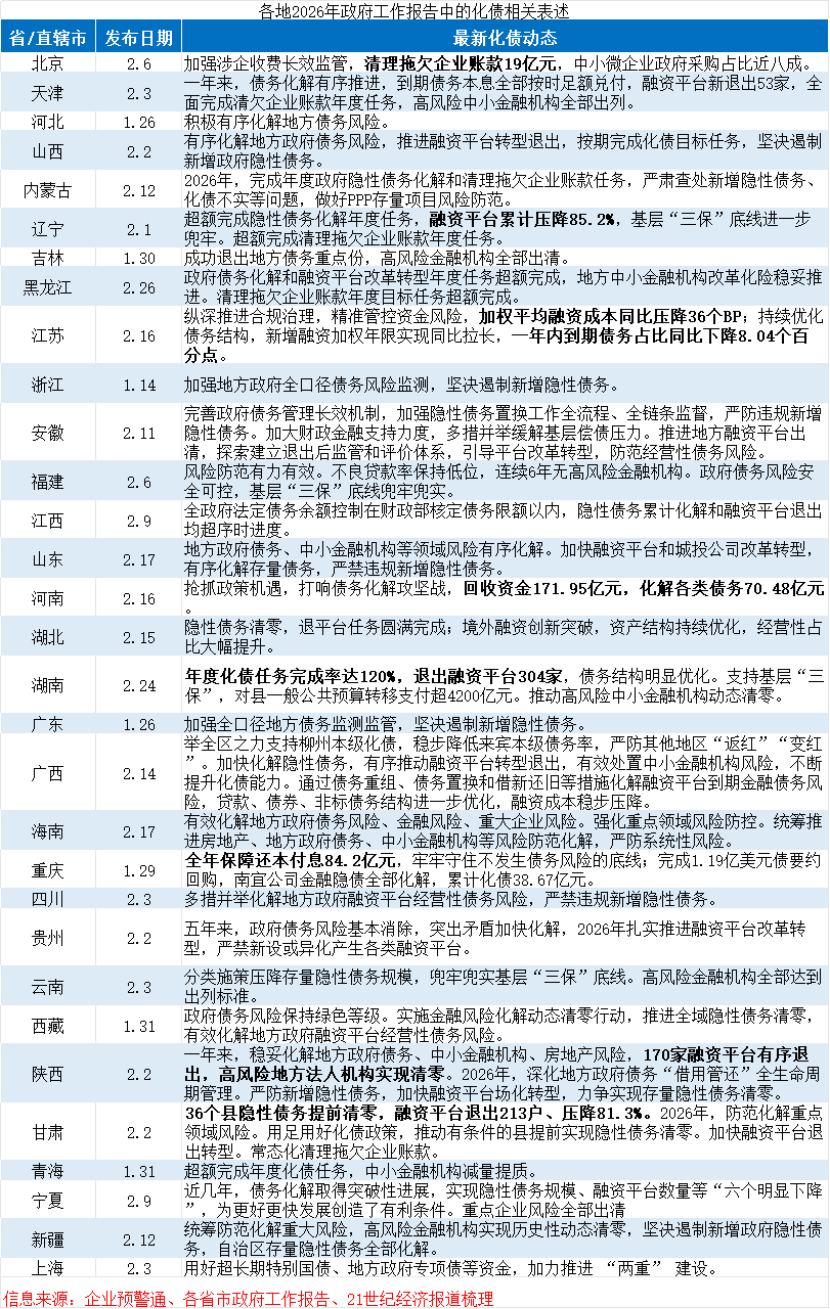
Core Viewpoint - The recent local government meetings have revealed significant progress in addressing hidden debt, with a focus on reducing the number of financing platforms and achieving "zero hidden debt" in various regions [1][2][3]. Group 1: Progress in Debt Resolution - Local governments have made breakthroughs in debt risk resolution, with a clear strategy of "clearing a batch, downgrading a batch, and controlling a batch" of debt risks [1]. - The number of financing platforms has been significantly reduced, with provinces like Gansu and Liaoning reporting over 80 platforms exited, and Hunan achieving a notable exit of 304 platforms [1][3]. - The scope of "zero hidden debt" has expanded, with regions like Xinjiang and several cities in Gansu, Jilin, and Jiangsu declaring complete resolution of hidden debts [2][3]. Group 2: Debt Risk Level Reduction - Many regions have successfully downgraded their debt risk levels, with cities like Liaoning's Yingkou seeing a 75 percentage point decrease in debt ratios [3]. - The average interest cost of debts has decreased by over 2.5 percentage points following debt replacement efforts, significantly alleviating local government burdens [3]. Group 3: Multi-faceted Debt Management Strategies - Various regions are implementing diverse strategies for debt resolution, including debt replacement, extending repayment periods, and revitalizing state assets [6][7]. - The "Three Assets" strategy (resources, assets, funds) has been highlighted as a key approach, with significant asset revitalization reported in provinces like Jilin and Hubei [6]. Group 4: Clearing Arrears to Boost Economic Confidence - The rapid progress in clearing overdue payments to enterprises is seen as a crucial step in optimizing the business environment and boosting regional market confidence [7][8]. - The issuance of special bonds for clearing overdue payments has exceeded expectations, with a total of 13,473.53 billion yuan allocated for this purpose in 2025 [8]. Group 5: Financing Platform Transformation - The orderly reduction and transformation of financing platforms is a significant outcome of the debt resolution efforts, with many regions reporting substantial exits [9][10]. - By 2025, 372 city investment companies have publicly announced they will no longer undertake government financing functions, indicating a shift towards market-oriented operations [10].

城投行业2026年信用风险展望:城投企业加速出清,债务化解与产业转型双轨并行
Da Gong Guo Ji· 2026-02-24 06:30
Report Industry Investment Rating - Not provided in the content Core Viewpoints of the Report - 2026 will be a crucial year for urban investment enterprises, featuring accelerated transformation, intensified credit differentiation, and market-oriented transformation. In the short term, the financing environment will remain tight overall, with strict control over new financing. Funds will flow more significantly to high-quality regions and platforms with strong fiscal strength and clear transformation plans, leading to unprecedentedly intensified credit differentiation in the industry. In the medium to long term, debt resolution and industrial transformation will be the main themes, and the "government credit endorsement" will gradually shift to "market-oriented credit" [1] Summary by Relevant Catalogs I. Industry Supply Capacity Analysis - In 2025, the debt resolution work continued the previous strict tone, practical measures, and strong characteristics. The "14th Five-Year Plan" proposed to promote the orderly resolution of risks such as local government debts, upgrading the positioning of local government debt issues from "local risk control" to a "systematic project related to the overall situation." Urban investment enterprises need to accelerate their transformation [2] - Throughout 2025, various policies were introduced to support debt resolution for urban investment enterprises, including financial support, bond issuance, and real - estate market stabilization. At the same time, regulatory requirements for local government financing platforms were strengthened, forcing them to rectify and adapt to financing requirements [3][4][6] II. Industry Demand Matching Ability Analysis 2.1 Regional Economic Environment - In 2025, China's economy ran smoothly, achieving the GDP growth target of 5.0%. However, the role of investment in driving the economy weakened, and real - estate development investment continued to decline. There were significant differences in general public budget revenue and local government debt levels among provinces [8][9][10] - In 2026, with a moderately loose monetary policy and a more proactive fiscal policy, China's local government debt balance is expected to continue to grow rapidly. High - tech manufacturing may maintain high - speed development, but attention should be paid to the incubation and output of emerging industries and their actual promotion of the economy [8][16] 2.2 Urban Investment Debt Pressure - As of January 13, 2026, the scale of urban investment bonds due before the end of 2026 is relatively large, accounting for 24.30% of the outstanding urban investment bonds. Among them, AA+ urban investment enterprises account for the largest proportion. In key provinces, Chongqing and Tianjin face relatively high pressure of concentrated bond maturities within the year, and attention should be paid to bond refinancing [17][19][21] III. Industry's Industrial Chain Analysis 3.1 Source of Funds Analysis - Under the background of strict policy control over the increment of bonds and non - standard financing, the bank borrowings of urban investment companies increased. In the process of risk prevention and debt resolution, they became more dependent on indirect financing [26] 3.2 Bond Issuance Situation - In 2025, the bond issuance volume of urban investment enterprises decreased year - on - year, and the net repayment scale expanded. The issuance of urban investment bonds was still concentrated in the eastern provinces with strong economic and fiscal strength, and high - level urban investment entities were still the main force in bond issuance. The new bond varieties were mainly corporate bonds, medium - term notes, and short - term financing bills. The overall bond financing cost decreased, and the issuance term tended to be medium - to long - term. It is expected that in 2026, the supply of urban investment bonds may further shrink [29][30][40] IV. Industry Innovation Ability Analysis - Under the background of policy adjustment and stricter supervision, the declaration of urban investment enterprises as market - oriented business entities and the "exit from the platform" accelerated. The transformation of urban investment and the establishment of related industrial companies accelerated [41][42][47] - Driven by policy guidance and regional economic transformation and upgrading needs, the main business of urban investment platforms has changed, with the growth of traditional infrastructure business slowing down, and urban operation and industrial investment becoming new growth points [48][49] V. Industry Credit Rating Situation Analysis 5.1 Rating Adjustment - In 2025, the credit ratings or outlooks of 46 urban investment enterprises were adjusted, including 41 upgrades and 5 downgrades. The number of upgrades increased year - on - year, and the number of downgrades decreased significantly. The credit differentiation of urban investment enterprises further intensified [50] - Rating upgrades were mainly concentrated in regions with strong economic and fiscal strength such as Jiangsu, Zhejiang, Hunan, and Guangdong, while rating downgrades or negative - outlook entities were concentrated in regions with high debt resolution difficulties such as Guizhou [50][51][53] 5.2 Non - Standard Risk Events - In 2025, non - standard risk events of urban investment mainly occurred in regions with weak local economic and fiscal strength, high debt pressure, or poor debt management ability. The number of non - standard risk events involving high - rating urban investment entities decreased year - on - year. Attention should still be paid to the progress of non - standard default event disposal and regional debt risk mitigation [55][56][58] VI. Industry Development Outlook - In 2026, urban investment enterprises will face accelerated transformation, intensified credit differentiation, and market - oriented transformation. The regulatory focus will gradually shift to the management and resolution of existing operating debts. The financing environment will remain tight, and funds will flow to high - quality regions and platforms [64] - The merger and integration of urban investment enterprises will accelerate, and the number of platforms within regions will significantly decrease. The main transformation paths include becoming urban comprehensive operators or state - owned industrial investment entities. The "government credit endorsement" will gradually shift to "market - oriented credit" [64][65]
中锐股份(002374) - 关于园林业务2025年第四季度经营情况的公告
2026-01-30 08:30
证券代码:002374 证券简称:中锐股份 公告编号:2026-004 关于园林业务 2025 年第四季度经营情况的公告 本公司及董事会全体成员保证公告内容真实、准确和完整,不存在虚假记载、 误导性陈述或者重大遗漏。 根据《深圳证券交易所股票上市规则》《深圳证券交易所上市公司自律监管 指引第 3 号——行业信息披露》等相关规定,山东中锐产业发展股份有限公司(以 下简称"公司")发布园林业务 2025 年第四季度经营情况公告。公司园林项目 已完成施工,且无新增项目,该业务主要工作是回收项目应收款项,截至报告期 末公司主要项目情况如下: 1、2015 年 9 月,重庆华宇园林有限公司(以下简称"华宇园林")与四川 省巴中市巴州区人民政府(以下简称"巴州政府")签订了《巴中市巴州区津桥 湖城市基础设施和生态恢复建设(PPP)项目合作协议书》,工程总投资额约为 55,000 万元,业务模式为 PPP 模式。2021 年 2 月,华宇园林与巴州政府、巴中 华丰建设发展有限公司(系项目 SPV 公司)签订了《巴中市巴州区津桥湖城市基 础设施和生态恢复建设(PPP)项目合作协议书补充协议》,计划提前支付项目 服务费。该项目 ...

潍坊城投债:化债见效,关注配置价值(上)
Changjiang Securities· 2026-01-17 14:48
1. Report Industry Investment Rating - No industry investment rating is provided in the report. 2. Core Viewpoints of the Report - Weifang City has a solid economic foundation, with its GDP exceeding 820 billion yuan in 2024, steady growth, and distinct echelon development among districts and counties. The characteristic industrial system based on manufacturing is its core advantage, and the regional debt management is effective, with market confidence continuously restored [3][6]. - Under the top - level design framework of "unified management of three types of debts" and "city - province linkage" in Shandong Province, Weifang's debt resolution has entered the stage of systematic optimization. Through multiple measures, the regional financing structure has been improved, short - term repayment pressure has been effectively relieved, and market confidence has been gradually restored [14]. 3. Summary According to Relevant Catalogs Regional Overview - Weifang is an important regional central city in Shandong Province. In 2024, its GDP reached 820.32 billion yuan, with a year - on - year growth of 5.9%. The industrial structure is continuously optimized, and the scale of the service industry is steadily expanding. The number of market entities is large, and the urbanization rate has increased to 65.2%, with continuous improvement of public service facilities [6][15]. - The general public budget revenue in 2024 was 61.956 billion yuan, with a year - on - year growth of 1.8%, showing stable growth. The government - funded revenue was 57.703 billion yuan, with a year - on - year growth of 17.5%, showing a significant recovery trend. The land transfer revenue was 50.981 billion yuan, ranking high in Shandong Province [6][26]. - The explicit debt level shows that in 2024, the local government debt limit was 329.402 billion yuan, and the debt balance was lower than the limit. The general debt balance was 80.202 billion yuan, and the special debt balance was 205.238 billion yuan, with special debt dominating the debt structure. The broad debt ratio was 238.54%, at a medium - high level among cities in Shandong Province [35]. District and County Differentiation - In terms of economic scale, Shouguang City ranked first in the city in 2024 with a GDP of 108.19 billion yuan, being the only area exceeding 100 billion yuan. Areas with a GDP between 50 billion and 100 billion yuan, including Zhucheng, Qingzhou, Gaomi, Changyi, and Anqiu, are the backbone of economic growth [7][39]. - In terms of economic growth rate, Kuiwen District had the highest growth rate of 6.8%, and most districts and counties had a growth rate above 5.6%, showing strong consistency and stability [7][44]. - In terms of budget revenue, the growth rate of county - level general public budget revenue in 2024 was significantly differentiated. Some areas had negative growth, and there were differences in general debt levels and government - funded revenue among districts and counties [46]. Industrial Support - In terms of industrial layout, in 2024, Weifang's secondary industry accounted for 42.35%, significantly higher than that of Jinan and Qingdao, highlighting a solid manufacturing foundation. The industrial structure of each district and county is distinctively different, with the core urban areas focusing on the service industry, some cities and counties having prominent secondary industries, and some having a significantly higher proportion of the primary industry [53][58]. - In terms of industrial clusters, Weifang has formed a "9 + 3+N" industrial system, with 9 major advantageous industrial chains, 3 emerging industrial chains, and a number of future industries developing in an echelon manner. The "9 + 3+N" key industrial system has effectively promoted industrial upgrading [64]. - During the "15th Five - Year Plan" period, Weifang aims to build a national agricultural modernization model area in agriculture, upgrade the manufacturing industry to be intelligent, green, and integrated in the manufacturing industry, and enhance the supporting and enabling role of the service industry in the service industry [68]. - Weifang has 3 national - level and 2 provincial - level parks, which are important carriers for the development of emerging manufacturing industries. The listed companies in Weifang have a leading total market value in Shandong Province, and the leading enterprises play a strong leading role, forming a virtuous cycle of industry - finance integration [71][78].
坚持守牢底线,积极稳妥化解重点领域风险(稳中求进、提质增效 实现“十五五”良好开局)
Xin Lang Cai Jing· 2026-01-14 00:09
Group 1 - The core idea emphasizes the importance of balancing development and security, with a focus on stabilizing the real estate market and addressing key risks through targeted policies [1][11] - The Central Economic Work Conference highlighted the need for tailored measures to revitalize the real estate market, including controlling new supply, reducing inventory, and optimizing housing supply [2][12] - Local governments are actively implementing policies to acquire idle housing stock for affordable housing, with significant financial support from banks for these initiatives [2][12][13] Group 2 - The strategy of reducing inventory and improving structure is crucial for stabilizing the market and benefiting the public, with various regions innovating methods to enhance affordable housing supply [3][13] - During the 14th Five-Year Plan period, over 11 million units of various types of affordable housing have been constructed, benefiting over 30 million people [3][13] - The planned supply of residential land is set to decrease by 20% year-on-year by 2025, contributing to a significant reduction in new construction area and unsold inventory [3][13][14] Group 3 - The development of high-quality real estate still has considerable potential, with a focus on accelerating inventory digestion and promoting the construction of quality housing [4][14] - The "white list" system for real estate financing has been introduced to facilitate project funding based on project conditions rather than solely on credit, supporting the completion of nearly 20 million housing units [6][15] - Local governments are encouraged to develop housing supply systems that meet new demands and improve living conditions, with a focus on urban renewal and quality housing [16] Group 4 - The Central Economic Work Conference has called for proactive measures to manage local government debt risks, emphasizing the importance of restructuring and replacing existing debts [8][17] - A total of 6 trillion yuan in debt limits will be allocated over three years to support local governments in replacing hidden debts, aiming to reduce interest costs [8][17] - As of the end of 2024, the total government debt is reported at 92.6 trillion yuan, with a debt-to-GDP ratio of 68.7%, indicating a manageable risk level compared to international standards [18][19]
坚持守牢底线 积极稳妥化解重点领域风险——着力推进全年经济工作八大重点任务⑧(稳中求进、提质增效 实现“十五五”良好开局)
Ren Min Ri Bao· 2026-01-13 22:02
Group 1 - The core viewpoint emphasizes the importance of balancing development and security, with a focus on stabilizing the real estate market and addressing key risks through targeted policies [1] - The Central Economic Work Conference advocates for city-specific policies to revitalize the housing market, including the acquisition of idle properties for affordable housing [2][3] - A significant increase in support for affordable housing loans has been noted, with a total of 19.35 billion yuan in credit provided to support the acquisition of 4,938 units of existing housing [2] Group 2 - The report highlights the ongoing efforts to optimize the supply of affordable housing, with over 11 million units of various types of affordable housing planned during the 14th Five-Year Plan period, benefiting over 30 million people [3] - The supply of residential land is set to decrease by 20% year-on-year in 2025, contributing to a reduction in new construction area and a decline in unsold inventory [3] - The introduction of a "white list" system for financing has facilitated over 7 trillion yuan in loans for housing projects, supporting the construction and delivery of nearly 20 million homes [6] Group 3 - The report indicates that the high-quality development of the real estate sector still has significant potential, with a focus on stabilizing the market by addressing both supply and demand [4][7] - Local governments are encouraged to develop housing plans that align land supply with housing demand, with various regions implementing tailored strategies to enhance housing supply [7] - The emphasis on financial support for quality projects and affordable housing is expected to foster a positive cycle between real estate and finance [7] Group 4 - The Central Economic Work Conference has called for proactive measures to manage local government debt risks, with a focus on optimizing debt restructuring and replacement methods [8][9] - A total of 60 billion yuan in new debt limits has been allocated to support local governments in replacing hidden debts, aiming to reduce interest costs [8] - The overall government debt level is reported to be within a reasonable range, with a total debt of 92.6 trillion yuan and a government debt ratio of 68.7% [8]