
慢牛趋势

Search documents
国泰基金李昇:慢牛趋势,把握时代机遇
Zhong Guo Ji Jin Bao· 2026-02-18 10:53
Core Viewpoint - The article emphasizes the optimistic outlook for the A-share market in 2025, highlighting the importance of high-quality development in public funds and the role of technology innovation as a key driver for capital market improvement [1][4]. Group 1: Market Performance and Trends - In 2024, the A-share market demonstrated resilience with a deep V-shaped recovery, marked by significant fluctuations due to external factors, but stabilized by long-term capital inflows and timely monetary policy adjustments [1]. - The Shanghai Composite Index historically surpassed the 4000-point mark, supported by a strong spring market in January 2025, leading to continuous new highs and a sustained market profitability effect [1]. - The market is expected to enter a consolidation phase after consecutive increases, but the long-term upward trend remains intact, with potential for new highs post-Spring Festival [4]. Group 2: Policy and Regulatory Developments - The China Securities Regulatory Commission (CSRC) initiated a series of reforms aimed at promoting high-quality development in public funds, including the release of action plans and guidelines to enhance investment clarity and reduce costs [2]. - These reforms are designed to stabilize investment styles and improve the overall investor experience, thereby increasing the long-term sense of gain and satisfaction for investors [2]. Group 3: Strategic Focus Areas for Fund Management - The company aims to enhance its capabilities in supporting national strategies, particularly in fostering high-level technological self-reliance and innovation, by developing relevant equity products [2]. - There is a focus on identifying alpha opportunities in a market characterized by rapid rotation and complex driving factors, necessitating deeper investment research and a disciplined approach to capturing excess returns [3]. - The implementation of dual-track reforms for performance benchmarks and fee structures is expected to improve product transparency and investor engagement, while diversified asset allocation strategies will help mitigate risks and enhance stability [3].
两大主线集体退潮!盘后传来利好 A股调整到位了吗?
Mei Ri Jing Ji Xin Wen· 2026-01-15 08:09
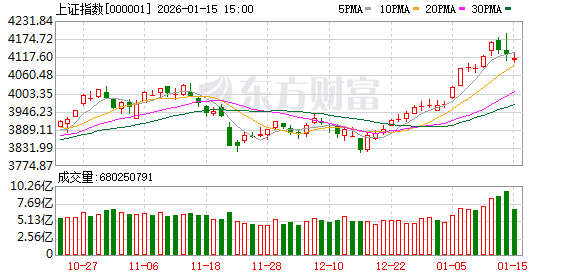
Market Overview - The three major indices showed mixed performance, with the Shanghai Composite Index dipping below 4100 points during the day, closing down 0.33%, while the Shenzhen Component Index and the ChiNext Index rose by 0.41% and 0.56% respectively [2] - The overall market saw over 3100 stocks decline, with a total trading volume of 2.91 trillion yuan, a decrease of 1.04 trillion yuan from the previous trading day [2] Sector Performance - The semiconductor sector strengthened in the afternoon, while the CPO concept fluctuated upward. The tourism and hotel sector was active, and the non-ferrous metals sector rose [2] - Conversely, sectors such as AI applications and commercial aerospace experienced significant declines, with high-profile stocks collectively retreating [2][3] Market Sentiment and Adjustments - The overarching theme in the A-share market is "cooling down," particularly affecting overheated sectors like commercial aerospace and AI applications, which are experiencing increased probabilities and magnitudes of correction [3] - There is a divergence in opinions regarding the extent and direction of market adjustments, with the Shanghai Composite Index maintaining the 4100-point level but nearing the 10-day moving average [4][6] ETF and Trading Activity - At the market close, the number of stocks hitting the daily limit down reached 71, a recent high, indicating increased selling pressure [8] - Notably, several broad-based ETFs saw significant trading volumes, with the CSI 500 ETF trading over 26.3 billion yuan, setting a historical high [7] Future Outlook - Analysts suggest that the recent "cooling" signals primarily target short-term overperformers rather than negating the overall "slow bull" trend. The market may experience a period of consolidation, with structural opportunities likely to continue [7] - The recent adjustments in monetary policy, including a 0.25 percentage point reduction in various structural monetary policy tool rates, are expected to support economic transformation and optimization [7] - The performance of precious metals, semiconductor chains, and tourism sectors is anticipated to align with the upward trends in policy and industry, suggesting potential for continued profitability [13]

天赢居:2025年12月26日直播
Jin Rong Jie· 2025-12-26 07:59
Core Viewpoint - The market is experiencing a strong upward trend with a series of gains, indicating a healthy momentum and potential for further growth, particularly in the technology hardware and non-ferrous metals sectors [1][2][4]. Market Performance - The main index has shown a stable recovery, crossing key moving averages, with a notable increase in the number of stocks hitting the daily limit, suggesting a broadening profit effect attracting outside capital [1][2]. - The trading volume has increased moderately, indicating that funds are not retreating but are actively participating in a "walking and switching" manner, maintaining a bullish trend [1][2]. Sector Rotation - The market structure reflects a characteristic of "strong main lines and rotating sub-lines," with technology hardware and non-ferrous metals taking turns leading the gains [2][5]. - After a two-day surge in technology hardware, there was a strategic shift to focus on non-ferrous metals, which proved to be a correct call as these sectors are interlinked in the supply chain [2][5]. Technical Analysis - The current market is in a typical "strong trend but short-term prone to fluctuations" state, with indicators showing overbought conditions, suggesting a need for consolidation through minor corrections [2][4]. - The recent upward movement is part of a larger bullish cycle, with the index expected to face resistance near the 4018 level, necessitating caution as it approaches this key point [1][6]. Investment Strategy - The strategy emphasizes "going with the trend and focusing on strong stocks," advising investors to reduce exposure to weaker or declining sectors while concentrating on those with stronger consensus and trends [3][4]. - The market's current phase is seen as an opportunity for disciplined buying during pullbacks, particularly in sectors that are showing resilience and potential for further gains [4][6]. Conclusion - The market is characterized by a healthy upward trajectory, with a focus on sector rotation between technology hardware and non-ferrous metals, supported by a solid technical foundation and strategic investment approaches [5][9].
外资败逃A股!一场阳谋
雪球· 2025-12-01 07:58
Group 1 - The article questions the intelligence of foreign capital, suggesting that it often engages in a "buy high, sell low" strategy, particularly during market downturns [5][6]. - It highlights a significant decline in foreign investment in China's real economy in 2023 and 2024, which some interpret as a lack of interest in China [10][11]. - The article emphasizes that foreign capital flows are influenced by interest rates, noting that after interest rate hikes in the US and Europe, capital outflow from China is not surprising due to lower domestic rates [12][13]. Group 2 - The article distinguishes between trading-oriented foreign capital, which has been rapidly exiting the A-share market, and long-term investment funds, which continue to flow in [22][26]. - It points out that while active funds have withdrawn over $16 billion from A-shares since 2023, passive funds are slowly entering, indicating a shift towards long-term investment [24][28]. - The article suggests that the increasing presence of long-term capital, such as state-owned enterprises and insurance funds, is beneficial for the A-share market's stability and growth [31][32]. Group 3 - The article discusses the dual nature of foreign capital, noting that while patient capital is welcomed, speculative capital is not, as it can lead to market instability [39][40]. - It raises concerns about the influence of foreign capital on domestic markets, particularly in the context of geopolitical tensions and the potential for financial manipulation [41][42]. - The article argues that the current low proportion of foreign capital in China mitigates the impact of potential crises in the US, suggesting that China could even benefit from such situations [68][72]. Group 4 - The article concludes that the recent withdrawal of foreign capital is complex, driven by both external political factors and domestic policies aimed at attracting long-term investment [71][72]. - It asserts that China does not lack capital but rather needs patient capital that can support economic transformation and upgrading [73][74]. - The article encourages a positive outlook on foreign capital withdrawal, emphasizing the importance of aligning with like-minded investors for sustainable growth [75].

指数回调 A股中长期慢牛趋势未变
Sou Hu Cai Jing· 2025-11-23 16:08
Group 1 - A-shares experienced a significant decline last week, with the Shanghai Composite Index dropping 3.90% to close at 3834.89 points, and the Shenzhen Component Index falling 5.13% to 12538.07 points [1] - The ChiNext Index saw a weekly drop of 6.15%, closing at 2920.08 points, and fell below the 3000-point mark on November 21, with a single-day decline of 4.02% [1] - Over 5000 stocks declined on Friday, indicating a continuous sell-off trend, which has severely impacted investor confidence [1] Group 2 - Despite short-term pressures, several brokerages maintain that the long-term slow bull trend of A-shares remains unchanged [2] - Analysts suggest that the current mid-term adjustment is in its early stages, and investors should remain patient as the market faces potential downward pressure from global stock markets [2] - The long-term upward trend is expected to continue, with a potential transition into a "second phase" after the current adjustments [2] Group 3 - The market's overall resilience is noted, with long-term funds providing support, which reduces the likelihood of significant declines [3] - After a 200-point pullback, the market is expected to have a foundation for recovery, although uncertainties remain regarding global economic factors and domestic industry performance [3] - Investors are advised to maintain a core position of 50-60% and to be cautious of stocks that have risen significantly without strong earnings support [3]
上证指数时隔十年再上4000点,成交额仍待放量|市场观察
Di Yi Cai Jing· 2025-10-28 04:42
Core Viewpoint - The A-share market has shown resilience, with the Shanghai Composite Index breaking the 4000-point mark, reflecting improved market sentiment and investor confidence, supported by ongoing developments in U.S.-China trade negotiations and favorable regulatory policies [1][3][4] Market Performance - On October 28, the Shanghai Composite Index rose by 0.21% to close at 4005 points, with total trading volume in Shanghai, Shenzhen, and Beijing reaching 1.36 trillion yuan, a decrease of 216.5 billion yuan compared to the previous day [1] - The index initially broke through 4000 points but experienced a pullback before regaining that level later in the morning [1] Regulatory Environment - The China Securities Regulatory Commission (CSRC) has introduced measures to optimize the Qualified Foreign Institutional Investor (QFII) system, enhancing access and operational efficiency for foreign investors [2] - Future plans include the introduction of a refinancing framework to support mergers and acquisitions, and encouraging listed companies to improve governance and increase shareholder returns through dividends and buybacks [2] Investor Sentiment - Analysts suggest that the recent market movements indicate a structural bull market, with the 4000-point level serving as a psychological barrier that, if maintained, could attract further capital inflow [3] - There is a cautionary note regarding high valuations in certain sectors, particularly technology and semiconductors, which may lead to profit-taking and increased volatility [2][3] Economic Context - The market is influenced by global economic conditions, including expectations of a potential interest rate cut by the Federal Reserve, which could support global liquidity [4] - The upcoming APEC meeting may provide opportunities for U.S.-China dialogue, potentially easing geopolitical tensions and trade friction [4]
牛市中期震荡,或应选择老将
Xin Lang Ji Jin· 2025-10-22 08:31
Core Viewpoint - The current market is characterized by a period of oscillation and differentiation, moving away from the previous bull market's straightforward upward momentum, indicating a need for more selective investment strategies [2][3]. Market Conditions - The Shanghai Composite Index is experiencing fluctuations around the 3900-point mark, with a shift in market dynamics from a collective rise to a more segmented performance [2]. - The market is showing signs of structural opportunities, with some high-valuation sectors undergoing adjustments while new opportunities emerge [2]. Investment Strategy - The current market environment requires a more cautious approach, moving away from aggressive trading strategies to a focus on selecting experienced fund managers who can navigate through market volatility [3]. - Trust in seasoned fund managers, like Hu Song from Guotai Fund, is emphasized as a key factor for investors looking to capitalize on market opportunities during this complex phase [3][4]. Fund Performance - Hu Song's fund, Guotai Jinpeng Blue Chip, achieved positive returns during the bear market of 2023, contrasting with the 11.38% decline of the CSI 300 index [4][5]. - Guotai Jinsheng, managed by Hu Song, has reported a year-to-date return of 50.73%, significantly outperforming the CSI 300 index and its benchmark [7]. - Since its inception in February 2024, Guotai Jinsheng has delivered a total return of 55.36% and an annualized return of 30.33% [7]. Future Outlook - Hu Song remains optimistic about a "slow bull" market trend, anticipating a gradual upward adjustment of the index amid improving market conditions [8]. - The domestic market is supported by a combination of stabilizing fundamentals and liquidity easing, while external factors, such as the U.S. Federal Reserve's interest rate cuts, are expected to enhance market risk appetite [9]. - The long-term outlook suggests continued market strength driven by the internationalization of the RMB and improving corporate earnings [9].
创业板50ETF(159949)大涨近3%,机构称A股延续慢牛趋势,成长风格有望进入第二阶段行情
Xin Lang Ji Jin· 2025-10-15 06:52
Core Viewpoint - The A-share market is experiencing a collective rise, with the ChiNext 50 ETF increasing by 2.75% and a net subscription of 1.43 billion yuan over the past 10 days, indicating a positive market sentiment and potential for a "slow bull" trend in the long term [1][2]. Group 1: Market Trends - Long-term revaluation of Chinese assets is anticipated, with short-term fluctuations not altering the overall positive trend [1]. - The market is expected to maintain an upward trajectory, with core trends remaining intact despite short-term external shocks [2]. Group 2: Investment Strategies - In the technology growth sector, there is a continued focus on AI computing power, innovative pharmaceuticals in Hong Kong, and military industry, with increased attention on AI applications and internet sectors at relatively low levels [1]. - Value investment strategies should focus on sectors benefiting from improved supply-demand dynamics, particularly in metals, transportation, chemicals, lithium batteries, photovoltaics, and pig farming [1]. - The growth style is likely to transition from valuation-driven to performance-driven, with significant opportunities expected in late October to early November [1][2]. Group 3: Fund Performance - The Huazhang ChiNext 50 ETF has achieved a return of 38.38% since its inception, with a year-to-date return of 44.15% and a one-year return of 43.79% [2]. - The fund's manager, Xu Zhiyan, has delivered a return of 44.35% during his tenure since June 1, 2016 [2].






华金证券:十月慢牛趋势不变,风格难改
Sou Hu Cai Jing· 2025-10-12 03:45
Core Viewpoint - The main factors influencing the A-share market in October are policies and external events, liquidity, and fundamentals, with historical data indicating a tendency for the market to be volatile during this month [1][2]. Group 1: Historical Performance - Since 2010, the Shanghai Composite Index has shown an upward trend in October during years when the "Five-Year Plan" was implemented, such as in 2010, 2015, and 2020 [2][3]. - Out of the last 15 years, the index has risen in 8 instances during October [2]. Group 2: Influencing Factors - Policies and external events are the core influencing factors; positive developments may lead to market gains, while tightening policies or negative external shocks could weaken the market [2][3]. - Liquidity conditions are also crucial; a loose liquidity environment can boost the market, as seen in 2010 with the anticipation of QE2, in 2015 with interest rate cuts, and in 2019 with Fed rate cuts [2][3]. - The performance of the third-quarter reports is expected to significantly impact the market in October, with potential structural recovery in earnings [2][3]. Group 3: October Outlook - The A-share market is likely to continue a slow bullish trend in October, supported by positive policy expectations and a potentially loose liquidity environment [3]. - The upcoming Fourth Plenary Session may enhance positive policy expectations, while geopolitical tensions could remain a concern, particularly regarding U.S.-China trade relations [3]. - Economic conditions are expected to show weak recovery, with third-quarter earnings reports indicating a structural rebound in sectors like technology and cyclical industries [3]. Group 4: Sector Allocation - The technology and growth sectors are expected to outperform in October, particularly those related to the "14th Five-Year Plan," which emphasizes technological innovation and domestic demand [4]. - Historical data suggests that industries with strong earnings reports during the third-quarter disclosure period tend to perform well, with high growth expected in technology and cyclical sectors [4]. - The current Fed rate cut cycle may favor technology and certain cyclical industries, with a higher likelihood of leading performance from sectors like computing, automotive, and electronics [4]. - Recommendations include accumulating positions in sectors benefiting from policy support and improving fundamentals, such as communication, machinery, electronics, and renewable energy [4].
十月慢牛趋势不变,风格难改
Huajin Securities· 2025-10-11 10:53
Group 1 - The core factors influencing the October market trends are policies, external events, and liquidity [4][11][18] - The A-share market is expected to continue a slow bull trend in October, driven by positive policy expectations and a potential easing of liquidity [7][11][18] - Historical data shows that in 15 years since 2010, the Shanghai Composite Index has risen in October 8 times, often influenced by significant policy announcements [4][5][11] Group 2 - In October, technology and cyclical sectors are expected to outperform, with a focus on growth-oriented industries related to the "14th Five-Year Plan" [21][22][30] - The disclosure of Q3 earnings reports is likely to favor technology and cyclical sectors, as historically, industries with strong earnings tend to perform well in October [22][25] - The current Fed rate cut cycle is anticipated to benefit technology growth and certain cyclical industries, with historical trends indicating that high-growth sectors perform better during such periods [30][34] Group 3 - The calendar effect suggests that technology sectors such as computers, automobiles, home appliances, and electronics are likely to lead in performance during October [36] - The expected structural recovery in earnings for the A-share market is supported by a low base effect from the previous year, particularly in exports and retail sales [18][20] - Key sectors expected to benefit from policy support include communication, machinery, electronics, and new energy, while real estate investment is likely to remain weak [18][20]