企业盈利

Search documents
通胀“暂时论”再现!华尔街看好CPI公布后美股继续上涨
智通财经网· 2025-08-12 11:16
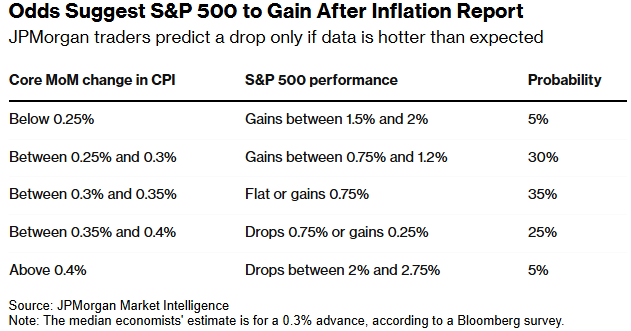
智通财经APP获悉,经济学家预计最新消费者价格数据将显示通胀小幅上升,但华尔街专业人士并不担 心这会破坏近期股市的涨势。 泰勒写道,回调的主要风险是季节性的,因为标普500指数在过去25年中9月份平均下跌1.5%——但随 后在第四季度上涨4%。 根据彭博社对经济学家的调查中值预测,剔除波动较大的食品和能源成本的核心CPI预计7月份将比6月 份上升0.3%。 美国总统特朗普全面加征全球关税的通胀影响预计将开始体现在最新 CPI 数据中,该数据将于周二开 盘前公布。尽管如此,包括摩根大通和摩根士丹利在内的华尔街投行预计,投资者将对这些担忧置之不 理,并通过关注强劲的企业盈利和降息来保持股价飙升。 摩根大通全球市场情报主管安德鲁·泰勒周一在给客户的一份报告中写道,宏观经济数据仍然"支持看涨 的理由,盈利可能会保持其积极趋势",并补充说美联储正朝着降息的方向发展。 泰勒认为,任何潜在的通胀上升都可能是暂时的,而且峰值可能会低于预期。事实上,他的团队在周二 CPI数据公布后,将标普500指数进一步上涨的几率定为70%,预测如果数据符合预期或低于预期,该指 数可能上涨2%。 | Core MoM change in CP ...


晶泰控股:预计上半年纯利不少于5000万元,同比扭亏
Xin Lang Cai Jing· 2025-08-12 00:08
Core Viewpoint - Jingtai Holdings expects to achieve a consolidated revenue of no less than RMB 500 million for the period ending mid-2025, representing a year-on-year increase of at least approximately 387% [1] Financial Performance - The company anticipates turning a loss into a profit, with a net profit of no less than RMB 50 million for the mid-2025 period [1] - Adjusted net profit is expected to be no less than RMB 120 million, marking the company's first half-year profitability [1]
PRF: All Weather Alpha For Strategic Long Term Investing
Seeking Alpha· 2025-08-10 15:45
Group 1 - The article emphasizes the advantages of a fundamental rules-based passive methodology for ETFs, contrasting it with market cap weighted methodologies that are seen as backward looking and prone to overleveraging on the same stocks [1] - The author has over 20 years of experience in quantitative research, financial modeling, and risk management, focusing on equity valuation, market trends, and portfolio optimization [1] - The research approach combines rigorous risk management with a long-term perspective on value creation, with a particular interest in macroeconomic trends, corporate earnings, and financial statement analysis [1]
股指黄金周度报告-20250808
Xin Ji Yuan Qi Huo· 2025-08-08 10:33
1. Report Industry Investment Rating - No relevant content provided 2. Core Viewpoints of the Report - In the short - term, due to repeated digestion of previous policy benefits and unimproved corporate profits, the stock index may face callback risks after continuous rise; for gold, although the market's expectation of a Fed rate cut in September has increased, the easing of global trade tensions may lead to a continuation of the adjustment after the rebound, maintaining a band - short thinking [39][40] - In the medium - to long - term, the stock index's valuation is dragged down by the decline in corporate profit growth, and it is expected to maintain a wide - range shock; gold may face a deep adjustment due to the fading of tariff policy uncertainties and the release of dovish signals by the Fed [40] 3. Summary by Relevant Catalogs 3.1. Macroeconomic Data at Home and Abroad - In July this year, the growth rates of imports and exports both rebounded, mainly due to the rise in commodity prices and the low - base effect of the same period last year. However, domestic and foreign demand remains weak [4] 3.2. Stock Index Fundamental Data 3.2.1. Corporate Profit - The rise in commodity prices helps improve the profits of upstream raw material processing industries, but due to weak terminal demand, enterprises still face great operating pressure, with the phenomenon of increasing revenue but not profit. They have to reduce production and inventory, and the inflection point of profit growth has not arrived [15] 3.2.2. Capital Situation - The margin balance of the Shanghai and Shenzhen stock markets is approaching the 2 - trillion - yuan mark. The central bank conducted 1.1267 trillion yuan of 7 - day reverse repurchase operations this week, achieving a net withdrawal of 536.5 billion yuan [19] 3.3. Gold Fundamental Data 3.3.1. US Economic Data - In June, the number of new non - farm jobs in the US was 73,000, far lower than the expected 110,000, and the unemployment rate rose from 4.1% to 4.2%. In July, the ISM manufacturing PMI dropped to 48, contracting for 5 consecutive months. Fed officials released dovish signals, suggesting that the time window for a rate cut is approaching [23] 3.3.2. Gold Inventory - The warehouse receipts and inventory of Shanghai gold futures have soared, while the New York futures inventory has continued to decline, and the market's bullish sentiment has cooled [36] 3.4. Strategy Recommendation - Short - term: Be cautious of the callback risk of the stock index; for gold, maintain a band - short thinking [40] - Medium - to long - term: The stock index is expected to maintain a wide - range shock; gold may face a deep adjustment [40] 3.5. Next Week's Focus and Risk Warning - Key data such as China's July investment, consumption, industrial added value, US CPI, and speeches by Fed officials [41]
企业盈利支撑,欧股集体高开、油价结束五连跌、美元基本持平
Hua Er Jie Jian Wen· 2025-08-06 07:46
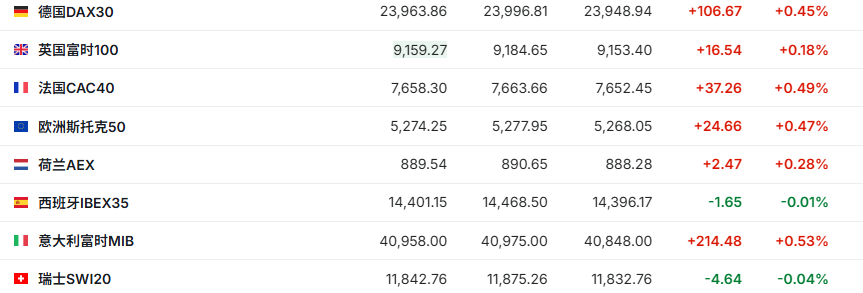
Group 1 - European companies reported strong earnings, boosting market confidence and leading to a collective rise in European stocks [1][2] - ABN Amro announced a new stock buyback plan after exceeding profit expectations, while Siemens Energy expects to reach the upper limit of its annual performance [2] - Fresenius SE raised its full-year sales forecast, and Bayer's sales exceeded analyst expectations [2] Group 2 - Despite some positive reports, Novo Nordisk's revenue growth fell short of expectations, although its weight-loss drug Wegovy performed better than anticipated [2] - Commodity giant Glencore's earnings did not meet expectations, and it canceled plans to move its primary listing from London to New York [2] - European stock indices showed positive movement, with the Euro Stoxx 50 index opening up by 0.5% and the DAX index also rising by 0.5% [1]
蔚来四季度盈利要靠这款车,乐道L90试驾体验如何?
Xin Jing Bao· 2025-08-05 09:57
新京报贝壳财经记者近期对这款车进行了道路试驾,车辆的驾乘体验表现较好,产品性价比很高,但潜 在弱点或是没有混合动力形式产品提供。 蔚来子品牌乐道在7月31日上市了大型纯电SUV L90,这款车起售价被拉低至26.58万元。蔚来创始人李 斌计划在第四季度实现盈利,L90或将成为企业盈利的重要一环。 视频剪辑郭栩君 ...

美股异动丨英国石油盘前涨1.7%,Q2盈利远超市场预期
Ge Long Hui· 2025-08-05 08:45
Core Insights - BP reported a Q2 core replacement cost profit of $2.35 billion, significantly exceeding the analyst consensus estimate of $1.81 billion from LSEG [1] - In comparison, BP's net profit for Q2 last year was $2.76 billion, and for Q1 2025, it was $1.38 billion [1] Dividend and Share Buyback - BP announced an increase in its Q2 dividend from $0.08 to $0.0832 per share [1] - The company will maintain its share buyback program at $750 million [1]

全球每周 - 美国企业盈利超预期,而全球市场下跌-Global Weekly Kickstart_ US earnings beat estimates while global markets down
2025-08-05 08:17
Summary of Key Points from the Conference Call Industry Overview - Global markets experienced a downturn last week, primarily influenced by tariff news and weaker macroeconomic data, with Europe declining over 4% [1] - The cyclical sectors underperformed compared to defensive sectors globally, indicating a shift in market sentiment [1] Company Earnings Insights - Approximately two-thirds of S&P 500 companies reported their Q2 earnings, with 63% exceeding consensus EPS forecasts, marking one of the highest rates of positive earnings surprises in 25 years [5] - The frequency of positive surprises is attributed to a low bar set at the beginning of the quarter, resulting in smaller-than-average rewards for stocks with EPS beats [6] - US companies expressed confidence in managing tariff impacts on profits during earnings calls, although cost pressures may rise in the second half of 2025, posing risks to real revenue growth [6] - The "Magnificent 7" tech companies reported a 26% year-on-year earnings growth in Q2, contrasting with a mere 4% growth for the remaining S&P 493 constituents, which is expected to support index earnings [6] Macroeconomic Indicators - Upcoming macroeconomic data releases include the ISM services index in the US, final PMI and industrial production numbers in Europe, and trade data in China, Indonesia, and the Philippines [2][3] - Key policy events include the Bank of England's monetary policy meeting, which could influence market dynamics [2] Market Performance Metrics - The report highlights the performance of various global indices, with the MSCI indices showing mixed results over different time frames [11] - The report also provides forecasts for GDP growth across major economies, with the US projected to grow by 2.8% in 2024, while Japan and the Euro area are expected to grow by 0.2% and 0.9%, respectively [18] Sector Performance - The report details sector performance across regions, indicating that sectors such as utilities and communication services have shown resilience, while materials and industrials have underperformed [36] - Year-to-date sector performance shows significant variances, with some sectors like consumer staples and healthcare performing better than others [38] Risk and Sentiment Indicators - The report includes various risk and sentiment indicators, suggesting a cautious market outlook with a current GS Bull/Bear Market Indicator at 70%, indicating a relatively high level of caution among investors [29] Conclusion - The overall sentiment in the market remains cautious, with mixed earnings results and macroeconomic indicators suggesting potential volatility ahead. Investors are advised to consider these factors in their decision-making processes [8]
股指黄金周度报告-20250801
Xin Ji Yuan Qi Huo· 2025-08-01 10:44
1. Report Industry Investment Rating - Not provided 2. Core Viewpoints of the Report - In the short - term, due to the repeated digestion of previous policy benefits and the decline of the official manufacturing PMI in July, the market expectation gradually returns to reality, and the stock index needs short - term adjustment. One should patiently wait for low - buying opportunities. The Fed's interest rate decision sent a hawkish signal, global trade tensions eased, and the risk - aversion sentiment continued to cool down. After the end of the gold rebound, it may continue to adjust, maintaining a band - short thinking [39]. - In the medium - to - long - term, the valuation of the stock index is mainly dragged down by the decline of corporate profit growth at the molecular end, while the support at the denominator end mainly comes from the rise of risk preference. The stock index maintains a wide - range shock thinking in the medium term. The US may reach trade agreements with more countries, the risk - aversion sentiment significantly drops, the Fed's interest rate decision is hawkish, and there is a risk of deep adjustment in gold [40]. 3. Summary According to Relevant Catalogs Stock Index Fundamental Data - In July, the official manufacturing PMI dropped to 49.3, down 0.4 percentage points from the previous month, and was in the contraction range for four consecutive months. Industrial production slowed down, demand contracted again, external demand downward pressure increased, and the prosperity of small enterprises weakened further, indicating that the foundation for China's economic recovery is not solid, and insufficient demand remains the main contradiction [3]. - From January to June, the decline in the profits of industrial enterprises above designated size widened, and the year - on - year growth rate of finished product inventory continued to decline. There were differentiations in the profit structure among different industries, indicating that downstream enterprises still face great operating pressure, the inflection point of upward profit growth has not arrived, and they are still in the stage of active inventory reduction [16]. - The growth of margin trading balance in the Shanghai and Shenzhen stock markets slowed down. The central bank conducted 1.6632 trillion yuan of 7 - day reverse repurchase operations this week, achieving a net investment of 6.9 billion yuan [18]. Gold Fundamental Data - The US real GDP in the second quarter increased by 3% quarter - on - quarter, the highest growth rate since 2024. The core PCE price index in June increased by 2.8% year - on - year, rising for two consecutive months. The Fed's interest rate decision remained unchanged, and the monetary policy statement was hawkish. The 10 - year US Treasury yield remained high [22]. - The warehouse receipts and inventory of Shanghai gold futures soared, the New York futures inventory continued to decline, and the market's bullish sentiment cooled down [38].
PCE Comes in Warmer Than Expected
ZACKS· 2025-07-31 16:11
Pre-market futures are in the green this morning and holding steady — all but the small-cap Russell 2000, which is currently trading down half of one percent. The Dow is up +115 points, the S&P 500 is +60 and the Nasdaq is up a strong +320 points at this hour. Bond yields are also ticking up somewhat. These numbers appear to be in reaction to this morning's economic posts. PCE Most Warmer than Expected in June Almost as a node to Fed Chair Jerome Powell's comments yesterday about the state of the economy, t ...