
新经济

Search documents
经济大省挑大梁丨“十五五”广东新经济八面来风
2 1 Shi Ji Jing Ji Bao Dao· 2025-12-08 10:41
制作:学习经济工作室 近日出炉的《中共广东省委关于制定广东省国民经济和社会发展第十五个五年规划的建议》创新性地开 设专栏,就发展8种新经济打出"组合拳"。一条视频,读懂广东如何抢占这8大新风口! 统筹:丁青云 谭婷 曾婷芳 (原标题:经济大省挑大梁丨"十五五"广东新经济八面来风) ...
聚焦金融“五篇大文章”:新经济环境下券商数据资产证券化的创新路径与实践探索
Zheng Quan Shi Bao Wang· 2025-12-08 03:21
Core Insights - The article emphasizes the importance of asset securitization in connecting capital markets with the real economy, particularly under the strategic guidance of the central financial work conference focusing on technology finance, green finance, inclusive finance, pension finance, and digital finance [1][2] Group 1: New Economy and Digital Finance - The new economy is characterized by the integration of digital and intelligent technologies, which transforms real-world information into digital information, facilitating rapid dissemination and interaction [2] - The government report for 2025 highlights "new quality productivity" as a primary task, aiming to enhance emerging industries and support small and medium enterprises through digital financial services [2][3] - Digital finance leverages technologies like the internet and big data to provide financial services, which is crucial for the development of the new economy and the real sector [2] Group 2: Asset Securitization and Data Assets - Asset securitization is a vital financing method that offers low costs, quick liquidity, and risk diversification, particularly beneficial for revitalizing state-owned enterprises [3] - The integration of data assets into securitization represents a significant innovation, allowing for a new valuation basis and enabling brokers to convert data assets into tradable securities [3][4] - The article discusses the need for innovative approaches to securitize data assets, focusing on the use of data usage rights and revenue rights as underlying asset pools [4] Group 3: Regulatory Framework and Policy Support - The "three rights" mechanism proposed in the "Data Twenty Articles" aims to separate management, usage, and operational rights of data assets, enhancing their circulation and utilization [6][7] - Recent policies provide a solid foundation for exploring innovative paths in data asset securitization, ensuring compliance and effective management of state-owned data assets [7] Group 4: Innovation in Data Asset Securitization Models - As of September 2025, the Shanghai and Shenzhen exchanges have issued nine data asset-related products, totaling 9.92508 billion yuan, primarily based on infrastructure REITs [8] - The article highlights the emergence of data asset pledge financing as a new funding avenue, although it notes that this method does not fully capture the independent value creation potential of data assets [8][9] - A proposed ideal model focuses on future revenue rights as core assets, aiming to establish a market pricing mechanism for data products and ensure stable cash flow [9][10] Group 5: Practical Exploration and Case Studies - The article outlines the process from data to data asset securitization, emphasizing the importance of rights confirmation, valuation, credit enhancement, and liquidity [12] - A pilot project in Shanghai involving health data products demonstrates the potential for data asset securitization to create stable cash flows and enhance market liquidity [14][16] - The successful implementation of data asset securitization can facilitate the transformation of data from a resource into capital, broadening financing channels for enterprises [17] Group 6: Challenges and Future Directions - Despite ensuring data security and compliance, pricing and valuation of data products remain significant challenges in asset securitization [18] - The need for a dynamic pricing model that considers data quality and market factors is highlighted, along with the importance of collaboration between brokers and technology firms to establish industry standards [18]

险资集体大涨:监管下调风险因子,耐心资本获准“降本入市”
Xin Lang Cai Jing· 2025-12-05 12:09
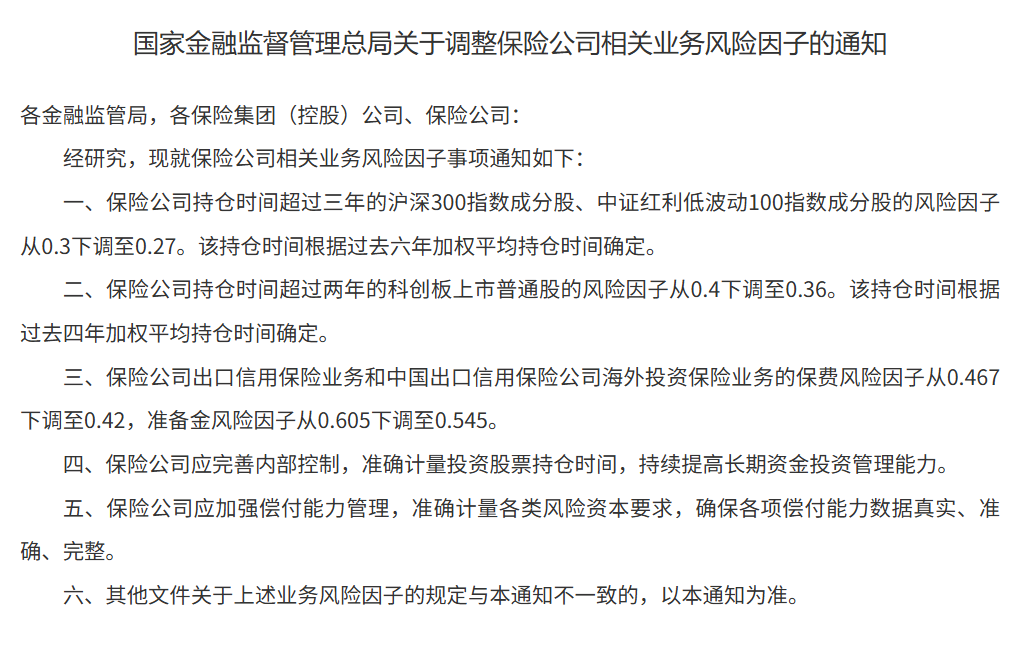
Core Viewpoint - The recent surge in the stock prices of listed insurance companies is attributed to the announcement by the National Financial Regulatory Administration regarding the adjustment of risk factors for insurance companies, effectively "unbinding" capital for insurers [9][11]. Group 1: Policy Adjustments - The core of the policy adjustment is to reduce the capital occupation cost for insurance companies through technical means, guiding funds more precisely [3][11]. - The risk factors for index components held for over three years, such as the CSI 300 and CSI Dividend Index, have been lowered from 0.2 to 0.17, while the risk factor for stocks locked for over five years on the Sci-Tech Innovation Board has been reduced from 0.4 to 0.36 [4][11]. - This adjustment allows insurance companies to release more usable capital without increasing their capital base [5][11]. Group 2: Market Implications - The regulatory intent is clear: to encourage insurers to adhere to "value investing" by lowering the holding costs of blue-chip and dividend stocks, acting as a "ballast" for the market [5][11]. - The adjustment also provides more room for insurers to support "hard technology" and "new economy" sectors, particularly favoring the Sci-Tech Innovation Board [5][11]. - The recent stock price increase reflects a perfect resonance between policy benefits and the transformation needs of insurance companies, especially in a declining interest rate environment [6][11]. Group 3: Future Outlook - The surge on December 5 may be just the beginning of a new round of asset allocation adjustments by insurers, with incremental funds gradually flowing into high-value areas of the A-share market [7][12]. - This situation presents a good opportunity for insurers to optimize their balance sheets and signifies that "patient capital" has better access to the market [7][12]. - However, the effectiveness of this policy relaxation will ultimately depend on the insurers' stock selection capabilities and risk management in a volatile market [7][12].






新阶层·新经济丨德勤中国主席蒋颖:新阶层是新经济生态中的专业力量与智慧桥梁
Zhong Guo Xin Wen Wang· 2025-12-02 14:28
中新网12月2日电(范宇斌康玉湛)"大家经常会问新的社会阶层人士代表什么?在我看来,新的社会阶层人士主 要的内核和底色是专业能力。"近日,全国政协委员、上海市新的社会阶层人士联谊会监事长、德勤中国主席 蒋颖接受中新网专访时表示。 在她看来,新阶层人士正通过专业能力,在新经济生态中扮演着至关重要的角色——他们链接技术与产业、 沟通政策与市场、贯通国内与国际,成为推动新质生产力发展的关键力量。 专业底色,价值创造 "当前中国GDP中约60%来自服务业,其中生产性服务业约占30%,这一比例与发达经济体相比还有提升空 间。"蒋颖分析道,"十五五"规划建议中重点强调提升现代服务业,新阶层人群恰好处于这个框架的核心范 围。 她将新阶层的核心价值概括为三个方面:首先是技术与产业的链接者,能把实验室的尖端技术通过专业咨 询、专利转化落地为市场商品和产业;其次是政策与实业的"翻译官",既能解读政策适配企业需求,又能将企 业实践反馈给政府;第三是国内与国外的桥梁,凭借国际化视野助力中外经济交流合作。 2025年是蒋颖加入德勤的第30个年头。她深有感触地说:"这30年既是我个人的工作事业的历程,也是伴随中 国改革开放的过程。我们既 ...

中金 | 股市长牛之中国道路:向新而生
中金点睛· 2025-12-01 23:51
Group 1: Core Views - The article discusses the favorable factors for the Chinese stock market from both the asset and funding sides, emphasizing the importance of stable profit growth and elevated valuation levels during economic transformation and upgrading [3][4]. - Historical experiences from developed countries indicate that a stable profit growth rate and rising valuation levels can sustain a long-term bull market, even when economic growth rates decline [6][10]. Group 2: Transformation and Growth - Since the "924" event last year, the A-share market has diverged from the economic fundamentals, with A-shares rising over 50% while domestic demand remains under pressure [6]. - The current financial cycle's downward trend is expected to enhance overall efficiency in the Chinese economy, transitioning from a focus on real estate to innovation and technology [18][21]. Group 3: High-Quality Global Expansion - China is actively expanding through trade and investment, with high-tech and high-growth companies increasingly exposed to overseas markets, leading to better revenue growth and profitability compared to traditional sectors [28][30]. - The share of overseas revenue for specialized and innovative companies is projected to rise significantly, indicating a shift towards global market engagement [32][33]. Group 4: Corporate Governance Improvement - Recent policies aimed at improving corporate governance are expected to enhance transparency and shareholder returns, transitioning the capital market towards a balance between financing and investment [45]. - The contribution of dividends to total returns in the A-share market has been relatively low, but recent reforms are likely to improve this situation, with dividend rates increasing from 35% in 2020 to nearly 45% [49][51]. Group 5: Long-Term Capital Inflows - Stable inflows of long-term capital, particularly from insurance and pension funds, are anticipated to support a structural bull market in A-shares [56][59]. - Global capital rebalancing is expected to attract more foreign investment into the Chinese market, which has been undervalued in recent years [60][62].

上证观察家 | 适应产业变革 打造类型化产业金融服务新模式
Sou Hu Cai Jing· 2025-12-01 00:40
Core Insights - The transformation of traditional industries in China has led to the emergence of new technologies, business models, and industries, which are crucial for high-quality economic development [10][11] - Financial institutions need to develop new service models that align with the demands of new economic industries, focusing on five categories: new consumption, new technology, new digital, new terminals, and future industries [10][13] Group 1: New Economic Industries - New economic industries are becoming a significant driving force for economic development, with the added value of the new economy reaching 24.3 trillion yuan in 2024, accounting for 18.01% of GDP, an increase of 0.43 percentage points from the previous year [11] - As of June 2025, there are 25.36 million registered new economy enterprises in China, representing over 40% of the total number of enterprises, with a year-on-year growth of 6.6% [11] Group 2: Financial Service Requirements - The five new economic categories present unique requirements for financial services, including challenges in intangible asset valuation and sustainable business model assessment in new consumption, technology path judgment and information asymmetry in new technology, and the need for a scientific valuation system in new digital industries [10][12] - Financial institutions must accelerate the formation of tailored financial service models for each of the five new economic categories, focusing on diverse value creation and innovative supply-demand relationships [10][12] Group 3: New Consumption Financial Services - New consumption industries are crucial for expanding domestic demand, with a shift towards service, value, cultural, and green consumption, maintaining over 10% growth in sectors like leisure and tourism despite overall consumption pressure [14] - Financial institutions face challenges in serving new consumption industries due to the intangible nature of core assets, lack of market comparables for valuation, and the non-linear growth paths of new consumption enterprises [15][16] Group 4: New Technology Financial Services - New technology industries are vital for innovation-driven development, with over 500,000 high-tech enterprises in China as of 2024, marking an 83% increase since 2020 [18] - Financial institutions encounter challenges in serving new technology industries, including limited understanding of technological innovation, information asymmetry regarding non-financial metrics, and differing valuation logic across various technology sectors [19][20] Group 5: New Digital Financial Services - The digital economy is rapidly growing, with its added value exceeding 43% of GDP in 2024, driven by sectors like industrial internet and smart manufacturing [21][22] - Current financial services for new digital industries are insufficient, with low representation in the A-share market and a need for improved valuation and pricing capabilities [22][23] Group 6: New Terminal Financial Services - New terminal industries, characterized by deep integration of manufacturing, digital, and technology, require financial services that respond to complex ecological collaboration relationships [24][25] - Financial institutions must optimize value assessment capabilities and provide integrated financial solutions for the entire industrial chain, focusing on collaboration with leading enterprises [25][26] Group 7: Future Industry Financial Services - Future industries are marked by breakthroughs in common technologies and face significant risks, including feasibility of technology paths and market demand realization [27][28] - Financial institutions should innovate comprehensive financial service models to address the uncertainties faced by future industries, leveraging government funds and private equity investments to support development [29]
并购提升公司质量 助力新经济发展
Sou Hu Cai Jing· 2025-11-28 22:15
Core Viewpoint - The article highlights the increasing activity in mergers and acquisitions (M&A) in the Chinese capital market, particularly following the implementation of the "M&A Six Guidelines" by the China Securities Regulatory Commission (CSRC) and the recent introduction of the "Beijing M&A 19 Measures" aimed at supporting high-quality development of listed companies [1][2]. Group 1: M&A Activity and Policies - The end of the year is typically a busy period for M&A activities in the securities market, with a noticeable increase in M&A transactions since the release of the "M&A Six Guidelines" by the CSRC last year [1]. - The "Beijing M&A 19 Measures" emphasize two main points: supporting qualified enterprises in acquiring listed companies to enhance their quality and allowing pre-IPO companies to choose between IPO or M&A for market entry [1]. - The new measures position M&A as a key method for improving the quality of listed companies, placing it on equal footing with IPOs, which were previously prioritized [1]. Group 2: Market Dynamics and Future Outlook - Currently, there are over 5,500 listed companies across the Shanghai, Shenzhen, and Beijing stock exchanges, with a slowdown in IPOs due to stricter regulatory scrutiny, resulting in approximately 100 IPOs last year and a similar number expected this year [1]. - As the waiting time for IPOs increases, M&A is becoming a more viable option for companies seeking to enter the capital market, with the "Beijing M&A 19 Measures" specifically addressing this demand [1]. - The active M&A landscape this year includes significant interest from semiconductor, renewable energy, and artificial intelligence sectors, although successful cases of non-listed companies acquiring listed ones remain limited [2]. - The introduction of local policies like the "Beijing M&A 19 Measures" enhances support for M&A activities, suggesting a potential for accelerated growth in this area, which could facilitate the development of China's new economy [2].
广东外贸“十四五”成绩单:规模居全国首位,出口“含新量”攀升
2 1 Shi Ji Jing Ji Bao Dao· 2025-11-28 08:25
Core Insights - Guangdong's foreign trade has achieved significant growth during the "14th Five-Year Plan" period, surpassing 8 trillion and 9 trillion yuan in total trade value, marking historical highs [1] - The province's contribution to national foreign trade growth has increased from 17.8% in 2021 to 38.4% in 2024, solidifying its role as a key player in China's foreign trade [1] Trade Market Expansion - Guangdong has diversified its trade markets, with ASEAN becoming its largest trading partner, reaching an import-export scale of 1.45 trillion yuan in 2024, a growth of 33.5% [2] - Exports to emerging markets such as Latin America, the Middle East, India, Russia, and Central Asia have seen substantial increases, with growth rates of 76.8%, 55.1%, 70.8%, 103.6%, and 208.9% respectively [2] - Trade with countries involved in the Belt and Road Initiative reached 3.48 trillion yuan, growing by 36.4% and accounting for 38.3% of Guangdong's total trade [2] Trade Structure Optimization - General trade has become increasingly significant, with a 46.1% growth in general trade imports and exports, contributing to a 6.3 percentage point increase in overall trade growth [2] - The number of private enterprises engaged in import-export activities rose from 77,000 to 123,000, a 60.7% increase, with their trade value growing by 48.2% [2] Export Dynamics - The export of electric vehicles and lithium batteries has surged, with growth rates of 31 times and 1.3 times respectively, reflecting a shift towards advanced manufacturing and green low-carbon industries [3] - The export scale of integrated circuits, computers, and ships has increased by 77.5%, 70.3%, and 1.7 times compared to the end of the "13th Five-Year Plan," enhancing Guangdong's share in national exports of these products [3] - Self-branded products now account for 21.1% of total exports, up 2.6 percentage points from 2020, indicating a strong global presence of "Guangdong manufacturing" [3] Import Trends - The demand for imports has shifted towards new and high-quality products, with significant growth in the import of integrated circuits, semiconductor manufacturing equipment, and computers, showing increases of 27.1%, 190.3%, and 132.2% respectively [3] - There has been a notable rise in imports of agricultural products and pharmaceuticals, with growth rates of 26.7% and 27.4% respectively, reflecting the increasing domestic consumption needs [3]
2025年前9个月,泰国企业投资额实现翻番
Shang Wu Bu Wang Zhan· 2025-11-27 06:57
Core Insights - Thailand's investment has significantly increased in the first nine months of 2025, with 840 projects totaling over 447 billion THB, representing a 99% year-on-year growth, indicating the private sector's potential in driving the country towards a "new economy" [1] Investment Focus Areas - Major investments are concentrated in five key sectors: - Agriculture, food, and biotechnology with over 31 billion THB, focusing on high-end food, bioplastics, and biofuels [1] - Tourism, logistics, and medical services with investments exceeding 30 billion THB [1] - Digital sector investments surpassing 140 billion THB, with data centers being a core growth driver [1] - Industrial utilities investments over 93 billion THB, primarily in solar and biomass energy [1] - Automotive and machinery parts investments exceeding 3.4 billion THB, reflecting Thailand's supply chain competitiveness [1] Support for SMEs - The BOI emphasizes special support for small and medium-sized enterprises (SMEs), with a minimum investment requirement of only 500,000 THB and higher corporate tax incentives to help more businesses grow into international competitors [1]
2026年度展望:中国宏观
2025-11-26 14:15
Summary of Conference Call Notes Industry Overview - **Macro Economic Outlook for China**: The actual GDP growth target for 2026 is expected to be around 5%, reflecting government confidence and policy strength. Over the next decade, GDP growth must not be lower than 3.5% to reach the level of moderately developed countries [1][4] - **Fiscal Policy**: The fiscal policy is expected to remain expansionary, with a fiscal deficit rate maintained at around 4%. Special government bonds may increase to 2 trillion, and special bonds could reach 4.6 trillion [1][5][6] - **Investment and Consumption**: Investment is anticipated to achieve positive growth in 2026, while export growth is expected to remain strong but slightly decrease to 3.5%-4%. Consumption is influenced by subsidy uncertainties and needs further analysis [1][7] Key Points - **New Economy Contribution**: The new economy's share of GDP has risen to approximately 18%, with high-tech investment accounting for 12% of total investment. The new economy has surpassed the traditional economy in scale, significantly driving economic growth [1][12] - **Impact of Artificial Intelligence**: AI significantly affects energy demand, with data centers' electricity consumption continuously increasing, driving demand for energy storage and raw materials like copper, aluminum, silicon, and rare earths [1][13] - **Consumer Market Performance**: In 2025, consumer growth reached its best level in 20 years, but sales of subsidized goods have declined. Internal consumption momentum is rising, with significant contributions from daily necessities, services, and cultural education products [1][14] Additional Insights - **Real Estate Market Trends**: Although the real estate market is still experiencing negative growth, the rate of decline is slowing, indicating stabilization. Policy support is crucial, and adjustments to mortgage rates are necessary to stabilize housing demand [2][21][23] - **Price Trends**: CPI is expected to return to around 0.5% in 2026, while PPI may also recover but is projected to remain negative. This indicates potential improvements in industrial profit margins and boosts confidence in listed companies' earnings [2][24][26] - **Future of Capital Markets**: The outlook for the capital market is optimistic, with expectations that the technology sector will continue to lead. The market performance will be influenced more by industry highlights and mid-level performance rather than macroeconomic fluctuations [1][29]