
消费电子

Search documents
中信证券电子2026年投资策略:“自主可控、AI”为贯穿全年主线 “消费电子”为支线、关注重大转折机遇
智通财经网· 2026-01-15 00:55
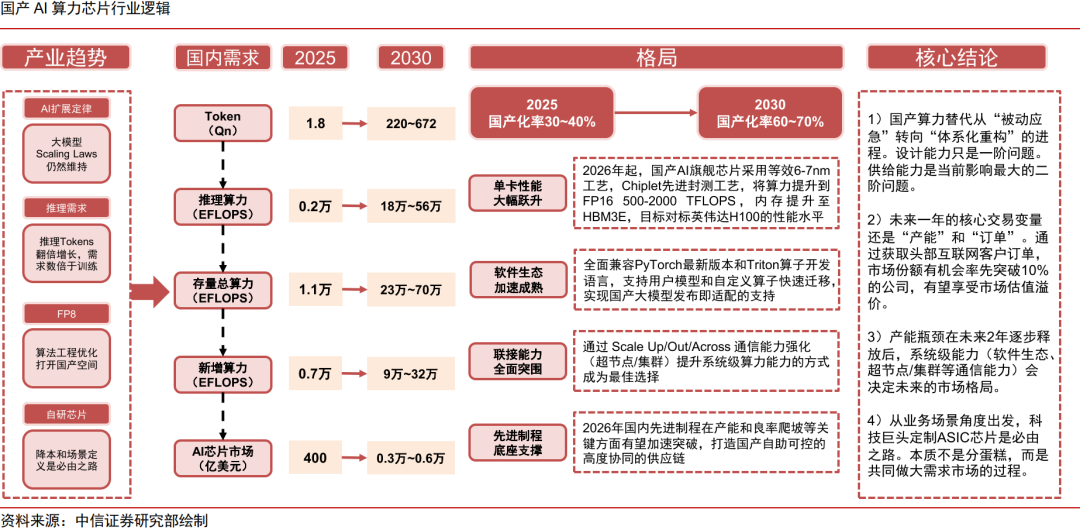
Core Viewpoint - The report from CITIC Securities indicates that the synergy between self-controllable technology and AI will drive significant performance in related sectors by 2025, with expectations for further strengthening in 2026. The focus will be on domestic computing power and semiconductor equipment, alongside a potential turnaround opportunity in consumer electronics by Q2 2026 [1]. Investment Theme 1: Domestic Computing Power and Semiconductor Equipment - Domestic computing power is expected to transition from point breakthroughs to systematic reconstruction by 2026, driven by increased local demand and intensified overseas restrictions. The market share of domestic manufacturers is projected to rise from 30-40% currently to 60-70% by 2030, with the total addressable market (TAM) for domestic computing power anticipated to grow from over $13 billion in 2025 to over $180 billion by 2030 [1]. - The expansion of domestic wafer fabs is being driven by the dual forces of increased production capacity and accelerated localization. The domestic equipment procurement rate is estimated to rise from 18% in 2022 to 25% in 2023, and further to over 30% by 2025, with expectations of reaching 40% by 2026 [4][5]. Investment Theme 2: High Growth in AI-Driven PCB and Storage Sectors - The PCB sector is expected to benefit from the demand for AI computing power, with significant growth anticipated in 2026-2027. The need for high-speed transmission and interconnectivity in AI chips will drive the upgrade of PCB technology, enhancing its value [16]. - The storage sector is entering a super cycle driven by AI demand, with prices for mainstream storage products expected to rise significantly. The visibility of shortages is high, and prices for DRAM and NAND are projected to continue increasing through the first half of 2026 [23]. Investment Theme 3: Consumer Electronics and Edge AI Opportunities - The consumer electronics sector is currently facing challenges due to storage price increases and shortages, but a potential turnaround is anticipated in Q2 2026. Innovations in AI smartphones, AI/AR glasses, and other AIoT products are expected to drive growth [30].


券商晨会精华 | 自主可控、AI为贯穿全年主线
智通财经网· 2026-01-15 00:55
Market Overview - The market experienced a pullback after an initial rise, with the Shanghai Composite Index dropping by 0.31% while the Shenzhen Component and ChiNext Index rose by 0.56% and 0.82% respectively [1] - The total trading volume in the Shanghai and Shenzhen markets reached 3.94 trillion yuan, an increase of 290.4 billion yuan compared to the previous trading day, marking the third consecutive day of surpassing 3.5 trillion yuan [1] - Over 2,700 stocks in the market saw gains, with notable sectors including AI applications, computing hardware, and semiconductors showing strong performance [1] Investment Insights - CITIC Securities emphasizes that "self-controllability and AI" will be the main theme throughout the year, predicting significant performance in related sectors by 2025 [2] - China Galaxy Securities highlights the "AI leap + century change" synergy driving a super copper cycle, suggesting that copper prices have substantial upward potential despite recent highs [3] - CICC notes that the mid-term "stock-bond seesaw" effect will further support A-share performance, with a global interest rate cut cycle expected to enter its second half in 2026 [3]
中信证券:“自主可控、AI算力”有望成为电子行业贯穿全年的绝对强主线
Zheng Quan Shi Bao Wang· 2026-01-15 00:21
人民财讯1月15日电,中信证券研报认为,2025年,自主可控与AI共振带动相关板块取得亮眼表现。展 望2026年,这一产业趋势料将得到进一步强化,"自主可控、AI算力"有望成为电子行业贯穿全年的绝对 强主线,自主可控关注国产算力及半导体设备加速放量趋势,AI算力方向PCB与存储高确定性景气;此 外"消费电子"作为支线或迎重大转折机遇,关注2026年第二季度景气反转机会。 ...
洁美科技(002859):纵横一体化构建护城河 多业务协同拓展持续打开成长空间
Xin Lang Cai Jing· 2026-01-14 12:30
Core Viewpoint - The company, Zhejiang Jiemai Electronic Technology Co., Ltd., is a leading enterprise in electronic packaging materials and has maintained a high market share and profitability through a vertical and horizontal integration strategy, achieving a revenue of 1.53 billion yuan in the first three quarters of 2025, a year-on-year increase of 13.7% [1]. Group 1: Business Overview - The company was established in April 2001 and specializes in the research, production, and sales of electronic packaging materials and electronic-grade film materials, including paper carrier tape, electronic adhesive tape, plastic carrier tape, release film, cast film, and IC trays [1]. - The company has maintained a gross margin of over 30% and has built a strong customer base due to the high recognition of its products [1]. Group 2: Market Demand - The global digitalization process has accelerated, driven by policies such as "new infrastructure" and "old-for-new" electronic product exchanges, leading to increased demand in markets like 5G networks, cloud computing, data centers, and electric vehicles [2]. - For instance, the demand for MLCC in AI servers is expected to be eight times that of traditional servers, with an annual growth rate exceeding 30% in the AI sector by 2030 [2]. Group 3: Production Capacity and Optimization - The company is expanding its production capacity both domestically and internationally to meet the surging demand for carrier tape driven by downstream electronic components [3]. - New production bases are being established and existing ones are being upgraded, including a new factory in Malaysia and a technology upgrade project in Jiangxi, which is expected to enter trial production by the end of 2025 [3]. Group 4: Strategic Acquisitions - The acquisition of Ruzhen Technology at the end of 2024 is expected to enhance the company's R&D and manufacturing capabilities in new energy materials, creating synergies and expanding market reach [4]. - Ruzhen Technology has already established deep collaborations with leading battery companies and has become a key supplier of composite aluminum foil for lithium batteries, receiving bulk orders from major clients [4]. Group 5: Financial Projections - The company is projected to achieve net profits of 207 million yuan, 359 million yuan, and 521 million yuan for the years 2025 to 2027, with corresponding price-to-earnings ratios of 61.53, 35.56, and 24.47 times [4].

不“卷”光伏老路,钙钛矿创业公司涌入消费电子赛道找新机
Jing Ji Guan Cha Wang· 2026-01-14 12:17
Core Insights - Numerous perovskite startups that have not yet entered the ground station market are shifting focus to the consumer electronics sector to seek opportunities [1][2] - Perovskite technology offers higher photoelectric conversion efficiency and better performance in low-light conditions, making it suitable for small-surface consumer electronic products [1][2] - The current market for perovskite-based consumer electronics is still in the promotional phase, with acceptance yet to be validated [2] Consumer Electronics Demand - The demand for perovskite products in consumer electronics is driven by three main factors: replacement of existing silicon batteries, expansion into new product categories, and regulatory pressures for greener energy solutions [3] - The EU's new battery regulations are expected to increase the cost of traditional batteries, prompting manufacturers to seek alternative energy solutions like perovskite [3] Product Development and Manufacturing - Transitioning from traditional photovoltaic markets to consumer electronics requires perovskite companies to adapt to a different operational logic, focusing on customization and direct consumer engagement [5] - The production process for consumer electronics involves more intricate post-processing techniques compared to large-scale photovoltaic components, necessitating a shift in manufacturing strategies [5][6] - Different consumer electronic products have varying requirements for perovskite components, such as impact resistance for smart locks and flexibility for mouse devices [6] Market Potential and Competition - The potential market for perovskite components in smart locks could reach 100 MW if the market share reaches 50%, highlighting the need for scalable production capabilities [7] - Competition in the consumer electronics sector will initially focus on performance metrics, followed by mass production capabilities and cost efficiency [7]

主力资金丨5股尾盘获主力资金大手笔抢筹
Zheng Quan Shi Bao Wang· 2026-01-14 11:16
Group 1 - The core point of the article highlights that on January 14, the main funds in the Shanghai and Shenzhen markets experienced a net outflow of 504.74 billion yuan, with the ChiNext board seeing a net outflow of 210.18 billion yuan and the CSI 300 index stocks a net outflow of 154.4 billion yuan [1] - Among the 17 primary industries, the computer industry had the highest increase, rising by 3.42%, while the banking and real estate sectors saw declines exceeding 1% [1] - Ten industries experienced net inflows of main funds, with the computer industry leading at a net inflow of 46.7 billion yuan, followed by non-bank financials and telecommunications with inflows exceeding 11 billion yuan each [1] Group 2 - In individual stock performance, the automotive parts company Shanzi Gaoke had the highest net inflow of main funds at 21.18 billion yuan, with a trading volume of 128.48 billion yuan and a turnover rate of 24.14% [2] - PCB concept stock Hu Dian shares saw a net inflow of 13.28 billion yuan, ranking second, while AI financial stock Lakala had a net inflow of 12.91 billion yuan [2] - The article also notes that over 250 stocks had net outflows exceeding 1 billion yuan, with 10 stocks seeing outflows over 10 billion yuan [3] Group 3 - The article mentions that leading sectors for net outflows included robotics, electricity, and wind power, with each seeing outflows exceeding 21 billion yuan [4] - Hai Ge Communication experienced a net outflow of 14.3 billion yuan, with the company announcing expected losses for the 2025 fiscal year [4] - The tail-end trading session saw a net outflow of 54.14 billion yuan, with the CSI 300 index stocks experiencing a net outflow of 49.52 billion yuan [5]






英集芯跌0.55%,成交额2.57亿元,近3日主力净流入-3713.87万
Xin Lang Cai Jing· 2026-01-14 07:53
Core Viewpoint - The company, Yingjixin Technology Co., Ltd., is actively involved in the development and sales of power management and fast charging protocol chips, with a focus on automotive electronics and consumer electronics sectors. Group 1: Company Overview - Yingjixin was established on November 20, 2014, and went public on April 19, 2022, with its headquarters located in Zhuhai, Guangdong Province [7] - The company's main business revenue composition includes power management (65.15%), mixed-signal SoC (22.02%), battery management (12.33%), and others (0.49%) [7] - As of September 30, 2025, the company had 15,600 shareholders, an increase of 13.58% from the previous period [8] Group 2: Financial Performance - For the period from January to September 2025, Yingjixin achieved operating revenue of 1.169 billion yuan, representing a year-on-year growth of 14.16% [8] - The net profit attributable to the parent company for the same period was 114 million yuan, reflecting a year-on-year increase of 28.54% [8] - The company has distributed a total of 171 million yuan in dividends since its A-share listing, with 155 million yuan distributed over the past three years [9] Group 3: Product Development and Market Position - The company has successfully developed automotive-grade charging chips that meet AEC-Q100 standards and has begun mass production for domestic and international automotive manufacturers [2] - Yingjixin's TWS earphone charging case chip offers a highly integrated power solution, supporting deep customization of MCU software, which reduces design complexity and material costs for customers [2] - The company has established itself as a major supplier of power management and fast charging protocol chips in the consumer electronics market, leveraging its advantages in mobile power and fast charging adapters [2] Group 4: Industry Recognition - Yingjixin has been recognized as a "specialized, refined, distinctive, and innovative" small giant enterprise, which is a prestigious title awarded to companies that excel in niche markets, possess strong innovation capabilities, and maintain high market share [3]

金太阳涨2.13%,成交额1.93亿元,主力资金净流入1275.35万元
Xin Lang Cai Jing· 2026-01-14 07:05
Core Viewpoint - The stock of Jintaiyang has shown a mixed performance in recent trading sessions, with a year-to-date increase of 6.00% but a decline of 3.52% over the last five trading days. The company operates in the precision polishing materials and high-end intelligent equipment sectors, with a significant portion of its revenue coming from polishing materials [1][2]. Group 1: Stock Performance - As of January 14, Jintaiyang's stock price increased by 2.13%, reaching 24.92 CNY per share, with a trading volume of 1.93 billion CNY and a turnover rate of 6.68% [1]. - The stock has experienced a year-to-date increase of 6.00%, a decline of 3.52% over the last five trading days, a rise of 17.55% over the last 20 days, and a slight increase of 3.57% over the last 60 days [1]. Group 2: Financial Performance - For the period from January to September 2025, Jintaiyang achieved an operating income of 424 million CNY, representing a year-on-year growth of 22.06%. The net profit attributable to shareholders was 20.97 million CNY, reflecting a growth of 2.83% [2]. - The company has distributed a total of 108 million CNY in dividends since its A-share listing, with 37.35 million CNY distributed over the past three years [3]. Group 3: Shareholder Information - As of September 30, 2025, the number of shareholders for Jintaiyang was 15,700, a decrease of 8.80% from the previous period. The average number of circulating shares per shareholder increased by 8.02% to 7,486 shares [2]. - Notably, Ping An New Xin Pioneer Mixed A (000739) has exited the list of the top ten circulating shareholders [3]. Group 4: Business Overview - Jintaiyang, established on September 21, 2004, and listed on February 8, 2017, is located in Dongguan, Guangdong Province. The company specializes in the research, development, production, and sales of new precision polishing materials and high-end intelligent equipment, providing comprehensive solutions for precision polishing and manufacturing of precision components [1]. - The revenue composition of the company includes 60.74% from paper-based/fabric-based polishing materials, 24.77% from intelligent CNC equipment and precision components, 14.22% from new polishing materials, and 0.27% from other sources [1].

【IPO追踪】引入高通等基石投资者,龙旗科技今起招股
Sou Hu Cai Jing· 2026-01-14 03:05
Core Viewpoint - The recent performance of the new stock market has been strong, with companies like Zhaoyi Innovation, Biran Technology, and Zhiyu experiencing significant post-listing gains. Longqi Technology is set to launch its IPO in Hong Kong, following this trend [2]. Group 1: IPO Details - Longqi Technology plans to globally issue approximately 52.26 million H-shares, with 10% allocated for public offering in Hong Kong and 90% for international offering. There is an option for an additional 7.84 million shares under an over-allotment option, representing a 15% over-allotment ratio based on the base offering size [2]. - The maximum offer price is set at HKD 31 per share, with expected net proceeds of approximately HKD 1.52 billion if the over-allotment option is not exercised. The funds will be allocated as follows: 40% for expanding production capacity, 20% for R&D, 10% for marketing and customer expansion, 20% for strategic investments or acquisitions, and 10% for working capital [2]. Group 2: Subscription Period and Fees - The subscription period for Longqi Technology is from January 14 to January 19, 2026, with the listing on the Hong Kong Stock Exchange expected on January 22. The minimum investment for one board lot of 100 shares is HKD 3,131.26 [3]. Group 3: Institutional Interest - Longqi Technology's IPO has attracted significant interest from various institutions, including Qualcomm, Jiangxi Guokong, and others, with a total subscription amounting to approximately USD 56.5 million (or about HKD 440 million) [4]. Group 4: Company Overview - Longqi Technology is a leading global provider of smart products and services, offering a full range of solutions from product research and design to manufacturing and support. Its diverse product portfolio includes smartphones, AI PCs, automotive electronics, tablets, smartwatches, and smart glasses, catering to various sectors such as consumer electronics and IoT [5]. - According to Frost & Sullivan, Longqi ranks second globally in the consumer electronics ODM segment with a market share of 22.4%, first in the smartphone ODM segment with a market share of 32.6%, and among the top three in the tablet ODM segment [5]. - The company's revenue for the years 2022 to 2024 and the first three quarters of 2025 are projected to be RMB 29.34 billion, RMB 27.19 billion, RMB 46.38 billion, and RMB 31.33 billion, respectively, with adjusted net profits of RMB 620 million, RMB 672 million, RMB 565 million, and RMB 604 million [5].

研判2025!中国有色光电基膜行业相关政策、产业链、市场规模、竞争格局及未来趋势分析:消费电子领域持续恢复,带动有色光电基膜行业发展[图]
Chan Ye Xin Xi Wang· 2026-01-14 01:13
Core Viewpoint - The colored optical base film industry in China is experiencing an upward trend in market size, driven by the growth of consumer electronics and supported by government policies promoting high-end functional films. However, the growth rate has slowed down from 2022 to 2023, with a gradual recovery expected in 2024, reaching a market size of 4.267 billion yuan, a year-on-year increase of 15% [1][7]. Industry Overview - Colored optical base film is a functional material used in consumer electronics manufacturing, serving roles such as release, protection, identification, and optoelectronic tracking. It is a type of biaxially oriented polyester film (BOPET) available in various colors and specifications, crucial for the production of smartphones, tablets, and laptops [3]. Industry Policies - The government has introduced several policies to support the development of the colored optical base film industry, including the "Guidance Catalog for Industrial Structure Adjustment (2024 Edition)" which encourages high-end functional films [4]. Other policies focus on enhancing the supply capacity of key products in various sectors, including electronic chemicals and high-performance membrane materials [4]. Industry Chain - The industry chain consists of upstream components like polyester chips and additives, midstream production of colored optical base films, and downstream applications in consumer electronics, renewable energy, and photovoltaics. The demand for colored optical base films is expected to rise with the growth of the consumer electronics sector [6][7]. Current Market Status - The market size of the colored optical base film industry has been increasing, primarily due to the rapid updates in consumer electronics and the proliferation of 5G, IoT, and smart wearable devices. However, the growth rate slowed from 2022 to 2023 due to insufficient effective demand, with a recovery anticipated in 2024 [1][7]. Competitive Landscape - The market is predominantly occupied by foreign manufacturers with advanced technology. However, domestic companies like Hangzhou Heshun Technology Co., Ltd. and Jiangsu Yuxing Film Technology Co., Ltd. are emerging as strong competitors, expected to increase R&D investments to enhance market competitiveness [7]. Key Companies - Hangzhou Heshun Technology Co., Ltd. is a leading domestic player in the colored optical base film sector, with a revenue of 135 million yuan in the first half of 2025, a year-on-year increase of 6.53% [9]. Jiangsu Yuxing Film Technology Co., Ltd. is a major manufacturer of functional polyester films, reporting a revenue of 713 million yuan in the first nine months of 2025, a year-on-year decrease of 16.35% [10]. Future Development Trends - The colored optical base film industry is expected to evolve towards lightweight, flexible, and customized products. Innovations in ultra-thin technology and molecular chain structure optimization will enhance the performance of films, meeting the demands of emerging products like foldable phones and wearable devices [10]. Customization will also become a key trend, allowing companies to develop specialized products for different segments of the consumer electronics market [10].


