美国例外论

Search documents
每日投行/机构观点梳理(2025-07-21)
Jin Shi Shu Ju· 2025-07-21 08:39
Group 1 - The report from Bank of America indicates a significant decline in the global fund allocation to US stocks, dropping from 72% in 2024 to less than 50% in 2023 due to trade war concerns and political risks associated with the Trump administration [1] - Foreign capital inflow into US stocks has slowed to less than $2 billion in the past three months, compared to $34 billion in January [1] - Concerns over the US fiscal deficit and a depreciating dollar are dampening investor enthusiasm for US assets [1] Group 2 - HSBC's analysis suggests that the reasonable valuation range for USD/JPY is between 146 and 152, with potential intervention from the Japanese government if the exchange rate reaches between 155 and 160 [2] - Key factors influencing the yen's potential rebound include a US-Japan trade agreement and the Federal Reserve's monetary policy decisions [2] Group 3 - Barclays warns that dismissing Federal Reserve Chairman Powell may backfire, potentially leading to increased inflation expectations and prolonged periods of inaction or even rate hikes by the FOMC [3] - The report emphasizes that even a new Fed chair would need consensus with other FOMC members to implement significant policy changes [3] Group 4 - Deutsche Bank analysts believe that the recent mild recovery of the dollar may only represent a pause in its depreciation trend, not a reversal [4] - The report highlights that the upcoming US tariff deadline and threats to the Fed's independence could reignite concerns over the dollar's value [4] Group 5 - Deutsche Bank also notes that the upcoming Japanese elections could negatively impact the yen, as the government risks losing its majority, increasing uncertainty in fiscal policy [5] - The potential for new elections in the House of Representatives adds to the challenges in US-Japan trade negotiations, which could further weaken the yen [5] Group 6 - Deutsche Bank's foreign exchange analyst states that even with significant rate cuts from the European Central Bank, the euro may continue to appreciate against the dollar due to US policies undermining the dollar [6] - The forecast predicts that the EUR/USD exchange rate could rise to 1.20 by December 2025 and 1.25 by September 2026 [6] Group 7 - The report from CICC highlights the potential of the Yarlung Tsangpo River downstream hydropower project, which could be three times the scale of the Three Gorges Project, providing long-term growth opportunities for electrical equipment manufacturers [8] - The project is expected to significantly impact the market for hydropower equipment, with major suppliers like Harbin Electric and Dongfang Electric benefiting from the anticipated demand [8] Group 8 - Huatai Securities estimates that the Yarlung Tsangpo River downstream hydropower project, which commenced on July 19, could generate a total value of approximately 53.5 billion to 95.4 billion yuan in turbine and generator business [10] - The project is expected to become a new growth point for hydropower equipment after 2030, ensuring high capacity utilization in the industry [10] Group 9 - CICC's report indicates that the recent comments from President Trump and Treasury Secretary Mnuchin reflect a strategy of market manipulation, with Trump delivering negative news while Mnuchin provides reassurances to stabilize the market [9] - This dynamic is seen as part of a broader "TACO trading" strategy, where market reactions are influenced by the contrasting messages from the administration [9] Group 10 - CICC suggests that the probability of a Fed rate cut in July is low, as key employment indicators show resilience in the US job market, despite some mixed signals [11] - The report emphasizes that the Fed does not need to rush into rate cuts, as many indicators support a wait-and-see approach [11] Group 11 - CICC notes that the implementation of pricing mechanisms in the electricity reform is expected to stabilize profitability for leading operators in the sector, as new projects focus on coastal wind and renewable energy bases [12] - The report highlights that leading operators are likely to outperform the industry average in project returns due to their superior capabilities [12] Group 12 - CICC identifies overseas expansion as a strong driver for performance exceeding expectations, with companies benefiting from increased ROE and profit margins [13] - The report anticipates that as trade war expectations stabilize, overseas expansion could lead to sector-wide market movements [13] Group 13 - CICC forecasts that commodity prices will return to being driven by fundamentals in Q3 2025, with industrial metals and crude oil potentially weakening, while coal and steel supply-demand dynamics may improve [15] - The report suggests that liquidity easing and supply constraints could keep precious and industrial metal prices stable [15] Group 14 - CICC expresses optimism for sectors related to foundation treatment, civil explosives, cement, and engineering contracting due to the significant investment in the Yarlung Tsangpo River downstream hydropower project [16] - The project is expected to create high demand growth across multiple construction and building material segments [16] Group 15 - Zheshang Securities highlights that RWA (Real World Assets) could lead to a temporary expansion of dollar credit as blockchain technology accelerates the replacement of traditional finance [17] - The report discusses the potential challenges RWA poses to traditional financial institutions, including banks and brokers [17] Group 16 - Huatai Securities suggests that despite entering the e-commerce off-season, the pressure on terminal franchisees may ease due to price stabilization, leading to improved profitability for express delivery companies [18] - The report emphasizes the importance of policy catalysts in supporting the express delivery sector [18] Group 17 - Huatai Securities recommends maintaining positions in the market while making selective switches, as the A-share market shows signs of strength and a shift towards large-cap growth stocks [19] - The report indicates that sectors with low valuations and potential for price increases are likely to maintain market interest [19] Group 18 - GF Securities expresses confidence in the non-bank sector, suggesting that increased market activity and policy signals could enhance the valuation of brokerage firms [20] - The report highlights the potential for recovery in brokerage performance and the importance of monitoring policy-driven mergers and acquisitions [20]


书单 | 货币与权力:读懂国际货币体系(20本经典著作) (申万宏观·赵伟团队)
申万宏源宏观· 2025-07-20 02:20
Core Viewpoint - The article discusses the ongoing challenges and potential shifts in the international monetary system, particularly focusing on the decline of the US dollar and the implications of stablecoins in this context [3][4][5]. Group 1: Current Monetary System Challenges - Since early 2025, the narrative of "American exceptionalism" has been challenged, leading to a 12.5% decline in the US dollar index [3]. - Following the "reciprocal tariffs" impact in April, the US financial markets experienced simultaneous declines in stocks, bonds, and currency [3]. - The "Triffin Dilemma," which predicts a crisis of confidence in the dollar due to excessive credit expansion, is highlighted as a historical precedent for current issues [3][4]. Group 2: Stablecoins and Their Role - The article raises questions about the nature and functions of stablecoins, exploring their potential roles in the monetary system and their relationship with the US dollar [5]. - It emphasizes the need for a deeper understanding of the essence of money and the functions it serves, particularly in the context of stablecoins [5]. Group 3: Political and Economic Interconnections - The relationship between alliance politics, monetary issues, and strategy is underscored, indicating that the dollar and gold issues are intertwined with broader political concerns, such as US-NATO relations and Germany's role [6]. - The article stresses that economic policies cannot be viewed in isolation from strategic and foreign policy issues, highlighting the political dimensions of monetary matters [6].


特朗普一系列操作痛击美债 外资蜂拥至欧债市场:创2023年以来最大买入规模
智通财经网· 2025-07-18 13:49
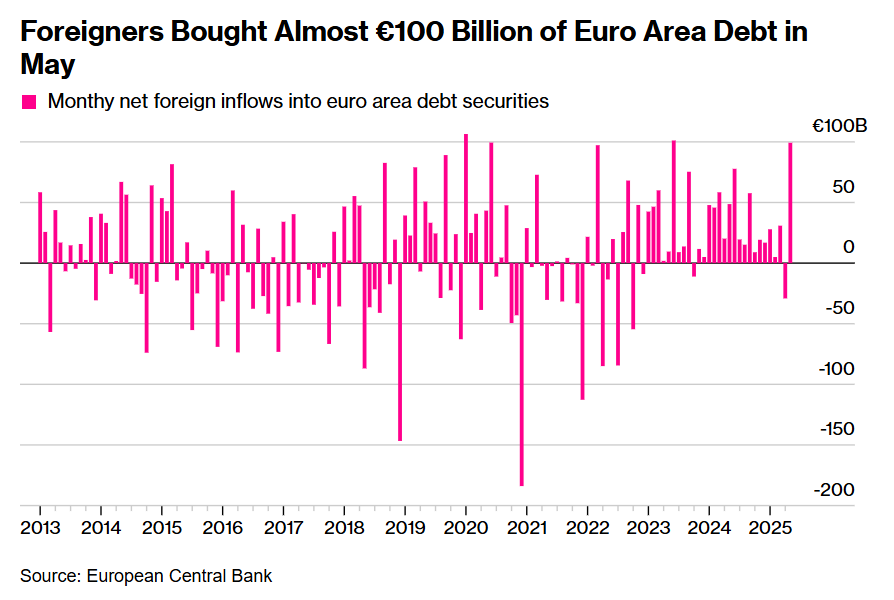
Core Viewpoint - The aggressive tariff policies led by the Trump administration and the "big and beautiful" bill, which significantly increases the budget deficit, have caused the so-called "American exceptionalism" to collapse, prompting overseas investors to flock to the European market [1] Group 1: Overseas Investment Trends - In May, overseas buyers purchased nearly €100 billion (approximately $116 billion) of eurozone bond assets, marking the strongest buying scale by overseas investors in 2023 [1][4] - Traditional asset management institutions have significantly sold off U.S. Treasury assets in response to Trump's tariff announcements, seeking to allocate funds into safer European sovereign bonds like German government bonds [1] Group 2: U.S. Treasury Market Dynamics - Foreign investors' total holdings of U.S. Treasury bonds reached $9.05 trillion in May, with a modest increase of $32.4 billion from April [5] - Despite this, concerns over potential inflation due to Trump's tariff policies and the collapse of "American exceptionalism" have led to a sell-off in the U.S. Treasury market, with the 30-year Treasury yield rising by 50 basis points since April 2 [5] - The "big and beautiful" bill is expected to significantly expand the government budget deficit, contributing to upward pressure on U.S. Treasury yields, particularly for the 10-year Treasury yield, which is seen as a global asset pricing anchor [5][6] Group 3: European Bond Market Appeal - Compared to the U.S., Europe offers a more stable policy environment, lower budget deficit outlook, and lower inflation levels, making its sovereign bonds more attractive to global central banks [6] - The European Central Bank has more room to lower interest rates to stimulate economic growth due to lower inflation, enhancing the appeal of European bonds [6] Group 4: Market Sentiment and Future Projections - The market is currently questioning the independence of the Federal Reserve's monetary policy due to Trump's threats to potentially dismiss Fed Chairman Powell, which has led to increased scrutiny on long-term Treasury yields [6] - The term premium for 10-year U.S. Treasury bonds is hovering at its highest level since 2014, reflecting investor concerns over the future borrowing scale of Washington [6][7] - Economists predict that under the Trump administration, the scale of national debt and budget deficits will be significantly higher than official forecasts, driven by a framework of "domestic tax cuts + external tariffs" [7]
美银:贸易战冲击“美国例外论”,美股全球资金占比骤降
news flash· 2025-07-18 11:07
Core Viewpoint - The ongoing trade war has raised doubts about the "American exceptionalism," leading to a significant decline in the share of global funds flowing into U.S. equities by 2025 [1] Group 1: Global Fund Flows - Year-to-date, U.S. equity funds have attracted less than half of the global fund inflows, compared to 72% in 2024 [1] - In the past three months, foreign capital inflows have slowed to less than $2 billion, down from $34 billion in January [1] Group 2: Political and Economic Factors - Trump's unstable trade policies, expanding fiscal deficits, and a depreciating dollar have dampened investor enthusiasm for U.S. assets [1] - Some asset management firms have warned that due to the political risks associated with the Trump administration, the U.S. is no longer considered a safe investment destination for foreign investors [1]
【世界说】关税冲击、赤字猛增、信任缺失……外媒:“美国例外论”在不确定性中褪色
Sou Hu Cai Jing· 2025-07-18 09:32
Group 1 - The concept of "American exceptionalism" is being re-evaluated due to economic policy uncertainties and record fiscal deficits, impacting national identity and global investment strategies [1][4] - The U.S. dollar index is projected to decline by 10.8% in the first half of 2025, marking the worst start since 1973, influenced by erratic tariff policies and criticisms of the Federal Reserve [2][5] - The principle of "There Is No Alternative" regarding U.S. assets is being questioned as global investors diversify their reserves, increasing gold holdings to hedge against dollar depreciation [2][4] Group 2 - The weakening dollar is raising costs for international travel and imported goods, while reduced demand for U.S. Treasury bonds is increasing government borrowing costs [2][4] - Major investment firms are downgrading their outlook on U.S. assets, with Citigroup stating that "American exceptionalism" has been "paused" during the Trump administration [5] - Economic forecasts for U.S. GDP growth have been revised downwards due to the uncertainties surrounding tariff policies, with the Federal Reserve lowering its growth prediction from 2.1% to 1.7% [5]
人民币与美元指数“同涨”,后续走势如何?
Xin Lang Cai Jing· 2025-07-17 07:27
Group 1 - The recent rebound of the US dollar is attributed to lowered expectations for interest rate cuts by the Federal Reserve, improved outlook for a "soft landing" in the US economy, and diminishing uncertainty regarding tariffs [1] - The US dollar index has shown signs of recovery due to a slight increase in inflation risks as indicated by the Consumer Price Index (CPI) for June, which has led to a minor rebound in US Treasury yields and the dollar index [1][2] - Analysts believe that the long-term trend of a weaker dollar is supported by the ongoing diversification of the international monetary system, with the dollar's global reserve share falling below 60% for ten consecutive quarters [2] Group 2 - The recent appreciation of the Chinese yuan indicates that the central bank may be guiding the currency towards a moderate strengthening, with expectations that it could maintain its strength in the short term [3] - The yuan's performance is closely linked to the outlook for the US dollar, with potential for appreciation if the dollar continues to weaken, although significant fluctuations are not anticipated [3][5] - Analysts predict that the yuan will likely fluctuate within the range of 7.1 to 7.3 against the dollar for most of the second half of the year, despite a potential weakening of the dollar index [5] Group 3 - The increase in cross-border RMB settlement amounts reflects the acceleration of RMB internationalization, with significant inflows indicating foreign confidence in Chinese assets [6] - In the first half of the year, cross-border RMB settlement amounted to 8.3 trillion yuan, with trade and direct investment contributing significantly to this figure [5][6]
世界黄金协会:下半年金价或陷横盘震荡 滞胀风险下潜在涨幅或达15%
智通财经网· 2025-07-16 03:44
Group 1 - The World Gold Council's mid-year outlook report indicates that if economists and market participants' macroeconomic predictions are accurate, gold prices may experience a sideways trend in the second half of the year, with some upward potential [1] - Historical experience shows that economic performance rarely aligns perfectly with consensus forecasts, suggesting uncertainty in future gold price movements [1] - If economic and financial conditions worsen, along with increased stagflation pressures and escalating geopolitical tensions, safe-haven demand could drive gold prices up by 10%-15% [1] - Conversely, if global conflicts are resolved broadly and sustainably, gold may retrace 12%-17% of its gains this year, although this scenario is currently considered unlikely [1] - The World Gold Council anticipates that global central bank demand for gold will remain strong in 2025, despite a potential decline from record levels, still expected to exceed the average of 500-600 tons per year prior to 2022 [1] - The report emphasizes that pressures related to the US dollar may persist, and discussions about the end of the "American exceptionalism" narrative could become a focal point for investors [1] - Overall, these conditions position gold as a net beneficiary, although some positive factors are already reflected in current gold prices [1] Group 2 - In June, the US Consumer Price Index (CPI) rose by 2.7% year-on-year, exceeding the 2.4% increase in May and aligning with economists' expectations [2] - Typically, gold performs best in low-interest-rate environments, making it more attractive compared to interest-bearing assets like bonds [2] - The main gold futures contract for July delivery on the New York Commodity Exchange fell by 0.6%, settling at $3,329.80 per ounce, while the main silver futures contract dropped by 1.6%, closing at $37.834 per ounce [2]
对话东方汇理资管:“美国例外论”式微,看好中国AI发展
2 1 Shi Ji Jing Ji Bao Dao· 2025-07-15 11:57
Group 1 - The confidence in the "American exceptionalism" narrative is declining, with institutional investors showing the lowest bullish sentiment towards the dollar and US stocks since 2005 [1][5] - Over $100 billion has flowed into European equity funds in the first half of 2025, doubling from the previous year, while outflows from the US have exceeded $87 billion [1][2] - The US economy is slowing down, and the policy environment has shifted from "market-friendly" to "market-damaging," impacting investor sentiment [1][5] Group 2 - The S&P 500 index's earnings growth is expected to slow to 5.8% in Q2, down from 13.7% in Q1 [2] - The Chinese stock market shows potential, with the Shanghai Composite Index up 2.8% and the Hang Seng Index up 20% in the first half of the year [2][8] - The emergence of DeepSeek signifies a shift in the AI investment landscape, indicating that the dominance of the "Big Seven" US tech companies is being challenged [2][6] Group 3 - China has over 4,500 AI companies, covering a complete chain from basic computing power to industry applications, with significant penetration in various sectors [3][10] - The gap in foundational technology between China and the US is narrowing, although the US maintains a more closed and costly ecosystem [3][11] - The Chinese market is expected to benefit from a new round of fiscal and monetary policy easing, with a focus on domestic demand-driven sectors [8][9] Group 4 - The Chinese technology sector is seen as undervalued compared to its US counterparts, particularly in AI applications and downstream software development [7][8] - The integration of AI technology with manufacturing capabilities is crucial for future advancements, with a focus on robotics and intelligent vehicles [7][10] - China's strong performance in STEM education and research output positions it favorably in the global AI landscape [10][11]
华泰证券|周度债市讨论会
2025-07-15 01:58
Summary of Key Points from the Conference Call Industry Overview - The discussion primarily revolves around the **bond market** in China for the year 2025, highlighting its characteristics and risks [2][3][4]. Core Insights and Arguments 1. **Market Characteristics**: The bond market is characterized by high starting points, low returns, negative carry, and high volatility. Risk control is crucial, especially during periods of high volatility or significant drawdowns [2][3]. 2. **Investment Opportunities**: Short-term deposits and short-term credit bonds have increased in value after recent adjustments in the bond market. The ten-year government bond is seen as having a good payout above 1.7%, with 1.8% acting as a resistance level [3][4]. 3. **Macroeconomic Factors**: The macro narrative shifted from a positive outlook post-Spring Festival to concerns over overseas disturbances, such as U.S. tariff policies and geopolitical uncertainties, which have weakened the macro logic [3][5]. 4. **Monetary Policy Focus**: The central bank's focus is on stabilizing the exchange rate, maintaining bank interest margins, and preventing bond market risks, with less emphasis on growth stabilization [6]. 5. **Government Debt Supply**: The government is expected to issue a large amount of debt in 2025, with net issuance in the first two months reaching 800 to 900 billion, which is 3 to 4 times higher than previous years [7]. 6. **AI Investment**: AI investment is projected to account for approximately 0.4% to 0.7% of GDP, with a complete industrial chain and lower discount effects. The increase in R&D personnel and changes in financial conditions are critical to monitor [3][24]. 7. **Market Sentiment**: Recent market sentiment has been pessimistic due to significant declines in the bond market, affecting various institutions, particularly smaller banks [8]. 8. **Investment Recommendations**: In the current high-volatility environment, short-term deposits and mid-term credit bonds are recommended. For long-term investments, a pyramid strategy is suggested for ten-year government bonds priced above 1.7% [9]. Additional Important Insights 1. **U.S. Economic Dynamics**: The U.S. economy's relative strength is diminishing, with high interest rates starting to show lagging effects on economic data, such as declining service sector performance [10][12]. 2. **Geopolitical Impacts**: Geopolitical tensions, particularly the ongoing Russia-Ukraine conflict, are affecting market expectations and asset allocation strategies [18]. 3. **Consumer Behavior**: The performance of the U.S. stock market is closely linked to consumer savings rates, with lower savings correlating with higher consumer spending [11]. 4. **Long-term Economic Outlook**: The U.S. economy is expected to remain weak in the near term, with high interest rates continuing to exert downward pressure on economic performance [12]. 5. **Bond Market Risks**: The convertible bond market presents limited opportunities, with high valuations and risks associated with redemption and credit quality [27][28]. This summary encapsulates the key points discussed in the conference call, providing a comprehensive overview of the current state and outlook of the bond market and related economic factors.
4月巨大波动时刻果断出手!陈光明与霍华德·马克斯最新对话谈到很多共识
聪明投资者· 2025-07-10 11:56
Core Viewpoint - The key to investment lies in the ability to objectively assess true value, and when market fluctuations cause prices to deviate from value, investors should capitalize on these fluctuations rather than being swayed by them [1][55][56]. Group 1: Market Sentiment and Investment Strategy - During periods of market volatility, such as the significant fluctuations in April, both Howard Marks and Chen Guangming acknowledged that their institutions actively bought into the market, taking advantage of the opportunity to acquire undervalued assets [2][17][58]. - Chen emphasized the importance of maintaining a calm and courageous approach during turbulent times, focusing on the intrinsic value of companies rather than being influenced by market price movements [19][60]. - Marks highlighted that true returns come from the long-term compounding growth of excellent companies, rather than short-term market predictions driven by emotions [1][64]. Group 2: U.S. Market and Economic Outlook - Marks discussed the current state of the U.S. economy, noting that while it remains vibrant, there are concerns regarding the sustainability of the "American exceptionalism" narrative due to recent policy changes and market volatility [10][12][11]. - He pointed out that the U.S. stock market's total market capitalization represents 50% of the global total, while its GDP accounts for only about 25%, indicating a potential overvaluation from a valuation perspective [5]. - Despite concerns, Marks believes that the U.S. remains a highly attractive destination for investment, with a strong likelihood of continued returns over the coming decades [13][12]. Group 3: China Market Potential - Chen expressed optimism about the Chinese market, suggesting that the recent developments, such as the emergence of DeepSeek, indicate that global investors are beginning to recognize China's long-term growth potential [36][49]. - He noted that the perception of China as an uninvestable market was a classic case of emotional overreaction, and those who maintained their positions during this period have seen positive returns [57][58]. - Chen highlighted that the intrinsic value of Chinese companies has not significantly changed despite market fluctuations, and he believes that the long-term competitiveness of China is on the rise [50][49]. Group 4: Value Investment Principles - Both Marks and Chen emphasized that value investing is a practical science focused on assessing true value, with the principle of buying below intrinsic value to achieve investment returns [52][55]. - Chen pointed out that while the fundamental principles of value investing are universal, the practice may differ across markets due to varying stability and predictability of intrinsic value [53]. - Marks reiterated the importance of focusing on value itself rather than being swayed by market emotions, advocating for a disciplined approach to investing [81][82].