
高端化

Search documents
徐工机械(000425) - 2026年2月4日投资者关系活动记录表
2026-02-14 05:16
Group 1: Mining Machinery Business - The company offers a comprehensive range of mining machinery products, including two-bridge mining trucks, excavators, electric shovels, and wide-body dump trucks, positioning itself as a leading player in the global market [2] - The mining machinery sector is projected to exceed 40 billion by 2030, driven by increasing demand for new energy minerals and ongoing upgrades in mining equipment [3] - The company has established a strong technical foundation in mining machinery, receiving recognition from international high-end clients [3] Group 2: Financial Performance and Strategy - The company's gross margin increased by 0.7 percentage points in the first half of 2025, with plans for continued improvement through cost reduction and structural adjustments [3] - Future gross margin growth is expected to align with industry cycles and operational progress, with a focus on stabilizing prices and reducing costs across procurement, R&D, and production [3] Group 3: Global Market Expansion - The mining machinery export business operates in over 190 countries, with key markets in Southeast Asia, Latin America, Africa, and Oceania [3] - The company aims to enhance its market penetration and competitiveness through accelerated globalization and localization strategies [3] Group 4: New Energy Mining Machinery - The company leverages its core components in electric control to enhance the competitiveness of its new energy mining machinery, aiming to provide comprehensive solutions for various application scenarios [3] Group 5: Agricultural Machinery Development - Established in June 2020, the agricultural machinery division focuses on high-end, large-power products, achieving significant revenue growth in recent years [3] - The division aims to provide optimal solutions for sustainable agricultural development, with a commitment to advanced technology and autonomous systems [3]

百威亚太(01876.HK)2025年报点评
Huachuang Securities· 2026-02-14 00:25
Investment Rating - The report maintains a "Buy" rating for Budweiser APAC (01876.HK) with a target price of HKD 10 [1]. Core Insights - The company reported a revenue of USD 5.76 billion and normalized EBITDA of USD 1.59 billion for the year 2025, reflecting a year-on-year decline of 6.1% and 9.8% respectively. The normalized net profit attributable to shareholders was USD 670 million, down 14.4% year-on-year. For Q4 alone, revenue and normalized EBITDA were USD 1.07 billion and USD 170 million, with a year-on-year decline of 4.2% and 24.7% respectively [1][5]. - The company plans to distribute a dividend of USD 750 million, maintaining the same level as the previous year, resulting in a dividend payout ratio of 153.4% [1][5]. Financial Performance Summary - **Revenue and Growth Rates**: - Total revenue for 2025 was USD 5,764 million, with a year-on-year growth rate of -7.7%. Projections for 2026, 2027, and 2028 are USD 5,921 million, USD 6,033 million, and USD 6,150 million respectively, with expected growth rates of 2.7%, 1.9%, and 1.9% [1][10]. - **Net Profit and Growth Rates**: - The net profit attributable to shareholders for 2025 was USD 489 million, down 32.6% year-on-year. Projections for the following years are USD 533 million, USD 563 million, and USD 580 million, with growth rates of 9.0%, 5.7%, and 3.0% respectively [1][10]. - **Earnings Per Share (EPS)**: - The EPS for 2025 is projected to be USD 0.04 for the years 2026 to 2028, with a price-to-earnings (P/E) ratio decreasing from 27 in 2025 to 23 in 2028 [1][10]. - **Dividend and Yield**: - The company maintains a high dividend strategy with a dividend yield of approximately 5.7% based on the current dividend payout [1][5]. Market Performance - The report highlights that the company faced challenges in the Chinese market, with a year-on-year revenue decline of 11.4% in Q4 due to weak demand in core on-premise channels. However, the Indian market showed strong growth, contributing significantly to overall revenue [5][6].

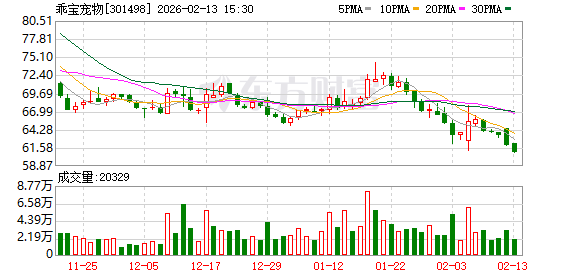
乖宝宠物:公司目前已有泰国生产基地,新西兰高端宠物食品项目正按计划建设中
Mei Ri Jing Ji Xin Wen· 2026-02-13 16:47
Core Viewpoint - The company, Guibao Pet (301498.SZ), is expanding its production capabilities internationally, with a focus on long-term strategies and brand development, unaffected by short-term profit fluctuations [2]. Group 1: Company Expansion - Guibao Pet currently has a production base in Thailand and is in the process of building a high-end pet food project in New Zealand [2]. - The company emphasizes a long-term commitment to its self-owned brand strategy, prioritizing brand share over immediate profits [2]. Group 2: Strategic Focus - The company is dedicated to the core business of pet food, pursuing a strategy of high-end, functional, and global development [2]. - Guibao Pet aims to build long-term barriers through product upgrades, channel expansion, cost optimization, and research transformation [2]. Group 3: Market Positioning - The pet industry has significant market potential, with various companies adopting unique development paths [2]. - Guibao Pet is committed to differentiated competition, continuously strengthening its advantages in the market [2].

百威亚太(01876):经营持续调整,股息突出亮眼:百威亚太(01876.HK)2025年报点评
Huachuang Securities· 2026-02-13 14:20
Investment Rating - The report maintains a "Buy" rating for Budweiser APAC (01876.HK) with a target price of HKD 10 [1]. Core Views - The company reported a revenue of USD 5.76 billion and normalized EBITDA of USD 1.59 billion for the year 2025, reflecting a year-on-year decline of 6.1% and 9.8% respectively. The normalized net profit attributable to shareholders was USD 670 million, down 14.4% year-on-year [1]. - The company plans to distribute a dividend of USD 750 million, maintaining a high payout ratio of 153.4% [1]. - The report highlights that the company is undergoing operational adjustments while maintaining a strong dividend policy, which is expected to attract investors [1]. Financial Summary - **Revenue and Profitability**: - Total revenue for 2025 was USD 5,764 million, with a projected growth of 2.7% in 2026 and 1.9% in both 2027 and 2028 [1]. - Normalized net profit is expected to recover to USD 533 million in 2026, with further growth to USD 563 million in 2027 and USD 580 million in 2028, after a decline of 32.6% in 2025 [1]. - **Earnings Per Share (EPS)**: - EPS is projected to remain stable at USD 0.04 from 2025 to 2028 [1]. - **Valuation Ratios**: - The price-to-earnings (P/E) ratio is expected to decrease from 27 in 2025 to 23 by 2028, while the price-to-book (P/B) ratio is projected to decline from 1.3 to 1.1 over the same period [1]. Market Performance - The report notes that the company faced challenges in the Chinese market, with a year-on-year revenue decline of 11.4% in Q4 2025, primarily due to weak demand in core on-premise channels [5]. - In contrast, the Indian market showed strong growth, contributing over two-thirds of the revenue with a year-on-year growth of over 20% in the P&SP product segment [5]. - The report anticipates a recovery in the Chinese market in 2026, with ongoing efforts to enhance distribution channels and focus on premium products [5].
宇通客车:公司围绕“电动化、智能网联化、高端化、国际化”四化战略,发挥新能源及智能网联核心优势
Zheng Quan Ri Bao Wang· 2026-02-13 13:40
Core Viewpoint - Yutong Bus (600066) emphasizes its commitment to the "electrification, intelligent networking, high-end development, and internationalization" strategy, aiming to strengthen its leadership in various market segments while expanding its international presence and enhancing global competitiveness and brand influence [1] Group 1 - The company focuses on leveraging its core advantages in new energy and intelligent networking [1] - Yutong Bus aims to consolidate its leading position in various niche markets [1] - The company is steadily expanding its international market presence [1]

明泰铝业:公司现阶段将坚持高端化、绿色化、智能化发展战略
Zheng Quan Ri Bao Wang· 2026-02-13 13:14
Core Viewpoint - The company, Ming Tai Aluminum (601677), is committed to a development strategy focused on high-end, green, and intelligent growth, with plans to accelerate its layout in sectors such as new energy, automotive lightweighting, and high-end aluminum materials [1] Group 1 - The company aims to enhance product added value and core competitiveness [1] - Future initiatives will include stable dividends, market value management, technological innovation, and extending the industrial chain [1] - The company will actively pursue overseas capacity layout [1]

百威亚太在中国不好卖了,销量连跌两年
Jin Rong Jie· 2026-02-13 09:05
Core Viewpoint - Budweiser is facing unprecedented growth pressure in the Chinese market, with declining sales and profits reported in its latest earnings report [1][2]. Financial Performance - Budweiser APAC reported a revenue of $5.764 billion (approximately 39.787 billion RMB) for 2025, a year-on-year decrease of 6.1% [1]. - Beer sales reached 7.966 billion liters, down 6.0% year-on-year [1]. - The profit attributable to equity holders was $489 million (approximately 3.375 billion RMB), a significant decline of 32.6%, marking a low point in net profit over recent years [1]. Market Challenges - The company has experienced a continuous decline in key metrics, with beer sales and revenue in China dropping by 8.6% and 11.3% respectively in 2025 [2]. - The decline is attributed to a slowdown in high-end dining and entertainment channels, which have traditionally been strong for Budweiser [2]. - The company has been slow to adapt to new retail and e-commerce channels, with a lower proportion of non-on-premise sales compared to competitors [2]. Strategic Initiatives - Budweiser is increasing investments in non-on-premise channels and enhancing its sales team capabilities, particularly in Guangdong [2]. - The company is also focusing on marketing its core sub-brands, including new endorsements for Harbin Beer to strengthen connections with younger consumers [2]. Cost Pressures - Increased investments to support distributors and brand promotion in emerging channels have created additional profit pressures for Budweiser [3]. - The company plans to maintain high-intensity marketing and channel investments in 2026, coinciding with the World Cup events [3]. Industry Context - The domestic beer industry is entering a contraction phase, with local brands accelerating their premiumization and channel transformation, increasing pressure on international giants like Budweiser [3][4]. - Competitors such as Yanjing Beer and Chongqing Beer are forecasting significant profit growth, with Yanjing expected to achieve a net profit of 1.584 billion to 1.742 billion RMB, a year-on-year increase of 50%-65% [3][4]. Leadership Focus - CEO Cheng Yanjun has emphasized the need to reignite growth and rebuild market share in China as a primary task [4].
中金:维持百威亚太跑赢行业评级 目标价9.80港元
Zhi Tong Cai Jing· 2026-02-13 02:13
Core Viewpoint - CICC has lowered Budweiser APAC's (01876) 2026 EBITDA forecast by 7.1% to $1.593 billion and introduced a 2027 EBITDA forecast of $1.637 billion, maintaining a target price of HKD 9.80 per share, indicating a potential upside of 25.2% from the current price [1] Group 1: Financial Performance - The company's 4Q25 performance was in line with expectations, with revenue, sales volume, ASP, and EBITDA declining by 4.2%, 0.7%, 3.5%, and 24.7% year-on-year, respectively [2] - In China, 4Q25 revenue, sales volume, ASP, and EBITDA saw declines of 11.4%, 3.9%, 7.7%, and 42.3% year-on-year, respectively, indicating continued adjustments in performance [2] Group 2: Regional Analysis - In China, 4Q25 sales volume decreased by 3.9% due to weak performance in key channels such as dining and nightlife, while ASP fell by 7.7% due to increased investment in off-premise channels [3] - In the Eastern Asia region, 4Q25 sales volume declined by 1.3% due to a weak consumption environment in South Korea, although ASP increased by 2.5% due to price hikes in core categories [4] - The Indian market continues to show strong growth, helping to offset some pressures from the Chinese market [4] Group 3: Strategic Outlook - The company is prioritizing growth in 2026, adopting a proactive approach to market challenges, with expectations of stabilization as the industry’s on-premise channel share is at a historical low [5] - The company may release stronger-than-industry elasticity if the on-premise channel recovers, supported by macroeconomic stabilization and strategic adjustments [5]
中金:维持百威亚太(01876)跑赢行业评级 目标价9.80港元
智通财经网· 2026-02-13 02:09
Group 1 - The core viewpoint of the report indicates that China International Capital Corporation (CICC) has lowered Budweiser APAC's (01876) 2026 EBITDA forecast by 7.1% to $1.593 billion and introduced a 2027 EBITDA forecast of $1.637 billion, maintaining a target price of HKD 9.80 per share, which implies a 25.2% upside potential from the current stock price [1] Group 2 - For Q4 2025, the company's performance was in line with CICC's expectations, with revenue, sales volume, average selling price (ASP), and EBITDA showing year-on-year declines of -4.2%, -0.7%, -3.5%, and -24.7% respectively, particularly in China where these figures were -11.4%, -3.9%, -7.7%, and -42.3% [2] Group 3 - In the China region, Q4 2025 faced weak demand and deepened channel adjustments, leading to a 3.9% year-on-year decline in sales volume, primarily due to the poor performance in key channels like dining and nightlife, while ASP dropped by 7.7% due to increased investment in off-premise channels [3] Group 4 - Other regions showed mixed results, with India continuing to grow while South Korea's profitability awaited recovery; in the Eastern Asia region, sales volume declined by 1.3% year-on-year due to a weak consumption environment in South Korea, although ASP increased by 2.5% due to price hikes in core categories [4] Group 5 - The company has set a growth-first strategy for 2026, aiming to proactively address market challenges, with the current on-premise channel share at a historical low, suggesting limited downside potential; if the on-premise channel recovers, Budweiser could exhibit stronger-than-industry elasticity [5]
百威亚太(01876.HK):4Q25延续调整 公司2026年定调增长优先
Ge Long Hui· 2026-02-12 22:09
Core Insights - The company's 4Q25 performance aligns with expectations, showing a decline in revenue, sales volume, ASP, and EBITDA, particularly in the Chinese market [1] - The company aims for growth in 2026, adopting a proactive approach to market challenges, with potential for recovery in the on-premise channel [2] Financial Performance - 4Q25 revenue, sales volume, ASP, and EBITDA decreased by 4.2%, 0.7%, 3.5%, and 24.7% year-on-year, respectively, with the Chinese market showing declines of 11.4%, 3.9%, 7.7%, and 42.3% [1] - The EBITDA forecast for 2026 is adjusted down by 7.1% to $1.593 billion, with a new estimate for 2027 at $1.637 billion [2] Market Trends - In China, weak demand and channel adjustments continue to pressure volume and pricing, with a 3.9% decline in sales volume attributed to poor performance in key channels [1] - The Indian market continues to show strong growth, helping to offset pressures from the Chinese market [1] Strategic Outlook - The company is prioritizing growth in 2026, with expectations for stabilization as the macro environment improves and strategic adjustments are made [2] - The current stock price reflects a valuation of 6.5x and 6.2x EV/EBITDA for 2026 and 2027, respectively, with a target price of HKD 9.80 per share indicating a potential upside of 25.2% [2]