
宏观政策

Search documents
加紧实施更加积极有为的宏观政策
Jing Ji Ri Bao· 2025-06-01 22:25
Core Viewpoint - The recent Central Political Bureau meeting emphasizes the need for more proactive macroeconomic policies, signaling a commitment to strengthen counter-cyclical adjustments and stabilize the economy [1] Group 1: Macroeconomic Policy Implementation - The Central Committee has deployed a series of stock and incremental policies to promote economic recovery, indicating a positive start to the year [1] - The economic growth is showing a steady upward trend, but the foundation for sustained recovery needs further stabilization due to increasing external shocks and uncertainties [1] - The government is urged to act quickly and effectively in macroeconomic regulation to meet economic and social development goals [2] Group 2: Fiscal and Monetary Policy Measures - Fiscal policy has been proactive this year, with significant support for key projects and policies aimed at boosting consumption and investment [2] - The issuance of special long-term bonds and increased funding for consumption policies are part of the strategy to enhance domestic demand [2] - The People's Bank of China has intensified macroeconomic control by implementing a series of monetary policy measures, including lowering reserve requirements and interest rates to support stable growth [3] Group 3: Policy Coordination and Effectiveness - There is a strong emphasis on the coordination of fiscal, monetary, employment, industrial, and regional policies to enhance overall effectiveness [4] - The government aims to stimulate consumption through financial support and incentives, while also increasing effective investment through various funding mechanisms [4] - The resilience and potential of the Chinese economy are highlighted, with a focus on stabilizing employment, businesses, and market expectations to navigate external uncertainties [4]
制造业PMI回升至49.5%,企业信心保持稳定
Di Yi Cai Jing· 2025-05-31 03:11
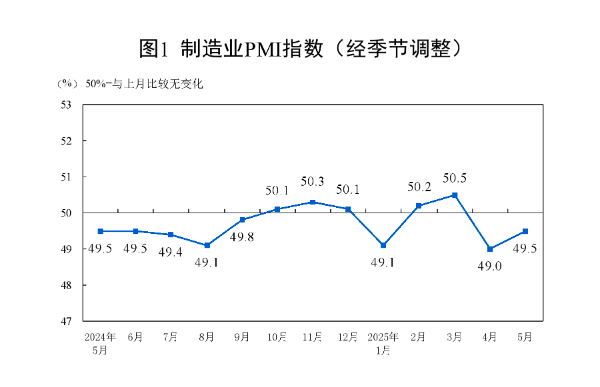
Group 1: Manufacturing Sector - The manufacturing production index increased by over 4 percentage points, reaching above 54%, maintaining above 50% for 10 consecutive months [1] - The manufacturing PMI for May was reported at 49.5%, up 0.5 percentage points from the previous month, indicating a recovery in manufacturing activity [1] - The new export orders index rose to 47.5%, an increase of 2.8 percentage points, suggesting a slowdown in the decline of manufacturing exports [4] - The production index for manufacturing returned to the expansion zone at 50.7%, up 0.9 percentage points from the previous month [5] - Large enterprises reported a PMI of 50.7%, with a production index increase of 1.7 percentage points, indicating a strong recovery in supply and demand [5] Group 2: Non-Manufacturing Sector - The non-manufacturing business activity index was at 50.3%, a slight decrease of 0.1 percentage points, but still indicating expansion [10] - The civil engineering construction industry saw a significant increase in new export orders, with the business activity index rising to over 60% [10] - The telecommunications services business activity index rose to over 60%, reflecting strong demand in the sector [10][11] - The information services sector continues to show growth potential, supported by policy measures and sustained market demand [11]

创新工具支持稳外贸促投资 PSL有望重启扩张
news flash· 2025-05-29 23:29
自4月25日召开的中共中央政治局会议提出"要加紧实施更加积极有为的宏观政策"以来,金融部门快速 响应,在5月集中发布一揽子金融政策支持稳市场稳预期。目前,降准降息、新的结构性货币政策工 具、债券市场"科技板"等政策措施陆续落地。尽管一揽子金融政策举措正在持续发挥政策效能,但考虑 到部分领域的结构性矛盾依然有待解决,新型政策性金融工具仍有出台必要,市场机构预计在二季度落 地。新型政策性金融工具或创新支持稳定外贸和扩大有效投资。在受访专家看来,财政货币政策有望提 供配套支持,通过扩张抵押补充贷款(PSL)和中央财政贴息支持新工具实施。(人民财讯) ...
中信证券:年度级别牛市!
Zhong Guo Ji Jin Bao· 2025-05-28 10:48
Group 1 - The core viewpoint is that China's equity assets are entering an annual-level bull market, expected to begin in Q4 2025, with both fiscal and monetary policies expanding simultaneously in major global economies [1][8] - The capital market ecosystem in China is significantly improving, with increasing attractiveness of Chinese assets, and a more coordinated investment and financing environment is being established [2][3] - The overall economic growth in China is projected to achieve a 5.0% increase in 2025, with macro policies expected to be proactive in supporting this growth [4][5] Group 2 - The strategy for investment should focus on reshaping the Hong Kong and A-share allocation, increasing the proportion of Hong Kong stocks, and returning to core assets, particularly leading companies in emerging and traditional industries [1][8] - Key long-term trends to focus on include the enhancement of China's independent technological capabilities, the reconstruction of European defense, and the acceleration of social security improvements in China to stimulate domestic demand [9] - The timing for entering the market is suggested to be critical around the end of Q3 to Q4, coinciding with the anticipated bull market [1][8]

中信证券:降准降息仍有空间,2025年或再降准50基点
news flash· 2025-05-28 06:12
Group 1 - The core viewpoint of the article is that China's macroeconomic policy will become more proactive, with room for further cuts in reserve requirement ratios and interest rates [1] Group 2 - The event discussed is the opening of the CITIC Securities 2025 Capital Market Forum in Shanghai [1] - The chief economist and FICC chief analyst of CITIC Securities, Mingming, provided insights on the macroeconomic policy direction [1]
经观月度观察| 企业融资和投资需求有待提升 政策组合拳重点激活内生动力
Jing Ji Guan Cha Wang· 2025-05-27 15:24
Core Insights - The macroeconomic policies in China are being intensified to address insufficient domestic demand and increased external shocks, with a focus on enhancing corporate financing needs and investment willingness [2][4][6] CPI - In April 2025, the Consumer Price Index (CPI) rose from -0.7% to -0.1%, aligning with market expectations, primarily due to the impact of tariff policies and falling international oil prices [4] - The core CPI remained low at 0.5%, indicating a weak domestic price level, prompting continued monetary and fiscal policy efforts to stimulate consumption and investment [4] PPI - The Producer Price Index (PPI) fell to -2.7% in April, marking a decline for two consecutive months, influenced by international factors and insufficient domestic demand [6] - The central government has proposed more proactive macro policies to counteract these challenges, including a package of financial policies aimed at boosting domestic demand [6] PMI - The Manufacturing Purchasing Managers' Index (PMI) dropped to 49.0%, indicating a contraction in manufacturing activity, with declines in production and new orders [8] - The non-manufacturing PMI also decreased to 50.4%, reflecting a slowdown in the service and construction sectors [8] Fixed Asset Investment - Fixed asset investment in the first four months of 2025 grew by 4.0% year-on-year, with manufacturing investment contributing significantly to overall growth [12] - Real estate investment showed a larger decline, while infrastructure investment remained stable due to government policy support [12] Credit - New RMB loans in April totaled 280 billion, a decrease of 450 billion year-on-year, with corporate loans being the main drag on credit growth [15] - The decline in consumer loans indicates weak consumer sentiment, while medium to long-term loans are affected by real estate market conditions [15] M2 - The broad money supply (M2) grew by 8.0% in April, reflecting an expansion in monetary supply supported by policy measures [19] - The growth rate of M2 outpaced that of narrow money (M1), indicating limited improvement in corporate liquidity and cautious investment sentiment [19]

华宝期货晨报铝锭-20250527
Hua Bao Qi Huo· 2025-05-27 04:44
Report Summary 1) Report Industry Investment Rating No explicit industry investment rating is provided in the report. 2) Core Views - For building materials, it is expected to have an oscillating and sorting operation. The price center of building materials has been moving downward. In the pattern of weak supply and demand, the market sentiment is also pessimistic, and this year's winter storage is rather sluggish, with weak support for prices [4]. - For aluminum ingots, the price is expected to have a short - term strong - side oscillation. The inventory in the East China region has been decreasing, and holders generally have a strong willingness to hold up prices, but the downstream buying has weakened. In the Central China market, the consumption is showing a weakening trend [4]. 3) Summary by Relevant Catalogs Building Materials - **Production Disruption**: Yunnan - Guizhou region's short - process construction steel enterprises are expected to affect a total of 741,000 tons of construction steel output during the Spring Festival shutdown. In Anhui Province, 6 short - process steel mills have shutdown or will shutdown, with a daily output impact of about 16,200 tons during the shutdown [3][4]. - **Real Estate Transaction**: From December 30, 2024, to January 5, 2025, the total transaction area of newly built commercial housing in 10 key cities was 2.234 million square meters, a 40.3% decrease from the previous period and a 43.2% increase year - on - year [4]. - **Market Performance**: Building materials continued to oscillate downward yesterday, reaching a new low. In the context of weak supply and demand, the market sentiment is pessimistic, and this year's winter storage is sluggish, with weak price support. The view is an oscillating and sorting operation [4]. - **Later Concerns**: Macro - policies and downstream demand [4]. Aluminum Ingots - **Market Performance**: Yesterday, the aluminum price moved within a range. In the East China region, due to the decreasing inventory, holders have a strong willingness to hold up prices, but the downstream buying is weakening, and the market transaction is becoming lighter. In the Central China market, the consumption is showing a weakening trend, and the spot premium is under pressure [4]. - **Inventory Situation**: On May 26, 2025, the inventory of electrolytic aluminum ingots in the mainstream consumption areas in China was 534,000 tons, a decrease of 23,000 tons from last Thursday and 51,000 tons from last Monday. In the short term, the inventory is expected to continue to decrease, but there is an expectation of inventory accumulation in the off - season [4]. - **Industry Operation**: The operating rate of leading aluminum processing enterprises in China decreased slightly by 0.2 percentage points to 61.4% last week, with different trends in each sector [4]. - **Later Concerns**: Changes in macro - expectations, development of geopolitical crises, resumption of production at the mine end, and consumption release [5].
螺纹热卷等成材:逢高空为主 不追空
Sou Hu Cai Jing· 2025-05-27 03:50
【螺纹热卷:成材宜逢高空,勿追空】昨日成材价格弱势,跌破前期低点。前期上涨已消化中美关税利 好,后期需关注抢出口需求增量。国内宏观政策真空,贸易关税暂停,大规模刺激政策推出延迟。螺纹 产量因钢厂复产环比回升,电炉开工及日耗走高,总库存环比下降但降幅收窄,表需数据环比回落受降 雨影响,将入需求淡季预期走弱。热卷产量因钢厂检修环比回落,总库存环比下降压力不大,国内终端 需求上方空间有限,关注出口修复带来的实际需求增量。策略上,成材宜逢高空,勿追空,关注终端需 求。【铁矿石:短期单边宜区间操作】昨日连铁偏弱,09 合约收盘 706.5,跌幅 1.60%,现货市场心态 谨慎观望,港口现货成交回落,近期到港偏低支撑现货价格,基差走强。供应端,二季度中后期外矿发 运季节性增加;需求端,铁水产量连续两期高位回落,本周 SMM 检修影响量 99.21 万吨,环比增加 0.47 万吨,预计近期铁水高位小幅波动。港口库存因到港偏低继续去化。现实层面铁矿石高需求、紧平 衡支撑仍在,边际风险来自铁水高位回落和外矿发运季节性增加,短期单边宜区间操作;中长期若需求 转弱预期兑现,矿价有较大回调空间,继续逢高沽空。【焦煤:作黑链套利空配或 ...
美元再度走弱、中国宏观政策支撑,人民币汇率日内升破7.17
2 1 Shi Ji Jing Ji Bao Dao· 2025-05-26 10:49
Core Viewpoint - The strong performance of the Renminbi (RMB) continues, with both onshore and offshore RMB exchange rates surpassing 7.17, marking the highest level since November 2024 [1][2]. Exchange Rate Performance - As of May 26, the onshore RMB closed at 7.1843, up 52 points from the previous trading day, with an intraday high of 7.1674. The offshore RMB reached a high of 7.1616, averaging 7.17. In May, the onshore RMB rose by 906 basis points, while the offshore RMB increased by over 1,000 points [1]. - The People's Bank of China set the RMB to USD central parity rate at 7.1833 on May 26, a significant increase of 86 points, the largest adjustment since January of this year [1]. Factors Influencing RMB Strength - The recent appreciation of the RMB is attributed to the ongoing depreciation of the US dollar, driven by concerns over the US fiscal health and the impact of proposed tariffs by the Trump administration [2][3]. - Domestic macroeconomic policies, including interest rate cuts and accelerated fiscal spending, have bolstered the resilience of the Chinese economy against external fluctuations, providing internal support for the RMB [2]. Market Dynamics - Analysts note that the appreciation of the RMB is influenced by the strengthening of other Asian currencies, such as the Korean won, and the easing of external depreciation pressures due to positive developments in US-China trade talks [3]. - The narrowing of the exchange rate gap between onshore and offshore RMB indicates strong motivation among overseas institutions to support RMB appreciation [3]. Economic Implications - Continuous RMB appreciation can enhance its attractiveness and reflect market confidence in the Chinese economy, potentially benefiting the stock market. However, it may also reduce the competitiveness of export goods, impacting domestic employment [3]. - Maintaining a stable RMB exchange rate is crucial, with a focus on expanding domestic demand and reducing reliance on exports, as excessive appreciation or depreciation could destabilize the Chinese economic fundamentals [3][4]. Future Outlook - The future trajectory of the RMB will largely depend on the progress of US-China trade negotiations and the performance of the US dollar. The complexity of resolving high tariff issues suggests that RMB fluctuations will continue, but the likelihood of sustained unilateral appreciation is low [4]. - The RMB is expected to experience a dual-directional fluctuation process against the dollar, with relatively smaller amplitude compared to other major currencies, indicating a more stable outlook [4].
税收增速转正折射经济持续恢复
Jing Ji Ri Bao· 2025-05-25 22:08
Economic Performance and Tax Revenue - China's economy is showing a positive trend, providing strong support for tax revenue growth [1][3] - In April, national tax revenue increased by 1.9%, marking the first month of positive growth after a period of decline [1][3] - The growth in tax revenue aligns with improved economic indicators such as industrial added value and retail sales [1] Industry-Specific Tax Revenue - Certain industries, particularly equipment manufacturing, are maintaining strong tax revenue performance, reflecting their robust development [2] - In April, the added value of the equipment manufacturing industry grew by 9.8%, contributing 55.9% to the growth of large-scale industry [2] - Tax policies supporting technological innovation and manufacturing have resulted in significant tax reductions and refunds, totaling 424.1 billion yuan in the first quarter [2] Macroeconomic Policy and Fiscal Measures - The central government is implementing more proactive macroeconomic policies to sustain economic recovery and tax revenue growth [3][4] - Fiscal spending in the first four months of the year has been the fastest since 2020, aimed at boosting economic activity and ensuring livelihood support [3] - Continued emphasis on expanding domestic demand and supporting new productive forces is crucial for maintaining economic stability [3] Fiscal and Tax System Reforms - To promote fiscal revenue growth, reforms in the fiscal and tax system are necessary, particularly to enhance local financial autonomy [4] - There is a focus on improving the efficiency of fund usage and policy effectiveness through better fiscal management practices [4] - The interaction between economic performance and tax revenue is emphasized, with a positive cycle expected as proactive policies are implemented [4]