
货币政策

Search documents
德意志银行邓智杰:年内黄金仍能实现正收益 但价格波动幅度将加大
Sou Hu Cai Jing· 2026-01-26 08:34
Group 1 - The core viewpoint is that gold prices have reached a historical high of over $5100 per ounce, with an annual increase exceeding 18%, driven by rising geopolitical risks and central banks reducing dollar holdings while increasing gold purchases [1] - Deutsche Bank's Chief Investment Officer for Emerging Markets, Deng Zhijie, noted that the interest in gold among investors has surged due to its performance and the current market conditions [1] - Deng expects that gold assets will continue to yield positive returns this year, although price volatility may increase due to speculative trading behaviors [1] Group 2 - Deng highlighted a positive outlook for the global economy, projecting a growth rate of 3% to 3.1% for the year, with global stocks expected to achieve returns of 8% to 10%, particularly in emerging markets [2] - The optimistic return forecast is attributed to relatively loose monetary policies from major economies, including anticipated interest rate cuts by the Federal Reserve, with two cuts of 25 basis points expected this year [2] - The first rate cut is projected to occur after May, with a target interest rate range of approximately 3% to 3.25% for the year [2]

特朗普锁定“超级大咖”接棒鲍威尔,一匹华尔街“灰马”正悄然冲刺
Jin Shi Shu Ju· 2026-01-26 08:26
SHMET 网讯:美国总统特朗普表示,他已经完成了对下一任美联储主席候选人的面试,并重申他 心中已有人选。 "我很快就会告诉你们。我有一个人选,我认为会非常出色,但我不会透露是谁,"特朗普周四对记 者表示。 "这是一位非常受尊敬、非常、非常知名的人士,而且我认为,会做得非常出色,"他补充道。 特朗普的最终候选名单包括国家经济委员会主任凯文·哈塞特(Kevin Hassett)、贝莱德高管里克· 里德尔(Rick Rieder)、现任美联储理事克里斯托弗·沃勒(Christopher Waller)以及前理事凯文·沃什 (Kevin Warsh)。哈塞特一度被视为最热门人选,但特朗普此后已暗示可能更倾向于让他留任白宫职 位。 特朗普提名的央行领导人将接替现任主席鲍威尔,后者的主席任期将于5月结束。特朗普对鲍威尔 一直持高度批评态度,屡次指责他在降息方面行动太慢。 特朗普周三在达沃斯接受CNBC采访时,对于还有多少候选人在考虑之中给出了矛盾的信号。负责 遴选工作的财政部长贝森特曾表示,最终候选名单上有四位竞争者,特朗普可能在本月底前宣布人选。 "我想说我们已经缩减到三人,但又缩减到两人。也许我可以说,在我心里已经 ...
外汇结汇潮,如何影响国内流动性?
Hua Er Jie Jian Wen· 2026-01-26 06:45
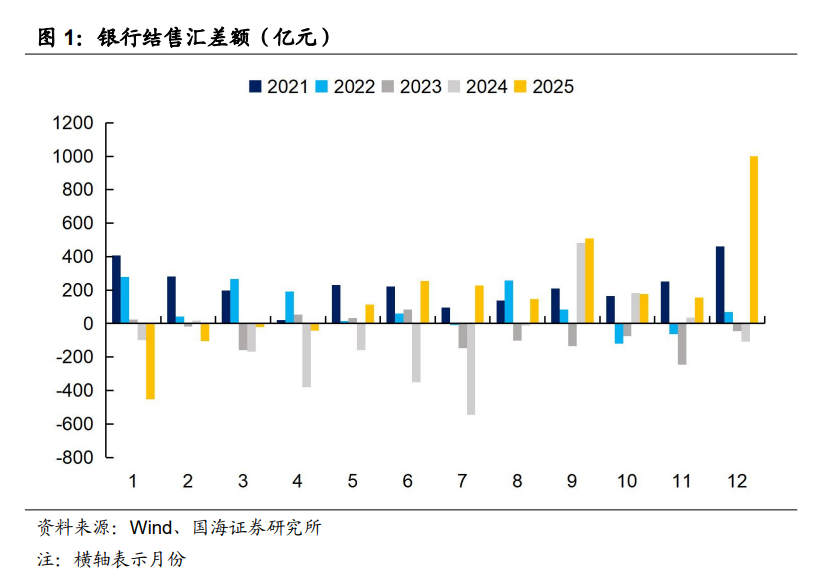
Core Viewpoint - The surge in foreign exchange settlement since 2025 is not indicative of "liquidity injection" into the banking system, but rather a consumption of excess reserves, leading to a temporary liquidity squeeze [1][7][9]. Group 1: Foreign Exchange Settlement Trends - Since 2025, there has been a significant increase in corporate willingness to settle foreign exchange, with the bank's settlement surplus reaching approximately 100 billion yuan at the end of the year, a historical high [3][12]. - The increase in foreign exchange settlement has a certain "money creation" effect, as companies selling foreign exchange to banks increase their RMB deposits, which are counted in M1 [6][12]. Group 2: Impact on Banking Liquidity - Despite the increase in foreign exchange settlement, the overall liquidity in the banking system remains manageable, with the excess reserve ratio in December 2025 being approximately 1.6%, lower than the historical average [7][12]. - The central bank is not expected to passively inject liquidity through foreign exchange reserves to counteract settlement pressures, as this mechanism has been significantly weakened since the 2017 reforms [9][17]. Group 3: Central Bank's Policy Stance - The central bank's recent policy indicates that exchange rates are no longer the primary variable in decision-making, with a focus on domestic economic and financial conditions [17]. - Historical data shows that previous surges in foreign exchange settlement did not lead to monetary policy easing, suggesting that current trends may not trigger similar responses [14][17].

央行连续 11 个月加量操作 MLF;资金面边际收敛,债市震荡调整
Dong Fang Jin Cheng· 2026-01-26 06:40
央行连续 11 个月加量操作 MLF;资金面边际收敛,债市震荡调整 【内容摘要】1 月 22 日,税期走款,资金面边际收敛;债市震荡调整;转债市场主要指数集 体跟涨,转债个券多数上涨;各期限美债收益率走势分化,主要欧洲经济体 10 年期国债收益 率走势分化。 一、债市要闻 (一)国内要闻 【央行行长潘功胜:继续维护好金融市场平稳运行,支持资本市场稳定发展】1 月 22 日,央 行行长潘功胜在接受采访时表示,2026 年,央行将继续实施好适度宽松的货币政策,把促进 经济稳定增长、物价合理回升作为货币政策的重要考量,发挥增量政策和存量政策集成效应, 为经济稳定增长、高质量发展和金融市场稳定运行营造良好的货币金融环境,为实现"十五五" 良好开局提供有力的金融支撑。潘功胜谈到,总量政策方面,灵活高效运用降准降息等多种货 币政策工具,保持流动性充裕,使社会融资规模、货币供应量增长同经济增长、价格总水平预 期目标相匹配。今年降准降息还有一定的空间。央行还将做好利率政策执行和监督,促进社会 综合融资成本低位运行。结构性政策方面,央行已在今年年初先行出台一批货币金融政策,对 结构性货币政策工具的政策要素作了优化完善。 【央行 ...
国债周报:债期超长端温和修复-20260126
Guo Mao Qi Huo· 2026-01-26 05:09
1. Report Industry Investment Rating - No relevant information provided in the content 2. Core Viewpoints - Last week, the Treasury bond futures market showed an oscillating upward trend, with ultra - long - term varieties performing particularly prominently. The main drivers for the bond market's strength this week were allocation demand and foreign capital inflows. The central bank's large - scale liquidity injection and the indication of a moderately loose monetary policy also provided support [4]. - In the short term, the Treasury bond futures market is expected to continue the oscillating pattern, and it is difficult to form a unilateral trend. In the long term, the bond market's trend will depend on the sustainability of economic recovery, the actual strength of fiscal policy, and the future direction of monetary policy [6]. 3. Summary by Relevant Catalogs 3.1 Part One: Main Viewpoints - **Market Performance**: The Treasury bond futures market showed an oscillating upward trend last week, with ultra - long - term varieties standing out. At the beginning of the week, there was obvious market differentiation, but the 30 - year Treasury bond futures gradually strengthened in the following three trading days, and all contracts closed up on Friday [4]. - **Driving Factors**: The main reasons for the bond market's strength were the continuous allocation demand for long - term interest - rate bonds from institutions such as banks and insurance companies, and the inflow of overseas hedging funds. The central bank's indication of a moderately loose monetary policy and a large - scale liquidity injection also played a role [4]. - **Market Outlook**: In the short term, the market is expected to oscillate, with multiple long and short factors at play. In the long term, the bond market's trend will be affected by economic recovery, fiscal policy, and monetary policy [6]. 3.2 Part Two: Liquidity Tracking - The content includes a large number of charts related to liquidity, such as open - market operations (including currency投放, currency回笼, and net投放), medium - term lending facilities (in terms of quantity and price), various interest rates (reverse repurchase rate, deposit - based pledge - style repurchase rate, SHIBOR, etc.), LPR, deposit reserve ratio, Treasury bond yields, and US Treasury bond yields [10][11][13] 3.3 Part Three: Treasury Bond Futures Arbitrage Indicator Tracking - The report tracks various arbitrage indicators of Treasury bond futures, including basis, net basis, IRR, and implied interest rate for 2 - year, 5 - year, 10 - year, and 30 - year Treasury bond futures [41][42][44]
【UNFX财经事件】多重宏观风险集中释放 黄金突破历史关口加速上行
Sou Hu Cai Jing· 2026-01-26 03:54
政策层面,美联储即将结束本周的议息会议。市场普遍预期政策利率将维持不变,但投资者的关注焦点 已明显从"是否调整利率"转向政策沟通与前瞻指引本身。一方面,交易层面对2026年后货币政策再度转 向宽松的定价仍未完全消退;另一方面,美联储主席鲍威尔在央行独立性问题上的立场,以及对未来数 据路径的判断,将直接影响利率预期的再定价节奏。机构普遍认为,短期内降息条件尚不充分,但政策 不确定性本身已构成对黄金的重要支撑。在低利率环境延续的背景下,无收益资产的持有成本优势依然 存在,这也是金价能够在高位维持强势的重要原因之一。 UNFX 1 月 26 日讯 随着全球风险偏好再度趋紧,黄金市场的多头动能明显增强。周一亚洲交易时段, 现货黄金强势突破5000美元/盎司这一重要心理关口后延续上行,盘中一度触及5085美元,价格运行区 间被整体抬升,刷新历史高位区间。从阶段性节奏来看,金价延续了上周以来的强势结构。上周黄金累 计涨幅超过8%,年初至今的涨幅已接近20%。在数月时间内先后跨越4000美元与5000美元两大整数关 口,价格运行斜率显著上移,反映出市场对避险资产的配置需求仍在持续强化。 近期金价快速走高的核心驱动,仍指向地 ...
陆家嘴财经早餐2026年1月23日星期五
Sou Hu Cai Jing· 2026-01-26 03:06
Monetary Policy and Economic Measures - The central bank governor Pan Gongsheng stated that a moderately loose monetary policy will continue in 2026, utilizing various tools such as reserve requirement ratio cuts and interest rate reductions to maintain ample liquidity [1] - The first batch of 936 billion yuan of ultra-long special government bonds has been allocated to support equipment renewal across various sectors, expected to drive total investment exceeding 460 billion yuan [2] - The central bank will conduct a 900 billion yuan MLF operation on January 23, net injecting 700 billion yuan into the market, marking the 11th consecutive month of increased operations [2] Consumer and Investment Trends - The six major state-owned banks collectively announced the implementation of personal consumption loan interest subsidy policies, allowing some high-quality clients to enjoy effective interest rates as low as 2%, even lower than current housing loan rates [1] - Public funds have focused their fourth-quarter 2025 positions on core sectors such as electronics and power equipment, with Zhongji Xuchuang becoming the largest holding stock [1] Market Performance - The A-share market saw a slight increase, with the Shanghai Composite Index rising 0.14% to 4122.58 points, and the Shenzhen Component Index increasing by 0.5% [3] - The Hong Kong stock market also experienced minor fluctuations, with the Hang Seng Index rising 0.17% to 26629.96 points, while southbound funds recorded a net purchase of 5.166 billion HKD [3] Corporate Developments - Alibaba Group has decided to support its chip subsidiary "Pingtouge" for independent listing, with plans for restructuring to establish it as a mixed-ownership enterprise [4] - Blue Arrow Aerospace's IPO status has changed to "inquired," aiming to raise 7.5 billion yuan to become the "first stock in commercial aerospace" [4] - Yuanqi Forest is reportedly considering a Hong Kong listing, although the company has stated there are currently no IPO plans [4] Regulatory and Policy Updates - The State Administration for Market Regulation has issued a red card for the first time in the public utility sector, prohibiting a merger case involving gas companies in Foshan [7] - Nine departments jointly issued opinions to promote high-quality development in the pharmaceutical retail industry, encouraging mergers and acquisitions among retail pharmacies [7] - The Ministry of Civil Affairs and the Ministry of Finance announced a subsidy program for elderly individuals with moderate to severe disabilities, set to be implemented nationwide starting January 1, 2026 [2]

一周流动性观察 | 跨月周政府债缴款升至5000+亿元 预计资金利率难以继续显著上行
Xin Hua Cai Jing· 2026-01-26 02:54
Core Viewpoint - The People's Bank of China (PBOC) is actively managing liquidity through various monetary policy tools, including reverse repos and medium-term lending facilities (MLF), to ensure stable financial conditions amid tax period fluctuations and economic growth expectations [1][2][3][4]. Group 1: Monetary Policy Operations - On January 26, the PBOC conducted a 150.5 billion yuan 7-day reverse repo operation at an interest rate of 1.40%, maintaining the previous rate [1]. - The PBOC's net withdrawal from the open market was 207.8 billion yuan, considering the maturity of 2 billion yuan in 1-year MLF and 158.3 billion yuan in 7-day reverse repos [1]. - Last week, the PBOC's reverse repo operations resulted in a net injection of 229.5 billion yuan, with a significant 9 billion yuan MLF operation on January 23 [2]. Group 2: Market Liquidity and Interest Rates - The liquidity environment faced pressure during the tax period, with overnight rates (R001) rising by 11 basis points to 1.48%, while the 7-day rate (R007) remained relatively stable [2]. - After the tax period, liquidity conditions improved, leading to a slight decline in both R001 and R007 rates, which closed at 1.47% and 1.54%, respectively [2]. - The upcoming week will see a total of 1,181 billion yuan in 7-day reverse repos maturing, with additional MLF maturities, indicating potential liquidity challenges [2]. Group 3: Economic Outlook and Policy Implications - Analysts suggest that the PBOC's actions, including a net injection of 1 trillion yuan through MLF and reverse repos, are akin to a 0.5 percentage point reserve requirement cut [3]. - The Loan Prime Rate (LPR) has remained unchanged for eight consecutive months, reflecting stable economic conditions influenced by strong exports and growth in high-tech manufacturing [3]. - The central government's focus on expanding domestic demand and implementing proactive fiscal policies is expected to support economic growth, with GDP growth projected to rebound to around 4.7% in Q1 2026 [4].
中国每周前瞻:市场微跌 1%;四季度 GDP 符合预期,12 月经济数据喜忧参半-China Weekly Kickstart_ Markets edged down 1%; Q4 GDP in line with expectations amid mixed December activity data
2026-01-26 02:49
24 January 2026 | 12:02AM HKT Portfolio Strategy Research CHINA WEEKLY KICKSTART Markets edged down 1%; Q4 GDP in line with expectations amid mixed December activity data MXCN/CSI300 both edged down by 0.6% this week. Vice Premier He Lifeng delivered a keynote speech at the World Economic Forum in Davos on Jan 20. MoF hosted a press conference on Jan 20 and reiterated its commitment to maintaining proactive fiscal policy in 2026. CSRC released Guidelines for performance benchmarks of mutual funds, effective ...
铝产业链周度报告-20260126
Zhong Hang Qi Huo· 2026-01-26 02:34
1. Report Industry Investment Rating No information provided. 2. Core Viewpoints of the Report - Aluminum prices are expected to continue high - level volatility in the short term, but there is still support in the long - term fundamentals [53]. - The aluminum alloy price will follow the electrolytic aluminum price and may experience high - level shock adjustment [50]. 3. Summary According to the Table of Contents 3.1 Report Summary - The report analyzes the aluminum industry from multiple aspects, including economic data at home and abroad, supply and demand of raw materials, production and inventory of aluminum products, and downstream consumption. It points out that the aluminum market is affected by various factors, with short - term price fluctuations and long - term positive fundamentals [53]. 3.2 Multi - empty Focus - **Bullish factors**: Stable operation of domestic electrolytic aluminum production capacity and high enthusiasm of precious metal funds [8]. - **Bearish factors**: Continuous accumulation of social inventory, further weakening of consumption near the Spring Festival, and accumulation of inventories in domestic and foreign exchanges [8]. 3.3 Data Analysis - **Macroeconomic data**: In the US, the GDP in Q3 2025 had an annualized quarter - on - quarter growth of 4.4%, the core PCE price index in November increased moderately, and the number of initial jobless claims was 200,000. In China, the GDP in 2025 increased by 5% year - on - year, and the central bank will continue to implement a moderately loose monetary policy [11][14]. - **Raw material supply**: Domestic bauxite supply is tight, with a 4.21% year - on - year increase in cumulative output from January to November 2025, but a 5.26% year - on - year decline in November. Overseas bauxite supply may be relatively loose, with China's imports in December 2025 reaching 14.67 million tons, and Guinea's supply stabilizing [16][19]. - **Alumina production**: In 2025, domestic alumina added 9.8 million tons of new capacity, and it is expected to add 8.6 million tons in 2026. The supply surplus will exceed 10 million tons. Overseas, 8.5 million tons of new capacity is planned from 2025 - 2026, with 5.5 million tons expected in 2026 [23]. - **Electrolytic aluminum production**: In December 2025, domestic electrolytic aluminum production increased by 1.9% year - on - year, and the aluminum - water ratio decreased by 0.8 percentage points to 76.5%. At the end of December, the national electrolytic aluminum operating capacity increased by 383,000 tons month - on - month [26]. - **Downstream processing**: The average weekly operating rate of downstream processing enterprises increased by 0.2% to 60.2% due to pre - Spring Festival stocking. The operating rate of aluminum wire and cable remained stable at 59.6%, aluminum plate and strip increased by 1% to 66%, aluminum foil increased by 0.7% to 71.4%, and aluminum profiles decreased by 0.9% to 47.9%. The operating rate of recycled aluminum alloy remained stable at 58% [28]. - **Inventory situation**: LME aluminum inventory accumulated to 509,275 tons, and SHFE aluminum inventory increased by 29.23% to 185,879 tons in the week of January 16. As of January 19, the social inventory of electrolytic aluminum in major Chinese markets was 764,000 tons, an increase of 15,000 tons from last Thursday [34][37]. - **Price situation**: On January 19, the average price premium of Shanghai Wumaotrade aluminum was - 160 yuan/ton, and the LME aluminum 0 - 3 premium was 18.98 US dollars/ton, with both premium ranges expanding [39]. - **Recycled aluminum**: In December 2025, domestic recycled aluminum alloy ingot production decreased by 41,800 tons month - on - month. Small and medium - sized aluminum plants faced difficulties in raw material procurement, and the operating rate of small enterprises was only 12.74%. As of January 15, the operating rate of the recycled aluminum alloy industry was 58%, remaining flat week - on - week [41][42]. - **Aluminum alloy inventory**: As of January 23, the weekly social inventory of Chinese aluminum alloy was 67,000 tons, a decrease of 2,300 tons from last week, and the in - plant inventory was 65,100 tons, an increase of 4,900 tons from last week [46]. 3.4后市研判 - Aluminum prices are expected to continue high - level volatility in the short term, but the long - term fundamentals are positive with support [53].