
财政政策

Search documents
野村全球宏观主管Rob Subbaraman:美国滞胀风险或再现
Zhong Guo Ji Jin Bao· 2025-07-17 09:56
Core Viewpoint - The risk of stagflation in the U.S. economy is re-emerging, with inflation expected to rise and economic growth to slow down in the second half of the year [1][2]. Group 1: Inflation Drivers - Tariff impacts are not fully realized yet, as U.S. companies imported heavily in Q1 to avoid high tariffs, leading to high inventories. Once these inventories are depleted, companies will have to resume imports, likely passing tariff costs onto consumers [2]. - Immigration policies have tightened, leading to labor shortages in key sectors such as construction, agriculture, and elder care, which may push up wage levels and contribute to inflationary pressures [2]. - Moderate fiscal policy expansion is anticipated to contribute 0.4 to 0.5 percentage points to GDP growth over the next 12 months, increasing inflation risks [2]. Group 2: Economic Growth Projections - U.S. GDP growth is projected to be below trend levels, with estimates of 1.3% for this year and 1.2% for next year [3]. Group 3: Long-term Fiscal Concerns - The rapid passage of the "Big and Beautiful" bill, which makes the temporary personal income tax cuts from 2017 permanent, is expected to increase the budget deficit by over $3 trillion over the next decade. This is unusual given the already low unemployment rate [5]. - The U.S. budget deficit is projected to remain above 6% of GDP in the coming years, with government debt reaching about 100% of GDP, and interest payments consuming 3% to 4% of GDP, which is unsustainable [5]. - Changes in the buyer structure of U.S. debt, with reduced purchases from foreign central banks and increased sensitivity from private investors, may lead to greater volatility in bond yields [5]. Group 4: Global Economic Outlook - Other regions are expected to experience slower growth but easing inflation, providing more room for central banks to cut rates. Asian exports are anticipated to decline further in the second half of the year, while Germany's fiscal and infrastructure spending may take time to support economic growth [6]. Group 5: Currency and Monetary Policy - The Nomura team holds a "soft dollar" stance due to stagflation pressures in the U.S., despite current interest rate differentials favoring the U.S. The dollar is considered significantly overvalued, and the persistent trade deficit may limit its performance [7]. - Concerns about the potential appointment of a "shadow Fed chair" by Trump could add uncertainty to monetary policy, as this individual might influence market expectations and complicate the current Fed chair's policy-making [8].
财政政策或加码?日本参院选举,五大不确定性下的政策变局
Hua Er Jie Jian Wen· 2025-07-17 09:20
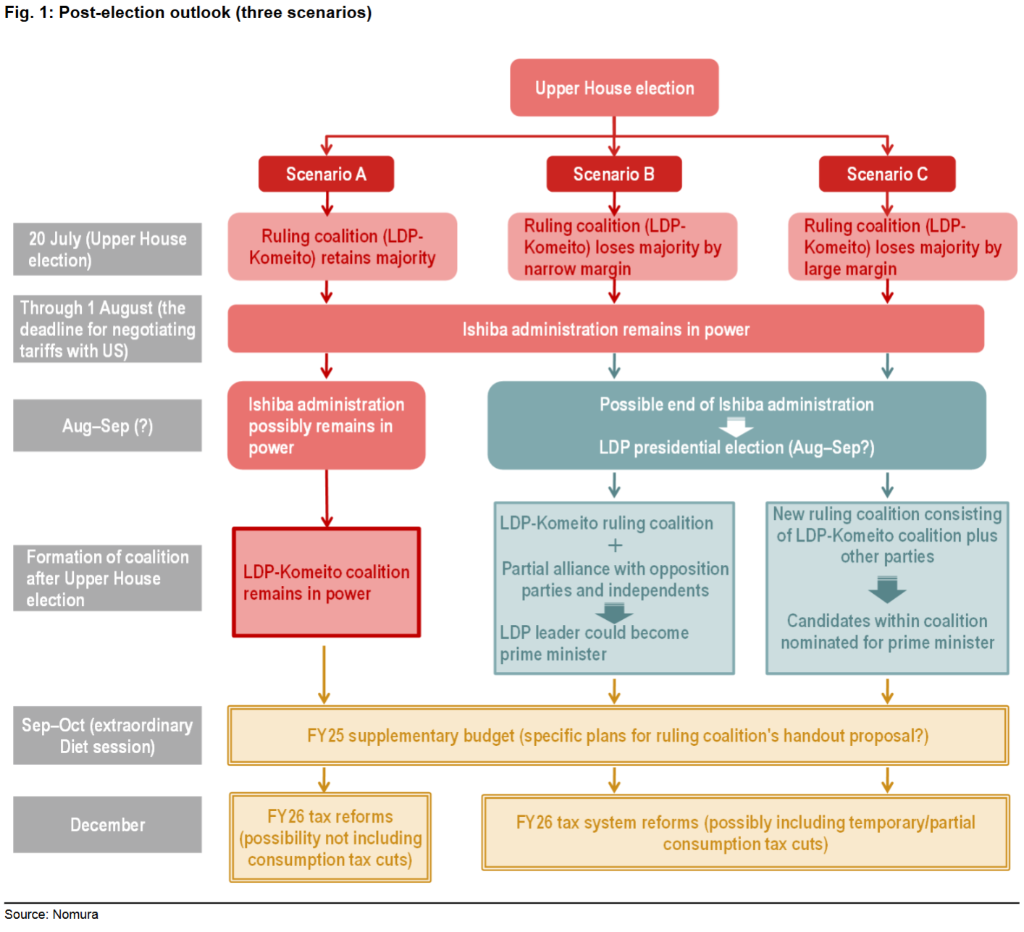
Core Viewpoint - The upcoming Japanese Senate election poses significant challenges for the ruling coalition, which must secure at least 50 additional seats to maintain a majority in the Senate [1][2]. Group 1: Election Context - The ruling coalition, consisting of the Liberal Democratic Party (LDP) and Komeito, currently holds 75 non-renewable seats in the Senate and needs to win 50 more to maintain a majority [1]. - The election outcome could lead to various fiscal policies, including cash handouts and potential consumption tax cuts, depending on the coalition's performance [2][3]. Group 2: Possible Scenarios - Scenario A: The ruling coalition retains a majority, increasing the likelihood of cash handouts being included in the 2025 supplementary budget, but no consumption tax cuts in the 2026 tax reform proposal [2]. - Scenario B: The ruling coalition slightly loses its majority, leading to potential alliances with opposition parties, which may result in both cash handouts and temporary consumption tax cuts [3]. - Scenario C: A significant loss of majority may force the ruling coalition to include opposition parties, facing pressure for both cash handouts and consumption tax cuts [4]. Group 3: Economic Impact - The cash handout policy, amounting to approximately ¥3.5 trillion (about 0.6% of GDP), is expected to have limited impact on economic growth, with only a projected 0.2% increase in private consumption and 0.1% in GDP [7][9]. - In contrast, a reduction in the food consumption tax from 8% to 0% could lead to a more substantial GDP growth of about 0.5% due to a decrease in the effective consumption tax rate [9]. - Analysts warn that temporary consumption tax cuts may lead to a significant GDP decline of 6% in Q2 2027 when these measures expire, potentially prompting political pressure to extend them [12]. Group 4: Monetary Policy Outlook - Despite uncertainties surrounding the election, expectations remain that the Bank of Japan will raise interest rates in January 2026, maintaining the policy rate unchanged for the remainder of the fiscal year [13].

如何看二季度经济韧性和六月内需波动
2025-07-16 15:25
Summary of Conference Call Records Industry Overview - The conference call discusses the performance of the Chinese economy in Q2 2025, highlighting a strong GDP growth of 5.3% year-on-year, surpassing market expectations. Despite fluctuations in internal demand in June, the overall economic resilience remains strong. [2][12] - Structural pressures are evident, including a widening decline in the GDP deflator index, a decrease in nominal GDP growth, and a continued downward trend in industrial capacity utilization. [2][12] Key Points on Economic Performance - Q2 GDP growth was stable, aligning with the seven-year average, supported by internal demand. However, the retail sales of consumer goods fell in June, particularly in the restaurant sector, influenced by seasonal and non-market factors. [1][2] - Despite a slowdown in disposable income growth, consumer spending remained stable, indicating a recovery in consumer willingness. [6] - The real estate sector showed signs of stabilization, with improved funding sources for property companies and a decrease in unsold inventory, despite a larger decline in sales area and weakened investment growth. [7][8] Investment Trends - Overall investment in June showed a significant slowdown across real estate, manufacturing, and infrastructure, but equipment renewal investments increased against the trend. [9] - The government’s fiscal policy is expected to moderately support infrastructure investments in the second half of the year, with a notable increase in bond issuance in the first half. [10] - Manufacturing investment experienced a decline due to tariff impacts and subjective regulatory influences, although high-end manufacturing sectors continued to show strong growth. [11] Consumer Behavior and Retail Sales - June saw a notable decline in retail sales, particularly in the restaurant sector, but essential goods maintained resilience with a year-on-year growth rate above 5%. [5] - The consumer demand remained strong in essential goods, home appliances, communication equipment, and sports entertainment products, reflecting structural changes in consumption patterns. [5] Future Outlook - The internal demand is expected to recover gradually, supported by new policies and the implementation of existing measures, despite the observed fluctuations. [12] - The second half of the year may face external pressures, including potential tariff increases and cooling export demand, necessitating careful monitoring of economic conditions and policy responses. [12][13]
惠誉:财政政策是日本信用评级的主要风险
news flash· 2025-07-16 08:17
Core Viewpoint - Fitch Ratings has identified fiscal policy as a major risk factor for Japan's credit rating, particularly with the upcoming Senate elections and increasing calls for significant fiscal spending and tax cuts [1] Fiscal Policy Risks - Analysts note a trend of increasingly loose fiscal policy in Japan, with the government implementing subsidies and other measures to alleviate inflation's impact on households [1] - Recent polling suggests that this trend may strengthen post-election, raising concerns about the potential for tax cuts without accompanying policies to boost economic growth [1] - If Japan proceeds with tax cuts without significant economic growth, it could lead to an expansion of fiscal deficits and accelerate debt growth, putting pressure on the credit rating [1] Current Credit Rating - Fitch currently rates Japan's sovereign credit at "A," which is five levels below the highest rating of "AAA," with a stable outlook [1]
瑞银张宁:上调2025年中国GDP增速预测
news flash· 2025-07-16 04:12
Core Viewpoint - UBS has raised its GDP growth forecast for China in 2025, citing strong performance in Q2 2023 and expected government support measures [1] Economic Performance - China's GDP grew by 5.2% year-on-year in Q2 2023, indicating robust economic performance [1] - The growth was supported by improved retail sales due to "trade-in" subsidies and steady export growth [1] Government Policy Expectations - The government is expected to implement the remaining parts of the annual broad fiscal plan in the second half of the year, including planned trade-in subsidies [1] - A reduction in policy interest rates by 20 to 30 basis points is anticipated in the second half of the year, along with additional measures to promote real estate inventory reduction [1] Future Projections - Additional policy support measures may depend on economic data, with new fiscal policies potentially being introduced by the end of Q3 or in Q4 [1] - Overall, the GDP growth forecast for 2025 has been revised upward due to strong export resilience, low base effects from trade-in subsidy policies, early issuance of government bonds, and planned policy support measures [1] Inflation and Currency Outlook - CPI pressure is expected to rise slightly in the second half of the year, while the RMB may strengthen in the short term [1] - External uncertainties could lead to the RMB/USD exchange rate reaching 7.1 to 7.2 by the end of 2025 [1]

明明:财政、金融政策发力助上半年中国经济温和回升
Zhong Guo Xin Wen Wang· 2025-07-15 09:41
Core Viewpoint - The Chinese economy showed a moderate recovery in the first half of 2025, achieving a growth rate of 5.3%, supported by proactive fiscal and monetary policies [1][3]. Fiscal Policy - The fiscal policy has become more aggressive, with the issuance of special government bonds increasing from 1 trillion yuan to 1.3 trillion yuan, and the support for the trade-in program doubling from 150 billion yuan to 300 billion yuan [3]. - New special bonds amounting to 4.4 trillion yuan are expected to focus primarily on real estate acquisition [3]. - The government has maintained a high utilization rate of public fiscal deficits in the first quarter, indicating a continued expansion of fiscal spending [3]. Monetary Policy - Short-term interest rates have been lowered, with market interest rates declining more than benchmark rates since the second half of the first quarter [3]. - A series of financial support policies, including reserve requirement ratio cuts and interest rate reductions, have been implemented since May 7, which are expected to boost credit expansion and demand [3]. Consumption Sector - The consumption sector has seen a rebound in retail sales growth, driven by the trade-in policy, particularly in automobiles, home appliances, and digital products [4]. Manufacturing Sector - The industrial added value for large-scale enterprises grew by 6.4% year-on-year, with equipment manufacturing and high-tech manufacturing increasing by 10.2% and 9.5%, respectively [5]. - Manufacturing investment is projected to grow by approximately 8.4% in 2025, supported by policies aimed at enhancing new productive forces and equipment upgrades [5]. Future Outlook - The government is expected to implement expansionary policies in the second half of the year to support growth, particularly in weak areas such as real estate, services, and consumption [5]. - There is strong confidence in achieving a GDP growth rate of over 5% for the year, given the positive results from the first half [6].

日本选举临近国债动荡加剧 市场担忧英国特拉斯式冲击
news flash· 2025-07-15 09:41
Core Viewpoint - The potential defeat of the ruling party coalition in Japan's upcoming election raises concerns about fiscal policy, leading to fears of a market impact similar to the UK's "Liz Truss moment" [1] Group 1: Market Impact - The Japanese bond market may face significant turmoil due to heightened concerns over fiscal conditions [1] - The yield on 20-year and longer-term Japanese government bonds has increased by at least 20 basis points this month [1] Group 2: Historical Context - The situation draws parallels to the brief chaos in the UK bond market following former Prime Minister Liz Truss's proposed tax cuts three years ago [1]
6月金融数据点评:关注实体经济融资需求向好的持续性
Bank of China Securities· 2025-07-15 02:15
Group 1: Financial Data Overview - In June, new social financing (社融) reached 4.20 trillion yuan, exceeding the expected 3.71 trillion yuan by 13.2%[2] - The year-on-year increase in social financing was 900.8 billion yuan, marking a 27.3% rise compared to the same month last year[2] - New RMB loans in June amounted to 2.36 trillion yuan, an increase of 171 billion yuan year-on-year[2] Group 2: Monetary Supply and Trends - M2 growth was 8.3% year-on-year, up 0.4 percentage points from May[2] - M1 growth was 4.6%, showing a significant increase of 2.3 percentage points from the previous month[2] - M0 growth was 12.0%, slightly down by 0.1 percentage points from May[2] Group 3: Loan and Deposit Dynamics - New deposits totaled 3.21 trillion yuan, with household deposits contributing 2.47 trillion yuan, an increase of 330 billion yuan year-on-year[2] - New loans from financial institutions reached 2.24 trillion yuan, with corporate loans accounting for 1.77 trillion yuan, reflecting a positive trend[2] - The increase in short-term loans and bills was particularly notable, indicating a response to short-term export demands[2] Group 4: Economic Outlook and Risks - The report highlights the potential for continued monetary easing in the second half of the year due to external pressures from U.S. tariff policies[2] - Risks include a potential rise in global inflation and a rapid slowdown in the economies of Europe and the U.S.[2]
凯投宏观:美英债市波动揭示人物与政策对投资者同等关键
news flash· 2025-07-14 14:54
Core Insights - Recent volatility in the U.S. and U.K. sovereign bond markets highlights the critical importance of both personnel and fiscal policy for investors [1] Group 1: U.K. Bond Market - The U.K. bond market faces risks due to the potential replacement of Chancellor of the Exchequer, Reeves, by someone less committed to fiscal rules [1] Group 2: U.S. Bond Market - In the U.S., fiscal stability may hinge on Treasury Secretary Yellen's ability to maintain influence over President Trump and secure his favor [1] Group 3: Investor Concerns - Over the past few months, both U.S. Treasuries and U.K. bonds have experienced significant sell-offs as investors express concerns over fiscal sustainability [1]
分析师:欧元年底很可能会大幅走弱
news flash· 2025-07-14 14:13
Core Viewpoint - The euro is likely to weaken significantly by the end of the year due to underwhelming economic growth in the Eurozone, despite current market expectations being more favorable than those for the U.S. economy [1] Economic Growth Expectations - Market expectations for Eurozone growth are currently better than those for the U.S. [1] - The company anticipates that even if the U.S. does not impose the proposed 30% tariffs on EU imports, these growth expectations will still not be met [1] Fiscal Policy Impact - The company believes that loose fiscal policies will boost economic growth in Germany [1] - However, the overall impact of fiscal policy on the Eurozone is expected to be neutral [1] Tariff Effects - The macroeconomic research firm predicts that the impact of tariffs on U.S. economic growth will be relatively mild [1]