
货币政策

Search documents
日本央行:维持利率不变
Jin Rong Shi Bao· 2026-01-23 08:22
Core Viewpoint - The Bank of Japan (BOJ) decided to maintain the policy interest rate at 0.75%, aligning with market expectations, while one member voted against this decision, advocating for an increase to 1.0% due to achieved price stability and rising inflation risks from overseas economic recovery [1][2]. Group 1: Monetary Policy Decision - The BOJ's decision was passed with an 8 to 1 vote, with dissent from member Takeda, who argued for a rate hike based on the current economic conditions [1]. - The BOJ indicated that it would continue to raise policy rates if economic and price trends align with its forecasts, highlighting a balanced risk outlook for both economic and inflation prospects [1]. Group 2: Economic and Inflation Risks - The BOJ noted uncertainties in the global economic outlook, particularly regarding trade policies that could increase import prices and impact supply chains [2]. - The IMF has warned that Japan's debt-to-GDP ratio exceeds safe limits, raising concerns about potential debt default risks, especially with the upcoming elections possibly leading to more expansionary fiscal policies [2]. Group 3: Market Reactions - Following the BOJ's announcement, Japanese government bond yields surged, with 5-year, 30-year, and 40-year bonds reaching historical highs, while the 10-year bond yield was reported at 2.239% [2]. - The market is closely monitoring the upcoming press conference by BOJ Governor Ueda, which may influence the yen's exchange rate and provide insights into future monetary policy directions [1].
日本央行决定将政策利率维持在0.75%不变
日经中文网· 2026-01-23 07:45
Group 1 - The Bank of Japan decided to maintain the target uncollateralized overnight call rate at 0.75% during the monetary policy meeting on January 23, indicating a cautious approach to interest rate adjustments while observing their impact on the economy and prices [2][4] - The Bank of Japan has raised its economic growth and consumer price inflation forecasts for the fiscal year 2026, considering government economic measures and ongoing wage increases [2] - Among the nine policy board members, member Takeda expressed that the price stability target has been largely achieved and proposed raising the policy rate to 1.0% due to high inflation risks amid a recovering global economy, but this proposal was rejected by a majority vote [4]


央行将开展9000亿元MLF操作,有效应对春节前流动性波动
Huan Qiu Wang· 2026-01-23 07:30
Group 1 - The People's Bank of China (PBOC) announced a 900 billion yuan Medium-term Lending Facility (MLF) operation to maintain ample liquidity in the banking system, with a one-year term and a fixed quantity, interest rate bidding, and multiple price bidding method [1] - This operation follows the maturity of 200 billion yuan MLF this month, resulting in a net injection of 700 billion yuan, significantly increasing the scale of liquidity provision [1] - The total net liquidity injection for January is projected to reach 1 trillion yuan, exceeding previous levels, as the central bank aims to address seasonal funding demand fluctuations ahead of the Spring Festival [1][2] Group 2 - The upcoming issuance of local government bonds and the continued support from policy financial tools are expected to drive significant loan disbursements [2] - Experts suggest that the PBOC's decision to increase MLF is a reasonable choice to address pre-holiday liquidity fluctuations, serving as a substitute for potential reserve requirement ratio (RRR) cuts [2][4] - The monetary policy is expected to maintain a supportive stance, utilizing various open market operation tools to ensure reasonable liquidity levels for smooth government bond issuance [2] Group 3 - Analysts indicate that the PBOC's expanded MLF operation effectively mitigates potential liquidity tightening and stabilizes the funding environment, supporting major project financing and government bond issuance [4] - There is still room for RRR cuts and interest rate reductions in 2026, but timing and pace are crucial, with a lower likelihood of immediate implementation due to current market conditions [5] - The central bank is expected to flexibly conduct government bond transactions and maintain liquidity while ensuring a smooth transmission of interest rates from short to long [5]
——2026年1月23日利率债观察:如何看待近期DR001的上行?
EBSCN· 2026-01-23 07:10
Group 1: Report Industry Investment Rating - There is no information provided regarding the report industry investment rating in the given content. Group 2: Report Core Viewpoints - There is no need to worry about the so - called "interest rate hike" of DR001 recently. "Guiding the overnight interest rate to operate around the policy interest rate" does not mean guiding the average of the overnight interest rate to be exactly equal to the policy interest rate, and the 1.35% DR001 in the second half of 2025 can be considered to be operating around the policy interest rate [1][11]. - The statement of "guiding the overnight interest rate to operate around the policy interest rate" is not contradictory to the previous statement of "guiding short - term money market interest rates to operate around the policy interest rate center" because they describe different objects and states. Since the second half of 2025, the average of DR001 and DR007 is 1.42%, only deviating from the policy interest rate by 2bp, which is an embodiment of "operating around the policy interest rate center" [2][11]. - The recent increase in DR001 is not high. The value on January 22, 2026, is only at the 86% quantile level since the second half of 2025, and DR001 also has a law of rising in the second half of the month. The recent increase is just a return to the "normal" level [3][13]. - If the deviation of DR001 from the policy interest rate is limited within a period, it indicates that it is in the "around mode", and it is not advisable to over - interpret the normal fluctuations of DR or rely on the short - term changes of DR to judge the attitude of monetary policy [4][16]. Group 3: Summary by Related Catalogs 1. Is DR001 going to have an "interest rate hike"? - Some investors are worried that the average of DR001 will rise and approach 1.4% because the average of DR001 in the second half of 2025 was 1.35%, lower than the 7D OMO rate of 1.4%, and the average of DR001 since mid - January 2026 has been significantly higher than before [1][9]. - There is no need to worry. The statement of "guiding the overnight interest rate to operate around the policy interest rate" does not mean guiding the average of the overnight interest rate to be exactly equal to the policy interest rate, and it is consistent with the previous statement of "guiding short - term money market interest rates to operate around the policy interest rate center" [1][2]. 2. How to view the recent increase in DR001? - On January 22, 2026, DR001 reached 1.42%, the highest since early December 2025, but it is only at the 86% quantile level since the second half of 2025, and DR001 has a law of rising in the second half of the month [3][13]. - Comparing the average of DR001 from the beginning of the month to the 22nd in several months, the value in December 2025 was relatively low, and the recent increase is a return to the "normal" level [3][13]. - The monthly average of DR001 in the second half of 2025 did not differ much, and most months were around 1.37%, close to the policy interest rate. In the "around mode", it is not advisable to over - interpret the normal fluctuations of DR or rely on short - term changes to judge monetary policy [4][16].
邦达亚洲:会议纪要偏向鹰派 欧元小幅收涨
Xin Lang Cai Jing· 2026-01-23 06:42
Group 1: European Central Bank (ECB) Decisions - The ECB decided to maintain interest rates unchanged during the December 17-18 meeting, indicating that the current monetary policy stance is in a "good state" to balance economic support and inflation control [1][6] - The ECB emphasized its flexibility to adjust interest rates up or down in response to changes in economic and inflation outlooks [1][6] - The ECB raised its GDP growth forecasts for 2025 and 2026 by 0.2 percentage points, despite global trade challenges [1][6] Group 2: UK Government Borrowing - The UK government saw a larger-than-expected reduction in borrowing in December, with government spending exceeding tax revenue by £11.6 billion (approximately $15.6 billion) [1][6] - The deficit decreased by £7.1 billion compared to the same month last year, which was lower than the median forecast of £13 billion from economists [1][6] - This marks the lowest borrowing level for the UK government in December since 2003 [1][6]
TMGM外汇:澳元兑美元连续两日收涨,受经济数据支撑
Sou Hu Cai Jing· 2026-01-23 06:19
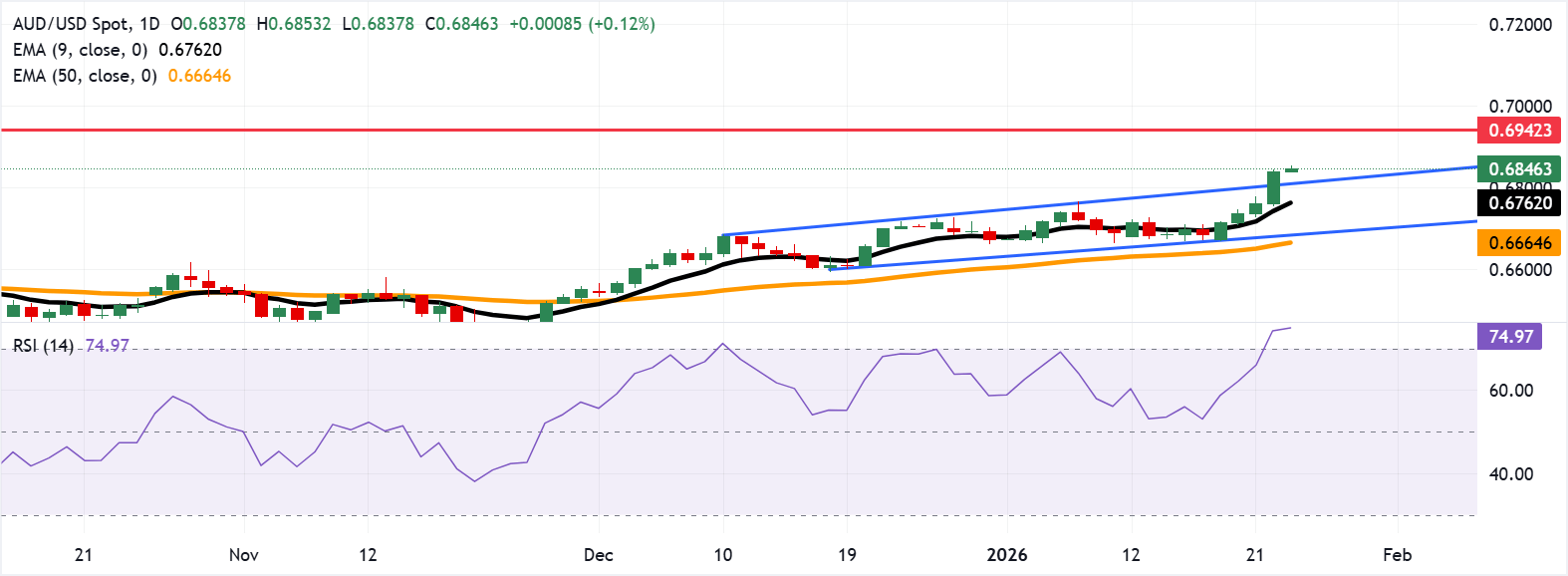
Core Viewpoint - The Australian dollar (AUD) has shown a slight increase against the US dollar (USD), supported by positive domestic economic data and a weakening USD, although overbought signals indicate potential for a pullback [1][4]. Economic Data - Australia's economic indicators have been strong, with the January manufacturing PMI rising to 52.4 from 51.6, and the services PMI increasing significantly from 51.1 to 56.0, indicating robust demand and economic momentum [1]. - Employment data also reflects a strong labor market, with December job changes recorded at 65.2K, significantly improving from the revised November figure of 28.7K, and the unemployment rate dropping to 4.1%, below the expected 4.4% [1]. Inflation Trends - Recent inflation data shows a rebound, with the December TD-MI inflation indicator increasing to 3.5% year-on-year from 3.2%, and a month-on-month surge of 1.0%, the fastest since December 2023 [2]. - Despite a decrease in core CPI to 3.4% in November, it remains above the RBA's target range of 2%-3%, prompting calls for caution from the IMF regarding ongoing inflation concerns [2]. USD Performance - The USD has been weak, with the DXY index stabilizing around 98.30, influenced by US economic data and Federal Reserve policy expectations [4]. - The US GDP annualized growth rate for Q3 2025 was reported at 4.4%, slightly above expectations, while initial jobless claims were lower than anticipated at 200,000 [4]. Technical Analysis - The AUD/USD pair is showing a clear bullish pattern, trading around 0.6850, with technical indicators suggesting a potential breakout above the upper channel [5]. - If the pair closes above the upper channel, it may target 0.6942, while key support is at 0.6762; a drop below this level could weaken momentum and test further support at 0.6680 [5].
2026年01月23日申万期货品种策略日报-国债-20260123
Shen Yin Wan Guo Qi Huo· 2026-01-23 05:35
| | | | | 申银万国期货研究所 唐广华(从业资格号:F3010997;交易咨询号:Z0011162) tanggh@sywgqh.com.cn 021-50586292 | | | | | | | --- | --- | --- | --- | --- | --- | --- | --- | --- | --- | | | | TS2603 | TS2606 | TF2603 | TF2606 | T2603 | T2606 | TL2603 | TL2606 | | | 昨日收盘价 | 102.408 | 102.444 | 105.835 | 105.845 | 108.150 | 108.120 | 112.17 | 112.29 | | | 前日收盘价 | 102.430 | 102.462 | 105.880 | 105.875 | 108.200 | 108.190 | 112.25 | 112.36 | | | 涨跌 | -0.022 | -0.018 | -0.045 | -0.030 | -0.050 | -0.070 | -0.080 | -0.070 | | | 涨跌幅 | -0 ...
日本央行维持利率不变 聚焦加息滞后效应与全球贸易风险
Xin Hua Cai Jing· 2026-01-23 05:31
Group 1 - The Bank of Japan (BOJ) decided to maintain the benchmark interest rate at 0.75%, aligning with market expectations, with an 8 to 1 vote, where one member opposed the decision advocating for a rate increase to 1.0% due to achieved price stability and rising inflation risks from overseas economic recovery [1] - The BOJ noted that current borrowing costs are at their highest level in 30 years and will closely monitor the impact of potential rate hikes in December 2025 on the economy and prices [1] - The BOJ anticipates a continued moderate economic recovery, with projected real GDP growth rates for fiscal years 2025 to 2027 at 0.9%, 1.0%, and 0.8%, respectively, which is an upward revision from previous forecasts [1] Group 2 - The BOJ emphasized the need to maintain the mechanism of synchronized wage and inflation increases, suggesting that the trend of passing wage increases onto sales prices could exceed expectations [2] - The central bank highlighted uncertainties in the global economic outlook, particularly regarding trade policies that may raise import prices and impact supply chains [2] - Despite low real interest rates, the BOJ reiterated its commitment to implementing monetary policy as needed to sustainably achieve the 2% inflation target, indicating potential future rate hikes if economic and price trends align with forecasts [2]
光大期货有色商品日报-20260123
Guang Da Qi Huo· 2026-01-23 05:30
1. Report Industry Investment Rating - No information provided in the report. 2. Core Views of the Report - **Copper**: Overnight, both domestic and international copper prices fluctuated strongly. The spot import of refined copper in China remained in a state of continuous loss. The US Q3 real GDP quarter - on - quarter final value was slightly revised up to 4.4%, with stable inflation expectations and healthy consumer spending. The central bank governor in China indicated that there is still room for reserve requirement ratio cuts and interest rate cuts this year. LME copper inventory increased by 8,850 tons to 168,250 tons, Comex inventory increased by 4,031 tons to 507,437 tons, SHFE copper warehouse receipts decreased by 2,408 tons to 143,173 tons, and BC copper decreased by 75 tons to 10,685 tons. Although the current domestic copper demand has entered the off - season and there is a need for adjustment in the industry, the high - spirited capital sentiment in the precious metals sector may have a spill - over effect on copper. It is advisable to be cautious before the Spring Festival, but the medium - term upward trend of copper prices remains unchanged, and attention should be paid to the operation rhythm [1]. - **Aluminum**: Overnight, alumina, Shanghai aluminum, and aluminum alloy all fluctuated strongly. The SMM alumina price dropped to 2,632 yuan/ton, and the aluminum ingot spot discount narrowed to 150 yuan/ton. The Australian ore rainy season's impact is evident, and the shipment of several mines is stable. Overseas geopolitical tensions have eased, and the US has postponed imposing tariffs on some key minerals. The domestic downstream Spring Festival stocking cycle has started, but the overall recovery is limited, and the aluminum ingot inventory accumulation continues. The short - term aluminum price on the disk may experience a phased correction but will still show anti - decline characteristics under high - level support. Attention should be paid to the downstream stocking process and inventory trends [1][2]. - **Nickel**: Overnight, LME nickel rose 0.7% to $18,100 per ton, and Shanghai nickel rose 0.28% to 142,730 yuan/ton. LME inventory decreased by 168 tons to 284,496 tons, and SHFE warehouse receipts increased by 432 tons to 41,584 tons. On January 21, Indonesia's energy and mineral resources ministry predicted that nickel ore production would decline by 10% - 15% compared to the previous year. As prices rise rapidly, the prices of products in each link of the industrial chain have strengthened, and the first - grade nickel production has increased by 18.5% to 37,200 tons month - on - month. The hedging demand may put some pressure on the disk price. The Indonesian policy provides short - term support for nickel prices, but the potential long - term quota supplement and high inventory are upward pressures. In the short term, it may fluctuate widely at a high level, and attention should be paid to market sentiment, current inventory, and policy implementation [3]. 3. Summary by Directory 3.1 Research Views - **Copper**: Macro - economically, the US economic data is positive, and China has room for monetary policy adjustment. Inventory changes vary in different markets. The domestic copper demand off - season and industrial divergence coexist with the positive factor of capital sentiment in the precious metals sector. The short - term is uncertain, and the medium - term trend is upward [1]. - **Aluminum**: The prices of alumina, Shanghai aluminum, and aluminum alloy are on the rise. The spot price and discount of aluminum have changed, and the raw material market and downstream processing fees also show different trends. Overseas and domestic factors jointly affect the aluminum market, with short - term correction and long - term anti - decline characteristics [1][2]. - **Nickel**: The price of nickel has increased, and inventory changes are different in LME and SHFE. The Indonesian policy and the increase in production in the industrial chain have an impact on the nickel price, with short - term high - level wide - range fluctuations [3]. 3.2 Daily Data Monitoring - **Copper**: The price of flat - water copper increased by 5 yuan/ton, the 1 bright scrap copper in Guangdong increased by 200 yuan/ton, and the refined - scrap price difference decreased by 194 yuan/ton. LME inventory remained unchanged, SHFE warehouse receipts decreased by 2,408 tons, and the total social inventory increased by 29,000 tons [1][4]. - **Lead**: The average price of 1 lead increased by 40 yuan/ton, and the warehouse receipts in SHFE increased by 201 tons, and the weekly inventory increased by 6,933 tons [4]. - **Aluminum**: The prices of aluminum in Wuxi and Nanhai increased by 30 yuan/ton. The LME inventory remained unchanged, the SHFE warehouse receipts increased by 101 tons, the total weekly inventory increased by 42,051 tons, the electrolytic aluminum social inventory increased by 13,000 tons, and the alumina social inventory decreased by 8,000 tons [5]. - **Nickel**: The price of Jinchuan nickel plate increased by 900 yuan/ton. The LME inventory remained unchanged, the SHFE nickel warehouse receipts increased by 432 tons, the weekly nickel inventory increased by 1,530 tons, and the stainless steel warehouse receipts decreased by 253 tons [5]. - **Zinc**: The main settlement price increased by 0.6%, the SMM 0 and 1 spot prices increased by 100 yuan/ton. The weekly inventory in SHFE increased by 793 tons, the LME inventory remained unchanged, and the social inventory decreased by 3,500 tons [7]. - **Tin**: The main settlement price increased by 1.9%, the SMM spot price increased by 7,500 yuan/ton. The weekly inventory in SHFE increased by 2,614 tons, the LME inventory remained unchanged [7]. 3.3 Chart Analysis - **Spot Premium**: Charts show the historical trends of spot premiums for copper, aluminum, nickel, zinc, lead, and tin from 2019 - 2026 [13][11]. - **SHFE Near - Far Month Spread**: Charts display the historical trends of the near - far month spreads for copper, aluminum, nickel, zinc, lead, and tin from 2021 - 2026 [14][16]. - **LME Inventory**: Charts present the historical trends of LME inventories for copper, aluminum, nickel, zinc, lead, and tin from 2019 - 2026 [20][22]. - **SHFE Inventory**: Charts show the historical trends of SHFE inventories for copper, aluminum, nickel, zinc, lead, and tin from 2019 - 2026 [26][28]. - **Social Inventory**: Charts display the historical trends of social inventories for copper, aluminum, nickel, zinc, stainless steel, and 300 - series from 2019 - 2026 [32][34]. - **Smelting Profit**: Charts show the historical trends of copper concentrate index, rough copper processing fee, aluminum smelting profit, nickel - iron smelting cost, zinc smelting profit, and stainless steel 304 smelting profit margin from 2019 - 2026 [39][41]. 3.4 Team Introduction - **Zhan Dapeng**: A science master, currently the director of non - ferrous research at Everbright Futures Research Institute, a senior researcher in precious metals, a gold intermediate investment analyst. He has more than a decade of commodity research experience, serves many leading spot enterprises, and has published dozens of professional articles in public newspapers and magazines. His team has won the Best Metal Industry Futures Research Team Award from Futures Daily & Securities Times for four consecutive sessions [46]. - **Wang Heng**: A master of finance from the University of Adelaide, Australia, currently a non - ferrous researcher at Everbright Futures Research Institute, mainly researching aluminum and silicon. He has won relevant industry awards and focuses on providing information and research services in the non - ferrous and new energy industries [46]. - **Zhu Xi**: A master of science from the University of Warwick, UK, currently a non - ferrous researcher at Everbright Futures Research Institute, mainly researching lithium and nickel. She has won relevant industry awards and focuses on the integration of non - ferrous metals and new energy, serving many leading new energy enterprises [47].
Japan Holds Rates at 0.75%: What It Means for Crypto Markets
Yahoo Finance· 2026-01-23 04:01
The Bank of Japan held its benchmark interest rate steady at 0.75% on Friday, while upgrading economic growth and inflation forecasts in a decision that carries significant long-term implications for cryptocurrency markets. As Japan navigates a collision between monetary tightening and fiscal expansion ahead of snap elections, crypto markets face growing exposure to yen-driven liquidity shifts and potential unwinding of carry trades. Split Vote Signals Internal Tension The decision came in a split 8-1 v ...