
信用风险

Search documents
【光大研究每日速递】20250522
光大证券研究· 2025-05-21 14:00
Group 1 - The coal industry is expected to see a decline in operating revenue in 2024, with a decrease in operating cash flow and significant net outflow in investment cash flow. However, overall debt repayment capability remains strong despite high leverage and increasing debt levels [4] - In 2025, coal enterprises' profitability will still be constrained, but there will be support for overall profitability. Operating cash flow is expected to remain relatively ample, while investment cash flow will continue to show a rigid net outflow [4] Group 2 - The banking sector is experiencing a systematic decline in interest rates due to recent monetary policy measures, with an expected improvement in industry interest margins by over 5 basis points. The management of funding costs is anticipated to alleviate pressure on interest margins [5] - The banking sector's fundamentals are stable, and there is optimism regarding the performance of bank stocks moving forward [5] Group 3 - In April 2025, the total retail sales of consumer goods reached 3.72 trillion yuan, showing a year-on-year growth of 5.1%, although the growth rate decreased by 0.8 percentage points compared to March. From January to April, the total retail sales amounted to 16.18 trillion yuan, with a year-on-year growth of 4.7%, an increase of 0.6 percentage points compared to the same period last year [6] - The restaurant industry is showing signs of recovery, with an increase in the number of stores and a rise in market activity in first-tier cities. Policy stimuli are expected to improve demand, while competition among stores is intensifying [10] Group 4 - The recent easing of trade tensions between China and the U.S. has led to a surge in shipping demand, resulting in a rapid increase in freight rates for routes between the U.S. and China. The average freight rates for the U.S. West and East routes rose by 31.7% and 22.0%, respectively [8]


瑞达利欧:穆迪仍然低估了美国国债面临的风险
news flash· 2025-05-19 16:43
桥水基金创始人瑞达利欧警告称,虽然穆迪下调美国主权信用评级,但"你应该知道,信用评级低估了 信用风险,因为它们只评估了政府不偿还债务的风险……它们没有考虑到更大的风险,即负债国家会印 钞偿还债务,从而导致债券持有人因所获资金价值下跌(而不是资金数量减少)而蒙受损失……换句话 说,对于那些关心资金价值的人来说,美国政府债务的风险比评级机构传达的要大。" ...
资金无忧,关注利率下行触发因素
Shenwan Hongyuan Securities· 2025-05-18 09:11
Group 1 - The report emphasizes that credit risk has historically received more attention than interest rate risk in the bond market, with the People's Bank of China highlighting the need for improved mechanisms to address interest rate fluctuations, although short-term impacts may be limited [3][8][11] - The bond market is expected to gradually improve its macro-prudential mechanisms, but the short-term focus remains on loose trading conditions, with a low probability of further tightening in liquidity [3][30] - The report indicates that the current monetary policy aims to maintain a moderately loose environment to counter external uncertainties and support fiscal issuance, while also ensuring stable interest rates to protect asset prices [3][30] Group 2 - The report discusses the evolution of the yield curve, suggesting that it may steepen, with a focus on duration value and less active interest rate instruments, as the macro-prudential approach prioritizes stabilizing growth and managing risks [3][34] - It highlights that the long-end of the bond market has limited upward potential, with the 10-year government bond yield unlikely to exceed 1.7%, and emphasizes the importance of monitoring potential triggers for interest rate declines [3][34] - The report identifies several factors that could lead to lower interest rates, including fluctuating expectations regarding US-China trade relations, a downward trend in financial institutions' overall costs, and pressures on exports in the second quarter [3][34]
固定收益点评:转债评级下调怎么看?
Guohai Securities· 2025-05-18 08:35
1. Report Industry Investment Rating No relevant content provided. 2. Core Viewpoints of the Report - Rating downgrades in the convertible bond market from 2021 - 2024 showed high - frequency, seasonal, and industry - concentrated characteristics. Over 61% of downgrades were in June, with cyclical industries like industrial and materials dominating, and over 80% of downgraded entities being private enterprises in coastal developed areas. High - rating entities had lower downgrade risks [6]. - Rating adjustments drove market differentiation. High - growth sectors such as TMT, electronics, and non - ferrous metals had low downgrade risks, while industries like real estate, steel, and power equipment faced greater downgrade pressure. After a downgrade, convertible bond prices generally showed a "first decline then rise" pattern, and market sentiment was significantly affected by the rating window period [6]. - To deal with credit risks, a triple - strategy approach could be adopted: using equity - biased convertible bonds to hedge risks, seizing repair opportunities of undervalued low - price bonds, and using short - duration high - YTM bonds for defense [6]. 3. Summary According to Relevant Catalogs 3.1 Rating Adjustment Review 3.1.1 Historical Rating Adjustments and Market Performance - From 2021 - 2024, there were 193 downgrades in the convertible bond market, accounting for 4.51% of all rating adjustments. Over 61% of them were in June. Industries such as industrial and materials were dominant, private enterprises accounted for over 80%, mainly in coastal areas like Guangdong and Jiangsu. Downgraded entities were generally of weak quality, with issuance ratings concentrated at AA and AA - [6][8][10]. - The broader market index often weakened in May and June. The CSI Convertible Bond Index usually had a phased decline before the release of rating adjustment announcements due to risk pre - screening by institutions, leading to a chain reaction of "forward - priced risk → wider credit spread → market correction" [16]. - After a downgrade, convertible bond prices generally showed a "first decline then rise" pattern. For example, Zhongzhuang Zhuan 2 and Ying 19 Convertible Bond rebounded about 1 month after the downgrade [19]. 3.1.2 Identification of Downgraded Convertible Bonds - Factors leading to rating downgrades included performance losses, weakened solvency, low industry prosperity, equity issues, and liquidity risks. For example, Lingnan Convertible Bond was downgraded multiple times due to a plunge in EBITDA margin to - 119% and a high short - term debt ratio [6][23][24]. 3.1.3 Rating Adjustments Showed Structural Differentiation - High - growth sectors such as TMT, electronics, and non - ferrous metals had strong profitability and low downgrade risks. For example, the computer industry had a 471.86% year - on - year increase in net profit, the electronics industry had a ROE of 6.27% and a 37.24% net profit growth, and the non - ferrous metals industry had a ROE of 11.3% and a 53.23% net profit growth [26]. - Traditional industries such as real estate, steel, and power equipment faced greater downgrade risks. The real estate industry had a 274% drop in net profit, the steel industry had a negative ROE, and the power equipment industry had a low ROE of 3.6% [28]. 3.2 How to Select Bonds Around the Rating Adjustment Window Period 3.2.1 Equity - linked Convertible Bonds Could Hedge Credit Risks - In the face of credit risk shocks, equity - biased convertible bonds showed stronger price resilience. For example, during the "20 Hongda Xingye SCP001" default in 2020, equity - biased convertible bonds rose while others declined [32]. 3.2.2 Low - price Convertible Bonds Presented a Layout Window - During the credit adjustment window period, the low - price index usually showed a "first decline then rise" return characteristic. In 2024, low - price convertible bonds initially underperformed but later achieved the highest cumulative return for the year. Currently, attention could be paid to undervalued but cash - flow - stable bonds [33]. 3.2.3 Layout of Short - duration High - YTM Convertible Bonds - Short - duration high - YTM convertible bonds with a remaining term of less than 2 years and positive YTM could be selected. For example, Wanshun Zhuan 2 in 2024 outperformed the market under the protection of the put - back clause [36]. 3.3 Post - market Allocation Suggestions - Focus on three types of opportunities: high - growth equity - biased convertible bonds such as Hao 24 Convertible Bond; low - price bonds with credit mispricing like Jingneng Convertible Bond; and short - duration high - YTM defensive bonds such as Lvyin Convertible Bond [40].
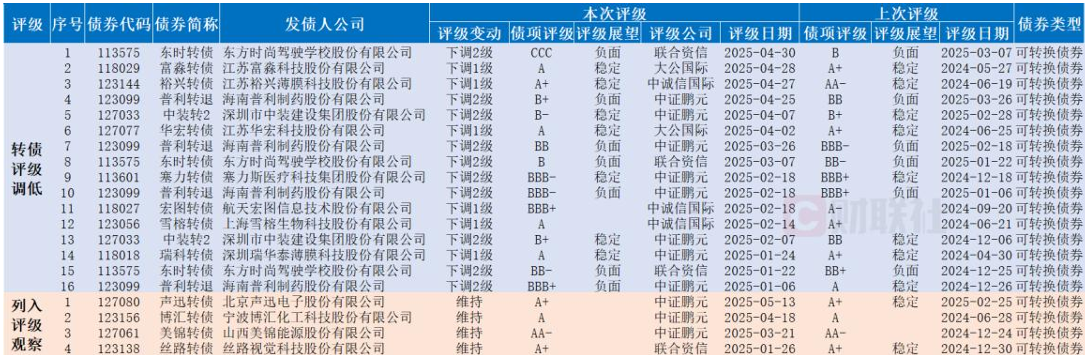
声迅转债被列入信用评级观察名单,今年以来16只转债评级遭下调
Xin Lang Cai Jing· 2025-05-16 08:59
Core Viewpoint - Zhongzheng Pengyuan has placed Beijing Sound Communication Electronics Co., Ltd. on a credit rating watch list due to significant losses and declining financial indicators, maintaining its credit rating at A+ [1] Group 1: Company Performance - In 2024, Sound Communication reported revenue of 302 million yuan, a year-on-year increase of 7.85%, but incurred a net loss of 51.2 million yuan, a decline of 304.23% compared to the previous year [1] - The company continued to experience losses in Q1 2025, with a net loss of 14.21 million yuan [1] - The decline in gross profit, increased expenses, and poor receivables collection have contributed to the company's financial struggles [1] Group 2: Credit Rating and Market Position - Zhongzheng Pengyuan has maintained the company's credit rating at A+ while placing it on a watch list due to the aforementioned financial issues [1] - Sound Communication has one outstanding bond, the Sound Convertible Bond, with a remaining scale of 279 million yuan and a maturity of 3.63 years [2] - The company, founded in 1994, provides comprehensive security solutions and services across various sectors, including rail transportation and finance [2] Group 3: Industry Context - In 2023, over 10 convertible bonds have had their ratings downgraded, with 4 bonds placed on a watch list, indicating a trend of increasing credit risk in the market [3] - The primary reasons for rating downgrades include operational losses, liquidity issues, and deteriorating credit conditions [7][9]
国泰海通|固收:美债危机下的全球债市配置:信用风险被高估,美债仍具相对价值
国泰海通证券研究· 2025-05-15 14:33
报告导读: 美国具有充足的安全垫机制,短期违约风险不大。美国债务风险被市场高估, 经济衰退仍是主要逻辑,当下的环境更像 2011 年,中长期来看美债配置价值优于欧日。 美国主权债务危机复盘:历史上未发生过主权债务违约,且当前有比较充足的风险垫机制,美债短期违约 风险不大。 回顾历史,美国国债未因债务上限发生过正式的债务违约,但曾有被视为技术性违约或接近违 约的案例。早在 18 至 20 世纪初期,美国曾多次因战争大量举债而最终无力偿还接近违约的案例,如 1779 年的独立战争时期和 1862 年的南北战争时期等。 20 世纪末至今则偶有几次发生技术性违约的情 况。总的来看,美国国债历史上并没有发生过真正意义上的违约(即未能按时支付本金或利息),过去几 轮技术性违约事件通常是由债务上限问题引发的,背后则是民主党和共和党对于财政扩张或财政保守之间 的政治博弈。解决方式主要是通过国会提高债务上限或采取非常规措施来维持支付能力。美联储、 TGA 账户资金和超常规措施提供安全垫,美债短期违约风险不大。 美债危机期间的资产变动:与全球经济、货币政策等因素紧密相关,衰退期间美债表现占优。 1 ) 1979 年美国经济衰退, ...

什么原因?多家公司转债评级遭下调
Zheng Quan Shi Bao· 2025-05-06 11:15
Core Viewpoint - The article discusses the recent updates on convertible bond ratings, highlighting that while most ratings remain unchanged, several have been downgraded due to deteriorating company fundamentals, including losses, increased debt pressure, and worsening credit conditions [1][3]. Group 1: Rating Updates - As of now, 72 convertible bonds have updated their ratings this year, with 65 bonds maintaining their previous ratings, accounting for 90.28% [3]. - Seven convertible bonds have experienced rating downgrades, including Dongshi Convertible Bond, Fumiao Convertible Bond, and others, primarily due to continuous losses and increased debt pressure [3][4]. Group 2: Reasons for Downgrades - Fumiao Convertible Bond's rating was adjusted from A+ to A due to declining profitability and increased debt pressure, with a significant rise in the asset-liability ratio expected by the end of 2024 [4]. - Dongshi Convertible Bond's rating was downgraded from B to CCC, reflecting increased liquidity risks and a negative outlook due to worsening credit conditions, including civil judgments and administrative penalties [5]. Group 3: Implications of Downgrades - The downgrades indicate a rise in credit risk for the affected convertible bonds, which could lead to potential liquidity issues and increased scrutiny from investors [6][7]. - The downgrade of the Puli Convertible Bond from BB to B+ was influenced by the termination of its stock and bond listings due to significant financial discrepancies, which severely impacted the company's market reputation [8][9]. - The company faces potential risks of early redemption of convertible bonds if stock prices fall below a certain threshold, exacerbating liquidity pressures and increasing the likelihood of default [10].

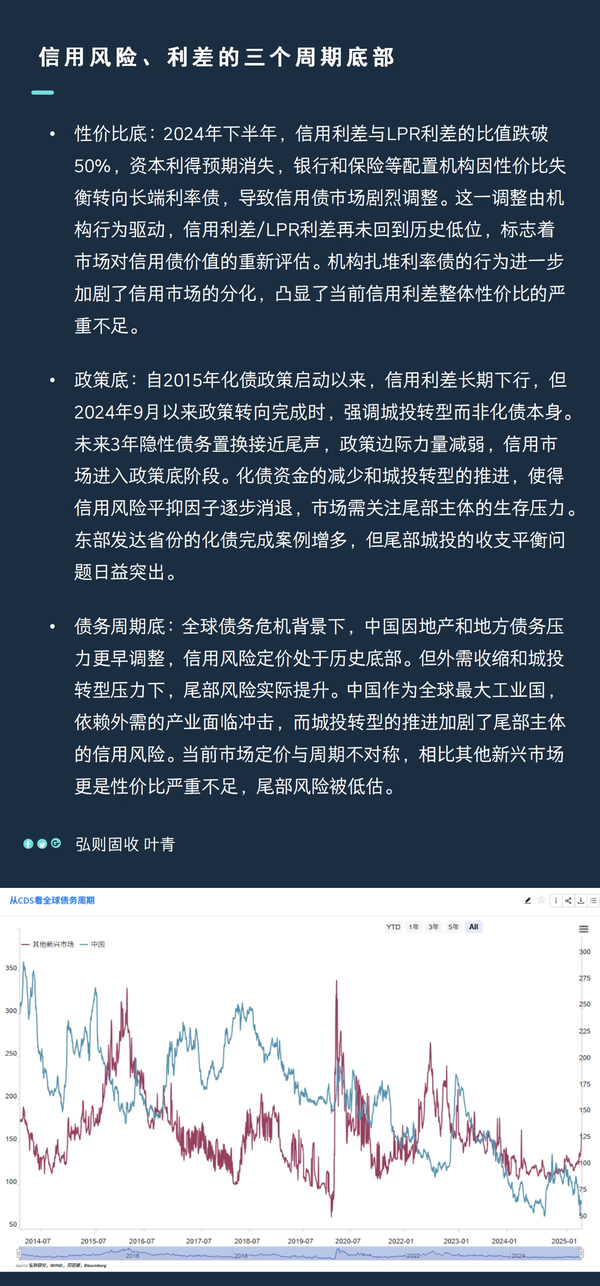
弘则固收叶青:信用风险、利差的三个周期底部
news flash· 2025-05-05 23:29
Core Viewpoint - The Chinese credit market is experiencing a significant shift as credit risks and spreads have reached historical lows, driven by a combination of value imbalance, policy changes, and debt cycle dynamics [1][2]. Group 1: Value Imbalance - The ratio of credit spreads to LPR spreads fell below 50% in the second half of 2024, leading to a disappearance of capital gain expectations [1]. - Institutional investors, such as banks and insurance companies, are shifting towards long-term interest rate bonds due to the imbalance in value, resulting in a sharp adjustment in the credit bond market [1]. - This institutional behavior has intensified the differentiation within the credit market, highlighting the severe inadequacy of overall credit spread value [1]. Group 2: Policy Dynamics - Since the initiation of the debt reduction policy in 2015, credit spreads have been on a long-term decline, but the policy focus has shifted towards urban investment transformation rather than debt reduction itself as of September 2024 [2]. - The next three years will see the completion of implicit debt replacement, leading to a reduction in policy support and a transition into a policy bottom phase for the credit market [2]. - The decrease in debt reduction funds and the advancement of urban investment transformation are gradually diminishing the factors that mitigate credit risk, necessitating attention to the survival pressures of tail-end entities [2]. Group 3: Debt Cycle Context - In the context of a global debt crisis, China has adjusted earlier due to pressures from real estate and local government debt, with credit risk pricing at historical lows [2]. - However, the pressures from external demand contraction and urban investment transformation are increasing actual tail-end risks [2]. - As the largest industrial nation globally, China’s reliance on external demand is facing challenges, while the push for urban investment transformation exacerbates credit risks for tail-end entities [2].
信用热点聚焦系列之十:中航产融相关影响预判
ZHESHANG SECURITIES· 2025-04-30 05:48
1. Report Industry Investment Rating No information provided in the report. 2. Core Views - Currently, the valuation fluctuations of AVIC Industry Finance reflect liquidity risks rather than credit risks. Given the low short - term actual default risk, there are opportunities to trade at high valuations [1][2][11]. - The yield under this phased shock is approaching its peak, and it has allocation value for proprietary accounts with stable liability ends and allocation accounts with few restrictions [3][14]. - As bonds gradually mature and are redeemed, market concerns will subside, and bond prices will gradually return to normal [2][11]. 3. Summary by Relevant Catalogs 3.1 AVIC Industry Finance Bond Trading Situation before and after Resumption - On April 23, 2025, AVIC Industry Finance issued a bond resumption announcement. The matter of off - exchange redemption of the company's bonds failed to pass the vote of the bondholders' meeting, and the relevant bonds resumed trading on April 24 [1][10]. - In the past week, the overall trading prices were mainly at a discount, with short - term varieties within 2 years being the main trading terms. Longer - term bonds declined more, and bonds within one year had relatively small fluctuations. On the first day of resumption on April 24, the average deviation from the valuation was 195bp; on the 25th, it was 77bp, and the deviation amplitude converged; on the 28th, the trading volume was 2.4 times that of the previous trading day, and the average deviation from the valuation rebounded to 107bp [2][10][13]. - Taking "22 Industry Finance 02" as an example, from April 14 to April 23, the bond valuation showed a slight upward trend. On the first day of resumption on April 24, the valuation increased significantly by 208bp, and it has been relatively stable in the past three trading days [2][11]. - AVIC Industry Finance has the credit endorsement of AVIC Group. With the high - level control of central - enterprise bond default risks and the support of the central - enterprise credit guarantee fund, and the company's positive attitude towards debt repayment, the default risk is likely to be controllable [11]. 3.2 Market Fluctuation Observation of Other Similar Companies - The total outstanding bond scale of the parent companies of trust - holding companies is 8.93 trillion yuan. After excluding several large state - owned and joint - stock commercial banks with high outstanding bond scales, the remaining balance is 1.43 trillion yuan [4][20]. - From March 31 to April 27, 2025, after the AVIC Industry Finance incident, the bond spreads of Minmetals Capital (Minmetals Trust) widened significantly. However, due to the strong individual specificity of the AVIC Trust issue, the valuation fluctuation risk of Minmetals Capital is controllable, and it is expected that there will be no actual credit risk disturbance [4][20].

申万宏源王牌|固收“申”音:月度策略
2025-04-02 14:06
Summary of Key Points from the Conference Call Industry or Company Involved - The conference call primarily discusses the bond market and credit bonds in China, focusing on the macroeconomic environment and monetary policy implications for the second quarter of 2025. Core Points and Arguments 1. **Market Funding Trends**: In Q2 2025, the market funding center is expected to seek a new equilibrium, with funding rates significantly rising compared to Q4 2024. This shift will favor credit bonds as the cash-out leverage strategy stabilizes [2][10][11]. 2. **Central Bank's Stance**: The central bank's cautious approach is a key focus, with expectations of fiscal supply expansion and potential changes in monetary policy due to external factors like tariffs and U.S. de-globalization [2][10][11]. 3. **Bond Market Volatility**: The bond market is anticipated to exhibit high volatility and a fluctuating market characteristic, with single-sided bull market expectations diminishing. The overall market is leaning towards a fluctuating market due to existing debt repayment pressures [2][17][19]. 4. **Credit Bond Opportunities**: Q2 presents significant opportunities in credit bonds, with a supply-demand mismatch expected. The current yield of over 2.3% on existing bonds is attractive compared to the previous year [2][21][28]. 5. **Fiscal Stimulus**: The necessity for increased fiscal stimulus is highlighted, as relying solely on monetary policy is insufficient to address core issues like insufficient credit demand and negative GDP deflator [2][13][14]. 6. **Investment Strategies**: In a high-volatility environment, strategies focusing on credit bond arbitrage and leveraging are more effective. Multi-asset strategies are recommended to enhance returns [2][19][26]. 7. **Local Government Bonds**: 2025 is identified as a significant year for debt resolution, positively impacting local government bonds. Plans to issue 2 trillion yuan in replacement bonds are underway, with 1.3 trillion already issued in Q1 [2][28][29]. 8. **Market Dynamics**: The market is characterized by a flattening yield curve, with short-term bonds showing stability while long-term bonds face challenges. The overall market environment is set for a return to normalcy in funding centers [2][5][18][20]. 9. **Credit Risk Monitoring**: Attention is drawn to potential credit risks, especially with a rise in performance warning announcements that could lead to rating downgrades [2][50]. 10. **Investment Recommendations**: Recommendations include focusing on high-yield credit bonds, particularly those with strong fundamentals and short to medium durations, as they are expected to perform better in the current market conditions [2][51][53]. Other Important but Possibly Overlooked Content - The impact of regulatory changes on the credit bond market, particularly regarding the introduction of credit bond ETFs, which could enhance liquidity and attract more investment [2][25]. - The historical context of different funding phases and their implications for investment strategies, emphasizing the importance of adapting to market conditions [2][27]. - The potential for local government support in the bond market, particularly through land reserve special bonds, which could provide additional funding avenues [2][29].
