
先进封装技术

Search documents
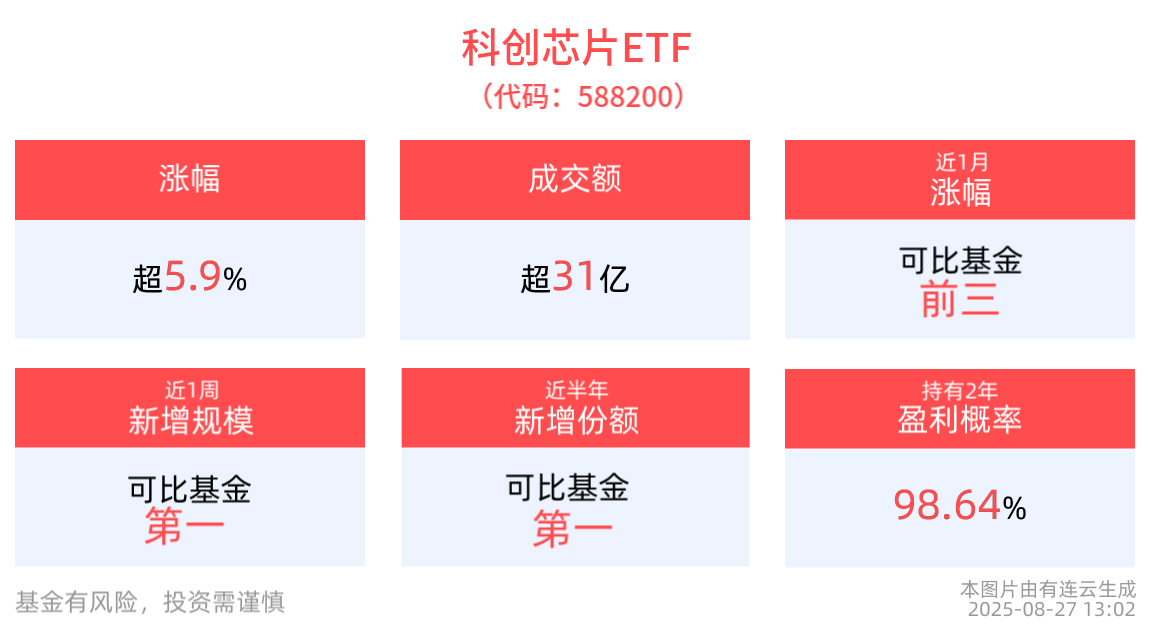
科创芯片ETF(588200)盘中涨近6%,成分股乐鑫科技、翱捷科技20cm涨停
Xin Lang Cai Jing· 2025-08-27 05:22
Group 1: ETF Performance - The Sci-Tech Chip ETF had an intra-day turnover of 8.79%, with a transaction volume of 3.11 billion yuan [3] - Over the past week, the average daily transaction volume of the Sci-Tech Chip ETF reached 4.459 billion yuan, ranking first among comparable funds [3] - The ETF's scale increased by 2.664 billion yuan in the past week, also ranking first among comparable funds [3] - In the past six months, the ETF's shares grew by 4.074 billion shares, marking significant growth and ranking first among comparable funds [3] - As of August 26, the ETF's net value increased by 130.13% over the past year, placing it first among comparable funds and ranking 23rd out of 2,977 index equity funds [3] Group 2: Key Stocks in the Index - The top ten weighted stocks in the Sci-Tech Chip Index include Cambricon, SMIC, Haiguang Information, and others, collectively accounting for 57.59% of the index [3] - Notable stock performances include SMIC with a 5.31% increase and a weight of 10.22%, and Haiguang Information with a 1.91% increase and a weight of 10.15% [6] Group 3: Industry Trends - Cambricon reported a Q2 revenue increase of 4,425% year-on-year, reaching 1.769 billion yuan, with a record net profit margin of 38.57% [4] - The penetration rate of liquid cooling technology is expected to rise from 5% to 35-50%, with Chinese manufacturers expanding component exports due to Southeast Asia's data center construction [4] - Advanced packaging technology is becoming crucial for supporting AI and high-performance computing demands, with traditional processes struggling to meet performance evolution [4] - Domestic manufacturers are accelerating technology catch-up in wafer-level packaging and 2.5D/3D processes, benefiting from policy and capital collaboration [4] Group 4: Investment Opportunities - Investors without stock accounts can access domestic chip investment opportunities through the Sci-Tech Chip ETF linked fund (017470) [7]






20cm速递 | 科创芯片ETF国泰(589100)盘中涨近3%,行业趋势与国产替代双轮驱动
Mei Ri Jing Ji Xin Wen· 2025-08-27 04:52
Core Viewpoint - The advanced packaging technology is becoming a critical path to support the computing power demands of AI and high-performance computing, as traditional processes struggle to overcome the "power wall, memory wall, and cost wall" bottlenecks [1] Group 1: Industry Insights - The HBM+CoWoS combination has become a standard requirement for AI servers due to their extreme demands for high bandwidth storage and high-speed interconnects [1] - The complexity of automotive SoCs is increasing due to the push for smart vehicles, alongside a recovery in the consumer electronics cycle, contributing to sustained market growth [1] - Domestic manufacturers are accelerating their technological catch-up in wafer-level packaging and 2.5D/3D processes, benefiting from a window of opportunity created by policy and capital collaboration [1] Group 2: ETF and Index Information - The Guotai Sci-Tech Chip ETF (589100) rose nearly 3% in early trading on August 27, tracking the Sci-Tech Chip Index (000685), which reflects the overall performance of listed companies in the chip industry [1] - The Sci-Tech Chip Index includes 50 constituent stocks focused on core chip areas and has a daily price fluctuation limit of 20%, indicating high market elasticity [1] - Investors without stock accounts can consider the Guotai SSE Sci-Tech Chip ETF Initiation Link A (024853) and Link C (024854) [1]
半导体板块沸腾!科创半导体ETF(588170)涨超3%,中芯国际涨超5%
Mei Ri Jing Ji Xin Wen· 2025-08-27 04:26
Group 1 - The Shanghai Stock Exchange Sci-Tech Innovation Board Semiconductor Materials and Equipment Index has risen by 3.02% as of August 27, with notable increases in constituent stocks such as Huafeng Measurement Control (up 6.56%), Zhongke Feimiao (up 5.84%), and SMIC (up 5.07%) [1] - The Sci-Tech Semiconductor ETF (588170) has increased by 3.28%, with a latest price of 1.26 yuan, and has accumulated a 10.42% increase over the past week as of August 26, 2025 [1] - Advanced packaging technology is becoming a key path to support the demand for AI and high-performance computing, as traditional processes struggle to support performance evolution due to the "power wall, memory wall, and cost wall" [1] Group 2 - The Sci-Tech Semiconductor ETF (588170) and its linked funds track the Sci-Tech Innovation Board Semiconductor Materials and Equipment Index, which includes hard tech companies in semiconductor equipment (60%) and semiconductor materials (24%) [2] - The semiconductor equipment and materials industry is a significant area for domestic substitution, characterized by low domestic substitution rates and high ceilings for domestic replacement, benefiting from the expansion of semiconductor demand driven by the AI revolution [2]


天承科技(688603):25H1营收稳健增长,持续受益下游AIPCB扩产
Great Wall Securities· 2025-08-25 10:16
Investment Rating - The report maintains a "Buy" rating for the company, indicating an expected stock price increase of over 15% relative to the industry index within the next six months [4][16]. Core Views - The company has shown steady revenue growth in the first half of 2025, benefiting from increased demand in the downstream PCB industry, particularly driven by AI PCB expansion [2][3]. - The gross margin for the first half of 2025 was 40.06%, reflecting a year-on-year increase of 1.55 percentage points, while the net margin was 17.23%, down 3.98 percentage points year-on-year [2]. - The company is actively expanding its production capacity, with plans to increase PCB specialty chemical production to 40,000 tons per year at its Shanghai facility, while also constructing factories in Zhuhai and Thailand [2][3]. Financial Summary - Revenue for 2023 is projected at 339 million yuan, with a year-on-year growth rate of -9.5%. By 2027, revenue is expected to reach 751 million yuan, with a growth rate of 25.2% [1]. - The net profit attributable to the parent company is forecasted to be 59 million yuan in 2023, increasing to 170 million yuan by 2027, with a significant growth rate of 41.7% in 2027 [1]. - The company's latest diluted EPS is projected to grow from 0.47 yuan in 2023 to 1.37 yuan in 2027, reflecting a strong upward trend in earnings per share [1][4]. Industry Context - The company is positioned as a leading player in the domestic PCB chemical industry, benefiting from the expansion of high-end PCB manufacturers driven by increased capital expenditures from cloud service providers [2][3]. - The report highlights the company's advancements in semiconductor packaging technologies, including TSV and RDL electroplating, which are crucial for meeting the rising demand for high-performance computing and AI applications [3][8].

卓胜微:目前先进封装技术产品已在部分客户项目中推进 但整体仍处于早期
Ge Long Hui· 2025-08-23 08:03
Core Viewpoint - The company has successfully validated and achieved scale shipments of products utilizing advanced packaging technology, laying a solid foundation for the development of RF front-end modules focused on miniaturization, low cost, and high performance [1] Group 1 - As of the end of the first half of 2025, products using advanced packaging technology have passed key customer validation and achieved scale shipments [1] - The production line specifically designed for advanced integration processes has successfully transitioned from technology implementation to large-scale production [1] - Advanced packaging technology is suitable for products with high requirements for size and shape, such as smart glasses [1] Group 2 - Related products are currently being advanced in some customer projects, although the overall progress remains in the early stages [1]
卓胜微:目前先进封装技术产品已在部分客户项目中推进,但整体仍处于早期
Xin Lang Cai Jing· 2025-08-23 07:38
Core Viewpoint - The company has successfully achieved large-scale shipments of products utilizing advanced packaging technology, which has passed key customer validation as of mid-2025 [1] Group 1 - The production line specifically designed for advanced integration processes has successfully transitioned from technology implementation to large-scale production, establishing a solid foundation for the company's ongoing development of RF front-end modules focused on miniaturization, cost reduction, and high performance [1] - Advanced packaging technology is applicable to products with high requirements for size and shape, such as smart glasses [1] - Related products are currently being advanced in some customer projects, although the overall progress remains in the early stages [1]
卓胜微:部分采用先进封装技术的产品顺利通过关键客户验证已实现规模出货
Zheng Quan Shi Bao Wang· 2025-08-23 07:33
Core Viewpoint - The company,卓胜微, has successfully validated and achieved scale shipments of products utilizing advanced packaging technology, with a focus on meeting the requirements of key clients by mid-2025 [1] Group 1: Product Development - Products employing advanced packaging technology have passed key customer validation and are now in scale production [1] - The production line specifically designed for advanced integration processes has successfully transitioned from technical implementation to large-scale production [1] Group 2: Market Application - Advanced packaging technology is particularly suitable for products with high demands on size and form, such as smart glasses [1] - Related products are currently being advanced in certain customer projects, although the overall market presence remains in the early stages [1]
通富微电(002156):核心客户稳定,受益AI浪潮
Orient Securities· 2025-08-22 02:49
Investment Rating - The report maintains a "Buy" rating for the company with a target price of 34.00 CNY based on a 50x PE valuation for 2025 [3][6]. Core Views - The company benefits from a stable core customer base and the AI wave, being the primary packaging supplier for AMD, which accounts for over 50% of its revenue in 2024 [11]. - The global advanced packaging market is expected to grow to 65 billion USD by 2027, with the company positioned to leverage advanced packaging technologies to enhance performance and reduce costs [11]. - The company is actively investing in capacity expansion, with a total planned investment of 6 billion CNY in 2025 to upgrade existing products and meet the demand for large multi-chip servers and AI products [11]. Financial Forecasts and Investment Recommendations - The company is projected to achieve earnings per share of 0.68 CNY, 0.86 CNY, and 1.08 CNY for the years 2025, 2026, and 2027 respectively, reflecting adjustments in revenue and expense rates [3][12]. - Revenue is expected to grow from 22,269 million CNY in 2023 to 34,393 million CNY in 2027, with a compound annual growth rate of approximately 11.6% [5][14]. - Operating profit is forecasted to increase significantly from 243 million CNY in 2023 to 2,369 million CNY in 2027, indicating a strong recovery and growth trajectory [5][14].

CoWoS,迎来替代者
半导体芯闻· 2025-08-21 10:26
Core Viewpoint - The emergence of CoWoP technology by Nvidia is seen as a potential disruptor to TSMC's CoWoS technology, which has been dominant in advanced packaging for AI chips. The industry is debating whether CoWoP is merely a temporary trend or a significant shift in semiconductor packaging [1][3]. Summary by Sections CoWoP vs CoWoS - CoWoP (Chip on Wafer on PCB) integrates the packaging substrate with PCB, allowing for a thinner, lighter, and higher bandwidth module design compared to CoWoS (Chip-on-Wafer-on-Substrate). This integration reduces material and manufacturing costs while accelerating production timelines [2][3]. Market Impact - The introduction of CoWoP has sparked discussions about its potential to replace CoWoS and has raised questions about the future of TSMC's CoPoS (Chip-on-Panel-on-Substrate) technology, which is designed to address CoWoS's production bottlenecks [3][4]. Advantages of CoWoP - CoWoP offers several advantages, including simplified system architecture, improved thermal management, reduced substrate costs, and potentially fewer backend testing steps. It aims to solve issues like substrate warping and enhance NVLink coverage without additional substrate layers [4][5]. Challenges and Risks - Despite its potential, CoWoP faces significant challenges in commercial viability, particularly in scaling up for high-capacity GPUs. The transition from existing technologies to CoWoP involves risks, especially given TSMC's current high yield rates with CoWoS [6][7]. Industry Sentiment - PCB manufacturers express skepticism about CoWoP's ability to replace CoWoS in the short term, citing the need for substantial advancements across the entire supply chain. They believe that existing technologies remain adequate and that the transition to CoWoP will take considerable time [7][8].


路维光电20250820
2025-08-20 14:49
Summary of Luvi Optoelectronics Conference Call Company Overview - **Company**: Luvi Optoelectronics - **Date**: August 20, 2025 Key Points Industry and Business Segments - Luvi Optoelectronics' revenue split for Q2 2025 was 85% from display business and 15% from semiconductor business [2][4] - Display business gross margin ranged from 30% to 35%, while semiconductor business gross margin was between 55% and 60%, with a 5 percentage point increase from Q1 [2][4] - Both business segments achieved double-digit growth [2][4] Semiconductor Business Insights - Within the semiconductor segment, devices accounted for 60% and packaging for 40% [6] - The rapid growth of IC mask business was noted, with major clients including Shenghe Jingwei and Jingfang [2][7] - The domestic semiconductor mask market is approximately 20 billion RMB, with advanced packaging masks accounting for less than 5 billion RMB [8] Expansion Projects - The Xiamen expansion project has a total investment of 2 billion RMB, with 11 production lines planned; the first phase will have 5 lines operational [9] - Expected revenue contribution from the first phase is around 200 million RMB in 2026, with full capacity potentially reaching 400-500 million RMB [10] - High-precision products from the Xiamen project are expected to have a gross margin of 35%-40% [11] Production Capacity and Equipment - Significant progress was made in H1 2025, including the arrival of a 40nm electron beam lithography machine, with trial production expected in H2 [3][5] - The company plans to advance to 14nm technology by 2027-2028 [17] - Equipment procurement for advanced processes is not hindered by international conditions [18] Market Demand and Competition - Demand for semiconductor and display products is expected to remain strong, with a focus on capacity and release rhythm for growth [12][13] - The domestic third-party mask market is estimated at 15 billion RMB, with new entrants like Jinghe impacting competition dynamics [20][21] Financial Performance and Projections - Q2 2025 exchange losses decreased significantly compared to Q1 [23][27] - The company anticipates better performance in H2 2025, driven by new equipment and production lines [33] - Depreciation costs are expected to peak in 2026, exceeding 100 million RMB, but revenue growth is expected to offset this [34] Strategic Goals - Luvi aims to capture 30%-40% of the domestic market share in display mask production within five years [32] - The long-term goal for the semiconductor sector is to achieve a 30% market share, with a dual focus on display and semiconductor businesses [32] International Expansion Plans - Currently, there are no plans to supply masks to South Korea, but the company is exploring opportunities in Southeast Asia and potential partnerships in the Korean market [35] Additional Insights - The company is actively working on domestic production of grinding substrates and has made investments in local manufacturers [22] - The verification cycle for new technologies like 40nm is lengthy, impacting the timeline for mass production [25]
