
商业航天

Search documents
2026中国商业航天:要么领跑,要么出局
3 6 Ke· 2026-01-30 02:50
Core Insights - The article highlights the explosive growth of China's commercial space industry, particularly in 2026, as multiple companies race for IPOs and the title of "first commercial space stock" [1][2][8] Group 1: Industry Dynamics - The commercial space sector in China is transitioning from a phase of "single-point breakthroughs" to "scale and commercialization" following significant developments in 2025 [1][2] - Key drivers of this transition include the establishment of a dedicated regulatory body, the "Commercial Space Administration," and the introduction of supportive policies for IPOs in the sector [2][4] - The total financing in the commercial space industry reached 18.6 billion yuan in 2025, marking a 32% year-on-year increase, with a shift towards state-backed investment [4][5] Group 2: Competitive Landscape - Five leading companies, including Blue Arrow Aerospace and Zhongke Aerospace, are competing aggressively for IPOs, with Blue Arrow being the fastest to progress [8][10] - The IPO process is influenced by stringent requirements for reusable rocket technology, which serves as a lever to direct resources towards more sustainable practices in the industry [10][11] - The average launch cost for China's commercial space sector is approximately 75,000 yuan per kilogram, compared to SpaceX's 20,000 yuan per kilogram, highlighting a significant cost disparity [11][12] Group 3: Strategic Moves - In late 2025, China submitted applications for approximately 203,000 low and medium Earth orbit satellites, a move that significantly outnumbers existing global satellite counts [5][7] - The urgency of this application stems from the limited availability of orbital slots, with a theoretical capacity of around 60,000 satellites in low Earth orbit [7][8] - The successful launch of Blue Arrow's reusable rocket, despite a recovery failure, demonstrates the potential for innovation and investment in the sector [11][12] Group 4: Future Outlook - 2026 is poised to be a critical year for the commercial space industry in China, with several companies expected to go public and validate their technologies [15][16] - The establishment of infrastructure, such as the Hainan commercial space launch site, is anticipated to enhance launch capabilities significantly [16] - The acceleration of satellite network deployment is expected, driven by both state-led initiatives and market-driven efforts, to meet international regulatory deadlines [16]

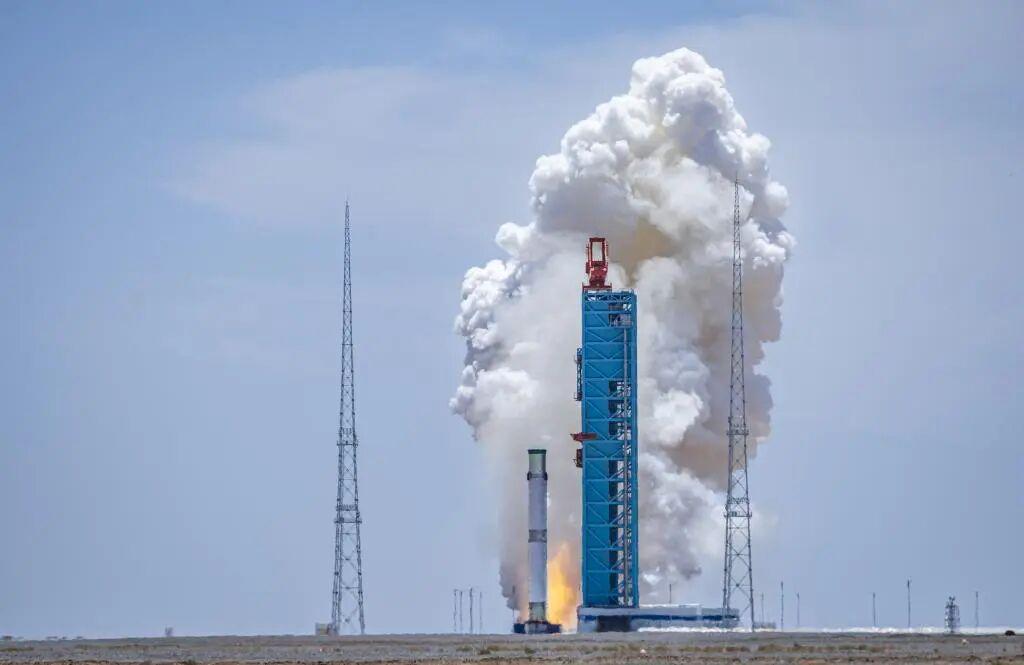
好评中国|向新向优,激活中国经济高质量发展新引擎
Huan Qiu Wang· 2026-01-30 02:38
站在新的起点,展望"十五五"时期,巩固和扩大科技创新优势至关重要。我们既要巩固在数字经济、绿 色经济等领域的现有优势,也需前瞻布局商业航天、低空经济、人形机器人等新赛道,形成"技术多点 突破、产业梯度接续、跨界深度融合"的发展格局。这要求我们进一步强化企业创新主体地位,深化产 教融合,让人才、技术、资本等要素流动更加顺畅,从而为实体经济注入源源不断的新动能。 察势者智,驭势者赢。当前全球科技竞争空前激烈,抓创新就是抓发展,谋创新就是谋未来。中国经济 的"向新而行",是一条依靠创新驱动提升全要素生产率、塑造核心竞争力的必由之路。只要我们坚持创 新在我国现代化建设全局中的核心地位,持续完善创新体系,激发人才活力,就一定能够不断开辟发展 新领域新赛道,在新一轮科技革命和产业变革中赢得主动、赢得优势、赢得未来。(甄郝) 科技创新与产业创新的深度融合,正催生一系列积极变革。2025年,我国规模以上数字产品制造业增加 值比上年增长9.3%,服务器、工业机器人等关键产品产量高速增长,标志着制造业正向更智能、更高 级迈进。以新能源汽车为例,其国内新车销量占比突破50%,这一里程碑式的数据,不仅是绿色消费理 念的普及,更是我国 ...
城建发展跌2.07%,成交额1.28亿元,主力资金净流出1920.77万元
Xin Lang Zheng Quan· 2026-01-30 02:10
Core Viewpoint - Beijing Urban Construction Investment Development Co., Ltd. has shown fluctuations in stock performance, with a recent decline in share price despite a year-to-date increase, indicating potential volatility in the market [1][2]. Group 1: Stock Performance - On January 30, the stock price of Beijing Urban Construction fell by 2.07% to 5.68 CNY per share, with a trading volume of 1.28 billion CNY and a turnover rate of 1.07%, resulting in a total market capitalization of 11.79 billion CNY [1]. - Year-to-date, the stock has increased by 12.03%, but it has experienced a decline of 11.94% over the last five trading days [1]. - The stock has appeared on the "Dragon and Tiger List" five times this year, with the most recent appearance on January 19, where it recorded a net buy of -19.49 million CNY [1]. Group 2: Company Overview - Beijing Urban Construction was established on December 30, 1998, and listed on February 3, 1999, primarily engaged in real estate development, equity investment, and commercial real estate operations [2]. - The company's revenue composition is heavily weighted towards real estate development, accounting for 97.24% of total income, with minor contributions from leasing and other services [2]. - As of September 30, the company reported a revenue of 19.31 billion CNY for the first nine months of 2025, reflecting a year-on-year growth of 64.20%, and a net profit attributable to shareholders of 0.765 billion CNY, up 40.24% [2]. Group 3: Shareholder Information - Cumulative cash dividends since the company's A-share listing amount to 5.243 billion CNY, with 0.519 billion CNY distributed over the past three years [3]. - As of September 30, 2025, the number of shareholders decreased by 1.74% to 47,600, while the average circulating shares per person increased by 1.77% to 43,583 shares [2][3]. - Notable institutional shareholders include Southern CSI Real Estate ETF and Hong Kong Central Clearing Limited, both of which have reduced their holdings compared to the previous period [3].

海特高新2026年1月30日跌停分析
Xin Lang Cai Jing· 2026-01-30 02:07
Core Viewpoint - Hite High-tech (SZ002023) experienced a limit down on January 30, 2026, with a price of 12.23 yuan, a decline of 10.01%, and a total market capitalization of 9.061 billion yuan, primarily due to significant asset impairment and investment risks impacting its aviation business [1]. Group 1: Financial Impact - The company announced a total asset impairment of approximately 620 million yuan, leading to a reversal from profit to loss for the year 2025, which significantly impacted current profits and contributed to the stock price drop [1]. - The market capitalization and circulating market capitalization both stand at 9.061 billion yuan, indicating a direct correlation between the financial announcements and market performance [1]. Group 2: Investment and Business Risks - Poor performance of investment projects, such as Huaxin Technology, highlights issues with asset allocation efficiency, raising concerns about the company's future growth [1]. - The impairment of aircraft assets suggests challenges in the aviation business, further increasing investor apprehension regarding the company's development [1]. Group 3: Market Sentiment and Reactions - Despite the introduction of a new commercial aerospace concept on January 9, 2026, the market's focus remained on the negative impacts of asset impairment and business risks, overshadowing any potential positive sentiment from the new concept [1]. - Recent increases in margin trading balances had previously boosted market interest, but the announcement of significant asset impairment led to cautious selling by investors, resulting in heightened selling pressure and the stock's limit down [1].

即将见证“超级商业帝国”诞生? 马斯克欲将“AI、机器人、商业航天与太空算力”装进同一估值表
Zhi Tong Cai Jing· 2026-01-30 01:32
Core Viewpoint - Tesla and SpaceX, both led by Elon Musk, are considering a potential merger to enhance SpaceX's valuation ahead of its planned IPO in 2026, while also possibly boosting Tesla's market value to meet Musk's compensation KPIs [1][2]. Group 1: Merger Considerations - SpaceX is exploring a significant merger with Tesla, driven by interest from large institutional investors [1]. - There are alternative merger discussions involving SpaceX and xAI, another Musk-founded company, as part of a strategy to create a vast "Musk Super Business Empire" [1]. - The merger discussions are still in preliminary stages, and SpaceX has not made any final decisions [2]. Group 2: Financial Implications - Any merger could attract substantial investment from infrastructure funds and sovereign wealth investors, indicating a need for significant financing [2]. - SpaceX is targeting a valuation of approximately $1.5 trillion for its IPO, with plans to raise up to $50 billion, potentially making it the largest IPO in history [6]. Group 3: Technological Synergies - SpaceX's vision includes deploying large-scale AI data centers in space to support complex computational workloads for AI applications on Earth, which could benefit both xAI and Tesla [3]. - The integration of SpaceX's capabilities with Tesla's AI and autonomous driving technologies could create a robust infrastructure for future innovations [4]. Group 4: Market Reactions - Following news of the merger discussions, Tesla's stock price rose by up to 4.5% in after-hours trading, despite a 3.5% decline during regular trading hours [5]. - The ongoing narrative surrounding SpaceX's IPO and its potential impact on Tesla's valuation continues to attract investor interest, reinforcing the belief in a strong long-term growth trajectory for Tesla [7][8]. Group 5: Broader Strategic Vision - Musk's overarching strategy appears to unify various sectors, including AI, space exploration, and robotics, into a comprehensive business model that could leverage synergies across these industries [11]. - The potential merger and the developments in SpaceX's projects are expected to significantly influence Tesla's long-term valuation and market sentiment [10].

金融界财经早餐:国办培育服务消费“路线图”出炉,涉房地产、汽车、旅游领域;“太空+”领域再迎利好!黄金巨震,多只黄金股提示风险;澜起科技今日开启招股(1月30日)
Jin Rong Jie· 2026-01-30 01:20
Group 1: Industry Insights - The China Aerospace Science and Technology Corporation aims to lead the commercial space industry during the 14th Five-Year Plan, focusing on new fields such as space resource development and space tourism [2] - The European chemical industry has seen a sixfold increase in capacity closures from 2022 to 2025, totaling 37 million tons, which is about 9% of Europe's total chemical capacity [9] - The AI industry is experiencing significant advancements, with multiple new models being released, including Alibaba's Qwen3-Max-Thinking and Baidu's Wenxin 5.0, indicating a competitive landscape [9] Group 2: Company Developments - Century Huatong expects a net profit of 5.55 billion to 6.98 billion yuan for 2025, representing a year-on-year growth of 357.47% to 475.34% [10] - Guizhou Moutai denied rumors of participating in SpaceX's Series A financing, clarifying that the information is false [10] - Apple reported a 16% year-on-year revenue increase to $143.76 billion for Q1 of fiscal 2026, with iPhone revenue reaching $85.27 billion [13]

经纬恒润:4季度盈利拐点出现,预计高阶智驾产品将成为新的增长点-20260130
Orient Securities· 2026-01-30 00:50
Investment Rating - The report maintains a "Buy" rating for the company with a target price of 213.21 CNY, based on a comparable company PE average valuation of 69 times for 2026 [3][6]. Core Insights - The company is expected to see a turning point in profitability in Q4, with high-level autonomous driving products anticipated to become a new growth driver [2]. - The forecasted EPS for 2025-2027 is 0.79, 3.09, and 4.98 CNY respectively, reflecting adjustments in revenue, gross margin, and expense ratios [3]. - The company is projected to achieve significant revenue growth, with expected revenues of 6.963 billion CNY in 2025, 8.687 billion CNY in 2026, and 10.510 billion CNY in 2027, representing growth rates of 25.7%, 24.8%, and 21.0% respectively [5][11]. Financial Summary - The company reported revenues of 4.678 billion CNY in 2023, with a year-on-year growth of 16.3%, and is expected to reach 5.541 billion CNY in 2024 [5][11]. - Operating profit is projected to turn positive in 2025, with an expected profit of 95 million CNY, following losses of 284 million CNY in 2023 and 595 million CNY in 2024 [5][11]. - The net profit attributable to the parent company is expected to be 95 million CNY in 2025, recovering from losses of 217 million CNY in 2023 and 550 million CNY in 2024 [5][11]. - The gross margin is expected to stabilize around 24.5% to 24.7% from 2025 to 2027, while the net margin is projected to improve from -4.6% in 2023 to 5.7% in 2027 [5][11]. Business Development - The company is expanding its automotive electronics business and has made significant progress in its high-level autonomous driving solutions, with the L4 level Robo-X product expected to drive future growth [10]. - Strategic partnerships, such as the one with White Rhino, are aimed at scaling up the commercial deployment of unmanned logistics vehicles, which is expected to enhance the company's product offerings and market presence [10]. - The company is also diversifying into commercial aerospace, leveraging its subsidiary's capabilities in avionics, communication, radar, and control systems [10].

2026年度策略:锚定AI未来,共启科技新篇
GOLDEN SUN SECURITIES· 2026-01-30 00:50
Group 1: Financial Technology - In 2026, global liquidity is expected to remain reasonably ample, with the domestic monetary policy maintaining a moderately loose tone[14] - The digital RMB 2.0 will officially implement on January 1, 2026, transitioning from M0 to M1 currency attributes[18] - The CIPS network expansion will be a key focus starting February 1, 2026, as new rules for the RMB cross-border payment system come into effect[20] Group 2: AI Applications - The AI application landscape is shifting towards commercial monetization, with a focus on achieving breakeven after initial explosive growth[24] - C-end applications are dominated by major tech giants, making it difficult for smaller firms to survive in the market[40] - B-end applications are seeing some achieving unit economics (UE) breakeven, particularly in sectors with high product-market fit (PMF) like robotaxi[45] Group 3: AI Computing Power - Global demand for AI computing power is on the rise, with domestic internet companies being the largest consumers of intelligent computing servers[3] - Domestic chip manufacturers are making significant breakthroughs, with companies like Huawei and Cambricon showing strong growth potential[3] - The shift towards scale-up supernode architectures is expected to accelerate, enhancing overall system performance[3] Group 4: AI Energy - The AIDC power supply paradigm is evolving towards 800V HVDC systems, driven by the need for higher power density and efficiency[4] - Nuclear fusion is being explored as a long-term energy solution, with significant advancements expected within the next five years[7]





黄金白银价格巨震;加快培育服务消费新增长点!国办印发工作方案|盘前情报
2 1 Shi Ji Jing Ji Bao Dao· 2026-01-30 00:41
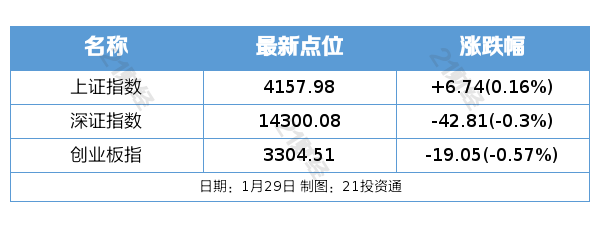
| 名称 | 最新点位 | 、涨跌幅 | | --- | --- | --- | | 上证指数 | 4157.98 | +6.74(0.16%) | | 深证指数 | 14300.08 | -42.81(-0.3%) | | 创业板指 | 3304.51 | -19.05 (-0.57%) | | | 日期:1月29日 制图:21投资通 | | 昨日A股 1月29日,三大指数涨跌不一,沪指窄幅震荡,上证50指数涨超1%,创业板指冲高回落,科创50指数跌 超3%。截至收盘,沪指涨0.16%,深成指跌0.3%,创业板指跌0.57%。沪深两市成交额3.23万亿,较上 一个交易日放量2646亿。 盘面上,市场热点快速轮动,全市场超3500只个股下跌。从板块来看,白酒板块午后爆发,泸州老窖、 水井坊、舍得酒业、皇台酒业、酒鬼酒涨停。有色金属板块反复活跃,金属铜、贵金属领涨,西部黄金 7天4板,中国黄金5连板,北方铜业2连板创历史新高。油气股延续强势,洲际油气7天5板,准油股份2 连板,中曼石油4天3板。房地产板块震荡反弹,大悦城、三湘印象、我爱我家涨停。下跌方面,芯片产 业链下挫,美埃科技、京仪装备跌超9%。 隔夜外盘 ...
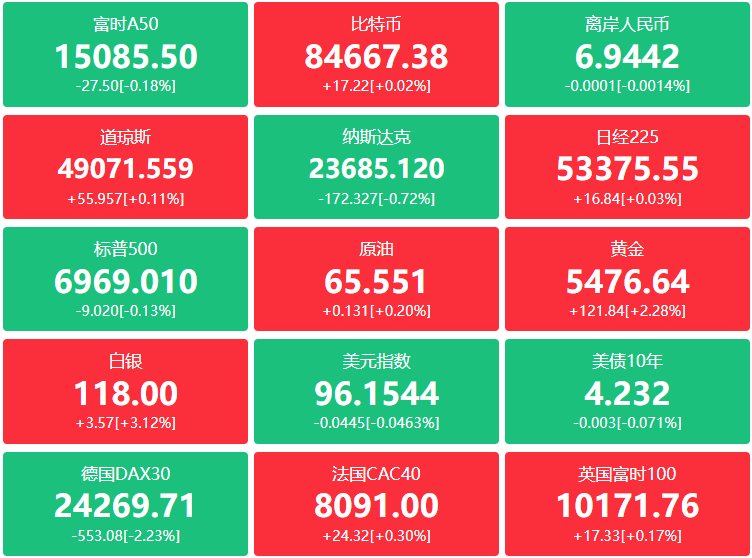
盘前必读丨国办发文加快培育服务消费新增长点;现货黄金本月累计涨幅约24%
Di Yi Cai Jing· 2026-01-30 00:04
Group 1 - The State Council issued a work plan to optimize and expand service supply, aiming to enhance service consumption and support high-quality economic development [2] - The work plan focuses on key areas such as transportation services, housekeeping services, and inbound consumption, emphasizing innovation and talent development [2] - The commercial aerospace industry is being prioritized, with plans to develop new fields like space resource development and space tourism during the 14th Five-Year Plan [3] Group 2 - Shanghai aims to become a national hub for the commercial aerospace industry, targeting an industry scale of approximately 100 billion yuan by 2027 [4] - The Beijing humanoid robot innovation center has launched a testing platform, capable of producing 5,000 humanoid robots annually [4] - The Kunshan AI industry fund has been established with a total scale of 5 billion yuan, focusing on AI core hardware and infrastructure [5] Group 3 - The market is experiencing mixed performance, with major U.S. indices showing slight fluctuations [6] - Microsoft shares dropped 10%, marking the largest single-day decline since March 2020, due to concerns over high AI capital expenditures [8] - Gold prices reached a record high of $5,594.82 per ounce before settling at $5,389.19, with a monthly increase of approximately 24% [9]




