货币政策

Search documents
东方金诚:2026年1月LPR报价保持不变,二季度有望跟进政策利率下调
Jin Rong Jie· 2026-01-20 02:44
Core Viewpoint - The People's Bank of China has maintained the Loan Prime Rate (LPR) unchanged for both 1-year and 5-year terms at 3.0% and 3.5% respectively, reflecting market expectations and stable monetary policy conditions [1] Group 1: LPR and Monetary Policy - The LPR quotes for January remained stable due to unchanged policy rates and stable medium to long-term market interest rates, indicating a lack of incentive for banks to lower LPR spreads [1] - Since June 2025, the LPR has not changed, primarily driven by strong export performance and rapid development in high-tech manufacturing sectors, allowing the macro economy to withstand external pressures [1] Group 2: Economic Outlook - Despite a downward trend in economic growth due to real estate market adjustments and weakened investment and consumption, employment remains stable and inflation is showing signs of recovery [2] - GDP growth is expected to rebound to approximately 4.7% year-on-year in Q1 2026, with monetary policy likely to remain stable in the short term [2] - There is potential for comprehensive policy rate cuts if economic pressures increase in Q2 2026, which could lead to a reduction in LPR and lower loan rates for businesses and households [2] Group 3: Real Estate Market Stability - Efforts will be made to stabilize the real estate market, with expectations that regulatory measures may lead to significant reductions in the 5-year LPR, combined with fiscal subsidies to lower residential mortgage rates [3]
央行发布1月LPR数据,连续8个月不变
Guan Cha Zhe Wang· 2026-01-20 02:41
Group 1 - The People's Bank of China announced that the Loan Prime Rate (LPR) for January 2026 remains unchanged for the eighth consecutive month, with the 1-year LPR at 3.0% and the 5-year LPR at 3.5% [1] - The previous LPR values were 3.10% for the 1-year and 3.60% for the 5-year, indicating a reduction in May 2025 to the current levels [1] - The LPR is determined by quoting banks based on the open market operation rate, aimed at providing a pricing reference for bank loans [1] Group 2 - The Central Economic Work Conference emphasized the continuation of a moderately loose monetary policy, focusing on stabilizing economic growth and ensuring reasonable price recovery [2] - The policy aims to utilize various tools such as reserve requirement ratio cuts and interest rate reductions to maintain ample liquidity and support key areas like domestic demand, technological innovation, and small and medium enterprises [2] - The goal is to keep the RMB exchange rate stable at a reasonable and balanced level [2]
LPR连续8个月“按兵不动”,降息窗口何时打开?
Sou Hu Cai Jing· 2026-01-20 01:51
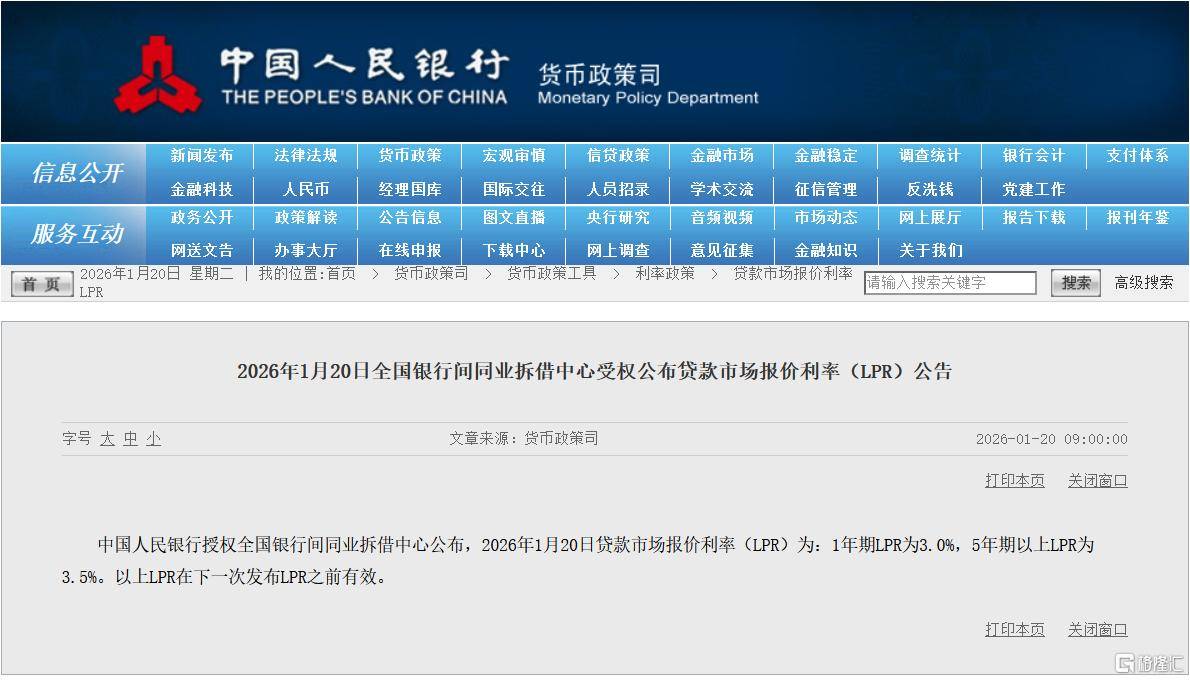
1月20日,中国央行公布最新LPR报价。 而LPR上一次调整则是在2025年5月,1年期和5年期以上LPR均下调10个基点。 | LPR市场公告 LPR | LPR简介 | LPR报价行成员 | 历史数据 | | | | --- | --- | --- | --- | --- | --- | | 贷款市场报价利率(LPR) | | | | | 2026-01-20 9:00 | | | 期限 | | | LPR(%) | | | | 17 | | | 3.00 | | | | 5Y | | | 3.50 | | 中国人民银行授权全国银行间同业拆借中心公布,2026年1月20日贷款市场报价利率(LPR)为:1年期LPR为3.0%,5年期以上LPR为3.5%。 以上LPR在下一次发布LPR之前有效。 | | | 中国人民纪行 THE PEOPLE'S BANK OF CHINA | | | 货币政策司 Monetary Policy Department | | | | | | --- | --- | --- | --- | --- | --- | --- | --- | --- | --- | | 信息公开 | ...

美联储独立性迎“生死考验”!美国最高法院就库克案举行听证会,鲍威尔将出席
Zhi Tong Cai Jing· 2026-01-20 00:51
智通财经获悉,据知情人士透露,美联储主席鲍威尔计划出席美国最高法院周三就美国总统特朗普试图 解职美联储理事丽莎·库克一案举行的听证会。在鲍威尔上周表示美国司法部已向美联储发出大陪审团 传票之后,他出席此次听证的这一动向更具分量。在此之前,鲍威尔似乎不愿发表任何可能激怒特朗普 的公开言论。在去年12月10日的新闻发布会上被问及该案件时,他选择不予回应,称"我们不是法律评 论员,此事正由法庭审理"。 美联储独立性面临严峻考验 除了试图罢免库克,特朗普政府还对鲍威尔本人发起了刑事调查。上周,据知情官员称,美国哥伦比亚 特区联邦检察官办公室已对鲍威尔展开刑事调查,调查内容涉及美联储对其华盛顿总部大楼的翻修工 程,以及鲍威尔是否就该项目的范围向国会撒谎。有知情官员透露,这项调查包括对鲍威尔公开声明的 分析以及对支出记录的审查,并于去年11月获得哥伦比亚特区联邦检察官珍妮娜·皮罗的批准。 随后,鲍威尔证实,美国司法部1月9日向美联储发出传票,威胁将就鲍威尔在参议院银行委员会作证一 事提起刑事指控,该证词部分涉及一项历时多年的历史性美联储办公楼翻新工程。 鲍威尔表示,此次新威胁既非针对去年六月的证词,也非针对美联储大楼翻修 ...
今日视点:“一行一局一会”工作会议释放哪些信号?
Xin Lang Cai Jing· 2026-01-19 23:10
Group 1 - The core policy direction of the People's Bank of China, the National Financial Regulatory Administration, and the China Securities Regulatory Commission remains stable, focusing on steady growth, promoting high-quality development, and risk prevention [1][2][3] - In monetary policy, the central bank emphasizes the importance of promoting high-quality economic development and reasonable price recovery as key considerations, while flexibly using various monetary policy tools [2][9] - The financial "five major articles" policy framework will be further improved in 2026, aiming to optimize the financial supply structure and inject lasting internal momentum into economic development [2][10] Group 2 - The emphasis on risk prevention remains clear, with the central bank proposing to improve macro-prudential and financial stability management tools, while the regulatory bodies focus on addressing existing risks and preventing new ones [3][10] - There is an increased focus on collaborative efforts among the three departments, recognizing that single-department actions have limited marginal effects in the current economic environment [4][11] - The 2026 work priorities show a shift towards more forward-looking and institutionalized arrangements, with a clear focus on the "15th Five-Year Plan" and the establishment of mechanisms to support capital markets [5][13]
2025年消费贷款余额超21万亿元
Xin Lang Cai Jing· 2026-01-19 22:17
在促进增强居民消费能力、支持真实消费融资需求方面,中国人民银行将继续实施好创业担保贷款政 策,支持重点群体的就业创业和符合条件的小微企业吸纳就业。支持中国资本市场健康稳定发展,增加 居民的投资渠道。规范发展消费金融,满足居民多样化、个性化的消费需求。加强金融、财政政策协 同,配合落实消费领域贷款贴息等政策,降低消费领域的融资成本。在优化消费金融基础服务方面,将 持续完善多元化支付服务体系,结合重点消费场景提升支付体验,实施一次性信用修复政策,改善消费 金融环境。 在加大信贷投放的同时,中国人民银行不断降低借贷成本。数据显示,2025年12月,新发放企业贷款加 权平均利率和新发放个人住房贷款加权平均利率在3.1%左右,自2018年下半年以来,分别下降2.5个和 2.6个百分点。发布会上,中国人民银行副行长邹澜宣布,下调各类结构性货币政策工具利率0.25个百分 点。具体而言,各类再贷款一年期利率从目前的1.5%下调到1.25%,其他期限档次利率同步调整;再贴 现利率从1.75%下调至1.5%。 邹澜还表示,今年降准降息仍有一定空间。中国人民银行将继续综合施策,促进社会综合融资成本低位 运行。比如,推动明示贷款综合 ...
“一行一局一会”工作会议释放哪些信号?
Zheng Quan Ri Bao· 2026-01-19 16:11
Core Viewpoint - The annual work meetings of the People's Bank of China, the National Financial Regulatory Administration, and the China Securities Regulatory Commission indicate a stable policy direction for 2026, with a focus on enhancing existing frameworks and mechanisms to support economic growth and risk management [1][2]. Group 1: Policy Continuity and Focus - The policy themes of stabilizing growth, promoting high-quality development, and preventing risks remain consistent, providing a key support for market expectations [2]. - The central bank emphasizes a flexible and efficient use of monetary policy tools, including potential interest rate cuts, while ensuring that policies effectively reach the real economy [2]. - The financial "five major articles" will continue to be a focus, with an aim to optimize the financial supply structure and inject sustainable internal momentum into economic development [2]. Group 2: Risk Management - The commitment to risk prevention remains strong, with the central bank and regulatory bodies focusing on improving macro-prudential tools and managing existing risks while preventing new ones [3]. - The emphasis on preventing significant market fluctuations reflects a high level of concern regarding financial stability [3]. Group 3: Enhanced Coordination - Increased coordination among the three departments is crucial in the current economic environment, where the marginal effects of single-department actions are limited [4]. - The focus has shifted from merely expanding financial scale to optimizing structure and improving efficiency, with unified goals across different regulatory levels [4]. Group 4: Forward-Looking and Mechanized Approach - The meetings signal a stronger emphasis on the "15th Five-Year Plan," indicating a shift towards long-term institutional development [6]. - Mechanisms for providing liquidity to non-bank institutions and optimizing related arrangements are being institutionalized, reflecting a transition from effective measures to systematic approaches [6]. - The overall strategy for 2026 combines continuity with innovation, aiming for a more systematic, coordinated, and forward-looking financial regulation framework [6][7].
美联储主席候选者生变:华尔街交易员里德尔成黑马
证券时报· 2026-01-19 15:01
Core Viewpoint - The competition for the new chair of the Federal Reserve has intensified with the emergence of Rick Rieder as a potential dark horse candidate, alongside established contenders Kevin Hassett, Kevin Warsh, and Christopher Waller [2][3]. Candidate Overview - Rick Rieder, currently the Chief Investment Officer of Global Fixed Income at BlackRock, has reportedly performed well in interviews with President Trump, increasing his odds of nomination significantly [4]. - Rieder's background is notable as he lacks a traditional economics PhD, similar to current chair Jerome Powell, which may signal a shift in the profile of Fed leadership [4]. Monetary Policy Stance - Rieder advocates for lowering interest rates to around 3% as the "neutral level" and has a more lenient view on government deficits and inflation, suggesting that slightly higher inflation could be acceptable if it stabilizes debt dynamics and supports employment [5]. Market Predictions - Current betting markets indicate that Kevin Warsh remains the frontrunner for nomination, with Rieder's odds rising sharply to second place, followed by Christopher Waller [6]. Political Context - Treasury Secretary Mnuchin hinted that Trump plans to announce the nominee around the Davos Forum to reduce market uncertainty. Hassett's potential continuation in his current role may narrow the competition to Rieder, Warsh, and Waller [8]. - The political environment is tense, with recent scrutiny of the Fed's renovation project leading to increased challenges for any nominee, but Rieder is viewed as a safer option due to his market-oriented background [8]. Confirmation Process - Mnuchin expressed confidence that the Senate will not block Trump's eventual nominee, indicating a belief in a smooth confirmation process [9].
美联储主席候选者生变:华尔街交易员里德尔成黑马
Zheng Quan Shi Bao· 2026-01-19 15:00
Core Viewpoint - The competition for the new Federal Reserve Chair has intensified with the emergence of a new candidate, Rick Rieder, alongside established contenders Kevin Hassett, Kevin Warsh, and Christopher Waller [1][2]. Group 1: Candidate Profiles - Rick Rieder, currently the Chief Investment Officer at BlackRock, has shown strong performance in interviews with President Trump, leading to an increased probability of his nomination [2][3]. - Rieder's background differs from traditional candidates as he lacks a PhD in economics, similar to the current Chair Jerome Powell, which may signal a shift in the selection process [2]. - Kevin Hassett, previously a leading candidate, may remain in his current role, narrowing the competition to Rieder, Warsh, and Waller, who represent more conventional choices with extensive central bank experience [5]. Group 2: Monetary Policy Views - Rieder advocates for lowering interest rates to around 3% as the "neutral level" and has a more lenient stance on government deficits and inflation, suggesting that slightly higher inflation could be acceptable if it stabilizes debt dynamics and maintains employment [3]. - The prediction market indicates that Kevin Warsh remains the frontrunner for nomination, with Rieder's chances significantly rising to second place [3]. Group 3: Political Context - Treasury Secretary Mnuchin has indicated that Trump plans to announce the nominee around the time of the Davos Forum to reduce market uncertainty [4]. - The political environment has become tense, particularly with the Justice Department's recent actions against the current Chair Powell, which may complicate the nomination process for any candidate [4]. - Rieder is viewed as a "safer option" for Senate confirmation due to his distance from political controversies, contrasting with traditional candidates who are more entrenched in Washington politics [4].
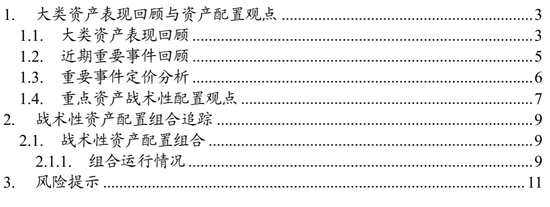
国泰海通:特朗普扰动地缘政治局势,建议超配黄金
Sou Hu Cai Jing· 2026-01-19 13:18
Core Viewpoint - The Trump administration's implementation of hegemonic policies has led to further deterioration of international geopolitical situations, which is favorable for gold performance. Tactical overweighting of A/H shares, US stocks, and gold is recommended, while underweighting US bonds and oil is advised [1]. Group 1: Asset Performance and Allocation Insights - Multiple factors support the performance of Chinese equities, suggesting an overweight in A/H shares. The upcoming economic work conference and the start of the 14th Five-Year Plan in 2026 are expected to lead to further expansion of the broad deficit and more proactive economic policies. The Fed's expected rate cut in December and the stable appreciation of the RMB provide favorable conditions for monetary easing in early 2026 [2][8]. - The uncertainty surrounding the new Fed chairperson has increased market speculation regarding US monetary policy, suggesting an underweight in US bonds. The cooling labor market, declining energy prices, and slow wage growth are conducive to a decrease in endogenous inflation stickiness, allowing for more flexibility in Fed policy adjustments. The resilience of the US economy may lead to a cautious direction in Fed policy guidance, with US bond yields expected to decline moderately [2][8]. - In the context of geopolitical upheaval, gold exhibits strong resilience and safe-haven attributes, recommending an overweight in gold. The rising uncertainty in global geopolitical situations and continued central bank purchases of gold support a long-term price floor for gold. Despite speculative inflows temporarily increasing gold volatility, the price remains resilient amid the Trump administration's hegemonic policies and the erosion of US international credibility [2][8]. Group 2: Recent Important Events Review - The uncertainty regarding the Fed chair candidates has risen again, with Trump indicating that Kevin Hassett may remain in his position. This could impact market expectations for monetary policy [6][7]. - Trump's imposition of tariffs on eight European countries and the push for the purchase of Greenland has escalated geopolitical tensions, significantly undermining US international credibility and reflecting hegemonic behavior [6][7]. Group 3: Tactical Asset Allocation Recommendations - The recommendation to overweight A/H shares is based on multiple supportive factors for Chinese equities, including anticipated proactive economic policies and favorable monetary conditions [9]. - An underweight in US bonds is advised due to the increasing uncertainty surrounding the new Fed chairperson and the relatively low risk-return ratio compared to risk assets [9]. - Gold is recommended for overweighting due to its strong resilience and safe-haven characteristics amid rising geopolitical uncertainties [9].