
现代化产业体系

Search documents
专访申万宏源赵伟:全年实现5%的经济增长目标具备坚实支撑
Nan Fang Du Shi Bao· 2025-10-30 07:54
Core Viewpoint - The 20th Central Committee's Fourth Plenary Session emphasizes the importance of the "15th Five-Year Plan" period for achieving socialist modernization and outlines the strategic direction for China's economic development amidst global uncertainties [1][4]. Economic Outlook - The session highlights that China's economy is at a stage where strategic opportunities coexist with risks and challenges, stressing the need to face significant tests with a proactive approach [4][5]. - The meeting indicates that achieving a 5% economic growth target for the year is supported by substantial financial measures, including the deployment of nearly 300 billion yuan in policy financial tools and the allocation of 500 billion yuan from local government debt limits [6][5]. Industrial Development - The session places a stronger emphasis on building a modern industrial system, explicitly stating the need to maintain a reasonable proportion of manufacturing [8][7]. - It prioritizes the optimization and upgrading of traditional industries to enhance global competitiveness, while also planning for strategic emerging industries and future industries [8]. Domestic Demand and Market Integration - The session calls for enhancing the internal dynamics and reliability of domestic circulation, with specific measures to stimulate consumption and investment [9][10]. - It emphasizes breaking down barriers to the construction of a unified national market, aiming to eliminate local protectionism and market segmentation [10]. Technological Advancement - The meeting underscores the importance of technological self-reliance and the role of new productive forces, with a focus on accelerating breakthroughs in key technology areas [11]. - It highlights the integration of technology development with digital economy initiatives and the need for coordinated development of education, technology, and talent [11].



热词里的“十五五” | 建设现代化产业体系,千行百业将迎来哪些变化?
Ren Min Wang· 2025-10-30 06:01
Core Viewpoint - The article emphasizes the importance of building a modern industrial system as the material and technological foundation for a modern nation, as outlined in the "14th Five-Year Plan" by the Central Committee of the Communist Party of China [1]. Group 1: Optimizing Traditional Industries - The plan aims to enhance and upgrade key traditional industries such as mining, metallurgy, chemical, light industry, textiles, machinery, shipbuilding, and construction to strengthen their global competitiveness [4]. - It focuses on improving the self-controllability of industrial chains and emphasizes the need for major technological breakthroughs and the implementation of high-quality development actions for key manufacturing industries [4]. Group 2: Developing Emerging Pillar Industries - The initiative includes the implementation of industrial innovation projects to promote the development of strategic emerging industries such as new energy, new materials, aerospace, and low-altitude economy [5]. - It aims to create a robust industrial ecosystem by facilitating large-scale application demonstrations of new technologies, products, and scenarios to accelerate the growth of emerging industries [5]. Group 3: Forward-Looking Layout for Future Industries - The plan encourages exploration of diverse technological routes, typical application scenarios, feasible business models, and market regulation rules to drive growth in sectors like quantum technology, biomanufacturing, hydrogen energy, and nuclear fusion [6]. - It also emphasizes the need for innovative regulatory methods and the development of venture capital to support the growth of future industries [6][8]. Group 4: Enhancing and Upgrading the Service Sector - The strategy includes actions to expand and improve the service sector, enhance regulatory reforms, and develop a supportive policy framework [9]. - It aims to promote the specialization and high-end value chain extension of productive services while fostering high-quality, diversified, and convenient development in the life services sector [9].
螺纹钢:宏观情绪推涨,钢价走势偏强震荡,热轧卷板:宏观情绪推涨,钢价走势偏强震荡
Guo Tai Jun An Qi Huo· 2025-10-30 06:01
Report Summary 1. Report Industry Investment Rating - No industry investment rating is provided in the report. 2. Core Viewpoints - The prices of rebar and hot - rolled coils are expected to show a strong and volatile trend driven by macro - sentiment [1]. 3. Summary by Relevant Catalogs 3.1 Fundamentals Tracking - **Futures Information**: For rebar contract RB2601, the closing price was 3,133 yuan/ton, up 31 yuan or 1.00%, with a trading volume of 1,239,602 lots, a position of 1,894,007 lots, and a position change of - 36,350 lots. For hot - rolled coil contract HC2601, the closing price was 3,345 yuan/ton, up 40 yuan or 1.21%, with a trading volume of 573,794 lots, a position of 1,461,059 lots, and a position change of - 12,738 lots [1]. - **Spot Price Information**: Rebar prices in Shanghai, Hangzhou, Beijing, and Guangzhou increased by 20 yuan, 10 yuan, 30 yuan, and 20 yuan respectively. Hot - rolled coil prices in Shanghai, Hangzhou, Tianjin, and Guangzhou increased by 20 yuan, 20 yuan, 20 yuan, and 30 yuan respectively. The price of Tangshan billet rose by 20 yuan to 3000 yuan/ton [1]. - **Price Difference Information**: The basis of RB2601 decreased by 22 yuan to 107 yuan, and the basis of HC2601 decreased by 20 yuan to 15 yuan. The spread of RB2601 - RB2605 increased by 10 yuan to - 53 yuan, and the spread of HC2601 - HC2605 increased by 2 yuan to 13 yuan [1]. 3.2 Macro and Industry News - **Policy News**: Five - department offices including the Ministry of Commerce issued the "Urban Commercial Quality Improvement Action Plan", supporting eligible commercial real estate projects to issue real estate investment trust funds (REITs). The 15th Five - Year Plan proposed directions for the high - quality development of the steel industry, such as promoting the quality improvement of key industries and enhancing the independent controllability of the industrial chain [2][3]. - **Production and Inventory Data**: In the week of October 23, rebar production increased by 5.91 tons, hot - rolled coil production increased by 0.62 tons, and the total production of five major varieties increased by 8.37 tons. Rebar inventory decreased by 18.94 tons, hot - rolled coil inventory decreased by 4.27 tons, and the total inventory of five major varieties decreased by 27.41 tons [3]. - **Output Data**: In September 2025, the national crude steel production was 7349 million tons, a year - on - year decrease of 4.6%. The daily output was 244.97 million tons/day, a month - on - month decrease of 1.8%. From January to September, the cumulative production of crude steel was 746 million tons, a year - on - year decrease of 2.9% [3]. - **Inventory Data**: In early October 2025, the steel inventory of key steel enterprises was 15.88 million tons, a week - on - week increase of 121 million tons or 8.2% [3]. 3.3 Trend Intensity - The trend intensity of rebar and hot - rolled coils is 1, indicating a relatively strong trend [3][4].
国泰君安期货商品研究晨报:黑色系列-20251030
Guo Tai Jun An Qi Huo· 2025-10-30 03:49
Report Industry Investment Rating No relevant content provided. Core Viewpoints of the Report - Iron ore is expected to fluctuate strongly [2][6]. - The prices of rebar and hot-rolled coil are pushed up by macro sentiment and are expected to fluctuate strongly [2][7]. - Ferrosilicon and silicomanganese are driven by anti-involution sentiment and are expected to fluctuate strongly [2][12][13]. - Coke is expected to fluctuate strongly [2][16]. - Coking coal resonates with the macro and sector themes and is expected to fluctuate strongly [2][17]. - Logs are expected to fluctuate repeatedly [2][19]. Summary by Related Catalogs Iron Ore - **Fundamental Data**: The futures price closed at 804.5 yuan/ton, up 12 yuan or 1.51%. The open interest decreased by 6,094 lots. The prices of imported and some domestic ores increased slightly. The basis and some spreads changed [5]. - **Macro and Industry News**: President Xi Jinping will meet with US President Trump in Busan, South Korea on October 30 to exchange views on Sino-US relations and common concerns [5]. - **Trend Intensity**: The trend intensity of iron ore is 0 [5]. Rebar and Hot-Rolled Coil - **Fundamental Data**: The futures prices of RB2601 and HC2601 increased, with the latter rising 1.21%. The trading volume and open interest of some contracts changed. The spot prices in various regions increased, and the basis and spreads also changed [7]. - **Macro and Industry News**: Five departments including the Ministry of Commerce support eligible commercial real estate projects to issue REITs. The 15th Five-Year Plan proposes directions for the high-quality development of the steel industry. Steel production and inventory data for October 23 and September 2025 are provided, and the steel inventory of key enterprises in early October increased [8][9]. - **Trend Intensity**: The trend intensity of rebar and hot-rolled coil is 1 [9]. Ferrosilicon and Silicomanganese - **Fundamental Data**: The futures prices of ferrosilicon and silicomanganese contracts increased. The spot prices of some products changed, and the basis, spreads, and cross-variety spreads also changed [13]. - **Macro and Industry News**: The prices of ferrosilicon and silicomanganese in different regions are reported. A large ferrosilicon factory in Gansu reduced production, and a steel mill in Zhejiang set a purchase price for silicomanganese. The production of silicomanganese in northern regions in October decreased [13][15]. - **Trend Intensity**: The trend intensity of ferrosilicon and silicomanganese is 0 [15]. Coke and Coking Coal - **Fundamental Data**: The futures prices of coking coal and coke contracts increased significantly. The spot prices of some coking coal and coke products changed, and the basis and spreads also changed [17]. - **Macro and Industry News**: President Xi Jinping will meet with US President Trump in Busan, South Korea on October 30 to exchange views on Sino-US relations and common concerns [18]. - **Trend Intensity**: The trend intensity of coke and coking coal is 0 [18]. Logs - **Fundamental Data**: The prices, trading volumes, and open interests of log futures contracts changed. The spot prices of different types of logs in various regions remained stable or changed slightly [20]. - **Macro and Industry News**: President Xi Jinping will meet with US President Trump in Busan, South Korea on October 30 to exchange views on Sino-US relations and common concerns [22]. - **Trend Intensity**: The trend intensity of logs is 0 [22].
首位任务!“十五五”为何将实体经济摆在最前?
Yang Guang Wang· 2025-10-30 02:48
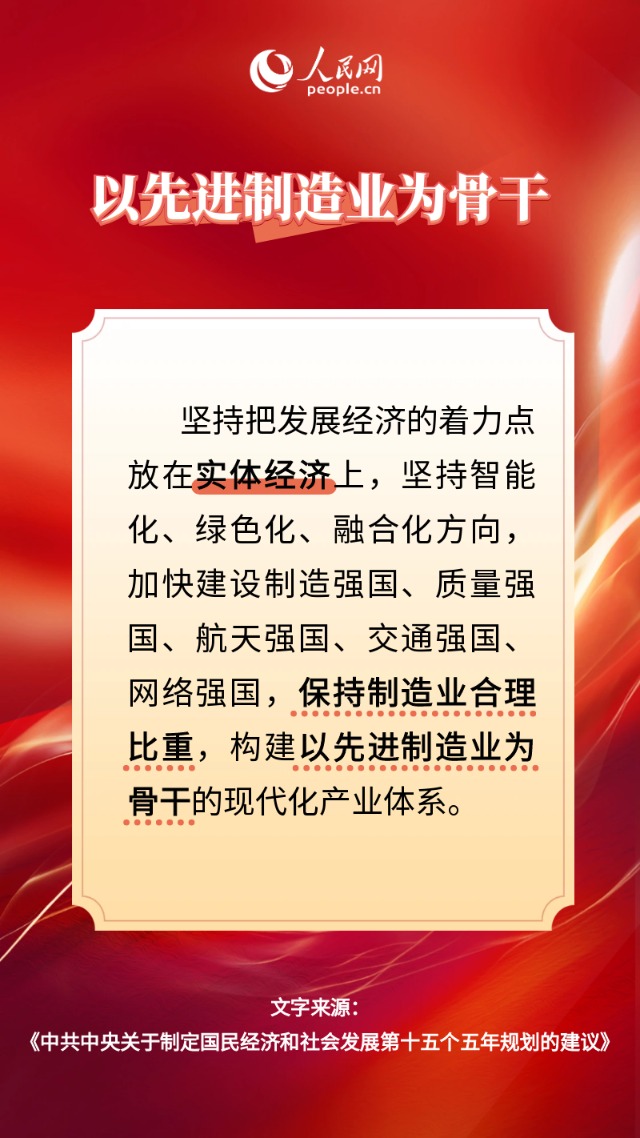
Group 1 - The core focus of the "15th Five-Year Plan" is to prioritize the construction of a modern industrial system and strengthen the foundation of the real economy, highlighting its strategic importance [1][2] - The real economy is deemed essential for national strength, with China's manufacturing sector maintaining its position as the largest globally for 15 consecutive years, increasing total industrial added value from 31.3 trillion yuan to 40.5 trillion yuan [2] - The plan emphasizes the need for a solid foundation in the real economy to effectively respond to risks and challenges, ensuring competitiveness in the global market [2] Group 2 - The approach to consolidating and strengthening the real economy includes optimizing traditional industries, nurturing emerging industries, and enhancing the quality of the service sector, alongside modern infrastructure development [3] - Advanced manufacturing is identified as the backbone of the modern industrial system, with a call to accelerate the establishment of a manufacturing powerhouse and promote high-quality development in various sectors [3][4] - The integration and collaboration between advanced manufacturing and modern services are crucial, with a focus on breaking bottlenecks and ensuring efficient resource allocation to support industrial upgrades [4]
“十五五”规划建议解读 - 产业政策的投资映射
2025-10-30 01:56
Summary of Key Points from Conference Call Industry Overview - **Transportation Industry**: China is building a modern high-quality comprehensive transportation network, aiming for a "national 123 travel circle" and "national global 123 fast cargo logistics circle" by 2035. The transportation power index has reached the fifth globally, with significant infrastructure progress, including the largest high-speed rail and highway networks in the world [1][4]. - **Chemical Industry**: The demand in the chemical industry is expected to continue expanding, with a potential alleviation of intense competition. Strategic emerging industries like new materials are anticipated to develop rapidly. As of October 28, 2025, the chemical sector's price-to-earnings (PE) ratio is at a historically high level, while the oil and petrochemical sector's PE ratio is at a low level, suggesting a focus on leading companies and new materials firms [1][10][11]. - **Nuclear Fusion Technology**: Due to technological advancements and increased energy competition, controlled nuclear fusion technology is gaining attention. Domestic projects are progressing, with significant investments planned for the Shanghai ITER project, expected to start construction in 2027 [1][13][14]. Core Insights and Arguments - **Transportation Goals**: The "15th Five-Year Plan" emphasizes accelerating the construction of a transportation power, with specific goals for urban commuting and logistics efficiency. The plan includes enhancing connectivity with Southeast Asia and countries along the Belt and Road Initiative [2][5]. - **Green and Smart Transportation**: Future initiatives will focus on green transportation, increasing the electrification of railways and airports, and promoting the use of electric heavy trucks and hydrogen fuel. Smart transportation technologies, including AI applications for autonomous driving, are also highlighted as key development areas [6][7]. - **Chemical Industry Outlook**: The chemical industry is projected to experience high-quality growth driven by increasing domestic demand and a shift towards strategic emerging industries. The focus will be on enhancing the self-sufficiency of key sectors like electronic chemicals and specialty materials [10][12]. - **Investment Recommendations**: The chemical sector's investment recommendations include focusing on leading companies benefiting from policy support and demand recovery, as well as sectors like semiconductor materials and new energy materials [12]. Additional Important Content - **Technological Innovation**: The plan emphasizes the importance of technological self-reliance and innovation, particularly in the semiconductor and electronic sectors. Emerging fields such as quantum technology and brain-computer interfaces are identified as future growth areas [20][23]. - **Market Dynamics**: The electronic technology sector is experiencing significant performance improvements, driven by global tech trends and supportive domestic policies. The current market is characterized by a convergence of fundamental and narrative factors, suggesting a robust growth outlook [22]. - **New Energy Storage**: The energy storage industry is expected to grow rapidly in the next five years, driven by the increasing share of renewable energy sources like wind and solar power [16][17]. - **Policy Impact on Emerging Technologies**: Government policies are crucial in fostering the development of emerging technologies, particularly in quantum computing and brain-computer interfaces, which are in their early stages but have vast market potential [25]. This summary encapsulates the key points discussed in the conference call, providing insights into the transportation and chemical industries, technological advancements, and investment opportunities.
关键词读懂“十五五”丨首位任务!“十五五”为何将实体经济摆在最前?
Yang Guang Wang· 2025-10-30 01:43
Group 1 - The core strategy of the "14th Five-Year Plan" emphasizes the importance of strengthening the real economy as the foundation for national strength and resilience [1][3] - China's manufacturing industry has maintained its position as the world's largest for 15 consecutive years, with total industrial added value increasing from 31.3 trillion yuan to 40.5 trillion yuan, and manufacturing added value rising from 26.6 trillion yuan to 33.6 trillion yuan during this period [1] - The "15th Five-Year Plan" aims to solidify the foundation of the real economy to effectively respond to risks and challenges, ensuring competitiveness in the global market [1] Group 2 - The Fourth Plenary Session emphasizes advanced manufacturing as the backbone of a modern industrial system, calling for the acceleration of building a manufacturing power, quality power, aerospace power, transportation power, and network power [2] - Experts highlight the need for traditional industries to undergo upgrades focusing on high-end, intelligent, green, and integrated transformations, while also prioritizing the development of strategic emerging industries and future industries [2] - The relationship between building a modern industrial system and consolidating the foundation of the real economy is interdependent, requiring clear top-level design and resource allocation to avoid fragmentation [2] Group 3 - The focus for the "15th Five-Year Plan" is on strengthening the real economy, with a dual approach of consolidation and expansion to achieve high-quality development and gain competitive advantages [3]
“十五五”,“建设现代化产业体系,巩固壮大实体经济根基”排首位
Ren Min Ri Bao· 2025-10-30 01:01
Core Viewpoint - The importance of the real economy is emphasized as a foundation for China's economic development and international competitiveness, particularly in the context of the "14th Five-Year Plan" and the upcoming "15th Five-Year Plan" [1][2][3]. Group 1: Importance of the Real Economy - The real economy is described as the foundation of a major country, with a strong emphasis on not allowing the economy to become detached from reality [2][3]. - The real economy serves as a "ballast" for economic operations, with significant labor demand across manufacturing, construction, agriculture, and services, absorbing over 400 million jobs, which accounts for 53% of the national employment population [3]. - Manufacturing is highlighted as a crucial pillar of the national economy, directly related to national strategic security, with China maintaining the world's largest manufacturing scale for 15 consecutive years, providing resilience against external uncertainties [3][4]. Group 2: Strategic Tasks for the "15th Five-Year Plan" - The strategic tasks for the "15th Five-Year Plan" include four main areas: 1. **Solid Foundation and Upgrading**: Optimizing and upgrading traditional industries, which account for over 80% of manufacturing, aiming to create approximately 10 trillion yuan in new market space over the next five years [4]. 2. **Innovation and New Industries**: Cultivating and expanding emerging and future industries, focusing on strategic emerging industries like new energy and new materials, and planning for quantum technology and biomanufacturing, with a goal of creating a scale equivalent to a new high-tech industry in the next decade [4]. 3. **Service Industry Development**: Promoting high-quality and efficient development of the service industry, enhancing the integration of modern services with advanced manufacturing and modern agriculture to meet people's needs and open new economic growth spaces [4]. 4. **Infrastructure Modernization**: Accelerating the construction of a modern infrastructure system, ensuring coordinated planning and development of new infrastructure to enhance connectivity and safety [5]. Group 3: Response to External Challenges - The real economy is positioned as a key element for navigating external uncertainties, with a call for leveraging technological advantages to transform into industrial strengths, ensuring that China's economy can withstand challenges and explore broader horizons [5].
全市前三季度经济运行分析会议召开
Zheng Zhou Ri Bao· 2025-10-30 00:55
Group 1 - The city's economy showed steady progress in the first three quarters, with a positive trend despite challenges [2] - Emphasis on achieving annual economic and social development goals, with a focus on stabilizing and enhancing the economic foundation [2][3] - The need for effective investment to drive high-quality development and enhance consumer activity [3] Group 2 - Plans to strengthen economic monitoring and release policy effects to support growth [3] - Importance of project construction and investment to lead economic development [3] - A call for the integration of primary, secondary, and tertiary industries to build a modern industrial system [3]
对标对表 稳扭转提 全面发力 勇挑大梁坚决打好冬春季攻保战役
Zheng Zhou Ri Bao· 2025-10-30 00:51
Core Insights - The city's economy showed steady progress in the first three quarters, with a positive trend despite challenges [2] - The meeting emphasized the importance of achieving annual economic and social development goals, focusing on stabilizing and enhancing the economic foundation [2][3] - Key strategies include enhancing innovation capabilities, optimizing service for key enterprises, and fostering new economic growth points [2] Group 1 - The city aims to consolidate advantages and stabilize the economic foundation while addressing weaknesses [2] - There is a focus on high-quality development and efficient allocation of production factors to sustain economic recovery [2] - The government plans to enhance employment support and ensure the well-being of citizens during winter [2] Group 2 - Project construction and investment expansion are prioritized to lead high-quality development [3] - The city is committed to modernizing its industrial system and promoting the integration of primary, secondary, and tertiary industries [3] - Economic monitoring will be strengthened to maximize the effects of policies [3]