
促消费政策

Search documents
9月企业短贷与居民中长贷双回暖:微观信心修复 政策效果渐显
Shang Hai Zheng Quan Bao· 2025-10-16 18:51
Group 1 - The central bank reported that in September, RMB loans increased by 1.29 trillion yuan, with short-term loans for enterprises rising by 710 billion yuan and long-term loans for residents increasing by 250 billion yuan, indicating a recovery in microeconomic confidence [1] - The manufacturing PMI rose by 0.4 percentage points to 49.8%, with the production index reaching a six-month high of 51.9%, reflecting the ongoing recovery of the real economy [1] - Factors contributing to the loan growth include the implementation of 500 billion yuan in new policy financial tools, improved corporate operating conditions, resilient exports, and low loan interest rates [1] Group 2 - The increase in long-term loans for residents suggests a rebound in housing mortgage demand, driven by recent adjustments in housing purchase policies in major cities [2] - Personal consumption loans for residents are expected to benefit from fiscal subsidies starting September 1, although the effects of these policies may not be fully realized until the fourth quarter [2] - Continuous financial policy implementation is anticipated to further stimulate microeconomic vitality and optimize credit structure, supporting high-quality economic development [2]
9月通胀数据点评:CPI环比季节性回升,PPI同比降幅收窄
Tai Ping Yang Zheng Quan· 2025-10-16 03:12
Group 1: CPI Analysis - In September 2025, the Consumer Price Index (CPI) decreased by 0.3% year-on-year, a narrowing of the decline by 0.1 percentage points from the previous month[3] - The core CPI, excluding food and energy, rose by 1.0% year-on-year, marking a continuous increase for five months and reaching a 19-month high[4] - Month-on-month, the CPI increased by 0.1%, transitioning from flat to positive growth, although this increase is below the historical average over the past decade[4] Group 2: PPI Analysis - The Producer Price Index (PPI) fell by 2.3% year-on-year in September, with the decline narrowing by 0.6 percentage points compared to the previous month[3] - The year-on-year decline in PPI is primarily attributed to a low base from the previous year, with production material prices decreasing by 2.4% and living material prices down by 1.7%[4] - Month-on-month, the PPI remained flat for two consecutive months, indicating a reduction in downward price pressure[4] Group 3: Future Outlook - The current low price levels are expected to persist, with pork prices continuing to decline; however, policies aimed at stimulating consumption may lead to a slight increase in CPI growth in October[4] - The real estate market remains weak, and infrastructure investment is below expectations, which may continue to exert pressure on industrial product prices[4] - The PPI is anticipated to continue its year-on-year decline, with a slight narrowing expected in October, but it is unlikely to turn positive within the year[4] Group 4: Risks - Potential risks include policy uncertainties, unexpected changes in macroeconomic fundamentals, and geopolitical risks from abroad[4]
9月份核心CPI同比涨幅近19个月以来首次回到1% 部分领域市场供求关系逐步改善
Jing Ji Ri Bao· 2025-10-16 00:27
Core Insights - The consumer price index (CPI) showed a slight increase in September, with a month-on-month rise of 0.1%, marking a shift from the previous month where it was flat. The core CPI, excluding food and energy, rose by 1% year-on-year, the highest increase in 19 months, indicating a recovery in consumer prices [1][2][3] Group 1: CPI Analysis - The year-on-year CPI decreased by 0.3%, but the decline was less severe than the previous month, narrowing by 0.1 percentage points. The drop was primarily due to the "carryover effect" from previous price changes [2] - Food prices fell by 4.4% year-on-year, contributing approximately 0.83 percentage points to the CPI decline. However, the core CPI's increase of 1% reflects a more stable underlying price level [2][3] - The rise in CPI was supported by government policies aimed at boosting consumption, with significant price increases in home appliances and mobile phones [2] Group 2: PPI Analysis - The producer price index (PPI) remained flat month-on-month for two consecutive months, with a year-on-year decline of 2.3%, which is a reduction of 0.6 percentage points from the previous month. This indicates some stabilization in industrial prices [3][4] - Certain industries, such as coal processing and black metal smelting, have shown price increases for two months, reflecting improved supply-demand dynamics [3][4] - The overall decline in PPI is influenced by last year's low comparison base and the positive effects of macroeconomic policies [3] Group 3: Market Dynamics - The construction of a unified national market has led to a reduction in year-on-year price declines across various sectors, with notable improvements in market competition and order [4] - Upgrading industrial structures and releasing consumer potential have contributed to price increases in specific sectors, such as aircraft manufacturing and nutritional food production [4]
9月份核心CPI同比涨幅近19个月以来首次回到1%——部分领域市场供求关系逐步改善
Jing Ji Ri Bao· 2025-10-15 22:11
Core Insights - The consumer price index (CPI) showed a slight increase in September, with a month-on-month rise of 0.1%, marking a shift from the previous month where it was flat. The core CPI, excluding food and energy, rose by 1% year-on-year, the highest increase in 19 months, indicating a recovery in consumer prices [1][2][3] CPI Analysis - The year-on-year CPI decreased by 0.3%, but the decline was less severe than the previous month, narrowing by 0.1 percentage points. The drop was primarily due to the "carryover effect" from previous price changes, with food prices falling by 4.4% [2][3] - Food prices saw a month-on-month increase of 0.7%, driven by seasonal rises in fresh vegetables, eggs, fruits, lamb, and beef, while pork and aquatic product prices decreased due to sufficient supply [1][2] PPI Insights - The producer price index (PPI) remained flat month-on-month for two consecutive months, with a year-on-year decline of 2.3%, which is a reduction of 0.6 percentage points from the previous month. This decline is attributed to a low comparison base from the previous year and the positive effects of macroeconomic policies [3][4] - Certain industries, such as coal processing and black metal smelting, have shown price stabilization, with some experiencing price increases for two consecutive months [3][4] Market Dynamics - The ongoing construction of a unified national market has contributed to a narrowing of year-on-year price declines in various sectors. Improved market competition and capacity management have led to better price stability in industries like coal and photovoltaic equipment [4] - The upgrading of industrial structures and the release of consumer potential have driven price increases in specific sectors, such as aircraft manufacturing and specialized electronic materials, reflecting a shift towards higher-quality and upgraded consumption [4]
【西街观察】物价回暖见韧性,经济向好有底气
Bei Jing Shang Bao· 2025-10-15 14:56
Group 1 - The core viewpoint of the article highlights positive signals from two major economic indicators released by the National Bureau of Statistics, indicating resilience in China's economy during its transformation [1][2] - The Consumer Price Index (CPI) has turned from flat to rising month-on-month, with the core CPI returning to a year-on-year increase of 1% after 19 months, reflecting a recovery in domestic demand [2][3] - The Producer Price Index (PPI) shows a narrowing year-on-year decline, further validating the steady recovery of domestic demand [4] Group 2 - Demand is a key driver of the economy, with the CPI reflecting consumer-related price changes. The core CPI's continuous increase over five months indicates a healthy growth in total demand [3][5] - The PPI's performance is closely tied to the strength of demand, with improvements in market competition and price stabilization in certain industries, indicating a recovery in supply-side activity [4][5] - The overall economic growth in China is supported by coordinated efforts across consumption recovery, stable investment, and resilient foreign trade, suggesting a more robust foundation for future growth [5]
近19月来首次,核心CPI同比涨1%
Mei Ri Jing Ji Xin Wen· 2025-10-15 14:06
Group 1: CPI Analysis - In September, the Consumer Price Index (CPI) increased by 0.1% month-on-month and decreased by 0.3% year-on-year, with the core CPI (excluding food and energy) rising by 1% year-on-year, marking the first return to this level in 19 months [1][4] - The year-on-year decline in CPI was primarily due to a "tail effect," with food prices dropping by 4.4%, significantly impacting the overall CPI [4][5] - The increase in core CPI is attributed to the effects of consumption promotion policies and rising prices in appliances and mobile phones, which offset the decline in food prices [4][5] Group 2: PPI Analysis - The Producer Price Index (PPI) remained flat month-on-month in September, with a year-on-year decline of 2.3%, a reduction in the decline by 0.6 percentage points compared to the previous month [6][7] - The flat PPI reflects weak domestic demand despite stable international oil prices and rising copper prices, with certain export-heavy industries facing price pressures [6][7] - Future PPI trends are expected to remain flat in October, with a year-on-year decline projected to be around 2.2%, indicating challenges in turning positive by year-end [6][7]

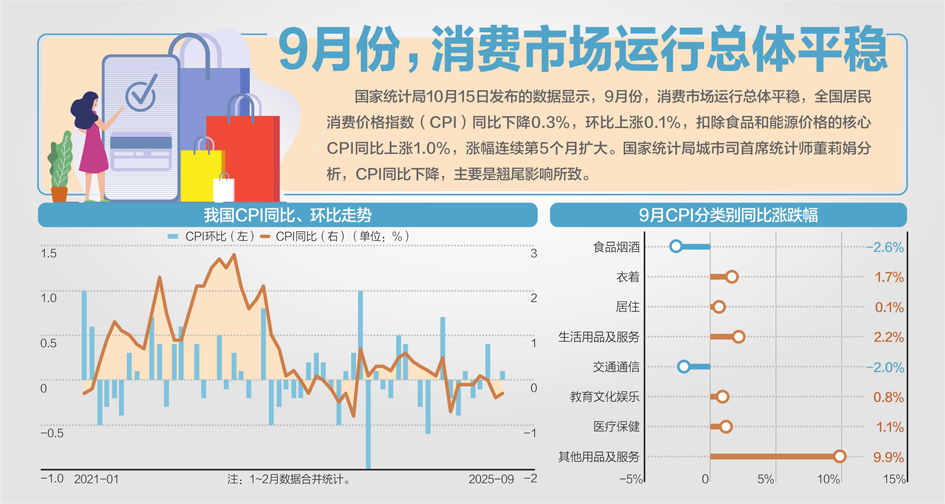
财经聚焦 | 核心CPI重回1% 9月物价数据透出哪些信号?
Xin Hua She· 2025-10-15 14:02
Group 1: Core CPI and Price Trends - The core CPI increased by 1% year-on-year in September, marking the first return to this level in 19 months and the fifth consecutive month of growth [1] - The overall CPI rose by 0.1% month-on-month, with food prices contributing significantly to this increase, particularly fresh vegetables, eggs, and meat [1] - Seasonal factors and holiday demand have driven up prices in certain categories, such as vegetables, which saw a price increase from 2.58 yuan/kg in August to 3.32 yuan/kg in September [1] Group 2: PPI and Market Dynamics - The Producer Price Index (PPI) decreased by 2.3% year-on-year in September, but the decline was less severe than in previous months, indicating a positive trend [3] - The reduction in PPI decline is attributed to improved macroeconomic policies and the ongoing development of a unified national market [3] - Certain industries, such as coal processing and black metal smelting, have shown signs of price stabilization, with coal processing prices rising by 3.8% month-on-month [3] Group 3: New Economic Drivers and Consumption Upgrades - Emerging industries are thriving, with new consumption patterns and business models contributing to positive price changes [4] - The manufacturing sector is experiencing a shift towards high-end, intelligent, and green development, leading to increased market demand and price growth in specific sectors, such as aircraft manufacturing [4] - Consumer demand is transitioning from quantity to quality, with significant price increases in sectors like arts and crafts, sports equipment, and nutritional foods [5]
核心CPI重回1%,9月物价数据透出哪些信号?
Xin Hua She· 2025-10-15 13:31
Group 1 - The core CPI has returned to 1%, marking the first increase in nearly 19 months, indicating a stable price environment supported by policies aimed at expanding domestic demand and promoting consumption [1] - In September, the CPI increased by 0.1% month-on-month, with food prices rising by 0.7%, contributing approximately 0.13 percentage points to the CPI increase [1] - Seasonal price increases were observed in fresh vegetables, eggs, fruits, lamb, and beef due to weather impacts and holiday demand [1] Group 2 - The PPI decreased by 2.3% year-on-year in September, with the decline narrowing by 0.6 percentage points compared to the previous month, reflecting the effectiveness of macroeconomic policies and the progress of a unified national market [3] - Improvements in supply and demand structures have led to price stabilization in certain industries, with coal processing prices rising by 3.8% and black metal smelting prices increasing by 0.2% [3] Group 3 - Emerging industries are thriving, with new consumption patterns and models driving positive price changes in related sectors [4] - The manufacturing sector is experiencing upgrades, with aircraft manufacturing prices increasing by 1.4% and electronic materials prices rising by 1.2% year-on-year [5] Group 4 - Consumer demand is shifting from quantity expansion to quality enhancement, with significant price increases in high-quality goods such as arts and crafts (14.7%) and sports equipment (4%) [6] - Policies aimed at boosting consumption are expected to further support the development of certain consumer goods and manufacturing sectors, improving market supply-demand relationships [6]
毛戈平、老铺黄金均涨超9%,消费板块投资机会来了?
Sou Hu Cai Jing· 2025-10-15 12:42
Core Viewpoint - The Hong Kong consumer sector has rebounded strongly due to market style switching and favorable policies, with various sub-sectors such as luxury goods, aviation, education, and new consumption showing active performance [2][3] Group 1: Market Performance - The consumer sector saw significant gains, with notable stocks like Guoquan (02517.HK) rising by 11.86%, Mao Ge Ping (01318.HK) by 9.71%, and China Eastern Airlines (00670.HK) by 9.27% [2] - Other strong performers included China Southern Airlines (01055.HK) up 7.98%, and Mijue Group (02097.HK) up 6.58% [2] Group 2: Policy Impact - The surge in the consumer sector was directly triggered by favorable policies announced during a meeting on October 14, emphasizing the need for effective counter-cyclical adjustments and resource utilization to boost domestic demand [3][4] - Ongoing policies such as "trade-in" programs and consumer loan subsidies have effectively activated market vitality [4] Group 3: Investment Insights - Analysts from Zhongyuan Securities noted that the food and beverage manufacturing sector has maintained high investment growth levels, significantly outpacing social investment growth [5] - The report highlighted production trends, indicating a contraction in the output of certain alcoholic beverages while cold fresh meat and edible oil production continued to grow [5] - Price trends showed increases in various food items, suggesting mild inflation in upstream sectors [5] Group 4: Future Consumption Trends - Guojin Securities indicated that Q4 is expected to see a convergence of style and policy in domestic consumption, with opportunities emerging for new consumption growth stocks [6] - The report suggested that the upcoming Double Eleven shopping festival will be a critical indicator for observing market trends [6][7]

2025年9月物价数据点评:促消费对CPI形成支撑作用,低基数推动PPI同比降幅收窄
Dong Fang Jin Cheng· 2025-10-15 05:55
Group 1: CPI Analysis - In September, the CPI decreased by 0.3% year-on-year, a slight improvement from the previous month's decline of 0.4%[1] - The cumulative year-on-year CPI decline from January to September is 0.1%[1] - The core CPI, excluding volatile food and energy prices, rose to 1.0% in September, reflecting a 0.1 percentage point increase from the previous month[3] - The increase in prices for home appliances and mobile phones contributed to the narrowing of the CPI decline, with home appliance prices rising by 5.5% and mobile phone prices by 1.5% year-on-year[4] Group 2: PPI Analysis - The PPI decreased by 2.3% year-on-year in September, a reduction in the decline from 2.9% in the previous month[1] - The cumulative year-on-year PPI decline from January to September is 2.8%[1] - The year-on-year PPI decline was primarily influenced by a lower base from the previous year[7] - Despite a stable international crude oil price and rising copper prices, domestic demand remains insufficient, leading to a flat PPI month-on-month[6] Group 3: Market Outlook - The low inflation environment is expected to persist, with CPI projected to rise to around 0.1% in October due to the effects of consumption promotion policies[5] - By the end of the year, CPI is anticipated to range between 0.5% and 1.0% as the base effects from the previous year become more favorable[6] - The PPI is expected to see a year-on-year decline of approximately -2.2% in October, with challenges in turning positive by year-end due to ongoing pressures in the real estate market and consumer confidence[9]