
经济复苏

Search documents
申万期货品种策略日报:股指-20260116
Shen Yin Wan Guo Qi Huo· 2026-01-16 02:05
Report Investment Rating - No investment rating information provided in the report. Core View - The continuous improvement of the stock market in 2026 is the result of the combined effects of the technology cycle resonance, policy dividend release, economic recovery, and overseas capital inflow. The market has gradually shifted from valuation expansion to profit - driven. It is expected that supply - side reform will continue in 2026, pushing up commodity prices and driving up resource - based stocks. With the continuous release of policy effects, the further strengthening of economic recovery momentum, and the continuous progress of overseas capital allocation of Chinese assets, the stock market is expected to continue its volatile upward trend [2]. Summary by Directory 1. Stock Index Futures Market - **IF Contracts**: The closing prices of IF contracts increased, with the increase in the current month contract being 15.00 points and a rise of 0.32%. The trading volume of each contract was 29122.00, 18351.00, 81140.00, and 17229.00 respectively, and the open interest decreased by 10720.00 in the current month contract and increased by 4194.00 in the next month contract [1]. - **IH Contracts**: The closing prices of IH contracts decreased, with the current month contract falling by 7.40 points and a decline of 0.24%. The trading volume of each contract was 10975.00, 6924.00, 34976.00, and 6009.00 respectively, and the open interest decreased in the current month and next - season contracts [1]. - **IC Contracts**: The closing prices of IC contracts increased, with the current month contract rising by 11.40 points and a rise of 0.14%. The trading volume of each contract was 32673.00, 26360.00, 110213.00, and 26152.00 respectively, and the open interest changed differently in each contract [1]. - **IM Contracts**: The closing prices of IM contracts increased, with the current month contract rising by 24.80 points and a rise of 0.30%. The trading volume of each contract was 38012.00, 29827.00, 148081.00, and 31844.00 respectively, and the open interest changed in each contract [1]. - **Inter - month Spreads**: The inter - month spreads of IF, IH, IC, and IM contracts changed, with the current values being - 0.40, - 0.20, 2.60, and - 14.00 respectively, different from the previous values [1]. 2. Stock Index Spot Market - **Index Performance**: The CSI 300 index increased by 0.20%, the SSE 50 index decreased by 0.21%, the CSI 500 index decreased by 0.05%, and the CSI 1000 index decreased by 0.20%. The trading volume and turnover of each index also changed [1]. - **Industry Index Performance**: Different industries in the CSI 300 industry index showed different trends, with the energy, raw materials, and telecommunications industries rising, and the main consumption, pharmaceutical, and real - estate finance industries falling [1]. 3. Futures - Spot Basis - The futures - spot basis of IF, IH, IC, and IM contracts changed compared with the previous two days, with different values for each contract and different trends [1]. 4. Other Domestic and Overseas Indexes - **Domestic Indexes**: The Shanghai Composite Index decreased by 0.33%, the Shenzhen Component Index increased by 0.41%, the Small and Medium - sized Board Index increased by 0.71%, and the ChiNext Index increased by 0.56% [1]. - **Overseas Indexes**: The Hang Seng Index decreased by 0.28%, the Nikkei 225 decreased by 0.42%, the S&P index increased by 0.26%, and the DAX index increased by 0.26% [1]. 5. Macroeconomic Information - The central bank took a series of measures to support high - quality economic development, including lowering re - loan and re - discount rates, increasing various loan quotas, expanding the scope of support for carbon - emission reduction tools, and lowering the minimum down - payment ratio for commercial housing loans. The central bank also stated that there is still room for reserve - requirement ratio cuts and interest - rate cuts this year [2]. - The US will impose a 25% ad - valorem import tariff on some imported semiconductors, semiconductor manufacturing equipment, and derivatives starting from January 15 [2]. - Chinese Premier Li Qiang held talks with Canadian Prime Minister Justin Trudeau, and the two sides witnessed the signing of multiple cooperation documents [2]. - Minister of Commerce Wang Wentao said that in 2026, the Ministry of Commerce will focus on "three focuses" to release consumption potential [2]. - Foreign Minister Wang Yi had a phone call with Iranian Foreign Minister Hossein Amir - Abdollahian, expressing opposition to the use or threat of force in international relations [2]. 6. Industry Information - Minister of Commerce Wang Wentao said that in 2026, China will actively expand independent opening - up, including expanding the opening of service sectors and promoting zero - tariff measures for African countries [2]. - During the 15th Five - Year Plan period, State Grid's fixed - asset investment will reach 4 trillion yuan, a 40% increase from the 14th Five - Year Plan period [2]. - In 2025, the number of idle land parcels to be acquired using special bonds exceeded 5500, with a total land value exceeding 750 billion yuan, and more than 300 billion yuan of special bonds have been issued [2]. - The 2nd Commercial Space Industry Development Conference and the 2026 Commercial Space Exhibition will be held in Shenzhen from March 17 - 18, focusing on hot topics in the commercial space industry [2]. 7. Stock Index Views - The three major US indexes rose, and the previous trading day's stock index mainly fluctuated and corrected, with the electronics sector leading the rise and the comprehensive sector leading the decline. The market turnover was 2.94 trillion yuan. The margin ratio for margin trading was adjusted on January 14, 2026 [2].
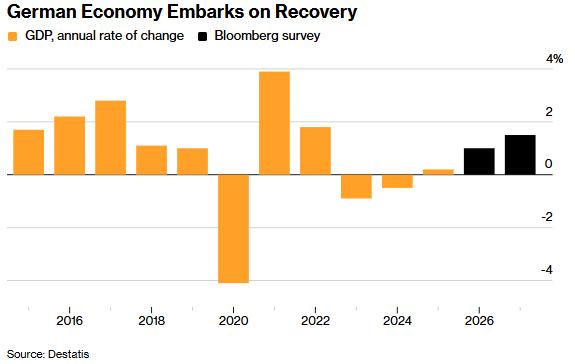
德国经济2025年实现三年来首次增长 财政支出热潮能否扭转颓势?
智通财经网· 2026-01-15 11:12
智通财经APP获悉,在政府支出热潮的推动下,德国经济在2025年实现了自2022年以来的首次年度增 长,艰难摆脱了长期的工业衰退。德国联邦统计局(Destatis)周四公布的数据显示,继此前连续两年萎缩 后,2025年国内生产总值(GDP)增长0.2%,与分析师预期中值一致。第四季度GDP环比也录得相同增 幅。 默茨清楚面临的挑战,并已承诺将重振经济增长作为首要任务。他在给执政联盟议员的信中描述某些行 业处于 "非常危急" 的状态。 近日,大众汽车和宝马均报告其在美国和中国的销量暴跌,美国关税以及比亚迪等亚洲汽车制造商的竞 争造成了冲击。据德国联邦统计局称,尽管欧盟内部贸易是 "稳定的锚" ,但对美国的出口额下降了近 8%,其中机动车辆和零部件受影响尤为严重。对华销售跌幅更大。 统计局指出,去年的经济增长主要由家庭消费和政府支出驱动,而投资出现下滑,贸易则对经济增长形 成拖累。近年来,欧洲最大经济体德国接连遭受能源危机、关键投入品渠道受限以及特朗普对全球贸易 的冲击,其工业中心地带所受打击尤为严重。 "这清楚地表明,中国正日益成为德国工业的竞争对手,而非德国工业产品的购买方," 统计局评论 道。 尽管市场对总 ...

IC平台:消费支撑经济温和扩张,但成本压力未消
Sou Hu Cai Jing· 2026-01-15 02:02
Group 1 - The latest Beige Book from the Federal Reserve indicates that as of January 5, 8 out of 12 Federal Reserve districts reported slight to moderate economic growth, 3 showed little change, and only 1 experienced a moderate decline [2] - Compared to previous reports where most regions showed stable economic performance, this period reflects a marginal improvement in economic conditions [2] - Consumer spending saw slight growth driven by holiday shopping, while manufacturing activity varied, and non-financial services demand remained stable [2] Group 2 - The employment market is overall stable, with most regions experiencing steady hiring activity and wages showing moderate growth, gradually returning to normal levels [2] - The significant impact of artificial intelligence on employment is expected to manifest in the coming years [2] - Most regions reported moderate price increases, with some areas experiencing slower growth, and ongoing cost pressures from tariffs were noted [2] Group 3 - Some businesses have passed on costs to consumers, but in competitive sectors like retail and dining, the ability to transfer costs is limited [2] - Energy and insurance costs continue to exert pressure on corporate profits [2] - Companies anticipate a slight easing in price increases in the future, but overall prices are expected to remain high, with cost pressures likely to continue affecting operations [2][3]
金融期货早班车-20260115
Zhao Shang Qi Huo· 2026-01-15 01:55
金融研究 2026年1月15日 星期四 金融期货早班车 招商期货有限公司 国债期货 0.022,IRR1.44%;10 年期国债期货 CTD 券为 250018.IB,收益率变动-1.1bps,对应净基差 0.03, IRR1.39%;30 年期国债期货 CTD 券为 210005.IB,收益率变动+0.75bps,对应净基差 0.023,IRR1.47%。 资金面:公开市场操作方面,央行货币投放 2,408 亿元,货币回笼 286 亿元,净投放 2,122 亿元。 交易策略:中长线,风偏上行叠加经济复苏预期,建议 T、TL 逢高套保。 风险提示:货币政策宽松超预期,经济复苏不及预期。 基差:IM、IC、IF、IH 次月合约基差分别为 42.17、9.1、1.73 与 3.87 点,基差年化收益率分别为-5.32%、 -1.15%、-0.38%与-1.3%,三年期历史分位数分别为 66%、82%、60%及 36%。 敬请阅读末页的重要说明 交易策略:中长期,我们维持做多经济的判断,当下以股指做多头替代有一定超额,推荐逢低配置各 品种远期合约。 风险提示:外生宏观冲击、财政扩张进度不及预期、其他系统性冲击。 市 ...
长城基金汪立:2026年港股机会看“三碗面” 聚焦科技与经济复苏双主线
Xin Lang Cai Jing· 2026-01-14 08:16
Core Viewpoint - The investment opportunities in the Hong Kong stock market for 2026 hinge on improvements in the policy environment, funding conditions, and the fundamental performance of companies [1] Policy Environment - The technology and consumer sectors in Hong Kong stocks are highly sensitive to policy changes; ongoing support for technological innovation and consumer encouragement will boost market confidence [1] Funding Conditions - The Hong Kong stock market is significantly influenced by global capital; with the upcoming change in the Federal Reserve chairmanship leaning towards dovish policies, global liquidity is expected to become more accommodative, potentially leading to a return of previously outflowed funds to the Hong Kong market [1] Fundamental Performance - The improvement in the profitability of listed companies is crucial for sustaining market trends; attention should be paid to revenue and profit growth in key sectors such as the internet and biotechnology [1] Investment Directions - Two main investment themes are suggested: first, aligning with technological trends by investing in artificial intelligence, semiconductors, and new energy vehicles; second, focusing on competitive consumer brands and pharmaceutical companies in line with economic recovery [1]
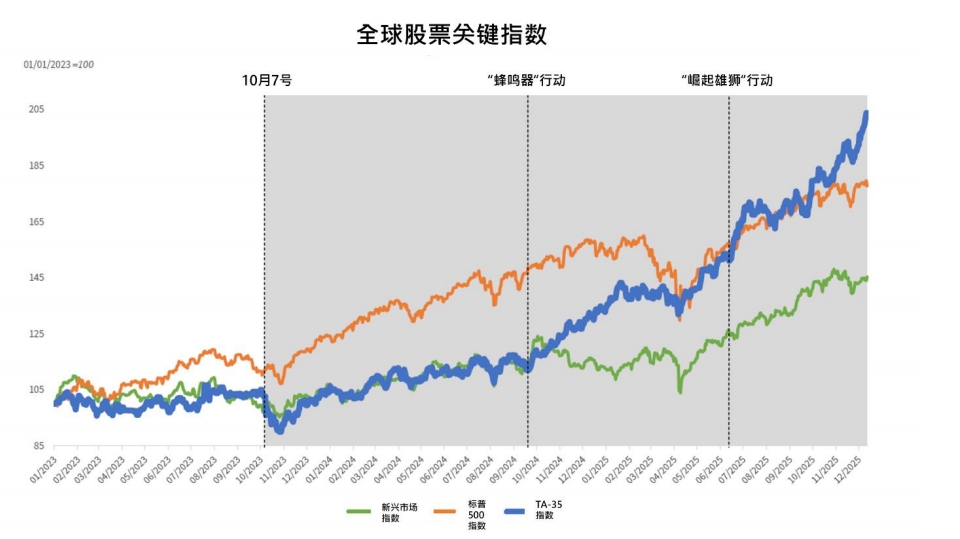
以色列经济复苏超预期
Guo Ji Jin Rong Bao· 2026-01-14 06:05
金融市场表现同步回暖。特拉维夫股市跑赢多数全球主要指数,主权风险溢价与信用违约互换(CDS)息差显著收窄,国债收益率 逐渐趋近同类评级经济体水平。谢克尔汇率在经历阶段性波动后,已向基本面回归,表明以色列央行及时推出的市场稳定措施成效显 著。 1月14日,记者从以色列经济与产业部获得的《以色列经济转折点:历经震荡、蓄势待发、展望新一年》报告显示,以色列经济目前 企稳复苏速度超越多数预期,正从复苏阶段稳步迈向新一轮增长。 该报告指出,目前,以色列科技研发投入强度稳居全球前列,风险资本募集水平已反弹,基本回升至与疫情前繁荣周期相当的水 平。以2024年为例,作为经济长期增长的核心驱动力,以色列高科技产业持续表现亮眼:贡献了该国约16%的GDP、57%的出口额、超 过40%的商业经济增长,并带动大量高附加值就业与财政税收。 整体而言,该国目前宏观经济基础扎实:就业市场活跃、产出超越长期趋势、通胀整体可控、公共债务持续下行。此前出现的经济 收缩主要源于劳动力短缺等供给端制约,而非需求疲软。 尤为关键的是,当前科技生态已超越早期的"暴涨暴跌"模式,产业结构更为多元与成熟,发展重点向具备稳定营收能力的后期企业 及前沿技术领 ...
基金观察:如何看待债市机会与风险?
Sou Hu Cai Jing· 2026-01-14 02:45
Core Viewpoint - The bond market is expected to experience fluctuations in 2025, with a shift in investor preference towards equities anticipated for 2026 due to declining risk premiums and supportive macroeconomic policies [2][3]. Group 1: Market Trends - The bond market has seen a strong performance over the past four years, primarily due to a lack of attractive returns in the equity market, leading investors to favor lower-risk bond assets [2]. - A significant drop in risk premiums indicates a rising risk appetite among investors, which is likely to result in a decline in bond prices and an increase in stock market performance [2]. - The central economic work conference has set a positive tone for macroeconomic policies, emphasizing proactive fiscal measures and moderately loose monetary policies, which are expected to enhance investor sentiment towards economic recovery [2]. Group 2: Investor Strategies - Investors should adjust their strategies in light of potential economic recovery, focusing on early indicators of corporate profitability such as the Producer Price Index (PPI) [3]. - Recommendations for bond investors include reducing duration by holding shorter-duration bonds and increasing exposure to equity-linked products like convertible bond funds and secondary bond funds to enhance returns [3]. - In the current interest rate environment, the choice between pure bond funds, convertible bond funds, and ETFs tracking government and technology innovation bonds should be based on the investor's outlook on interest rates and economic conditions [4][5]. Group 3: Product Insights - Pure bond funds are focused solely on bond assets, requiring careful attention to the fund manager's ability to adjust the portfolio based on credit and interest rate research [4]. - Government bond ETFs track government bond indices and are sensitive to interest rate changes, while technology innovation bonds carry additional credit risks, potentially offering higher returns [5].
金融期货早班车-20260114
Zhao Shang Qi Huo· 2026-01-14 02:30
Report Overview - The report is a financial futures early morning newsletter released by China Merchants Futures Co., Ltd. on January 14, 2026, covering stock index futures and treasury bond futures [1][2][3] 1. Stock Index Futures Market Performance - On January 13, the four major A - share stock indices pulled back. The Shanghai Composite Index fell 0.64% to 4138.76 points, the Shenzhen Component Index dropped 1.37% to 14169.4 points, the ChiNext Index declined 1.96% to 3321.89 points, and the Science and Technology Innovation 50 Index decreased 2.8% to 1469.57 points. Market turnover was 36,988 billion yuan, an increase of 542 billion yuan from the previous day [2] - In terms of industry sectors, petroleum and petrochemicals (+1.62%), pharmaceutical biology (+1.21%), and non - ferrous metals (+0.91%) led the gains; national defense and military industry (-5.5%), electronics (-3.3%), and communications (-2.88%) led the losses [2] - In terms of market strength, IH > IF > IC > IM. The number of rising/flat/falling stocks was 1,619/119/3,726 respectively. The net inflows of institutional, main, large - scale, and retail investors in the Shanghai and Shenzhen stock markets were -718, -568, 256, and 1030 billion yuan respectively, with changes of -772, -302, +341, and +733 billion yuan respectively [2] Basis and Basis Annualized Yield - The basis of IM, IC, IF, and IH next - month contracts were 2.73, -7.32, -1.97, and 0.53 points respectively, and the basis annualized yields were -0.33%, 0.9%, 0.41%, and -0.17% respectively. The three - year historical quantiles were 93%, 92%, 67%, and 46% respectively [2] Trading Strategy - In the medium - to - long term, maintain the judgment of going long on the economy. Currently, using stock index futures as a long - position substitute has certain excess returns. It is recommended to allocate long - term contracts of each variety on dips [2] 2. Treasury Bond Futures Market Performance - On January 13, interest - rate bonds strengthened slightly. Among the active contracts, TS remained flat, TF rose 0.04%, T rose 0.06%, and TL rose 0.28% [2] Cash Bond Situation - The current active contract is the 2603 contract. For the 2 - year treasury bond futures, the CTD bond is 250017.IB, with a yield change of +0.5 bps, a corresponding net basis of 0.033, and an IRR of 1.36%; for the 5 - year treasury bond futures, the CTD bond is 2500801.IB, with a yield change of +0.25 bps, a corresponding net basis of -0.014, and an IRR of 1.63%; for the 10 - year treasury bond futures, the CTD bond is 250018.IB, with a yield change of -0.1 bps, a corresponding net basis of 0.047, and an IRR of 1.28%; for the 30 - year treasury bond futures, the CTD bond is 210005.IB, with a yield change of -0.75 bps, a corresponding net basis of 0.091, and an IRR of 1.14% [3] Fundamentals - In open - market operations, the central bank injected 3,586 billion yuan and withdrew 162 billion yuan, with a net injection of 3,424 billion yuan [3] Trading Strategy - In the medium - to - long term, with the upward shift of risk appetite and the expectation of economic recovery, it is recommended to hedge T and TL contracts on rallies [3] 3. Economic Data - High - frequency data shows that the prosperity of manufacturing, imports and exports, and social activities is temporarily lower than in previous periods, while the prosperity of infrastructure and real estate is similar to previous periods [11]
银价油价齐升:申万期货早间评论-20260114
申银万国期货研究· 2026-01-14 00:34
首席点评: 银价油价齐升 美国总统特朗普威胁对与伊朗有商业往来的国家征收 25% 的关税。外交部发言人毛宁回应表示,中方将坚定维护自身正当 合法权益。对于七国集团财长同意加快减少从中国进口稀土,毛宁指出,中方维护关键矿产全球产供链稳定与安全的立场 没有变化,各方都有责任这样做。美国财政部表示,美国 2025 年 12 月预算赤字为 1450 亿美元,创当月历史新高,市场预 期为 1500 亿美元,而 2024 年 12 月的赤字为 870 亿美元。美国 2026 财年迄今赤字为 6020 亿美元,而 2025 财年同期赤字 为 7110 亿美元。 2025 年 12 月海关净收入 278.9 亿美元。国内商品期市走势分化,贵金属涨幅居前,沪银涨 5.9% 。航运 期货跌幅居前,集运指数(欧线)跌 5.45% 。新能源材料走势分化,多晶硅跌 4.45% ;碳酸锂涨 7.44% ,盘中一度涨停, 突破 17 万元 / 吨关口,年内累计涨幅接近 40% 。 重点品种:贵金属、股指、原油 贵金属 :贵金属冲高回落。从宏观面来看,近期公布的经济数据显示美国通胀压力缓解,就业仍然疲软,美国 12 月核心 CPI 反弹幅度 ...

海湾产油国经济复苏 非油部门成增长引擎
Shang Wu Bu Wang Zhan· 2026-01-13 10:59
ZAWYA网1月9日报道指出,2025年海湾阿拉伯产油国经济持续复苏,非石油部门成为主要增长动力。 IMF、世界银行等机构普遍看好GCC六国2025—2026年经济前景。国际金融协会预计,该地区两年内将 吸引约4600亿美元外资流入,GDP年均增速有望达4%,高于2024年水平。 ...