美国劳动力市场

Search documents
赵伟:美国劳动力市场——脆弱的“紧平衡”
Sou Hu Cai Jing· 2025-08-05 04:00
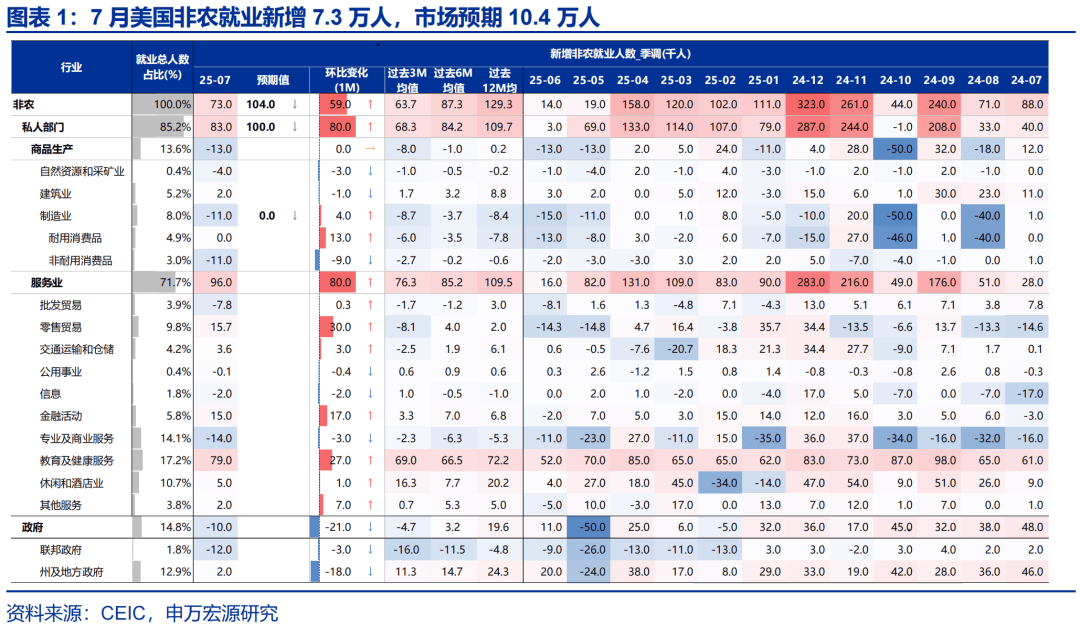
Group 1 - The core issue of the recent U.S. employment data is the significant downward revision of employment figures for May and June, which raises questions about whether this is due to statistical factors or a weakening economy [1][3][8] - In July, non-farm payrolls added only 73,000 jobs, falling short of the market expectation of 104,000, while the revisions for May and June were down by 125,000 and 133,000 jobs respectively [3][4][5] - The downward revisions primarily affected government employment, indicating that the previously reported strong job growth was misleading [1][8] Group 2 - The labor market is entering a "loosened" phase, with both supply and demand weakening, making it difficult for the unemployment rate to decrease significantly [2][42] - The unemployment rate for July rose to 4.2%, aligning with market expectations, while the labor force participation rate fell to 62.2% [3][7] - The economic outlook for the second half of the year suggests a continuation of the slowdown, with factors such as increased tariffs and reduced consumer spending likely to suppress economic growth [2][4] Group 3 - Following the release of the July employment data, the market has priced in an 80% probability of a 25 basis point rate cut by the Federal Reserve in September [2][3] - The market reaction included a decline in U.S. Treasury yields and the dollar index, alongside an increase in gold prices, indicating a shift towards "recession trading" [2][3] - The Federal Reserve's focus on the unemployment rate rather than non-farm payroll numbers suggests that a rate cut may be contingent on unemployment exceeding 4.3% [2][3]

?降息预期再升级! 旧金山联储主席戴利从观望转向支持降息 “三连降”摆上台面
Zhi Tong Cai Jing· 2025-08-05 03:43
Core Viewpoint - The San Francisco Fed President Mary Daly indicates that the timing for the Federal Reserve to restart interest rate cuts is approaching, with expectations for more than two rate cuts this year due to signs of a weakening labor market and lack of sustained inflation driven by tariffs [1][2]. Group 1: Labor Market and Employment Data - The U.S. non-farm payroll report showed only 73,000 jobs added in July, with significant downward revisions of 258,000 jobs for May and June combined, marking a historic downward adjustment of 90% [1][3]. - Despite the weak employment figures, Daly believes that the labor market is not critically endangered, as the unemployment rate only rose by 0.1 percentage points to 4.2% [3][4]. - Daly emphasizes that various labor market indicators show clear signs of softening compared to last year [3]. Group 2: Interest Rate Expectations - The probability of a rate cut by the Fed in September is nearing 90%, a significant increase from less than 40% prior to the non-farm report [1]. - Rick Rieder from BlackRock suggests that the weak employment report provides crucial evidence for a potential 50 basis point rate cut in September, especially if labor market weakness continues [2]. - Daly maintains an open stance on rate cuts, indicating that if inflation rises or the labor market rebounds quickly, fewer than two cuts may be necessary, but more than two cuts are likely given the current economic conditions [3][5]. Group 3: Economic Policy Considerations - Daly notes that the Fed is in a "balancing zone," needing to assess how monetary policy can continue to exert downward pressure on inflation while ensuring sustainable employment growth [5]. - There are no signs that tariff-driven price increases are broadly affecting inflation data, and waiting too long to act could result in the Fed's actions being too late [4][5].
如何看待非农“爆冷”? 新一轮关税加剧市场担忧、中美贸易谈判与地缘局势
2025-08-05 03:16
Summary of Conference Call Notes Industry Overview - The conference call discusses the current state of the U.S. economy, particularly focusing on the labor market, inflation, and the impact of tariffs and trade negotiations with China. [1][6][17] Key Points and Arguments 1. **Labor Market Data Revision**: The U.S. labor market data was significantly revised downwards, with July's job additions at 73,000 and a downward revision of 258,000 for the previous two months, leading to an average of only 35,000 jobs added over the last three months, the largest downward revision in decades. [2][3] 2. **Unemployment Rate**: The unemployment rate increased from 4.1% to 4.2%, indicating a potential slowdown in job creation despite the rate remaining relatively stable compared to last year. [2][3] 3. **GDP Growth**: The second quarter GDP growth rate was 3%, consistent with last year, but the internal demand growth rate fell to 1.2%, down from 2.4% last year, indicating weakening demand. [5] 4. **Impact of Tariffs**: New tariffs imposed by the Trump administration have raised the effective tax rate from 10% to 20.5%, leading to increased inflationary pressures as companies may pass on costs to consumers. [11][12] 5. **Inflation Expectations**: Structural inflation is expected to rise in the second half of the year, driven by core commodity price increases due to tariffs, while rent and service prices remain moderate. [13] 6. **Federal Reserve's Monetary Policy**: The Federal Reserve may need to adjust its monetary policy in response to the labor market's downturn and inflation pressures, with a significant increase in the probability of a rate cut in September from 40% to 88%. [9][16] 7. **Trade Negotiations with China**: Current U.S.-China trade negotiations have not yielded substantial results, with ongoing challenges related to market access, energy purchases, and investment. [17][24] 8. **Sector-Specific Impacts**: Different sectors are affected variably by tariffs; technology companies are performing well, while manufacturing firms like General Motors and Ford are experiencing losses. [14][15] 9. **Geopolitical Factors**: The complexity of U.S.-China relations is compounded by geopolitical factors, including the U.S. stance on Russia amid the Ukraine conflict, which may further complicate trade negotiations. [24][25] Other Important but Overlooked Content - **Labor Participation Rate**: The labor participation rate has decreased from 62.7% last year to 62.2% this year, indicating a decline in labor supply, particularly among foreign-born populations. [3][4] - **Market Sentiment**: Investor sentiment is cautious due to increased geopolitical risks and seasonal factors, with August and September typically being weaker months for the stock market. [26][27] - **Potential Cooperation Areas**: There are suggestions for exploring more cooperative areas between the U.S. and China, such as increased purchases of U.S. Treasury bonds by China, although feasibility remains uncertain. [20][21]
徽商期货:市场降息预期重燃,黄金逢低做多为主
Qi Huo Ri Bao· 2025-08-05 01:08
Core Viewpoint - The unexpected significant decline in US non-farm employment data for July has reignited market expectations for a Federal Reserve rate cut in September, leading to lower interest rates and a drop in the US dollar index, which has boosted precious metal prices [1][4]. Group 1: Labor Market - The US labor market showed a sharp downturn, with July non-farm payrolls increasing by only 73,000, far below the expected 104,000, and the unemployment rate rising from 4.1% to 4.2% [3]. - The Bureau of Labor Statistics significantly revised down the employment data for May and June, with May's job additions adjusted from 144,000 to just 19,000, and June's from 147,000 to 14,000, resulting in a total reduction of 258,000 jobs for those two months [3]. - The private sector added 83,000 jobs in July, while federal government employment decreased by 12,000, indicating ongoing layoffs [3]. Group 2: Trade Relations - The global trade situation has stabilized, with the US reinstating "reciprocal tariffs" on August 7 and reaching preliminary agreements with several economies, including the UK, Vietnam, and the EU [2]. - Despite the tariff adjustments, US Treasury Secretary Mnuchin emphasized that the negotiation window remains open, indicating ongoing discussions [2]. - The recent US-China trade talks led by Vice Premier He Lifeng and Treasury Secretary Mnuchin have resulted in a consensus to extend certain tariffs and countermeasures for an additional 90 days [2]. Group 3: Federal Reserve Dynamics - Internal divisions within the Federal Reserve have increased, particularly with the upcoming departure of Governor Quarles, which has raised concerns about the Fed's policy independence [4]. - The announcement of Quarles' resignation has heightened expectations for a rate cut in September, as President Trump expressed satisfaction with the opportunity to nominate a new Fed governor [4]. - The reduction in tariff uncertainties has improved market risk appetite, suggesting that gold may experience a period of volatility, with silver likely following gold's trend [4].
美国6月PCE和7月非农数据点评:就业数据下修、降息可能提前
Bank of China Securities· 2025-08-04 02:49
Report Investment Rating - No industry investment rating is provided in the report. Core Viewpoints - The significant downward revision of US non - farm payroll data and the slowdown of 2Q consumer nominal growth indicate that the restrictive policies have had obvious effects, and the Fed may have a more open attitude towards interest rate cuts. There is a possibility that the Fed will advance the interest rate cut to September, but it is still uncertain whether there will be three consecutive interest rate cuts in September, October, and December. The scenario of more than two interest rate cuts within the year requires the decline of inflation data in the next few months as support [2]. Summary by Related Content Non - farm Payroll Data - The US non - farm payroll data in July was lower than market expectations, and the data for May and June were significantly revised downward. The non - farm private enterprise average hourly wage increased by 3.91% year - on - year, the third - highest year - on - year growth rate this year. The latest changes in non - farm data are in line with the situation of cooling supply and demand in the labor market mentioned by Fed Chairman Powell [2][4]. Inflation - The increase in the US PCE price in June expanded as expected, which is in line with the assumption that tariffs affect prices. The actual year - on - year growth rate of US personal consumption in June (seasonally adjusted) decreased by about 0.1 percentage points compared with May, while the nominal growth rate (seasonally adjusted) rebounded by about 0.1 percentage points, resulting in an expansion of the year - on - year increase in PCE prices by about 0.2 percentage points. The actual growth of US consumer demand is not strong, and the nominal growth slowed down in the second quarter compared with the first quarter. The persistence of the impact of tariffs on inflation remains to be observed [2][6]. Economic Data in the Second Quarter - The restrictive policies have obvious effects. The growth rates of major domestic demand items such as personal consumption, private fixed - asset investment, and government spending have stabilized or declined. The liquidity surplus in the US economy has been significantly alleviated, and the ratios of currency in circulation to GDP and personal consumption have both returned to the 2017 level, which may also have a certain inhibitory effect on the transmission of tariffs to inflation [2][7][9].
"7月不降息、9月大幅降息”?市场热议:美联储是否“去年再现”
华尔街见闻· 2025-08-02 06:55
Core Viewpoint - The recent weak employment report has sparked discussions about whether the Federal Reserve will repeat last year's scenario of maintaining rates in July and then significantly cutting them in September, with notable figures like Nick Timiraos and economist El-Erian drawing parallels to the current situation [1][5][8]. Group 1: Employment Data and Market Reactions - The July non-farm payroll data revealed a significant cooling in the U.S. labor market, falling well below expectations and leading to substantial downward revisions of employment figures from the previous two months, indicating potential economic weakness [1]. - Following the weak employment report, the probability of a rate cut by the Federal Reserve in September surged from under 40% to nearly 90% [3][4]. - Rick Rieder, Chief Investment Officer at BlackRock, stated that the report provides evidence for a potential rate adjustment in September, questioning the extent of the cut [2]. Group 2: Historical Context and Comparisons - The current employment market's sudden downturn has led to comparisons with last summer's Federal Reserve policy trajectory, where a weak employment report prompted a 50 basis point rate cut in September after initially holding rates steady in July [5][6]. - El-Erian highlighted the possibility of the Federal Reserve repeating last year's pattern, maintaining rates in July and then making a significant cut in September despite seemingly unchanged economic conditions [6]. Group 3: Inflation Concerns and Economic Outlook - Timiraos pointed out a critical difference between last year and this year: while inflation was on a downward trend last year, current concerns revolve around potential inflationary pressures due to tariffs imposed by the Trump administration [9]. - The key question for the Federal Reserve is whether the economic fundamentals are genuinely deteriorating or if the recent slowdown is merely a temporary effect of policy changes [10]. - Rieder noted that if labor market slack increases or job additions remain below 100,000, a 50 basis point rate cut in September could be on the table, although current futures market pricing suggests a zero probability for such a move [11][12].
突然暴雷,美联储9月降息概率陡升
Di Yi Cai Jing Zi Xun· 2025-08-02 00:32
Core Viewpoint - The unexpected decline in the U.S. non-farm payroll report for July raises concerns about the current state of the labor market, prompting speculation about potential actions by the Federal Open Market Committee (FOMC) in September [2][5]. Employment Growth - In July, non-farm employment increased by 73,000, significantly below the market expectation of 115,000 [2]. - The unemployment rate rose to 4.2%, reflecting a decrease in household employment volatility [2]. - Job growth was primarily concentrated in the healthcare sector, which added 55,000 positions, while federal government employment decreased by 12,000 [2]. Data Revisions - Previous months' data were significantly revised downwards, with June's job additions revised down by 133,000 to just 14,000, marking a near five-year low [3]. - May's job additions were also revised down by 125,000, resulting in a total downward revision of 258,000 jobs over the two months [3]. - The average monthly job growth from May to July fell to approximately 35,000, the slowest pace since the onset of the COVID-19 pandemic [3]. Labor Market Dynamics - The number of job openings in June dropped from 7.7 million to 7.4 million, the lowest level in a year [4]. - Despite the decline in job openings, layoffs remain at historically low levels, with a layoff rate of 1%, below the average of 1.4% from 2010 to 2019 [4]. - The current labor market situation is characterized as "no extra hiring, lukewarm" by analysts [4]. Monetary Policy Outlook - The Federal Reserve decided to maintain the interest rate range at 4.25%-4.50%, with Chairman Powell emphasizing the need to stabilize long-term inflation expectations [4][5]. - The personal consumption expenditures (PCE) index, the Fed's preferred inflation measure, rose by 0.3% in the previous month, with the year-on-year growth increasing from 2.4% to 2.6% [4]. - Analysts suggest that the Fed may consider rate cuts if labor market weakness persists, similar to the previous year when a key recession indicator was triggered [5][6]. Market Expectations - Market expectations for rate cuts have increased, with an 82% probability of a rate cut in September according to futures pricing [6]. - Wells Fargo anticipates consecutive rate cuts in the remaining meetings of the year, reflecting a shift towards a more neutral monetary policy stance [6].
美联储官员卡什卡利表示,非农就业报告和ADP就业数据说的是同一件事,美国劳动力市场趋软。
news flash· 2025-08-01 23:37
Core Insights - Federal Reserve official Kashkari indicates that both the non-farm payroll report and ADP employment data reflect a softening labor market in the United States [1] Group 1 - The labor market in the U.S. is showing signs of weakness as indicated by recent employment reports [1]
布米普特拉北京投资基金管理有限公司:美国7月私营就业超预期增长10.4万
Sou Hu Cai Jing· 2025-08-01 10:47
Core Insights - The ADP report indicates that the U.S. private sector added 104,000 jobs in July, significantly exceeding market expectations of 76,000, marking the largest month-over-month increase since April [1][3] - Despite the positive July data, overall hiring remains below last year's average, highlighting an uneven recovery in the U.S. labor market [3][5] - The report reflects cautious attitudes among businesses amid economic uncertainty, with mixed signals regarding the strength of the labor market [5][6] Employment Data - The leisure and hospitality sector saw the most significant job growth, adding 46,000 positions, followed by the financial sector with an increase of 28,000 jobs [3] - Conversely, the education and healthcare services sector experienced job losses for the fourth consecutive month, shedding 38,000 positions [3][5] - The manufacturing sector added only 7,000 jobs, while construction grew by 15,000, indicating varied recovery rates across different industries [5] Wage Growth - Wage growth remained stable in July, with salaries for job switchers increasing by 7% year-over-year, while those remaining in their positions saw a 4.4% increase [3] - This trend suggests that despite a slowdown in hiring, competition in the labor market is still supporting wage levels [3] Economic Outlook - Economists express that the labor market's performance reflects businesses' cautiousness in the face of economic uncertainty, with July's rebound not fully alleviating concerns about potential economic slowdown [5][6] - The upcoming non-farm payroll report is anticipated to show an increase of about 100,000 jobs, with the unemployment rate possibly rising to 4.2% [5] - The strong ADP report may reduce the likelihood of interest rate cuts in the near term, as sustained wage growth above inflation could lead the Federal Reserve to maintain a cautious stance [6]


财信研究评美联储7月议息会议:内部分歧加大,降息或延后
Sou Hu Cai Jing· 2025-08-01 07:55
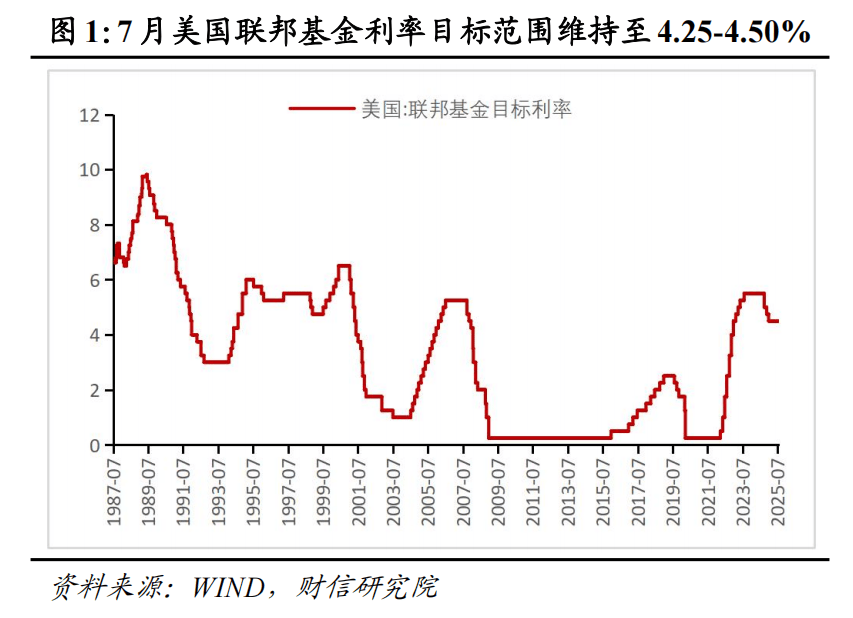
内部分歧加大,降息或延后 美联储7月议息会议点评 全文共1918字,阅读大约需要5分钟 文 财信研究院 宏观团队 胡文艳 段雨佳 伍超明 事件:北京时间2025年7月31日凌晨,美联储公布了7月份议息会议纪要。 正文 7月美联储选择继续暂停降息,维持"适度限制性"的利率水平,源于不考虑关税影响的通胀仍高于目标、就业处于目标水 平。展望后续,9月降息不确定性较高,但年内降息窗口犹存。 鲍威尔会后发言表明,美联储是否重启降息,关键取决于两点:一是美国经济(尤其是私人部门需求)是否会超预期放 缓,进而传导至劳动力市场,导致劳动力需求显著减弱,推动失业率明显上升。二是关税对通胀的影响,会否从一次性 推升演变为持续性压力。鲍威尔会后发言认为,"更高的关税已开始更明显地反映在某些商品的价格上,但其对经济活动 和通胀的总体影响仍有待观察。一个合理的基本情况是,对通胀的影响可能是短暂的——反映价格水平的一次性变动。 但通胀影响也有可能更持久,这是一个需要评估和管理的风险",因此通胀是否持续仍需更多时间观察。但有一点值得注 意的是,下半年美国物价的适度温和回升,本身并不会成为美联储降息的掣肘,正如6月议息会议所示,尽管美联储当 ...