
能源转型

Search documents
阳光财险:“保险+绿色基建”模式护航“一带一路”
智通财经网· 2025-11-21 08:17
Core Insights - China's overseas interests are expanding, leading to a growing demand for risk management and financial services, particularly in the context of the Belt and Road Initiative [1] - Sunshine Insurance is focusing on energy cooperation and has developed a replicable model of "insurance + green infrastructure" to support high-quality development along the Belt and Road [1] Group 1: Customized Insurance Solutions - The Akmolinsk Wind Power Project in Kazakhstan faces extreme winter temperatures and complex construction conditions, posing significant risks to its operation [2] - Sunshine Insurance has provided a comprehensive insurance package worth approximately 1.5 billion RMB, covering various risks to ensure the project's stable operation in harsh environments [2] Group 2: Green Empowerment - The Akmolinsk Wind Power Project is a model of Sino-Kazakh green cooperation, contributing to local energy structure transformation and carbon neutrality goals [3] - The project generates up to 843 million kilowatt-hours of clean electricity annually, reducing carbon emissions by 686,600 tons [3] Group 3: Collaborative Ecosystem - Sunshine Insurance has joined the Belt and Road Reinsurance Community to enhance its underwriting capacity and collaborate with domestic and international reinsurers [4] - The company successfully completed the first transaction on the Shanghai International Reinsurance Trading Center's "Reinsurance International Board," providing insurance for a photovoltaic project in Turkey [4] - Sunshine Insurance aims to continue supporting the Belt and Road Initiative and contribute to national strategies and social development through financial services [4]
德国倒向俄气?欧盟加速俄能源脱钩,德州长逆势宣布:要用俄气
Sou Hu Cai Jing· 2025-11-21 08:12
Group 1 - The core viewpoint of the articles highlights the irreversible decoupling of Russia and Europe in the energy sector, with Germany's energy policy becoming a focal point of public discussion following comments from Saxony's governor advocating for the resumption of Russian gas imports if the Ukraine war ceases [1][3] - Since the outbreak of the Ukraine conflict, the EU has imposed sanctions on Russia, particularly targeting the energy sector, which has historically seen significant reliance on Russian imports, accounting for 45% of natural gas, 30% of oil, and nearly 50% of coal in 2021 [1][3] - The EU's REPowerEU plan was introduced in 2022 to reduce dependence on Russian gas, but its implementation faces challenges due to insufficient infrastructure and the lengthy timeline required for new projects [1][3] Group 2 - Germany, as the economic engine of the EU, has been under significant pressure due to the energy decoupling from Russia, with pre-conflict dependencies of 55% on natural gas, 35% on oil, and 50% on coal [3] - The German government announced a complete halt to Russian energy imports starting in 2023, seeking alternative sources such as Norway and Qatar, but faces difficulties as Norway approaches production limits and Qatar prioritizes long-term contracts with Asia [3] - Energy prices in Germany surged by 40% year-on-year by 2023, leading to increased industrial electricity costs and forcing high-energy industries to reduce production or relocate, exemplified by BASF's closure of domestic chemical production lines for the first time since WWII [3] Group 3 - The energy crisis and inflation in Germany have contributed to a shrinking economy, with the eurozone inflation rate exceeding 10.7%, marking a historical high [3] - The geopolitical landscape of global energy is shifting, with the U.S. expanding LNG exports to the EU, becoming the largest supplier despite high prices exacerbating energy poverty in Europe [3] - Russia is advancing the Power of Siberia-2 gas pipeline project and securing long-term supply contracts with China and India, while the global energy market is increasingly polarized between OPEC+ led by Saudi Arabia and Russia, and the U.S.-led shale oil alliance [3] Group 4 - Germany's energy choices reflect deep-seated contradictions between energy security, economic interests, and political positions, with potential short-term solutions including increased gray imports and expanded renewable energy deployment [5] - A complete detachment from Russian energy reliance will require several years, necessitating the EU to accelerate the construction of a unified energy market and strengthen cooperation with regions like Africa and the Middle East [5] - The success of global energy transition will depend on advancements in technological innovation and the depth of international cooperation [5]


标普分析师胡丹:光伏从成本与规模,转向系统与消纳
2 1 Shi Ji Jing Ji Bao Dao· 2025-11-21 07:02
Core Insights - The photovoltaic industry is undergoing a phase adjustment in 2025, reflecting supply-demand imbalances and chaotic competition, yet the underlying demand for global energy transition remains strong due to climate goals and energy security [1][3] - Future opportunities will favor companies with integrated capabilities in technology, systems, and globalization, capable of innovation and adapting to local policies [2] Industry Trends - In China, renewable energy has transitioned from being an "auxiliary power source" to a "main power source," marking a significant change in the energy structure [3] - The global photovoltaic installed capacity is projected to grow from 150 GW in 2020 to nearly 600 GW in 2025, indicating a fourfold increase over five years, significantly outpacing other energy forms [3] - By 2025, global photovoltaic installations are expected to surpass coal power for the first time, establishing photovoltaics as the dominant source of new electricity generation [3] System Integration and Storage - The industry is shifting focus from merely increasing installed capacity to enhancing system integration and consumption capabilities [4] - Energy storage is becoming increasingly critical, with the consensus that "solar and storage are inseparable," as it helps stabilize photovoltaic output and supports high-quality renewable energy development [4] Market Dynamics - The U.S., China, and Europe remain the core engines for global photovoltaic and storage development, each undergoing different policy and market transformations [5][6] - In China, the photovoltaic market is experiencing a "high peak and subsequent decline" trend, with new installed capacity facing pressure due to policy changes and market integration [5] - The European market is witnessing a surge in demand for photovoltaic and household storage, particularly after significant power outages in Spain and Portugal, leading to increased focus on grid stability [6] Global Competitive Landscape - Despite challenges such as trade barriers and policy uncertainties, the U.S. remains a high-value market for renewable energy, with long-term demand expected to remain strong [6] - Emerging markets like Saudi Arabia, Pakistan, and parts of Africa are showing robust growth potential in the photovoltaic sector, becoming new hotspots for global industry layout [6] - China's renewable energy industry maintains a solid global competitive edge, supported by a comprehensive ecosystem that includes raw material supply, advanced manufacturing, and talent reserves [6] Technological Advancements - Continuous technological iterations are occurring, including breakthroughs in silicon battery efficiency and improvements in energy density for storage systems, which are driving deeper decarbonization of the energy sector [7]
标普分析师胡丹:光伏从成本与规模 转向系统与消纳
2 1 Shi Ji Jing Ji Bao Dao· 2025-11-21 06:50
Core Insights - The photovoltaic industry is undergoing a phase adjustment in 2025, reflecting supply-demand imbalances and disordered competition, yet the underlying demand for global energy transition remains strong due to climate goals and energy security [1] - Future opportunities will favor companies with integrated capabilities in technology, systems, and globalization, capable of deepening technological innovation and adapting to local market policies [2] Industry Trends - In China, renewable energy has transitioned from being an "auxiliary power source" to a "main power source," marking a significant change in the energy structure [3] - The global photovoltaic installed capacity is projected to grow from 150 GW in 2020 to nearly 600 GW in 2025, reflecting a fourfold increase over five years, significantly outpacing other energy forms [3] - By 2025, global photovoltaic installations are expected to surpass coal power for the first time, establishing photovoltaics as the dominant force in new power installations [3] System Integration and Storage - The industry is shifting focus from merely increasing installed capacity to enhancing system integration and consumption capabilities [4] - Energy storage is becoming increasingly critical, with the consensus that "solar and storage are inseparable," as it helps stabilize photovoltaic output and supports high-quality renewable energy development [4] Market Dynamics - The U.S., China, and Europe remain the core engines for global photovoltaic and storage development, each experiencing different policy and market transformations [5] - In China, the photovoltaic market is showing a "high peak and subsequent decline" trend, with new installed capacity facing pressure due to policy changes and market integration [5] - Europe is witnessing a surge in demand for photovoltaic and household storage, with large-scale storage expected to see explosive growth in 2025-2026 [5] Emerging Markets - Despite challenges such as trade barriers and policy uncertainties, the U.S. remains the highest-value renewable energy market, holding strategic significance for Chinese companies [6] - Emerging markets like Saudi Arabia, Pakistan, and parts of Africa are showing strong growth potential in the photovoltaic sector, becoming new hotspots for global industry layout [6] - China's renewable energy industry maintains robust global competitiveness, supported by a comprehensive ecosystem that includes raw material supply, advanced manufacturing, and technological innovation [6]
光伏50ETF(159864)跌超4%,技术迭代与需求前景成焦点,回调或可布局
Mei Ri Jing Ji Xin Wen· 2025-11-21 06:38
Core Insights - The photovoltaic (PV) industry is expected to see significant demand growth driven by the continuous advancement of Nationally Determined Contributions (NDC 3.0) and global energy transition, with an anticipated addition of 250 GW of new installations in China by 2026 [1] - Market-oriented reforms in the electricity sector are favorable for the PV industry, as market price signals can alleviate power restriction issues and promote the revaluation of green energy assets [1] - The current capacity issues in the PV industry will ultimately need to be addressed through technological iterations, with silicon-perovskite tandem cells identified as a key future technology direction, achieving a laboratory efficiency of 34.6% [1] Industry Trends - The penetration rate of wind and solar power exceeding 15% will lead to a rapid increase in system costs, necessitating greater investment in grid infrastructure and flexible resources, with domestic grid investment projected to grow by 15.3% year-on-year in 2024 [1] - The evolution of new power systems will rely on market mechanisms and technological collaboration [1] Investment Insights - The Photovoltaic 50 ETF (159864) tracks the photovoltaic industry index (931151), which includes publicly listed companies involved in the manufacturing of silicon materials, solar cells, modules, inverters, and related equipment, reflecting the overall performance of the PV industry chain [1] - The photovoltaic industry index exhibits significant growth potential and policy-driven characteristics, effectively representing the development trends within the PV sector [1]
澳专家:中国为全球降碳作出实质贡献 期待澳中深化能源合作 | 世界观
Zhong Guo Xin Wen Wang· 2025-11-21 06:12
Core Insights - China has made substantial contributions to global decarbonization, recognized internationally, particularly through technological innovation and manufacturing capabilities that have significantly reduced the costs of solar and wind energy [2][3] - The collaboration between Australia and China in the clean energy sector presents vast opportunities, despite differing governance systems, as both countries share a common goal of global decarbonization [4][6] Group 1: China's Contribution to Global Decarbonization - Over the past decade, China's efforts have led to an average cost reduction of 60% for wind power and 80% for solar power generation [3] - The scale of China's production and technological advancements has made electric vehicles more affordable, supporting energy transitions in developing countries [3] Group 2: Australia-China Cooperation in Clean Energy - There is potential for joint educational programs between Australian and Chinese universities focusing on energy transition, policy analysis, and clean technology [4] - The influence of Chinese brands in the Australian electric vehicle market is creating opportunities for establishing battery recycling and reuse systems, aligning with sustainable development goals [6] Group 3: Political Trust and Climate Cooperation - The implementation of climate commitments is hindered by political trust issues, with a need for genuine cooperation to enhance climate governance effectiveness [7] - The geopolitical tensions pose challenges to global climate action coordination, emphasizing the importance of political goodwill in achieving decarbonization goals [7]
拉美国家放开投资发力锂资源变现
Zhong Guo Hua Gong Bao· 2025-11-21 03:38
Core Insights - Latin American countries, holding over half of the world's lithium resources, are poised to improve their lagging investment situation in lithium extraction due to favorable global market conditions and government policy adjustments [1][2] Industry Overview - The global lithium demand has surged from 29,000 tons per year a decade ago to an expected 242,000 tons per year by 2024, with the battery sector's share increasing from 37% to 89% [1] - Latin America holds 53% of the world's total lithium resources, yet its actual lithium production in 2024 is projected to be only 77,000 tons, accounting for 32% of the global output of 240,000 tons [1] Resource Characteristics - The "Lithium Triangle" comprising Argentina, Chile, and Bolivia primarily utilizes lithium brine resources, while Brazil and Mexico focus on lithium ores [2] - The share of lithium spodumene in global lithium production has increased from 48% to 65% over the past decade, attributed to its high lithium content and shorter project timelines [2] Investment Climate - Argentina has become the most open to private investment in the lithium sector, with recent policy changes under President Milei, including tax incentives for investments over $200 million [3] - Chile's new lithium policy aims to attract investment while maintaining state control over strategic salt flats, allowing private companies to develop other sites independently [3] Project Developments - Significant projects include Rio Tinto's $2.7 billion project approved under Argentina's new investment framework and a $3 billion collaboration between Chile's state mining company and Rio Tinto [3] - Bolivia's state-owned YLB company has commenced production at a lithium carbonate plant with an annual capacity of 15,000 tons [3] Future Outlook - If global lithium supply shifts from surplus to shortage, it will further incentivize lithium development in Latin America [4] - Challenges in increasing global lithium supply include technological and quality issues, with warnings that if brine and hard rock projects do not overcome bottlenecks, lithium prices may rise again [4]
A股异动丨持续多日上涨的锂矿股集体回调,金圆股份、融捷股份等多股跌停
Ge Long Hui A P P· 2025-11-21 02:00
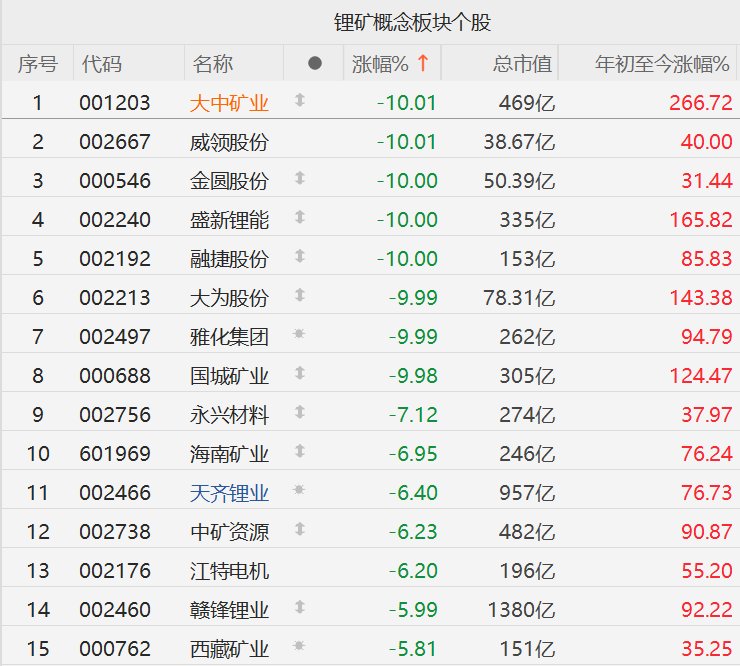
Core Viewpoint - Lithium mining stocks experienced a collective pullback after a period of continuous increase, with significant declines observed in various companies, while lithium carbonate prices saw a notable drop [1] Lithium Mining Sector Summary - Major lithium stocks such as Weiling Co., Jinyuan Co., Shengxin Lithium Energy, and others hit the daily limit down, with declines ranging from 5% to 10% [1] - Lithium carbonate futures contracts fell by 7%, reaching a price of 93,000 yuan per ton [1] Price Forecasts - BMI, a subsidiary of Fitch Solutions, projects that the average price of lithium carbonate in China will reach $10,100 per ton by 2025, and lithium hydroxide will average $9,700 per ton, both higher than previous expectations [1] - The optimistic price outlook is supported by demand driven by energy transition and supply reductions in China, although there are concerns about potential downward pressure on lithium prices due to expected supply restarts by the end of the year [1]




双融日报-20251121
Huaxin Securities· 2025-11-21 01:33
2025 年 11 月 21 日 双融日报 --鑫融讯 分析师:万蓉 S1050511020001 wanrong@cfsc.com.cn 市场情绪:32 分(较冷) 最近一年大盘走势 资料来源:Wind,华鑫证券研究 -10 -5 0 5 10 15 20 25 (%) 沪深300 相关研究 1、《双融日报》2025-11-20 2、《双融日报》2025-11-19 3、《双融日报》2025-11-18 ▌ 华鑫市场情绪温度指标:(较冷) 华鑫市场情绪温度指标显示,昨日市场情绪综合评分为 32 分,市场情绪处于"较冷"。历史市场情绪趋势变化可参 考图表 1 ▌ 热点主题追踪 今日热点主题:有色金属、电力设备、银行 1、有色金属主题:美元降息提振需求预期,AI 数据中心拉 动边际增量。铜:金融属性叠加矿端紧张、冶炼厂减产,传 统需求韧性+AI 拉动,价格中枢上移。铝:国内产能见顶、 海外增量有限,十五五开局紧平衡强化。相关标的:紫金矿 业(601899)、中国铝业(601600) 2、电力设备主题:在全球能源转型与数字化转型的交汇点, 人工智能正加速渗透电力行业。国际能源署(IEA)预测,到 2030 年,全 ...
曾毓群:不仅要做世界第一,更要让世界尊重
Shang Hai Zheng Quan Bao· 2025-11-21 00:28
Core Viewpoint - The Chinese lithium battery industry aims not only to be the world leader but also to achieve high-quality development that earns global respect [1][9]. Group 1: Industry Characteristics and Challenges - The lithium battery industry is entering the TWh era in 2024, with significant challenges ahead for high-quality development [1][3]. - There is a lack of true innovation in the industry, with many companies focusing on short-term profits rather than investing in R&D and quality [1][2]. Group 2: Long-term Development Strategy - The industry must embrace long-termism to drive high-quality development over the next 15 years [2]. - Recognizing the industry's characteristics is essential for identifying the correct long-term development path [2]. Group 3: Energy Transition Responsibility - Lithium batteries are crucial for energy transition, with increasing demand driven by the electrification of energy consumption and clean power supply [3]. - The penetration rate of new energy vehicles in China has surpassed 50%, indicating a growing market for electric commercial vehicles and other emerging sectors [3]. Group 4: Innovation and Technology - The lithium battery sector is technology-intensive, requiring continuous breakthroughs to expand development space [5]. - There is a significant potential for innovation, but the industry suffers from severe homogenization and insufficient disruptive innovation [6][7]. Group 5: Manufacturing and Profitability - The lithium battery industry is part of the manufacturing sector, which necessitates reasonable profit expectations for sustainable growth [8]. - Quality and technology iteration are critical, with significant technological upgrades occurring every 3 to 5 years [8]. Group 6: Global Competition and Market Dynamics - Chinese companies face intense competition in major markets like Europe and the Middle East, with some firms reducing prices by 30% while promising increased lifespan [9]. - The industry must establish high levels of self-discipline and adhere to long-term strategies to maintain its competitive edge [9].
