地缘政治风险

Search documents
金银周报-20260111
Guo Tai Jun An Qi Huo· 2026-01-11 11:12
强弱分析:黄金偏强、白银偏强 金银周报 国泰君安期货研究所 有色及贵金属 刘雨萱投资咨询从业资格号:Z0020476 日期:2026年1月11日 Guotai Junan Futures all rights reserved, please do not reprint Special report on Guotai Junan Futures 黄金:地缘政治刺激避险情绪;白银:高弹性下高位震荡 黄金:地缘政治刺激避险情绪;白银:高位回落,资金止盈离场 强弱分析:黄金偏强、白银偏强 3 价格区间:975-1050元/克、16500-19500元/千克 Special report on Guotai Junan Futures ◆ 本周伦敦金回升3.24%,伦敦银回升5.29%。金银比从前周的58回落至57,10年期TIPS回升至1.9%,10年期名义利率回落至4.18%(2年期 3.54%),美元指数录得99.13。 ◆ 近期地缘政治风险不断抬升,我们此前周报提及,委内瑞拉事件冲击市场,对贵金属来说委内瑞拉战况可能刺激避险情绪,利好黄金。更深层 次影响方面,委内瑞拉毫无反抗之力为整个南美都带来了威胁。在 ...
美委和中东局势动荡,油价短期受地缘风险支撑
Ping An Securities· 2026-01-11 10:29
Investment Rating - The report maintains a "Strong Outperform" rating for the oil and petrochemical sector [1]. Core Viewpoints - The oil price is supported in the short term by geopolitical risks, particularly due to tensions between the U.S. and Venezuela, as well as instability in the Middle East [6]. - The supply of oil from Venezuela may see a recovery, but significant uncertainties remain regarding the scale of production due to the need for substantial investment [6]. - The fluorochemical sector is expected to maintain high levels of activity due to supply constraints and favorable demand driven by policy support [6]. - The semiconductor materials sector is experiencing a positive cycle with improving fundamentals and domestic substitution trends [7]. Summary by Sections Oil and Petrochemicals - Geopolitical tensions are influencing oil prices, with WTI crude futures rising by 2.72% and Brent crude by 3.70% in early January 2026 [6]. - The U.S. Treasury Secretary indicated potential easing of sanctions on Venezuela, which could lead to increased oil supply, but investment interest from U.S. companies remains cautious [6]. - The macroeconomic outlook includes a projected 150 basis point rate cut by the Federal Reserve in 2026, with stable employment growth signals [6]. Fluorochemicals - The supply quota for HFCs has increased slightly, with a total of 797,845 tons for 2026, which is a year-on-year increase of 5,963 tons [6]. - The demand for refrigerants is expected to grow due to continued government subsidies and favorable policies, particularly in the home appliance and automotive sectors [6]. - The production of household air conditioners is projected to increase by 11% year-on-year in January 2026, indicating strong demand [6]. Semiconductor Materials - The semiconductor materials sector is benefiting from a positive inventory destocking trend and improving end-market fundamentals [7]. - The report suggests that the sector may see further upward movement due to cyclical recovery and domestic substitution [7]. - Companies to watch include Shanghai Xinyang, Lianrui New Materials, and Qiangli New Materials [7].
有色及贵金属周报合集-20260111
Guo Tai Jun An Qi Huo· 2026-01-11 10:13
王 蓉 投资咨询从业资格号:Z0002529 wangrong2@gtht.com 季先飞 投资咨询从业资格号:Z0012691 jixianfei@gtht.com 刘雨萱 投资咨询从业资格号:Z0020476 liuyuxuan@gtht.com 王宗源 (联系人)从业资格号:F03142619 wangzongyuan@gtht.com 2026年01月11日 国泰君安期货·有色及贵金属 周报合集 国泰君安期货研究所·有色及贵金属团队 04 铸造铝合金:锚定铝价,价格震荡偏强 07 铂金:持续震荡,钯金:需持续关注关税政策动向 Special report on Guotai Junan Futures 2 2 08 05 锌:强宏观定价,价格易涨难跌 06 铅:库存低位增加,价格震荡 Guotai Junan Futures all rights reserved, please do not reprint 1 CONTENTS 01 黄金:地缘政治刺激避险情绪 白银:高位回落,资金止盈离场 02 03 铜:微观长期看多,宏观扰动因素增加,价格走势坚挺且波动放大 铝:重心显著上行,高价仓位管理必要性 ...
国泰君安期货金银周报-20260111
Guo Tai Jun An Qi Huo· 2026-01-11 10:05
1. Report Industry Investment Rating No information provided in the content. 2. Core Viewpoints of the Report - Gold is influenced by geopolitical factors, with rising geopolitical risks stimulating risk - aversion sentiment. It is judged that gold has reached a new starting point for an upward trend, and it is recommended to increase gold allocation [3]. - For silver, there are signs of weakening in both capital and fundamentals, and the pressure for continued price increases is growing. The trend - following long - position strategy is worth exiting, but the long - term upward trend has not ended. Strategies such as buying silver puts, buying gold, and using platinum and palladium for short - position protection are recommended [4]. 3. Summary by Relevant Catalogs 3.1 Transaction Aspect (Price, Spread, Inventory, Capital, and Position) - **Price and Spread** - This week, London gold rose 3.24%, and London silver rose 5.29%. The gold - silver ratio dropped from 58 to 57. The 10 - year TIPS rose to 1.9%, the 10 - year nominal interest rate fell to 4.18% (2 - year 3.54%), and the US dollar index was 99.13 [3]. - Overseas gold: The spread between London spot and COMEX gold主力 fell to - 9.395 dollars per ounce, and the spread between COMEX gold continuous and COMEX gold主力 was - 45.4 dollars per ounce [10]. - Overseas silver: The spread between London spot and COMEX silver主力 rose to 0.114 dollars per ounce, and the spread between COMEX silver continuous and COMEX silver主力 was - 0.37 dollars per ounce [16]. - Domestic gold: The current - futures spread was - 3.56 yuan per gram, at the lower end of the historical range; the inter - monthly spread was 8.66 yuan per gram, at the upper end of the historical range [22][28]. - Domestic silver: The current - futures spread was 28 yuan per gram, at the upper end of the historical range; the inter - monthly spread was 31 yuan per gram, at the lower end of the historical range [24][31]. - **Inventory** - COMEX gold inventory decreased by 2.83 tons, and the registered warrant ratio rose to 53.2% [39]. - COMEX silver inventory decreased by 312 tons to 13677 tons, and the registered warrant ratio fell to 28.4% [41]. - Domestic gold futures inventory decreased by 0.05 tons, and domestic silver futures inventory decreased by 71.38 tons to 620 tons [45]. - **Position and Capital** - COMEX CFTC non - commercial net long positions in gold and silver both decreased slightly [47]. - Gold SPDR ETF inventory decreased by 0.57 tons, and domestic gold ETF increased by 5.8 tons [50]. - Silver SLV ETF inventory decreased by 135 tons [54]. - This week, the gold exchange's deferred fee for gold was mainly paid from longs to shorts, indicating strong delivery power; for silver, it was mainly paid from shorts to longs, indicating strong receiving power [37]. 3.2 Core Drivers of Gold - The correlation between gold and real interest rates has recovered, and the 10Y TIPS continued to decline [63]. - Information on inflation, retail sales performance, non - farm employment performance, industrial manufacturing cycle, financial conditions, economic surprise index, and inflation surprise index is presented in the form of charts, but no specific analysis conclusions are provided in the text. - The 3M gold lease rate was - 0.35%, and the 3M silver lease rate was 5.35% [58].
德福科技:主动规避地缘政治风险聚焦国内高质量整合
Quan Jing Wang· 2026-01-11 08:31
Core Viewpoint - The company, Jiujiang Defu Technology Co., Ltd., has made a strategic move by acquiring a 51% stake in Anhui Huiru Technology Co., Ltd. while terminating the acquisition of Circuit Foil Luxembourg due to geopolitical risks and strategic misalignment [1][2][3]. Group 1: Acquisition of Anhui Huiru - The acquisition of a 51% stake in Anhui Huiru is a significant strategic initiative aimed at strengthening the company's position in the electrolytic copper foil industry, enhancing total production capacity, and solidifying its leadership in the global copper foil market [1]. - This move is expected to leverage the scale and demonstration effects of a leading enterprise, promoting a shift in the Chinese copper foil industry towards higher concentration and competitiveness [1]. Group 2: Termination of CFL Acquisition - The termination of the acquisition of Circuit Foil Luxembourg was due to the Luxembourg Ministry of Economy's final decision, which imposed conditions that conflicted with the company's strategic control requirements [2][3]. - The company emphasized that the imposed conditions would hinder its ability to integrate CFL into its overall strategic framework, thus jeopardizing shareholder interests [3]. Group 3: Geopolitical Risk Insights - The company’s decision to terminate the acquisition reflects a prudent approach to avoid geopolitical risks, similar to the challenges faced by other Chinese tech firms in overseas acquisitions [4]. - The restrictions imposed by the Luxembourg government are akin to those experienced by Nexperia, highlighting the increasing scrutiny on foreign investments in sensitive sectors [4]. Group 4: Strategic Shift - The termination of the CFL acquisition is not a retreat from globalization but a strategic pivot towards domestic industry consolidation, which is seen as a more stable and efficient growth path [5]. - The company aims to focus on integrating domestic high-quality production capacities, particularly leveraging Anhui Huiru's advantages, to meet the growing demands of the electric vehicle and PCB industries [5]. Group 5: Future Outlook - The company plans to drive growth through a dual strategy of internal development and domestic acquisitions, emphasizing the importance of local integration and technological independence [6]. - Future international expansion will prioritize non-controlling forms of collaboration to mitigate geopolitical sensitivities, ensuring a more flexible approach to global competition [6]. - The company reassures that the termination of the CFL acquisition will not adversely affect its normal operations or financial health, as it maintains a healthy cash flow and is progressing with domestic integration projects [6].
兔死狐悲?特朗普要“强取”格陵兰岛,加拿大担心“自己是下一个”
Hua Er Jie Jian Wen· 2026-01-11 07:05
长久以来被视为美国坚定盟友的加拿大正陷入一场前所未有的主权焦虑危机。 据央视新闻报道,特朗普去年早些时候曾多次对加拿大主权发出威胁。特朗普公开表示,美国已厌倦为 加拿大提供安全保障。但如果加拿大成为美国的第51个州,美国就将为其安全负责。 在特朗普政府对委内瑞拉采取行动并重提控制格陵兰岛后,加拿大国内的恐慌情绪迅速升温。决策者被 迫开始严肃审视美国总统关于"吞并加拿大"的过往言论,担忧这不再是谈判策略,而是实质性的地缘政 治风险。 这一局势直接冲击了现任总理卡尼的战略考量。尽管卡尼政府试图通过增加国防开支和寻求贸易多元化 来减少对美依赖,但在即将到来的贸易协定审查前夕,投资者开始担忧美国可能通过经济手段"致残"加 拿大。 分析人士指出,美国对格陵兰岛——一个北约成员国及民主政体——表现出的控制欲,构成了对加拿大 的"终极警钟",预示着传统盟友关系可能面临结构性重塑。在这一背景下,加拿大正被迫制定应对"军 事胁迫"的极端预案。 贸易达摩克利斯之剑 特朗普的注意力虽然目前分散在其他领域,但市场普遍预期其目光将很快转回北境。美墨加协定 (USMCA)的定期审查即将启动,这极有可能演变为华盛顿向渥太华发泄不满的平台, ...
国际时政周评:关注地缘风险:西半球、中东
CMS· 2026-01-11 06:31
Group 1: Geopolitical Risks in the Western Hemisphere - The Trump administration is focused on strengthening control over the Western Hemisphere, particularly regarding Venezuela and Greenland[4] - The U.S. plans to manage 30-50 million barrels of oil from Venezuela, indicating a significant resource interest[9] - The geopolitical tension in Venezuela is expected to ease as the U.S. expresses satisfaction with the interim government, reducing the likelihood of further military action[10] Group 2: Oil Market Dynamics - Brent crude oil prices increased by 3.7% due to geopolitical conflicts and expectations of oversupply[10] - Venezuela's oil, being heavy crude, is crucial for U.S. refining industries, aligning with Trump's agenda to revitalize domestic energy production[13] Group 3: U.S. Domestic Politics and Trade Policies - The Trump administration's actions in Venezuela are politically motivated, aiming to resonate with domestic voters on issues of drugs and immigration[13] - The U.S. Supreme Court's delay in ruling on the legality of Trump's tariffs may provide the administration with more leeway in trade negotiations[5] Group 4: Broader Geopolitical Context - The U.S. seeks to counter external influences in Latin America, particularly from China and Russia, which have been increasing their presence in the region[13] - The potential for rightward political shifts in Latin America could align these countries more closely with U.S. strategic interests, impacting investment and trade dynamics[13]

地缘风险持续发酵 黄金获避险支撑
Jin Tou Wang· 2026-01-11 00:58
Group 1 - The core focus of the market remains on rising geopolitical risks, particularly following the U.S. expansion of oil export regulations on Venezuela, which supports gold's safe-haven demand [2] - Recent military actions in Caracas, Trump's controversial comments about Greenland, increased domestic unrest in Iran, and renewed tensions between China and Japan are contributing to a decline in risk appetite [2] - The U.S. is reportedly collaborating with Caracas to rebuild its oil and gas industry, with potential investments reaching approximately $100 billion [2] Group 2 - As of January 3, initial jobless claims in the U.S. slightly increased to 208,000, which is marginally below expectations [2] - The number of layoffs reported by Challenger companies in December fell to 35,553, marking the lowest level since July 2024 [2] - The U.S. trade deficit for October significantly narrowed to $29.4 billion, the smallest since June 2009 [2] Group 3 - Technically, spot gold is in a consolidation phase, maintaining a bullish outlook as prices remain above the rising 21-day simple moving average (approximately $4,387) [3] - Key support levels are identified between $4,400 and $4,380; a drop below this range could lead to a further decline towards the 50-day simple moving average (approximately $4,231) [3] - The immediate resistance level for gold is at $4,500; a sustained breakthrough could redirect focus towards record highs around $4,549 or higher [3]
9日国际油价上涨 全周布油涨超4%
Xin Lang Cai Jing· 2026-01-10 06:07
Core Viewpoint - International oil prices continue to rise due to concerns over potential disruptions in Iranian oil production amid ongoing domestic protests and restricted Russian oil exports, driven by geopolitical tensions and supply risks [1] Group 1: Price Movements - As of January 9, the price of light crude oil futures for February delivery on the New York Mercantile Exchange increased by 2.35% [1] - The price of Brent crude oil futures for March delivery rose by 2.18% [1] - For the week, the main contract price of U.S. oil futures increased by a cumulative 3.14% [1] - The main contract price of Brent oil futures rose by a cumulative 4.26% [1] Group 2: Market Analysis - Analysts suggest that international oil prices are in a complex negotiation phase due to the dual impact of escalating geopolitical risks and a continuous rise in global crude oil inventories [1]
金晟富:1.10黄金下周还会涨吗?黄金分析参考
Sou Hu Cai Jing· 2026-01-10 03:19
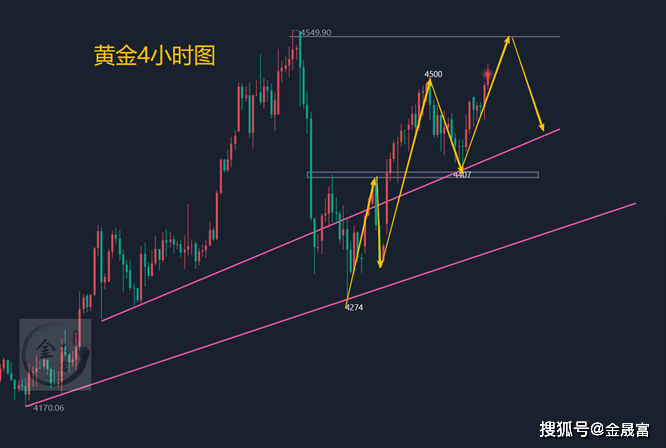
前言: 你若有缘看到金晟富的文章,相信你也肯定是看了无数篇的文章,寻找了无数个老师,却依旧做不好一 单的交易,我相信大家进来这个市场,追求的是长期稳健的收益,可现实往往让大家迷失了本心,偏离 了初衷。现在,是做出改变的时候了,找到属于自己的机会,晟富要做的就是用自己多年以来丰富的经 验和专业能力助你洞悉行情的涨跌,透过涨跌看透行情的本质。 从日线结构看,昨日收报一根长下影探底饱满反阳K,一般来讲,这种形态的企稳作用都相对强烈,也 意味着短期10均线位置基本确认完毕,这周的震荡区间下轨4400基本也就出来了,后续就看上轨4500的 突破,拿下之后或又展开新的高位区间或走趋势拉升;黄金4小时图来看:昨夜一波探底拉升之后,站 上了中轨和10均线,今日则双双成为顶底支撑,也就是守住4480-4460这个范围,此周期依然倾向于偏 强看涨;从小时线周期分析,价格下探4452后形成逐步抬升的低点,MACD指标在零轴上方维持金叉 状态,红柱温和放量,显示短期多头动能仍在延续;布林带轨道开口走平,价格依托布林中轨震荡上 行,当前运行至中轨与上轨之间,上轨4520附近存在初步压力,下轨4480则构成日内短期支撑;RSI指 标运行 ...