人民币国际化

Search documents
潘功胜:稳慎有序推进人民币国际化,全面提升人民币计价、支付、投融资、储备等国际货币功能
Sou Hu Cai Jing· 2025-10-28 12:27
Group 1 - The People's Bank of China (PBOC) is committed to advancing high-level bilateral financial openness while maintaining national financial security [1] - The PBOC aims to steadily promote institutional openness in the financial services sector and financial markets, facilitating trade and investment financing [1] - There is a focus on cautiously advancing the internationalization of the Renminbi, enhancing its functions as an international currency in pricing, payment, investment, financing, and reserves [1] Group 2 - The PBOC is working on the development of international financial centers in Shanghai and Hong Kong [1] - Financial support for the Hainan Free Trade Port's operations and high-quality development is a priority [1] - The PBOC is actively engaging in global governance initiatives and promoting reforms in global financial governance [1] Group 3 - There is a continuous effort to develop a self-controlled cross-border payment system [1] - The PBOC will monitor and assess the impact of overseas economic conditions and policies on China [1] - A strong commitment to safeguarding national financial security is emphasized [1]
创投观察:港股创新生态逻辑重塑,优质企业基石份额“不愁卖”
Zheng Quan Shi Bao Wang· 2025-10-28 12:23
Group 1 - The Hong Kong stock market has entered a new upward trend after four consecutive years of decline, with a significant increase in the number of IPOs and financing scale, indicating a vibrant market atmosphere [1] - The influx of southbound capital and clear expectations of interest rate cuts in the US are injecting vitality into the Hong Kong market, positioning it to attract some outflow funds as a global capital hub [1] - The transformation of the asset side, driven by the listing of high-quality "blue-chip" companies and a shift of new economy and technology firms from the US to Hong Kong, is crucial for revitalizing the market and diversifying its traditional focus on real estate and consumption [1] Group 2 - The shift in cornerstone investors' attitudes reflects a resurgence in the attractiveness of the Hong Kong stock market, with investors now actively seeking quality enterprises, particularly in the consumer and technology sectors [2] - Despite the positive changes, local investors in Hong Kong still need to adapt their perceptions of new economy enterprises, as there is a lag in understanding their value compared to traditional sectors [2] - The development of a healthy market mechanism is essential for the sustained improvement of the Hong Kong stock market, necessitating stricter regulatory measures to combat financial fraud and protect reputable companies [3] Group 3 - The long-term development of the Hong Kong stock market is closely tied to the internationalization of the Renminbi, with strong support from the government providing a solid strategic foundation [3] - The current phase of the Hong Kong stock market represents both a window of opportunity for capital and a transitional period for ecological restructuring, emphasizing the need for robust mechanisms to support innovation [3]
国务院关于金融工作情况的报告:人民币成为我国第一大跨境收付币种
Bei Jing Shang Bao· 2025-10-28 12:00
Financial Reform and Opening-up - Financial institution reforms are deepening, with state-owned commercial banks successfully raising 520 billion yuan to supplement capital. Efforts are being made to improve the quality of small and medium-sized financial institutions and accelerate the transformation of non-bank financial institutions like asset management companies [1] - A multi-tiered financial market is developing rapidly, with the implementation of comprehensive capital market reform plans and initiatives to promote high-quality development of public funds. There is a focus on increasing the equity investment ratio and scale of long-term funds like insurance capital, as well as expanding the scale of over-the-counter bond business [1] - A comprehensive cross-border payment system for the renminbi has been established, with the CIPS system playing a key role. The interconnectivity of payment systems between mainland China and Hong Kong, as well as with nine other countries, has been achieved [1] High-level Financial Opening-up - The orderly expansion of high-level financial opening-up is being promoted, with progress in optimizing the layout of renminbi clearing banks and developing the offshore renminbi market. The renminbi has become the largest currency for cross-border payments in China and ranks third in the IMF's Special Drawing Rights basket [2] - Measures have been introduced to facilitate cross-border capital flows and improve the foreign exchange management of cross-border investment and financing. The integration of domestic and foreign currency pools for multinational corporations is being expanded [2] International Financial Cooperation - International financial cooperation is deepening, enhancing the country's financial security capabilities. Financial exchanges and cooperation are being integrated into national diplomacy, with mechanisms established for meetings between central bank governors of China and Europe [3] - The foreign exchange reserve scale is projected to reach 3.3 trillion USD by the end of September 2025, an increase of 72.8 billion USD compared to November 2024 [3]
央行行长潘功胜会见阿布扎比第一银行行长罗斯塔马尼
Sou Hu Cai Jing· 2025-10-28 10:01
其间,潘功胜行长见证人民币业务清算协议签署。FAB在获得中国人民银行授权后,将担任阿联酋第二 家人民币清算行,也将成为第一家担任人民币清算行的区域性本土银行。清算行合作将为两国经贸合作 提供更加便捷的人民币清算服务和选择,进一步促进中阿双边贸易、投资便利化。 10月28日,中国人民银行行长潘功胜会见阿布扎比第一银行(FAB)行长罗斯塔马尼,就FAB在华展 业、深化金融合作等进行交流。 ...
十五五规划建议:推进人民币国际化,提升资本项目开放水平,建设自主可控的人民币跨境支付体系
Sou Hu Cai Jing· 2025-10-28 09:05
Core Viewpoint - The article discusses the release of the "Suggestions on Formulating the 15th Five-Year Plan for National Economic and Social Development" by the Central Committee of the Communist Party of China, emphasizing the importance of expanding autonomous openness and aligning with international high-standard economic and trade rules [1] Group 1: Economic Policy Initiatives - The plan aims to actively expand autonomous openness, focusing on market access and open fields in the service sector [1] - It highlights the acceleration of regional and bilateral trade investment agreements and the expansion of high-standard free trade zone networks [1] - The strategy includes optimizing regional openness layout and creating diverse highland forms of openness [1] Group 2: Trade and Investment Strategies - The implementation of a free trade pilot zone enhancement strategy and the high-standard construction of Hainan Free Trade Port are key components [1] - There is a focus on the coordinated development of major open cooperation platforms in innovation, service trade, and industrial development [1] Group 3: Financial and Economic Governance - The plan promotes the internationalization of the Renminbi and aims to enhance the openness level of capital projects [1] - It includes the establishment of a self-controlled cross-border payment system for the Renminbi [1] - The initiative also seeks to reform global economic and financial governance, advocating for a fair, just, open, inclusive, and cooperative international economic order [1]
X @外汇交易员
外汇交易员· 2025-10-28 08:54
Guiding Principles & Development Themes - The "15th Five-Year Plan" (Fifteenth Five-Year Plan) emphasizes "people-centered" development, prioritizing the people [1] - The plan highlights the combination of an effective market and an active government [1] - The plan shifts focus to "economic construction as the center," re-emphasizing its fundamental role [2] - The plan upgrades domestic demand from a strategic base to a development goal, aiming to build a strong domestic market [2] Economic & Technological Focus - "New productive forces" are a core keyword, emphasizing technological innovation to lead economic transformation [2] - The plan aims for decisive breakthroughs in key core technologies through "unconventional measures" [2] - The plan includes forward-looking layouts for future industries such as quantum technology, brain-computer interfaces, embodied intelligence, 6G mobile communication, hydrogen energy, and nuclear fusion energy [2] - The plan upgrades the artificial intelligence strategy to "Artificial Intelligence + Action" [2] Policy & Systemic Changes - The plan upgrades the protection of the private economy by proposing to "implement the Private Economy Promotion Law" [2] - The plan shifts from "expanding opening-up" to "actively expanding independent opening-up," emphasizing proactive expansion and enhanced autonomy under external pressure [3] - The plan emphasizes "promoting the internationalization of the RMB" and "building an independent and controllable RMB cross-border payment system" [3] - The plan clarifies "appropriately strengthening the central government's responsibilities and increasing the proportion of central government fiscal expenditure" to address local debt risks and strengthen central coordination [4] Social & Security Aspects - In education, the plan aims to build a high-quality education system and explore extending compulsory education and expanding free education [5] - In employment, the plan aims for higher-quality and fuller employment, with residents' income growth "synchronized" with economic growth [5] - The plan aims to improve and implement national unified basic pension insurance, gradually increasing basic pension for urban and rural residents [6] - The plan advocates for positive views on marriage and childbirth, effectively reducing the costs of raising and educating children [6] - The plan adds "more consolidated national security barriers" as an independent goal, emphasizing strengthening security capabilities in emerging fields such as network, data, AI, biology, and ecology [6]
审议金融工作情况报告:金融机构经营和监管指标保持在合理区间
Xin Jing Bao· 2025-10-28 07:36
Core Insights - The report presented by the Governor of the People's Bank of China indicates that financial institutions' operational and regulatory indicators remain within a reasonable range, with total assets of financial institutions exceeding 520 trillion yuan by the end of September 2025 [1][2]. Group 1: Financial Growth and Economic Support - The financial sector has shown reasonable growth, contributing positively to economic recovery, with social financing scale and broad money supply increasing by 8.7% and 8.4% year-on-year respectively by the end of September [2]. - The average interest rate for newly issued corporate loans was 3.14%, reflecting a low financing cost environment that supports market confidence and economic recovery [2]. - From November 2024 to September 2025, 98 companies in the A-share market raised 91.8 billion yuan through initial public offerings, with 86% being private enterprises and 92% in strategic emerging industries [3]. Group 2: Risk Management and Financial Stability - The report emphasizes the establishment of a comprehensive financial support framework to mitigate risks, with a significant reduction in the number of financing platforms and the scale of operating financial debt by 71% and 62% respectively since March 2023 [4]. - The financial health of commercial banks is robust, with a capital adequacy ratio of 15.36% and a non-performing loan ratio of 1.52% as of September 2025, indicating strong loss-absorption capacity [2]. - The report outlines measures to enhance the macro-prudential management of real estate finance, including lowering down payment ratios and mortgage rates to stabilize the housing market [4]. Group 3: Future Financial Strategies - The next steps include promoting the opening of financial services and markets, facilitating trade and investment, and advancing the internationalization of the renminbi [4]. - The report highlights the importance of developing a cross-border payment system and monitoring the impact of overseas economic conditions on China's financial security [4].
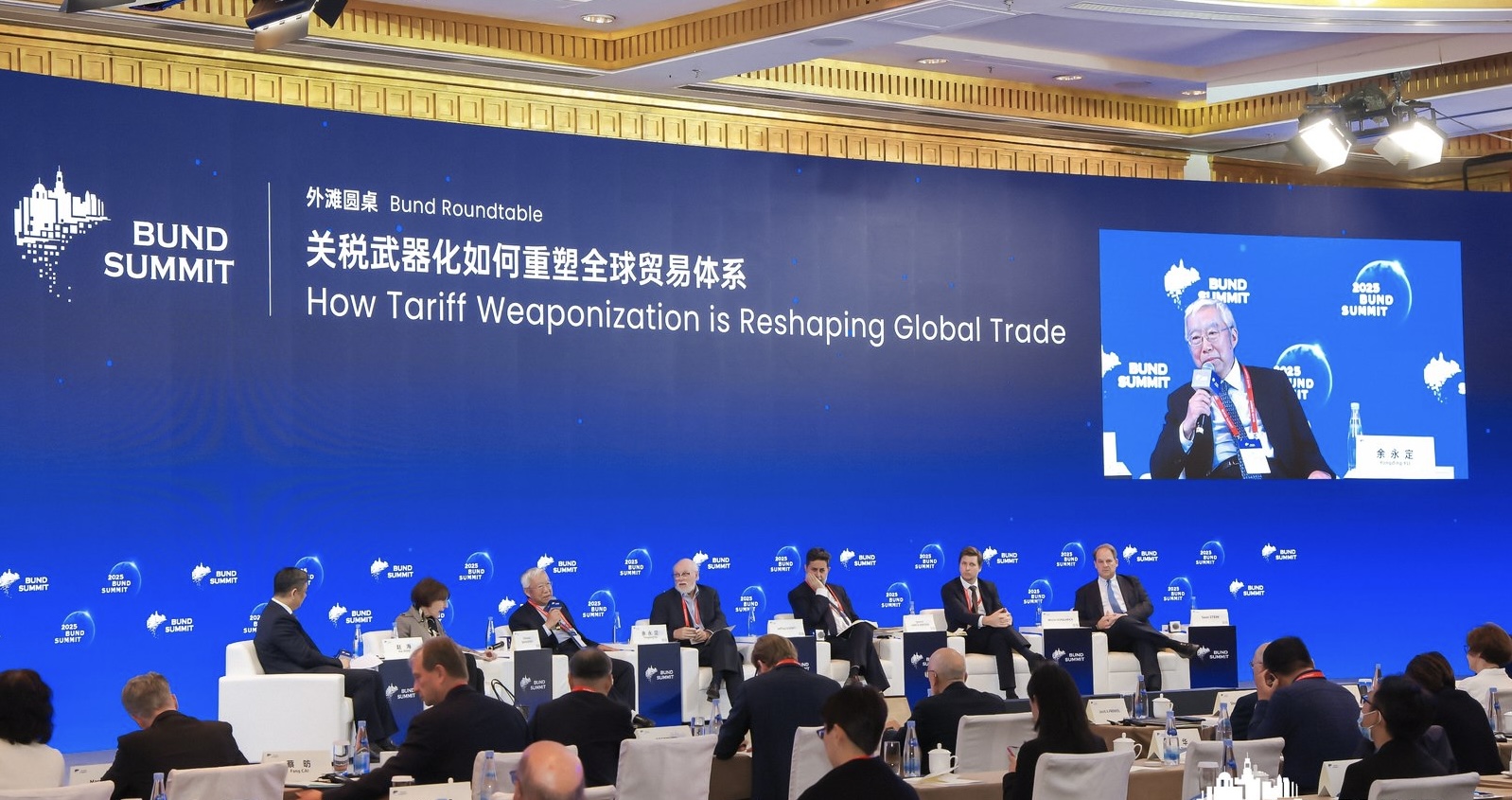
余永定:全球化关键是如何实现更公平的收益分配
Di Yi Cai Jing· 2025-10-28 04:16
Group 1 - The core principle of international division of labor benefits all countries, enhancing productivity through global supply chains [1] - The main issue lies in the equitable distribution of the benefits brought by globalization, both between countries and within domestic groups [3] - The U.S. should focus on upgrading infrastructure and improving benefit distribution to ensure that ordinary workers and blue-collar groups gain more from global supply chains [3] Group 2 - China has maintained a long-term surplus in its current and trade accounts, which was necessary in the past for foreign exchange reserves, but should now aim for balance by relying more on domestic demand [3] - The trade surplus as a percentage of China's GDP has decreased from over 10%-11% in 2006-2007 to around 2%-3% currently, indicating significant progress [3] - Progress has been made in promoting the use of the renminbi for cross-border settlements, but achieving its status as an international reserve currency remains a long-term goal with limited advancements [4]

重磅!央行、金融监管总局、证监会、外汇局发声|宏观经济
清华金融评论· 2025-10-28 01:42
Group 1: Financial Market Developments - The People's Bank of China (PBOC) will resume open market operations for government bonds, indicating a positive outlook for the bond market and a supportive monetary policy stance to foster economic recovery and financial stability [4] - The PBOC aims to implement a moderately loose monetary policy while enhancing the macro-prudential management system to monitor and assess systemic financial risks [4] Group 2: Digital Currency and Virtual Currency Regulation - The PBOC plans to optimize the management system for digital currency and support more commercial banks to operate digital currency services, while continuing to combat domestic virtual currency trading and speculation [5] - Policies to prevent and address risks associated with virtual currency trading remain effective, with ongoing collaboration with law enforcement to maintain economic and financial order [5] Group 3: Financial Reform and Opening Up - The National Financial Regulatory Administration emphasizes enhancing the adaptability of financial services to better support sustainable economic development and promote reform and opening up in the financial sector [6] - The administration will focus on strengthening funding support for major projects to boost domestic demand and improve financial services for various sectors, including education and healthcare [7] Group 4: Capital Market Reforms - The China Securities Regulatory Commission (CSRC) is committed to deepening capital market reforms to enhance the inclusiveness and coverage of the multi-tiered market system [8] - The CSRC will promote pilot policies in Beijing, encouraging high-quality financial resources to gather in the capital and support the development of the capital market [9] Group 5: Internationalization of the Renminbi - The State Administration of Foreign Exchange (SAFE) will coordinate the internationalization of the Renminbi with high-quality capital account opening, ensuring systemic risk prevention while enhancing the foreign exchange policy framework [10]