人民币汇率升值

Search documents
中金:联合解读中美经贸磋商成果
中金点睛· 2025-10-30 23:32
Core Viewpoint - The consensus reached during the China-US Kuala Lumpur economic and trade consultations is expected to stabilize trade relations, improve China's external circulation, and reduce market risk premiums [1][3]. Macro - The reduction and continued suspension of tariffs will help improve China-US trade and support Chinese exports. The US will cancel the 10% "fentanyl tariff" on Chinese goods and suspend the 24% equivalent tariff for one year, leading to a decrease in the overall effective tariff rate from 27% to 17% by 2025 [4][5]. - The expected increase in Chinese exports to the US could be around 10% due to the lowered tariff rate [4]. Export Controls - The US will suspend the implementation of the "50% penetration rule" for export controls for one year, which will benefit trade in key areas between China and the US. China will also relax certain export controls for rare earths and lithium battery materials for one year [6]. International Trade Costs - The suspension of port fees and related measures by both countries is expected to lower international trade costs and enhance shipping demand, particularly for agricultural products [7][19]. Agriculture - The consensus to expand agricultural trade is expected to accelerate trade in agricultural products, with projections indicating a slight decrease in China's soybean import share from the US in 2025 [7][20]. Technology - The outcomes of the consultations are favorable for the Chinese technology sector, particularly in terms of tariff reductions on electronic products and the suspension of certain export control measures, although restrictions on advanced technology access remain [25]. Commodities - The cancellation and delay of tariff barriers are expected to boost short-term demand for various commodities, including copper and aluminum, while also supporting the prices of precious metals like gold and silver [27][28]. Internet - The reduction in tariffs is expected to benefit cross-border e-commerce platforms, allowing them to maintain competitive pricing in the US market [31]. Textiles and Apparel - The easing of trade tensions may help stabilize the utilization rate of textile and apparel production capacity in China, benefiting companies that have not fully relocated their production [33]. Home Appliances - The reduction in tariff pressure is expected to provide direct benefits to the home appliance sector, improving the profitability of companies heavily reliant on exports to the US [36][37].


人民币 2024年10月15日以来最高
Shang Hai Zheng Quan Bao· 2025-10-27 04:51
Core Viewpoint - The recent strengthening of the Renminbi (RMB) against the US dollar signals a stable expectation in the currency market, with the RMB middle rate reaching its highest level since October 15, 2024, at 7.0881 on October 27, 2025 [1] Group 1: RMB Exchange Rate Trends - The RMB middle rate has shown a continuous upward trend, supported by a favorable external environment and strong domestic economic performance [1][2] - As of October 27, the onshore RMB opened at 7.1083 against the US dollar, reflecting an increase of over 100 points, and stabilized around 7.11 [1] - The CFETS RMB exchange rate index rose to 97.6, marking a 0.5% weekly increase, the highest level since April 2025 [2] Group 2: External Factors Influencing RMB - The US dollar index has decreased by 8.82% year-to-date, despite a recent slight rebound, primarily due to the weakness of non-US currencies like the Japanese yen [2][3] - Analysts expect the US dollar to maintain a weak trend in the long term due to anticipated Federal Reserve interest rate cuts and concerns over the US fiscal outlook [2][3] Group 3: Domestic Economic Support - The domestic economic fundamentals are expected to provide a supportive role for the RMB exchange rate, with a high sensitivity to growth-promoting policies [3] - The People's Bank of China has sufficient policy tools to stabilize the exchange rate, indicating a flexible adjustment approach to mitigate unilateral market expectations [3]
人民币汇率中间价创阶段性高点
Sou Hu Cai Jing· 2025-10-21 02:58
Core Viewpoint - The recent appreciation of the Renminbi (RMB) against the US dollar is attributed to both internal and external factors, with the RMB middle rate reaching a new high since October 2024, indicating a potential long-term appreciation cycle [1][3][4]. Group 1: RMB Exchange Rate Performance - On October 21, the RMB to USD middle rate was reported at 7.0930, an increase of 43 basis points from the previous trading day [1]. - The RMB middle rate has risen above the 7.10 mark for five consecutive trading days since October 15, marking a significant upward trend [1]. - The RMB middle rate has shown an overall increase of over 900 points throughout the year [1]. Group 2: Factors Driving RMB Appreciation - The appreciation of the RMB is driven by a decline in the US dollar and increased external market volatility, which has led to a stronger adjustment of the RMB middle rate [3]. - The US government shutdown has heightened financial market uncertainty, accelerating capital flows from the US to non-US countries [3]. - Internal factors such as the release of consumer potential, industrial structure upgrades, and improved market competition have provided fundamental support for the RMB exchange rate [3]. Group 3: Monetary Policy and Market Outlook - The People's Bank of China (PBOC) emphasizes a self-directed monetary policy that balances internal and external factors, maintaining stability in the foreign exchange market [4][5]. - Analysts suggest that the current RMB appreciation is primarily driven by the US Federal Reserve's easing monetary policy, which may continue to influence the RMB's strength in the near term [4]. - Despite optimism regarding the RMB's long-term trajectory, experts believe that exchange rate stability will remain the main theme, with dual-direction fluctuations becoming the norm [5].
重磅利好!人民币强势回归,汇率创11个月新高
Sou Hu Cai Jing· 2025-10-17 23:25
Core Viewpoint - The recent strengthening of the RMB against the USD has sparked discussions about the potential for a long-term appreciation cycle, driven by both internal and external factors [3][4][8]. External Factors - The risk of a U.S. economic recession has increased, leading the Federal Reserve to initiate a rate cut cycle, with a 25 basis point reduction announced on September 18, 2025 [4]. - The U.S. dollar index has declined significantly, down nearly 9% year-to-date, creating favorable conditions for non-USD currencies to appreciate [4]. Internal Factors - China's economy is showing signs of moderate recovery, with the core CPI rising 1.0% year-on-year, marking the first increase in 19 months [4]. - The strong performance of the A-share market has attracted international capital back to Chinese assets, increasing demand for the RMB [6]. - China's trade surplus and improved economic sentiment have provided fundamental support for the RMB [6][8]. Market Sentiment - There is a growing consensus among experts that the RMB may have entered a long-term appreciation cycle, although "two-way fluctuations" will likely become the norm rather than a one-sided appreciation [8][9]. - The relative economic advantages between China and the U.S. are expected to support the RMB's strength, as China is positioned to enter an upward economic phase while the U.S. faces a prolonged downturn [8][12]. Policy Outlook - The People's Bank of China (PBOC) aims to maintain a stable RMB exchange rate while allowing for market-driven fluctuations [9][11]. - Recent government measures, including the acceleration of new policy financial tools, are expected to bolster market confidence and support the RMB [11][12].

人民币中间价年内大涨近900点,收复7.1关口
21世纪经济报道· 2025-10-16 02:33
Core Viewpoint - The recent appreciation of the RMB against the USD is attributed to both internal and external factors, indicating a potential long-term upward trend in the RMB exchange rate [4][10][12]. Exchange Rate Movements - On October 16, the RMB to USD central parity rate was reported at 7.0968, an increase of 27 basis points from the previous trading day [1]. - The RMB has appreciated over 900 points against the USD this year, with an onshore appreciation of 2.40% and an offshore appreciation exceeding 2.8% [3][4]. Economic Indicators - The core CPI in China rose by 1.0% year-on-year, marking the first increase back to 1% in 19 months, reflecting the effectiveness of macroeconomic policies [3]. - The strong performance of the A-share market has attracted international capital back to Chinese assets, increasing demand for the RMB [4][11]. External Influences - The risk of economic recession in the US and the softening labor market have prompted the Federal Reserve to signal a potential interest rate cut, putting downward pressure on the USD index [4][10]. - The market anticipates a nearly 100% probability of a 25 basis point rate cut by the Federal Reserve in October following recent economic data [3]. Long-term Outlook - Analysts suggest that the RMB may have entered a long-term appreciation cycle, driven by the Federal Reserve's easing monetary policy and the relative economic strength of China [12][14]. - The RMB's appreciation is expected to be supported by structural economic adjustments and increased attractiveness of RMB-denominated assets [11][15].

收复7.1!人民币中间价创11个月新高 市场热议升值拐点到来
2 1 Shi Ji Jing Ji Bao Dao· 2025-10-15 14:35
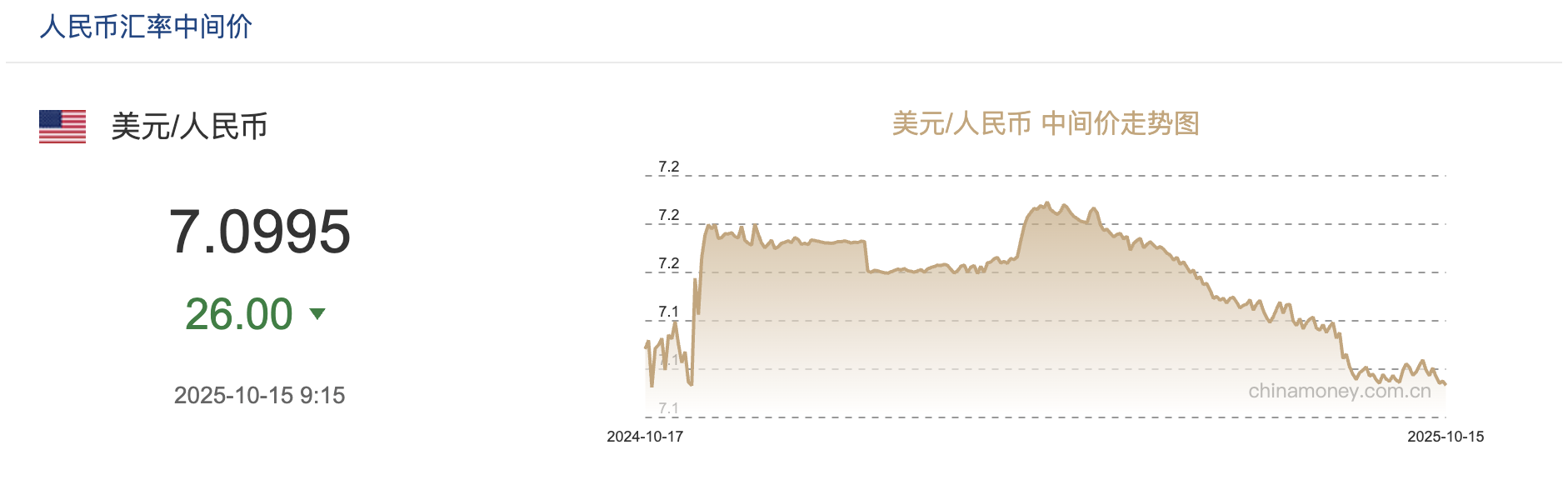
Core Viewpoint - The Chinese yuan has appreciated against the US dollar, reaching a new high since November 2024, driven by both internal and external factors [1][4][11]. Exchange Rate Movements - On October 15, the central bank set the yuan's midpoint at 7.0995 against the dollar, up 26 basis points from the previous day [1]. - The onshore yuan closed at 7.1238, rising 173 points, while the offshore yuan reached 7.13140, appreciating 0.12% [3]. - Year-to-date, the onshore yuan has appreciated by 2.40%, and the offshore yuan by 2.79% [3]. Economic Indicators - In September, the Producer Price Index (PPI) fell by 2.3% year-on-year, a decrease of 0.6 percentage points from the previous month, while the Consumer Price Index (CPI) dropped by 0.3% year-on-year [3]. - The core CPI, excluding food and energy, rose by 1.0%, marking the first increase in 19 months [3]. External Factors Influencing Yuan Strength - The US economy is facing recession risks, leading to expectations of interest rate cuts by the Federal Reserve, which has weakened the dollar [4][11]. - The strong performance of the A-share market has attracted international capital back to Chinese assets, increasing demand for the yuan [4][12]. Yuan Index Performance - The CFETS yuan index rose to 97.32, the BIS index to 103.43, and the SDR index to 91.89, all reaching new highs since April 2025 [5][7]. Long-term Outlook for Yuan - Analysts suggest that the yuan may have entered a long-term appreciation cycle, supported by a favorable economic environment and structural adjustments [13][14]. - The relative economic strength of China compared to the US is expected to provide solid support for the yuan's value [14][15].
攻守易形——25Q4策略展望
2025-10-13 14:56
Summary of Conference Call Records Industry or Company Involved - The records primarily discuss the Chinese economy, the impact of the Federal Reserve's monetary policy, and the investment landscape in China, particularly focusing on sectors such as manufacturing, consumption, and capital markets. Core Points and Arguments Federal Reserve's Monetary Policy Impact - The Federal Reserve's resumption of interest rate cuts is expected to accelerate cross-border capital inflows, leading to an appreciation of the Renminbi, projected to exceed 7.0 next year, reversing previous carry trade dynamics [1][4][11] - This shift is anticipated to drive various asset prices in China into a positive cycle, benefiting both manufacturing and consumer goods sectors [1][4][11] Chinese Manufacturing Sector - The rise of Chinese manufacturing is attributed to the unique dynamics of the Sino-US technology cycle, with fiscal subsidies driving high-end manufacturing expansion and policies aimed at restoring free cash flow [1][5][12] - The implementation of anti-involution policies has helped stabilize cash flows in high-end manufacturing, enhancing global competitiveness [5][12] Consumer Market Dynamics - The consumer sector is transitioning from a late-cycle to an early-cycle industry due to the recovery of national wealth and consumer confidence, spurred by the return of cross-border capital [1][6][14] - Low-valuation consumer goods are expected to benefit from this transition, with specific sectors like leisure food and passenger vehicles showing signs of recovery [2][19] Investment Recommendations - Suggested investment areas include non-ferrous metals (gold, silver, copper), new consumption sectors (snacks, pet care, travel), and domestic AI computing chains with competitive advantages [1][8][17] - High-end manufacturing sectors such as automotive, new energy vehicles, home appliances, chemicals, and pharmaceuticals are highlighted as having significant growth potential [18] Market Structure and Fund Holdings - Public funds currently hold over 30% in the TMT sector, indicating a crowded market structure, which may lead to a shift in market focus towards more reasonably valued sectors like high-end manufacturing and consumer goods [7][15][16] - The concentration of trading volume among a small number of companies suggests potential for a market shift, with recommendations to balance tech stock holdings [15][16] Global Financial Risks - Key global financial risks include potential crises in the US stock market due to prolonged interest rate hikes, reduced attractiveness of US Treasury bonds, and over-investment in AI capabilities [9][21] - The potential for a liquidity crisis in the US market is highlighted, necessitating close monitoring of these risks [9][21] Consumer Sector Valuation - The consumer sector is currently undervalued, with signs of recovery in margins for leisure food, passenger vehicles, and personal care products, while sectors like tourism and traditional Chinese medicine await larger capital inflows [2][19][20] Other Important but Possibly Overlooked Content - The records emphasize the importance of balancing investments across sectors in response to changing market dynamics, particularly as the Chinese economy shifts towards a consumption-driven model [13][14] - The potential for a "super cycle" in the non-ferrous metals sector is noted, driven by global re-industrialization and geopolitical uncertainties [17]
三大人民币汇率指数全线上行,多重利好因素或支撑人民币走强
Xin Hua Cai Jing· 2025-10-13 03:29
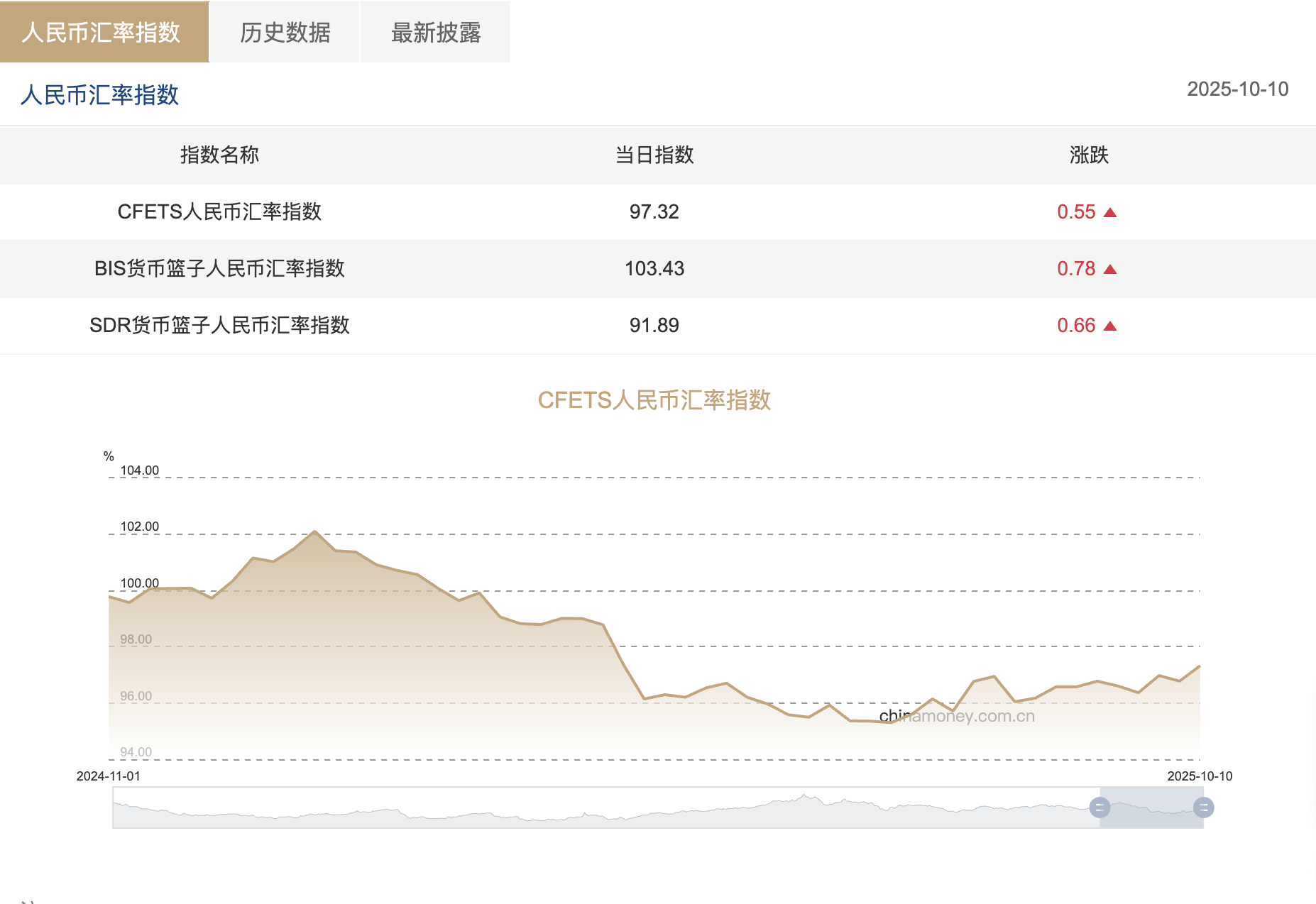
Currency Exchange Rates - The three major RMB exchange rate indices all rose during the week of October 10, with the CFETS RMB index at 97.32, up 0.55, reaching a new high since April 2025 [1] - The BIS currency basket RMB index rose to 103.43, up 0.78, also a new high since April 2025 [1] - The SDR currency basket RMB index increased to 91.89, up 0.66, marking a new high since April 2025 [1] USD Performance - The US dollar index continued its strong performance, breaking the 99 mark and reaching a two-month high, closing at 98.82 with a cumulative increase of 1.13% [5] - Non-USD currencies, including the Japanese yen, British pound, euro, and Australian dollar, all depreciated against the USD, with the euro down 1.01% [5] RMB Exchange Rate Outlook - The onshore RMB closed at 7.1360 against the USD, while the offshore RMB closed at 7.1232, with the RMB central parity rate at 7.1048, up 54 basis points from the previous trading day [5] - Analysts expect the RMB central parity rate against the USD to stabilize between 7.10 and 7.11 in the short term, with the central bank focusing on the performance against a basket of currencies [5] RMB Appreciation Drivers - The current RMB appreciation cycle is primarily driven by the US Federal Reserve's loose monetary policy, which is expected to continue until mid-next year [6] - The recent rebound of the USD is seen as a passive reaction to the weakness of the euro and yen due to political instability, with further USD strength dependent on the recovery of the US labor market [6]
三大人民币汇率报价全线升值
Bei Jing Shang Bao· 2025-10-10 02:34
Core Viewpoint - The People's Bank of China announced an increase in the central parity rate of the Renminbi against the US dollar, indicating a strengthening of the Chinese currency in the foreign exchange market [1] Exchange Rate Summary - The central parity rate for the Renminbi was set at 7.1048 CNY per USD, an increase of 54 basis points from the previous day's rate of 7.1102 CNY per USD [1] - As of 9:35 AM on the same day, the onshore Renminbi was quoted at 7.1263 CNY per USD, reflecting a daily appreciation of 0.04% [1] - The offshore Renminbi was reported at 7.1322 CNY per USD, showing a daily appreciation of 0.08% [1]
中国银行研究院:四季度主要金融数据有望回暖
Sou Hu Cai Jing· 2025-09-25 06:48
Core Insights - The report from the Bank of China Research Institute forecasts a recovery in major financial data in Q4 2025, driven by ongoing policy support and a stable upward trend in the RMB exchange rate [1] Financial Data Outlook - Total financing is expected to steadily expand, crucial for achieving annual and "14th Five-Year Plan" economic targets, with new policies anticipated to support infrastructure and real estate sectors, leading to stable growth in financing volume [1] - Funding in key areas and weak links is projected to maintain medium to high growth, with financial institutions increasing support for sectors like technology innovation, green finance, and elderly care, resulting in credit growth rates in these areas outpacing overall loan growth [1] - Government bond financing is expected to remain high, with fiscal policies reinforcing counter-cyclical adjustments and local investment demand accelerating, leading to record-high bond issuance for the year [2] Monetary Policy and Market Conditions - Interest rates are anticipated to continue a stable downward trend, providing a favorable monetary environment for real economy financing [4] - The A-share market is likely to maintain an upward trend, although caution is advised due to previous rapid increases and rising uncertainties [4] - The RMB is expected to appreciate further, supported by a stable domestic economic environment and downward pressure on the US dollar index, with demand for currency exchange bolstering the RMB's strength [4] Global Economic Context - Global economic growth expectations are mixed, with increasing uncertainties on the demand side and relative stability on the supply side [5] - Overall global inflation is stabilizing, but the US faces risks of inflation rebound, and geopolitical factors will continue to influence global capital flows [5] - Emerging market equities are becoming more attractive amid a weak US dollar index and fluctuating US Treasury yields [5]