风格轮动

Search documents
信达策略:当下或是牛市主升浪的前期
Sou Hu Cai Jing· 2025-08-17 23:57
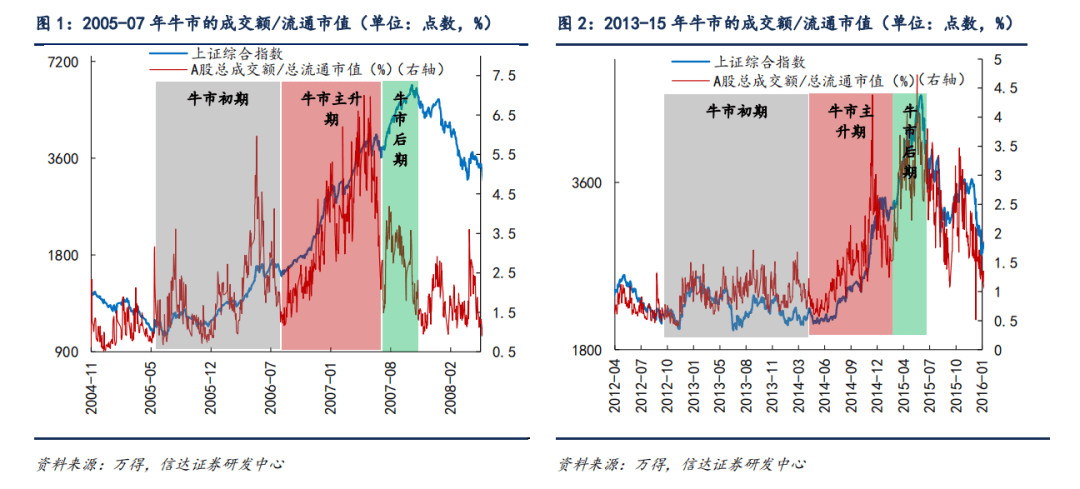
Group 1 - The current market may be in the early stage of a bull market's main upward wave, supported by three main reasons: the market turnover rate is still significantly lower than the peak observed at the beginning of the bull market, the prevailing small-cap style suggests it is likely the early stage of the main upward wave, and the equity financing scale has not yet reached historical highs [1][12][16] Group 2 - During previous bull market main upward waves, the market turnover rate typically increased significantly, with historical examples showing turnover rates rising from around 1.5% to over 6% and from below 1% to above 4% [2][4] - The style of leading stocks often changes between the early and late stages of a bull market, with small-cap stocks leading in the early stage and large-cap stocks taking over in the later stage [7][11] Group 3 - The scale of equity financing tends to increase rapidly during the main upward wave of a bull market, with historical bull markets showing significant recoveries in financing levels, while the current recovery remains slow [12][19] - The market is expected to experience a bull market main upward wave in the second half of the year, with structural opportunities arising from various themes and a gradual increase in resident capital inflows [16][18] Group 4 - Recent market performance shows significant gains in major indices, with the ChiNext 50 and ChiNext Index leading the increases, while certain sectors like telecommunications and electronics have outperformed [21]

A股趋势与风格定量观察:维持适度乐观,但需警惕短期波动
CMS· 2025-08-17 08:19
Quantitative Models and Construction Methods 1. Model Name: "Three-Dimensional Composite Timing Signal" - **Model Construction Idea**: This model integrates three key timing indicators—"Credit Impulse, Beta Dispersion, and Trading Volume"—to represent three core timing dimensions: economic fundamentals, overall sentiment, and structural risk. It aims to balance high probability and high payoff indicators for superior timing performance[5][12]. - **Model Construction Process**: - **Credit Impulse**: Measures the month-on-month change in credit balance percentile, reflecting economic fundamentals[5][15]. - **Beta Dispersion**: Captures the dispersion of stock betas, representing market sentiment and structural risk[5][12]. - **Trading Volume**: Quantifies market activity and liquidity, serving as a sentiment indicator[5][12]. - The composite signal combines these three indicators to generate timing signals, with historical backtesting showing strong in-sample and out-of-sample performance[12][14]. - **Model Evaluation**: The model demonstrates excellent timing performance in both in-sample and out-of-sample tests, effectively capturing market uptrends[12][14]. 2. Model Name: "Short-Term Timing Strategy" - **Model Construction Idea**: This model uses macroeconomic, valuation, sentiment, and liquidity indicators to generate weekly timing signals[20][23]. - **Model Construction Process**: - **Macroeconomic Indicators**: Includes PMI (>50 for optimism), credit impulse percentile (62.71%), and M1 growth rate percentile (96.61%)[20][23]. - **Valuation Indicators**: PE and PB percentiles (99.59% and 96.36%, respectively) are used to assess valuation levels[21][23]. - **Sentiment Indicators**: Beta dispersion (69.49%), trading volume sentiment (93.80%), and volatility (11.00%) are analyzed for market sentiment[21][23]. - **Liquidity Indicators**: Monetary rate (37.29%), exchange rate expectations (74.58%), and financing data (97.11%) are used to evaluate liquidity conditions[22][23]. - Signals are aggregated to determine overall market positioning[23]. - **Model Evaluation**: The strategy has consistently outperformed the benchmark, with significant annualized returns and lower drawdowns[22][23]. 3. Model Name: "Growth-Value Style Rotation Model" - **Model Construction Idea**: This model evaluates macroeconomic, valuation, and sentiment factors to determine the optimal allocation between growth and value styles[29][30]. - **Model Construction Process**: - **Macroeconomic Factors**: Profit cycle slope (4.17), interest rate cycle level (14.17), and credit cycle changes (-3.33) are analyzed[31]. - **Valuation Factors**: PE and PB valuation spreads (23.99% and 39.00%, respectively) are used to assess relative attractiveness[31]. - **Sentiment Factors**: Turnover and volatility spreads (38.13% and 19.97%, respectively) are considered for sentiment analysis[31]. - Signals are combined to recommend allocations between growth and value styles[31]. - **Model Evaluation**: The model has delivered significant excess returns over the benchmark since 2012, though it underperformed in 2025 YTD[30][32]. 4. Model Name: "Small-Cap vs. Large-Cap Style Rotation Model" - **Model Construction Idea**: This model evaluates macroeconomic, valuation, and sentiment factors to determine the optimal allocation between small-cap and large-cap styles[33][34]. - **Model Construction Process**: - **Macroeconomic Factors**: Profit cycle slope (4.17), interest rate cycle level (14.17), and credit cycle changes (-3.33) are analyzed[35]. - **Valuation Factors**: PE and PB valuation spreads (93.88% and 97.67%, respectively) are used to assess relative attractiveness[35]. - **Sentiment Factors**: Turnover and volatility spreads (81.01% and 51.58%, respectively) are considered for sentiment analysis[35]. - Signals are combined to recommend allocations between small-cap and large-cap styles[35]. - **Model Evaluation**: The model has consistently outperformed the benchmark since 2012, though it underperformed in 2025 YTD[34][36]. 5. Model Name: "Four-Style Rotation Model" - **Model Construction Idea**: This model integrates the conclusions of the growth-value and small-cap-large-cap rotation models to recommend allocations across four styles: small-cap growth, small-cap value, large-cap growth, and large-cap value[37]. - **Model Construction Process**: - Combines the signals from the growth-value and small-cap-large-cap models to allocate weights across the four styles[37]. - Current recommended allocation: small-cap growth (37.5%), small-cap value (12.5%), large-cap growth (37.5%), and large-cap value (12.5%)[37]. - **Model Evaluation**: The model has delivered significant excess returns over the benchmark since 2012, though it underperformed in 2025 YTD[37][38]. --- Model Backtesting Results 1. "Three-Dimensional Composite Timing Signal" - Annualized Return: 21.26% - Annualized Volatility: 14.46% - Maximum Drawdown: 12.80% - Sharpe Ratio: 1.2676 - Annualized Excess Return: 13.39%[14] 2. "Short-Term Timing Strategy" - Annualized Return: 17.83% - Annualized Volatility: 15.87% - Maximum Drawdown: 22.44% - Sharpe Ratio: 0.9874 - Annualized Excess Return: 13.24%[22][27] 3. "Growth-Value Style Rotation Model" - Annualized Return: 11.76% - Annualized Volatility: 20.77% - Maximum Drawdown: 43.07% - Sharpe Ratio: 0.5438 - Annualized Excess Return: 4.73%[30][32] 4. "Small-Cap vs. Large-Cap Style Rotation Model" - Annualized Return: 12.45% - Annualized Volatility: 22.65% - Maximum Drawdown: 50.65% - Sharpe Ratio: 0.5441 - Annualized Excess Return: 5.21%[34][36] 5. "Four-Style Rotation Model" - Annualized Return: 13.37% - Annualized Volatility: 21.51% - Maximum Drawdown: 47.91% - Sharpe Ratio: 0.5988 - Annualized Excess Return: 5.72%[37][38]
金融工程定期:8月转债配置:转债估值偏贵,看好偏股低估风格
KAIYUAN SECURITIES· 2025-08-17 05:16
Quantitative Models and Construction Methods Model 1: Convertible Bond Valuation Model - **Model Name**: Convertible Bond Valuation Model - **Model Construction Idea**: The model aims to compare the valuation of convertible bonds with their underlying stocks using a time-series comparable valuation metric called "100 Yuan Conversion Premium Rate" and the median of "Adjusted YTM - Credit Bond YTM" to measure the relative allocation value between debt-biased convertible bonds and credit bonds[4][5][15] - **Model Construction Process**: - **100 Yuan Conversion Premium Rate**: Fit the relationship curve between the conversion premium rate and conversion value in the cross-sectional space at each time point, and substitute the conversion value = 100 into the fitting formula to obtain the "100 Yuan Conversion Premium Rate" - Formula: $$ y_{i}=\alpha_{0}+\,\alpha_{1}\cdot\,{\frac{1}{x_{i}}}+\epsilon_{i} $$ where \( y_{i} \) is the conversion premium rate of the i-th convertible bond, and \( x_{i} \) is the conversion value of the i-th convertible bond[43] - **Adjusted YTM - Credit Bond YTM**: Adjust the YTM of debt-biased convertible bonds by stripping out the impact of conversion terms - Formula: $$ \text{Adjusted YTM} = \text{Convertible Bond YTM} \times (1 - \text{Conversion Probability}) + \text{Expected Conversion Annualized Yield} \times \text{Conversion Probability} $$ The conversion probability is calculated using the BS model, substituting the closing price of the underlying stock, option exercise price, stock volatility, remaining term, and discount rate to calculate the conversion probability \( N(d2) \)[44] - **Model Evaluation**: The model provides a systematic approach to evaluate the relative allocation value of convertible bonds compared to their underlying stocks and credit bonds[15] Model 2: Convertible Bond Comprehensive Valuation Factor - **Model Name**: Convertible Bond Comprehensive Valuation Factor - **Model Construction Idea**: The model combines the deviation of the conversion premium rate and the theoretical value deviation (Monte Carlo model) to construct a comprehensive valuation factor for convertible bonds[6][19] - **Model Construction Process**: - **Conversion Premium Rate Deviation**: - Formula: $$ \text{Conversion Premium Rate Deviation} = \text{Conversion Premium Rate} - \text{Fitted Conversion Premium Rate} $$ - **Theoretical Value Deviation (Monte Carlo Model)**: - Formula: $$ \text{Theoretical Value Deviation} = \frac{\text{Convertible Bond Closing Price}}{\text{Theoretical Value}} - 1 $$ The Monte Carlo model fully considers the conversion, redemption, downward revision, and repurchase terms of convertible bonds, simulating 10,000 paths at each time point and using the same credit term interest rate as the discount rate to calculate the theoretical value of the convertible bond[20] - **Comprehensive Valuation Factor**: - Formula: $$ \text{Convertible Bond Comprehensive Valuation Factor} = \text{Rank}(\text{Conversion Premium Rate Deviation}) + \text{Rank}(\text{Theoretical Value Deviation (Monte Carlo Model)}) $$ - **Model Evaluation**: The comprehensive valuation factor performs well in the overall, balanced, and debt-biased convertible bonds, while the theoretical value deviation (Monte Carlo model) performs better in equity-biased convertible bonds[19][20] Model 3: Convertible Bond Style Rotation Model - **Model Name**: Convertible Bond Style Rotation Model - **Model Construction Idea**: The model uses convertible bond momentum and volatility deviation as market sentiment capture indicators to construct a convertible bond style rotation portfolio, with bi-weekly rebalancing[7][26] - **Model Construction Process**: - **Market Sentiment Capture Indicators**: - Formula: $$ \text{Convertible Bond Style Market Sentiment Capture Indicator} = \text{Rank}(\text{Convertible Bond 20-Day Momentum}) + \text{Rank}(\text{Volatility Deviation}) $$ - **Style Rotation Position Calculation**: - Example Calculation: | | Convertible Bond Equity-Biased Low Valuation | Convertible Bond Balanced Low Valuation | Convertible Bond Debt-Biased Low Valuation | | --- | --- | --- | --- | | Equal Weight Index | 1 | 2 | 3 | | Volatility Deviation Ranking | 2 | 1 | 3 | | Market Sentiment Capture Indicator | 3 | 3 | 6 | | Style Rotation Position | 50% | 50% | 0% | - **Model Evaluation**: The style rotation model effectively captures market sentiment and allocates positions accordingly, showing superior performance compared to the equal-weight index[26][27][28] Model Backtesting Results Convertible Bond Valuation Model - **100 Yuan Conversion Premium Rate**: Rolling three-year percentile at 98.70%, rolling five-year percentile at 94.90%[4][15] - **Adjusted YTM - Credit Bond YTM**: Current median at -2.36%[5][15] Convertible Bond Comprehensive Valuation Factor - **Equity-Biased Convertible Bond Low Valuation Index**: - Annualized Return: 26.10% - Annualized Volatility: 20.55% - Maximum Drawdown: -22.94% - IR: 1.27 - Calmar Ratio: 1.14 - Monthly Win Rate: 62.22%[23] - **Balanced Convertible Bond Low Valuation Index**: - Annualized Return: 14.80% - Annualized Volatility: 11.82% - Maximum Drawdown: -15.95% - IR: 1.25 - Calmar Ratio: 0.93 - Monthly Win Rate: 62.22%[23] - **Debt-Biased Convertible Bond Low Valuation Index**: - Annualized Return: 13.37% - Annualized Volatility: 9.43% - Maximum Drawdown: -17.78% - IR: 1.42 - Calmar Ratio: 0.75 - Monthly Win Rate: 57.78%[23] Convertible Bond Style Rotation Model - **Convertible Bond Style Rotation**: - Annualized Return: 25.27% - Annualized Volatility: 16.68% - Maximum Drawdown: -15.89% - IR: 1.51 - Calmar Ratio: 1.59 - Monthly Win Rate: 65.56%[32] - **Convertible Bond Low Valuation Equal Weight Index**: - Annualized Return: 14.71% - Annualized Volatility: 10.97% - Maximum Drawdown: -15.48% - IR: 1.34 - Calmar Ratio: 0.95 - Monthly Win Rate: 61.11%[32] - **Convertible Bond Equal Weight Index**: - Annualized Return: 9.75% - Annualized Volatility: 11.66% - Maximum Drawdown: -20.60% - IR: 0.84 - Calmar Ratio: 0.47 - Monthly Win Rate: 60.00%[32]
[8月13日]指数估值数据(A股港股继续上涨,回到4.5星;美元降息,对A股港股有利吗)
银行螺丝钉· 2025-08-13 12:44
Core Viewpoint - The A-share and Hong Kong stock markets are experiencing strong upward momentum, with significant increases in various indices, particularly in growth-oriented sectors, while value stocks remain relatively subdued [1][3][6][8]. Market Performance - A-shares and Hong Kong stocks continue to rise, with the overall market returning to a rating of 4.5 stars [2]. - Major indices, including the CSI All Share Index, have surpassed their highest points from October 1 of the previous year [3]. - Both large-cap and small-cap stocks are on the rise, with small-cap stocks showing slightly higher gains [4][5]. - Growth style indices, such as the ChiNext, have seen substantial increases, while value style indices have lagged behind [6][7][8]. Economic Indicators - Recent U.S. economic data, including a lower-than-expected non-farm employment increase of 73,000 jobs in July, suggests potential signs of economic recession [16][17][20]. - The U.S. Consumer Price Index (CPI) for July rose by 2.7% year-on-year, which is below market expectations [21][22]. - The postponement of a 24% tariff between China and the U.S. for 90 days may help lower inflation rates [23][24]. - These economic indicators have increased the likelihood of a Federal Reserve interest rate cut in September [25]. Investment Implications - A decrease in interest rates is expected to positively impact asset prices, particularly benefiting bonds directly and stocks indirectly due to increased liquidity and lower funding costs [26][29]. - Non-dollar assets are likely to benefit even more during a U.S. interest rate cut cycle, as the dollar typically depreciates against other currencies [30][31]. - Historical trends indicate that the last bull market in Hong Kong stocks occurred during the 2020-2021 U.S. interest rate cut cycle [33]. - The current valuation levels of A-shares and Hong Kong stocks are significantly higher than during the last rate cut cycle, which may reduce the extent of future benefits from rate cuts [38]. Interest Rate Context - Historically, the average yield on 10-year U.S. Treasury bonds has been between 2-3%, with recent rates hovering just above 4% [40][43]. - Interest rate fluctuations are a short- to medium-term factor affecting market dynamics, providing opportunities for buying low and selling high, but having less impact on long-term investment returns [45][48]. Additional Features - A new feature in the "Today’s Star" app allows users to access real-time ETF valuation data and identify undervalued ETFs [49][50].

贵金属ETF收益反弹
Guo Tou Qi Huo· 2025-08-11 14:30
Report Investment Rating - The operation rating for the CITIC five-style - Cycle is ★☆☆ [4] Core Viewpoints - As of the week ending August 8, 2025, the weekly returns of Tonglian All A (Shanghai, Shenzhen, Beijing), ChinaBond Composite Bond, and Nanhua Commodity Index were 1.94%, 0.03%, and -0.36% respectively. In the public fund market, index enhancement strategies led in returns with a weekly increase of 1.65%. In the equity product segment, market neutral strategies generally had more gains than losses. For bonds, convertible bond returns rebounded, but the growth of short - and medium - to long - term pure bond funds slowed compared to the previous week. Among commodity funds, energy and chemical ETFs remained weak, while precious metals saw a rebound in returns, with the net value of silver ETFs rising significantly by 3.84% [4] - In the CITIC five - style, the style index closed up last Friday, with the cycle style leading in returns, rising 3.49%. The style rotation chart showed a slight recovery in the relative strength of the financial and cycle styles, and all five styles strengthened in terms of indicator momentum. Among the public fund pools, the excess returns of consumer - style funds recovered in the past week, with a weekly excess return of 1.06%, while the average return of cycle - style funds did not outperform the benchmark. From the trend of fund style coefficients, some consumer - style funds shifted towards the growth style. Currently, the market congestion is in the historically high - congestion range [4] - In terms of Barra factors, the ALPHA factor had a better return performance in the past week, with a weekly excess return of 0.34%. The returns of the valuation and residual volatility factors weakened. In terms of win - rate, the reversal - type factors strengthened marginally, while the profitability and liquidity factors declined slightly. This week, the cross - sectional rotation speed of factors increased compared to the previous week and is currently in the historically low - quantile range [4] - According to the latest scoring results of the style timing model, the cycle and financial styles recovered this week, while the consumer style declined. The current signal favors the cycle style. The return of the style timing strategy last week was 0.77%, with an excess return of - 1.02% compared to the benchmark balanced allocation [4] Summary by Relevant Catalogs Fund Market Review - In the public fund market, index enhancement strategies led in returns with a weekly increase of 1.65%. Market neutral strategies in equity products generally had more gains than losses. Convertible bond returns rebounded, but the growth of short - and medium - to long - term pure bond funds slowed compared to the previous week. Energy and chemical ETFs remained weak, while precious metals saw a rebound in returns, with the net value of silver ETFs rising significantly by 3.84% [4] Equity Market Style - The CITIC five - style index closed up last Friday, with the cycle style leading in returns, rising 3.49%. The relative strength of the financial and cycle styles slightly recovered, and all five styles strengthened in terms of indicator momentum. The excess returns of consumer - style funds recovered in the past week, with a weekly excess return of 1.06%, while the average return of cycle - style funds did not outperform the benchmark. Some consumer - style funds shifted towards the growth style, and the market congestion is in the historically high - congestion range [4] Barra Factors - The ALPHA factor had a better return performance in the past week, with a weekly excess return of 0.34%. The returns of the valuation and residual volatility factors weakened. The reversal - type factors strengthened marginally, while the profitability and liquidity factors declined slightly. The cross - sectional rotation speed of factors increased compared to the previous week and is currently in the historically low - quantile range [4] Style Timing Model - The cycle and financial styles recovered this week, while the consumer style declined. The current signal favors the cycle style. The return of the style timing strategy last week was 0.77%, with an excess return of - 1.02% compared to the benchmark balanced allocation [4]
基金限购潮起,要业绩不要规模,这轮牛市特有的味道?
Xin Lang Cai Jing· 2025-08-08 06:33
Core Viewpoint - Recent trend in the fund industry shows a shift from aggressive expansion to limiting purchases and controlling scale, reflecting a more cautious approach by fund companies in response to market dynamics [1][5][8] Group 1: Fund Limitation Trends - In the past two weeks, 255 funds have suspended large purchases, with 57 funds halting subscriptions, indicating a widespread adoption of purchase limits across various fund types [1][5] - The current wave of fund limitations is driven by a diverse range of factors, including fund capacity, strategy sustainability, and client structure stability, rather than solely performance-driven reasons [1][5][8] Group 2: Performance-Driven Limitations - High-performing funds such as Yongying Ruixin Mixed and GF Growth Navigator have announced large purchase limits due to significant year-to-date gains, with some funds seeing net value increases of over 60% [2][3] - The Hong Kong Advantage Selection Fund (QDII) has achieved a return rate of 144.41% this year and has limited subscriptions to prevent irrational inflows that could dilute existing investors' interests [3][7] Group 3: Risk Management and Strategy - Fund companies are implementing purchase limits as a risk control measure to maintain strategy effectiveness and protect existing investors, rather than simply responding to liquidity issues [4][8] - The trend of limiting purchases is also influenced by regulatory changes, shifting the focus from scale-driven incentives to performance-driven strategies among fund managers [6][8] Group 4: Market Dynamics and Investor Behavior - The current market environment reflects a sensitive period of style rotation, with small-cap stocks outperforming and fund companies adopting defensive strategies through purchase limits [7][8] - The limitations are not only a response to high demand but also a strategic choice to ensure a stable and manageable investor base, moving away from the perception of limits as a signal of "hot products" [8]
量化大势研判:预期成长优势差继续扩大
Minsheng Securities· 2025-08-04 06:40
Quantitative Models and Construction Methods 1. Model Name: Quantitative Market Trend Judgment Framework - **Model Construction Idea**: The framework identifies the dominant market style by comparing the intrinsic attributes of assets, which are tied to their industry lifecycle stages. It prioritizes assets based on the sequence of growth rate (g) > return on equity (ROE) > dividend yield (D) to determine the most advantageous assets and focuses on the most promising sectors[5][6][9] - **Model Construction Process**: 1. Define five style stages for equity assets: external growth, quality growth, quality dividend, value dividend, and distressed value[5] 2. Compare assets globally to identify advantageous ones based on their intrinsic characteristics[5] 3. Use the priority sequence g > ROE > D to evaluate whether good assets exist and whether they are overvalued[5][6] 4. Focus on sectors with the most advantageous characteristics in the current market[5][6] - **Model Evaluation**: The framework has demonstrated strong explanatory power for A-share market style rotations since 2009, achieving an annualized return of 26.70%[16] 2. Model Name: Asset Comparison Strategy - **Model Construction Idea**: This model categorizes assets into primary and secondary groups. Primary assets include actual growth, expected growth, and profitability assets. Secondary assets are prioritized based on crowding levels and fundamental factors[9] - **Model Construction Process**: 1. Classify assets into primary (expected growth, actual growth, profitability) and secondary (quality dividend, value dividend, distressed value) categories[9] 2. Allocate market funds to primary assets when any of them show an advantage; otherwise, shift to secondary assets[9] 3. Rank secondary assets by crowding levels and fundamental factors, with the order: quality dividend > value dividend > distressed value[9] --- Model Backtesting Results 1. Quantitative Market Trend Judgment Framework - Annualized return: 26.70% since 2009[16] - Historical performance: Positive excess returns in most years, with limited effectiveness in 2011, 2012, 2014, and 2016[16][19] - Excess returns by year: - 2009: 51% - 2010: 14% - 2013: 36% - 2017: 27% - 2020: 44% - 2022: 62%[19] --- Quantitative Factors and Construction Methods 1. Factor Name: Expected Growth (gf) - **Factor Construction Idea**: Measures the expected growth rate based on analysts' forecasts, regardless of the industry lifecycle stage[6] - **Factor Construction Process**: 1. Use analysts' forecasted growth rates as the primary input[6] 2. Calculate the spread (Δgf) between top and bottom groups to assess the trend of expected growth[21] - **Factor Evaluation**: The factor has shown consistent expansion, with top groups driving the increase, indicating analysts' optimism about high-growth sectors[21] 2. Factor Name: Actual Growth (g) - **Factor Construction Idea**: Focuses on performance momentum (Δg) during transition and growth phases[6] - **Factor Construction Process**: 1. Calculate the spread (Δg) between top and bottom groups based on actual growth rates[25] 2. Monitor the trend of Δg to identify growth opportunities in the market[25] - **Factor Evaluation**: The factor has shown gradual expansion, with opportunities in sectors maintaining strong momentum despite a slowdown in top-tier growth[25] 3. Factor Name: Profitability (ROE) - **Factor Construction Idea**: Evaluates valuation levels using the PB-ROE framework, focusing on mature industries[6] - **Factor Construction Process**: 1. Calculate the PB-ROE residuals for each industry[40] 2. Rank industries based on residuals to identify undervalued high-ROE sectors[40] - **Factor Evaluation**: The factor's advantage has declined, and its crowding level remains low, suggesting limited opportunities in the current market[28] 4. Factor Name: Quality Dividend (DP+ROE) - **Factor Construction Idea**: Combines dividend yield (DP) and ROE to identify high-quality dividend-paying industries[6] - **Factor Construction Process**: 1. Calculate DP and ROE scores for each industry[43] 2. Combine the scores to rank industries and select the top-performing ones[43] - **Factor Evaluation**: The factor has shown significant excess returns in specific years, such as 2016, 2017, and 2023[43] 5. Factor Name: Value Dividend (DP+BP) - **Factor Construction Idea**: Combines dividend yield (DP) and book-to-price ratio (BP) to identify undervalued dividend-paying industries[6] - **Factor Construction Process**: 1. Calculate DP and BP scores for each industry[47] 2. Combine the scores to rank industries and select the top-performing ones[47] - **Factor Evaluation**: The factor has demonstrated strong excess returns in years like 2009, 2017, and 2021-2023[47] 6. Factor Name: Distressed Value (PB+SIZE) - **Factor Construction Idea**: Identifies industries with low price-to-book ratios (PB) and small market capitalization (SIZE), focusing on stagnation and recession phases[6] - **Factor Construction Process**: 1. Calculate PB and SIZE scores for each industry[51] 2. Combine the scores to rank industries and select the lowest-scoring ones[51] - **Factor Evaluation**: The factor has shown significant excess returns during periods like 2015-2016 and 2021-2023[51] --- Factor Backtesting Results 1. Expected Growth (gf) - Δgf continues to expand, driven by top-tier groups, indicating analysts' optimism about high-growth sectors[21] 2. Actual Growth (g) - Δg shows gradual expansion, with opportunities in sectors maintaining strong momentum despite a slowdown in top-tier growth[25] 3. Profitability (ROE) - ROE advantage continues to decline, with low crowding levels and limited opportunities in the current market[28] 4. Quality Dividend (DP+ROE) - Significant excess returns in 2016, 2017, and 2023[43] 5. Value Dividend (DP+BP) - Strong excess returns in 2009, 2017, and 2021-2023[47] 6. Distressed Value (PB+SIZE) - Significant excess returns during 2015-2016 and 2021-2023[51]
A股趋势与风格定量观察:情绪略有隐忧,但整体仍中性偏多
CMS· 2025-08-03 11:05
Quantitative Models and Construction Methods 1. Model Name: Credit Impulse Timing Strategy - **Model Construction Idea**: The model uses credit impulse as a timing indicator for A-shares, where the direction of credit impulse determines the market position (full position when upward, empty position when downward) [6][13][14] - **Model Construction Process**: - Calculate the year-on-year growth rate of long-term corporate loans (TTM) as the credit impulse indicator - Use the direction of the credit impulse to determine market positions: full position when the indicator is upward, empty position when downward - Formula: $ \text{Credit Impulse} = \frac{\text{Long-term Corporate Loans (TTM)} - \text{Long-term Corporate Loans (TTM, previous year)}}{\text{Long-term Corporate Loans (TTM, previous year)}} $ - **Model Evaluation**: The model has shown high effectiveness in avoiding major downtrends in the market [6][13][14] 2. Model Name: Beta Dispersion Timing Strategy - **Model Construction Idea**: The model uses beta dispersion as an indicator to measure local market sentiment overheating, with significant monthly timing effectiveness [6][17] - **Model Construction Process**: - Calculate the monthly beta dispersion of the market - Use the beta dispersion to determine market positions: higher beta dispersion indicates higher risk - Formula: $ \text{Beta Dispersion} = \frac{\sum_{i=1}^{N} (\beta_i - \bar{\beta})^2}{N} $ where $\beta_i$ is the beta of stock i, $\bar{\beta}$ is the average beta, and N is the number of stocks - **Model Evaluation**: The model has shown significant monthly timing effectiveness since 2013 [6][17] 3. Model Name: Trading Volume Timing Strategy - **Model Construction Idea**: The model uses trading volume as an indicator for market timing, with significant daily timing effectiveness [6][17] - **Model Construction Process**: - Calculate the daily trading volume and its 60-day moving average - Use the trading volume to determine market positions: higher trading volume indicates stronger market support - Formula: $ \text{Trading Volume Indicator} = \frac{\text{Daily Trading Volume}}{\text{60-day Moving Average of Trading Volume}} $ - **Model Evaluation**: The model has shown significant daily timing effectiveness since 2013 [6][17] 4. Composite Model: Credit Impulse, Beta Dispersion, Trading Volume - **Model Construction Idea**: The composite model combines credit impulse, beta dispersion, and trading volume indicators for market timing [6][18] - **Model Construction Process**: - Use equal weighting to combine the three indicators - Adjust positions based on the combined signal: average 2-week signal change frequency - Formula: $ \text{Composite Indicator} = \frac{\text{Credit Impulse Indicator} + \text{Beta Dispersion Indicator} + \text{Trading Volume Indicator}}{3} $ - **Model Evaluation**: The composite model has shown a high annual turnover rate and significant annualized returns since 2013 [6][18] Model Backtesting Results 1. Credit Impulse Timing Strategy - **Annualized Return**: 10.83% [6][13][14] - **Avoided Major Downtrends**: 2015 H2, 2018, 2022-2024 H1 [6][13][14] 2. Beta Dispersion Timing Strategy - **Annualized Return**: 13.12% [6][17] - **Monthly Timing Effectiveness**: Significant since 2013 [6][17] 3. Trading Volume Timing Strategy - **Annualized Return**: 14.33% [6][17] - **Daily Timing Effectiveness**: Significant since 2013 [6][17] 4. Composite Model: Credit Impulse, Beta Dispersion, Trading Volume - **Annualized Return**: 19.98% [6][18] - **Annual Turnover Rate**: 24 times [6][18] Quantitative Factors and Construction Methods 1. Factor Name: Manufacturing PMI Timing Strategy - **Factor Construction Idea**: The factor uses manufacturing PMI as a timing indicator for A-shares, with positions adjusted based on PMI levels [6][13] - **Factor Construction Process**: - Calculate the rolling 5-year percentile of manufacturing PMI - Adjust positions based on PMI levels: full position when >60%, empty position when <40%, half position when between 40%-60% - Formula: $ \text{PMI Timing Indicator} = \begin{cases} \text{Full Position} & \text{if PMI Percentile} > 60\% \\ \text{Empty Position} & \text{if PMI Percentile} < 40\% \\ \text{Half Position} & \text{if 40\% \leq PMI Percentile \leq 60\%} \end{cases} $ - **Factor Evaluation**: The factor has shown poor timing performance with an annualized return of only 0.41% since 2009 [6][13] Factor Backtesting Results 1. Manufacturing PMI Timing Strategy - **Annualized Return**: 0.41% [6][13] - **Comparison with Benchmark**: Underperformed the Wind All A Index annualized return of 8.49% [6][13] Style Rotation Models and Construction Methods 1. Model Name: Growth-Value Style Rotation Model - **Model Construction Idea**: The model suggests overweighting growth based on economic cycle analysis, valuation differences, and sentiment indicators [35][36] - **Model Construction Process**: - Analyze economic cycle indicators: profitability slope, interest rate cycle, credit cycle - Calculate valuation differences: PE and PB percentiles - Assess sentiment indicators: turnover and volatility differences - Formula: $ \text{Growth-Value Rotation Indicator} = \frac{\text{Profitability Slope Indicator} + \text{Interest Rate Cycle Indicator} + \text{Credit Cycle Indicator} + \text{PE Difference Indicator} + \text{PB Difference Indicator} + \text{Turnover Difference Indicator} + \text{Volatility Difference Indicator}}{7} $ - **Model Evaluation**: The model suggests overweighting growth based on current indicators [35][36] 2. Model Name: Small-Cap Large-Cap Style Rotation Model - **Model Construction Idea**: The model suggests balanced allocation based on economic cycle analysis, valuation differences, and sentiment indicators [35][41] - **Model Construction Process**: - Analyze economic cycle indicators: profitability slope, interest rate cycle, credit cycle - Calculate valuation differences: PE and PB percentiles - Assess sentiment indicators: turnover and volatility differences - Formula: $ \text{Small-Cap Large-Cap Rotation Indicator} = \frac{\text{Profitability Slope Indicator} + \text{Interest Rate Cycle Indicator} + \text{Credit Cycle Indicator} + \text{PE Difference Indicator} + \text{PB Difference Indicator} + \text{Turnover Difference Indicator} + \text{Volatility Difference Indicator}}{7} $ - **Model Evaluation**: The model suggests balanced allocation based on current indicators [35][41] 3. Composite Model: Four-Dimensional Style Rotation Model - **Model Construction Idea**: The model combines growth-value and small-cap large-cap rotation models for allocation [35][44] - **Model Construction Process**: - Combine the signals from growth-value and small-cap large-cap rotation models - Adjust positions based on combined signals - Formula: $ \text{Four-Dimensional Rotation Indicator} = \frac{\text{Growth-Value Rotation Indicator} + \text{Small-Cap Large-Cap Rotation Indicator}}{2} $ - **Model Evaluation**: The model suggests specific allocation proportions based on current indicators [35][44] Style Rotation Model Backtesting Results 1. Growth-Value Style Rotation Model - **Annualized Return**: 11.65% [35][37] - **Comparison with Benchmark**: Outperformed the benchmark annualized return of 6.91% [35][37] 2. Small-Cap Large-Cap Style Rotation Model - **Annualized Return**: 12.32% [35][42] - **Comparison with Benchmark**: Outperformed the benchmark annualized return of 7.11% [35][42] 3. Composite Model: Four-Dimensional Style Rotation Model - **Annualized Return**: 13.22% [35][44] - **Comparison with Benchmark**: Outperformed the benchmark annualized return of 7.50% [35][44]

2025年8月大类资产配置展望:穿越震荡,韧性上行
Soochow Securities· 2025-08-03 09:02
Group 1 - The report anticipates a strong rebound in the A-share market in August 2025, with potential volatility due to alternating negative scores in the internal model [2][6][30] - The Hong Kong stock market is expected to follow a similar trend as the A-share market, with recent easing of pressure on the Hong Kong dollar from the US dollar index [2][6] - Growth style is likely to outperform in relative returns, while dividend sectors may perform moderately [2][6][30] Group 2 - The US stock market is projected to experience wide fluctuations in August, with high risk levels indicated by the risk trend model [2][6] - The gold market is assessed to have a medium risk level, with no significant overvaluation or undervaluation expected [2][6] - The report suggests a continued inverse fluctuation pattern between US stocks and gold, with attention needed on events driven by the "Trump 2.0" tariff framework [2][6] Group 3 - The domestic bond market is expected to show limited fundamental recovery, with a prevailing loose policy tone and overall interest rates likely to remain strong [2][6] - The US bond market is supported by fundamental pressures, easing supply, and rising risk aversion, contributing to a downward trend in interest rates [2][6] Group 4 - The report recommends a relatively balanced asset allocation strategy, anticipating a wide fluctuation market with ongoing structural opportunities [2][6]
[7月30日]指数估值数据(大盘回调;观察市场涨跌,看上证还是中证指数呢)
银行螺丝钉· 2025-07-30 13:58
Core Viewpoint - The article discusses the current state of the A-share market, highlighting the rotation between growth and value styles, and the performance of different indices over recent years, emphasizing the importance of using the CSI indices for a more stable market observation [4][21][25]. Market Performance - The overall market saw a decline today, with the CSI All Share Index down by 0.4% [1]. - Large-cap stocks in the CSI 300 experienced slight declines, while small-cap stocks faced more significant drops [3]. - There was a notable shift in market style, with value stocks showing strength today, contrasting with the previous days when growth stocks were performing better [4]. Index Analysis - The CSI All Share Index rose approximately 80% from 2019 to 2021, reaching over 6000 points at its peak [21]. - The article notes that the Shanghai Composite Index has a different composition than the Shenzhen Composite Index, which has led to varying performance during bull and bear markets [12][13]. - The maximum drawdowns from 2021 to 2024 were significant, with the Shanghai Composite Index down about 29.4%, while the Shenzhen Composite Index and the ChiNext Index saw larger declines of approximately 52.9% and 58.6%, respectively [14]. Investment Strategy - The article emphasizes the importance of understanding the characteristics of both the Shanghai and Shenzhen markets, as they each represent about half of the A-share market [19]. - It suggests that experienced investors should not rely solely on the Shanghai Composite Index to gauge market performance, advocating for a broader view that includes the CSI indices [19][20]. - The article introduces a new feature in the "Today Star" app that allows users to view real-time ETF valuations and identify undervalued ETFs, enhancing investment decision-making [26][35].