
国产替代

Search documents
金太阳2026年1月21日涨停分析:半导体抛光液+技术研发突破+业绩增长
Xin Lang Cai Jing· 2026-01-21 06:17
Group 1 - The core product of the company, semiconductor polishing liquid, has passed verification and achieved mass production, securing orders from leading FAB manufacturers, marking a breakthrough in domestic substitution and directly contributing to performance growth [2] - The company reported a significant increase in its financial performance, with a 126.9% year-on-year growth in net profit excluding non-recurring items and an 88.05% increase in net cash flow from operating activities, indicating strong profitability and good sales collection [2] - The company's construction projects increased by 70.85%, laying a foundation for future capacity expansion [2] Group 2 - The semiconductor materials industry has a broad development prospect driven by domestic substitution demand, with some stocks in the same concept sector also performing well, creating a certain degree of sector linkage effect [2] - The company was included in the "Dragon and Tiger List" on January 16, 2026, with a transaction amount of 686 million, indicating strong market interest from retail and institutional investors [2] - The stock price has upward momentum due to market capital inflow and improvement in the company's fundamentals, with the recent price surge likely reflecting positive market expectations for the company's future development [2]

存储芯片概念股强势上涨,科创芯片设计ETF、芯片ETF 、半导体ETF、科创芯片ETF涨超4%
Ge Long Hui· 2026-01-21 06:11
Core Viewpoint - Samsung and SK Hynix are reportedly reducing production, leading to a strong rise in storage chip concept stocks and related ETFs [1][3]. Group 1: Market Dynamics - Samsung's NAND wafer production is expected to decrease from 4.9 million units last year to 4.68 million units this year, below the reduction level planned for 2024 due to declining profitability [3]. - SK Hynix's NAND production is projected to drop from approximately 1.9 million units last year to 1.7 million units this year [3]. - Micron Technology has indicated that the shortage of memory chips has intensified, driven by surging demand for high-end semiconductors for AI infrastructure, which is expected to persist beyond this year [3]. - The storage market is reportedly surpassing the historical high of 2018, with suppliers' bargaining power reaching an all-time high, and storage prices are expected to rise by 40% to 50% in Q1 2026 and by about 20% in Q2 2026 [3]. Group 2: Industry Trends - The global 8-inch wafer supply and demand are entering a period of imbalance, with TSMC and Samsung's strategic production cuts impacting the total 8-inch foundry capacity, which is expected to shrink by 2.4% by 2026 [4]. - The average capacity utilization rate in the industry is recovering to a high of 90%, driven by strong demand for AI-driven power management chips [4]. - Major Chinese wafer foundries are increasing their prices by 5% to 20% to meet the demand for 8-inch chips [4]. - TSMC's capital expenditure is expected to exceed expectations, with a projected increase of 37% to a historical high of $56 billion in 2026, which will boost demand for advanced semiconductor manufacturing in the computing sector [4]. Group 3: Investment Opportunities - The geopolitical tensions are providing a window for domestic semiconductor alternatives, with companies like Huawei, Cambricon, and Haiguang rapidly improving their performance in next-generation computing chips [5]. - The storage chip sector is currently in a price uptrend due to multiple factors, including surging AI demand and supply-side contractions, which are expected to lead to a performance explosion for global storage industry chain enterprises [5]. - The acceleration of storage production line construction and the increase in domestic production rates are anticipated to create investment opportunities in supporting semiconductor equipment and packaging sectors [5].

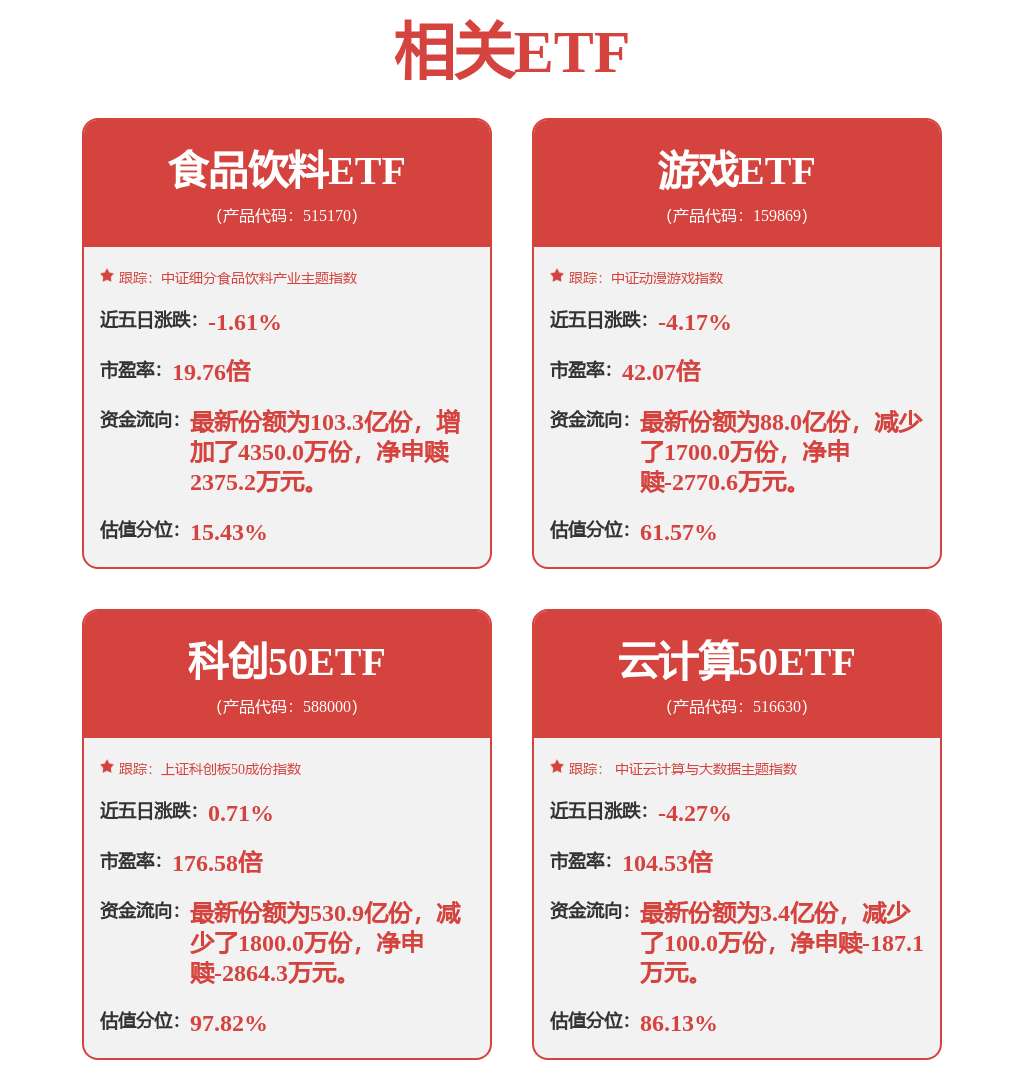
ETF盘中资讯|存储芯片概念拉动,半导体强势上涨!科创人工智能ETF华宝(589520)盘中猛拉3.2%,近5日吸金6405万元!
Sou Hu Cai Jing· 2026-01-21 05:51
Core Viewpoint - The domestic AI industry chain is experiencing significant investment interest, as evidenced by the strong performance of the Huabao Sci-Tech AI ETF (589520), which has seen a notable increase in net inflows and stock price recovery after a series of declines [1][4]. Group 1: ETF Performance - The Huabao Sci-Tech AI ETF (589520) rose by 2.54%, ending a four-day losing streak, with an intraday peak increase of 3.29% [1]. - Over the past five days, the ETF has attracted a net inflow of 64.05 million yuan, and over the last ten days, it has accumulated a total of 151 million yuan in inflows [1]. - The ETF's current price is 0.686 yuan, with a trading volume of 0 [1]. Group 2: Component Stocks - Leading stocks within the ETF include Lanke Technology, which surged over 10%, Yuntian Lifeng with a nearly 9% increase, and Hengxuan Technology rising over 6% [1][2]. - Other notable stocks include Chipone Technology, Fudan Microelectronics, and Cambricon Technologies, all of which experienced gains [1]. Group 3: AI Industry Insights - The AI application sector is advancing, with significant growth in digital human marketing applications, as evidenced by a 500% year-on-year increase in consumption [3]. - Long-term prospects for the AI industry are positive, with expectations for high growth driven by demand, supply improvements, and product enhancements [3]. - The Huabao Sci-Tech AI ETF focuses on a balanced allocation across application software, terminal applications, terminal chips, and cloud chips, reflecting a shift in the AI industry from reliance on foreign technology to domestic capabilities [3][4]. Group 4: Market Trends - The semiconductor market is experiencing a boost, with a reported 22.8% increase in storage chip production and a 12.6% increase in server production, driven by the "AI+" initiative [2]. - The ETF is positioned as an efficient tool for investing in domestic computing power, with a strong focus on domestic AI industry leaders [4].
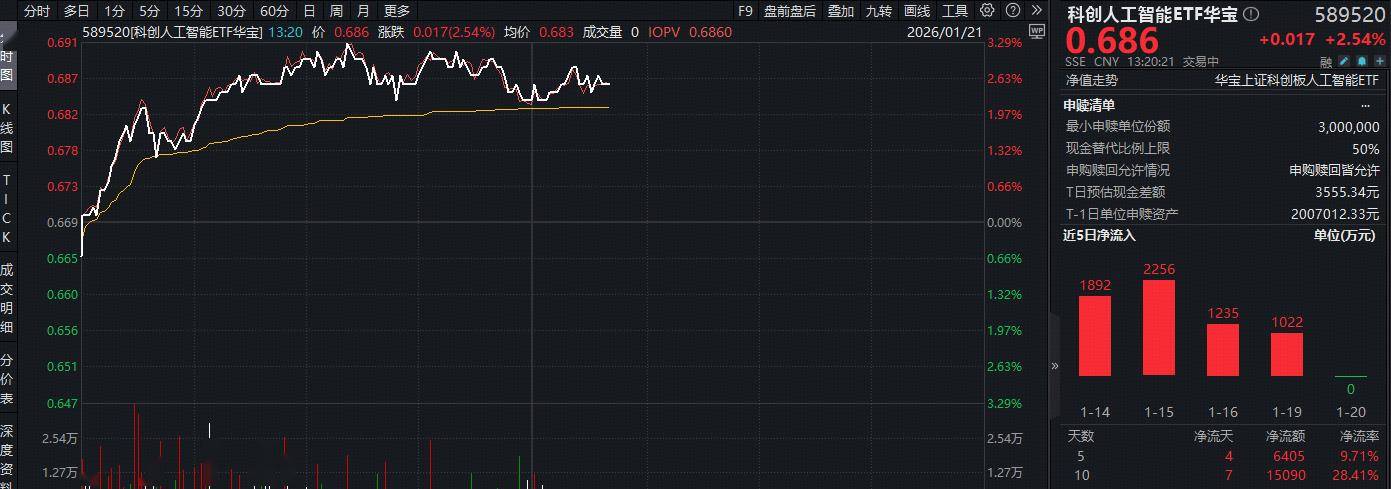
存储芯片概念拉动,半导体强势上涨!科创人工智能ETF华宝(589520)盘中猛拉3.2%,近5日吸金6405万元!
Xin Lang Cai Jing· 2026-01-21 05:36
Core Viewpoint - The domestic AI industry chain is experiencing significant growth, with the Huabao Sci-Tech AI ETF (589520) showing a strong upward trend, ending a four-day decline and attracting substantial capital inflow [1][7]. Group 1: ETF Performance - The Huabao Sci-Tech AI ETF (589520) saw an intraday increase of 3.29%, currently up 2.54%, marking the end of a four-day losing streak [1][7]. - Over the past five days, the ETF has received a net inflow of 64.05 million yuan, and over the last ten days, it has accumulated a total inflow of 1.51 billion yuan [1][7]. Group 2: Stock Performance - Notable stocks within the ETF include: - Lanke Technology, which rose by 10.43% [2][10]. - Yuntian Lifelike, increasing by 8.94% [2][10]. - Hengxuan Technology, up by 6.23% [2][10]. - Other stocks such as Xinyuan Co., Fudan Microelectronics, and Cambricon also showed positive growth [5][9]. Group 3: AI Chip Market - In the AI chip sector, SanDisk's stock surged by 8%, reaching a new historical high, with Citigroup raising its target price from $280 to $490 [2][10]. - The National Bureau of Statistics reported a 22.8% increase in storage chip production and a 12.6% increase in server production, indicating a sustained improvement in the semiconductor market [2][10]. Group 4: AI Applications - The collaboration between Zhejiang Wenlian and ByteDance's giant engine has led to the "Pai Zhi" digital human project, which is expected to consume over 250 million yuan by 2025, reflecting a fivefold year-on-year growth [3][11]. - Long-term prospects for AI applications are positive, with expectations for significant opportunities arising from model paradigm shifts by 2026 [3][12]. Group 5: Domestic AI Industry Focus - The Huabao Sci-Tech AI ETF focuses on the domestic AI industry chain, emphasizing strong domestic substitution characteristics, with major holdings in leading domestic GPU and ASIC companies [4][13]. - The ETF's top ten holdings account for nearly 70% of its weight, with the semiconductor sector representing almost half of its portfolio, indicating a high concentration and aggressive positioning [4][13].
国产半导体设备材料领域景气度或提升!科创半导体设备ETF(588710)获资金逆势加仓
Xin Lang Cai Jing· 2026-01-21 05:14
Group 1 - The semiconductor equipment and materials sector is expected to maintain high visibility in orders and performance due to the expansion and price increase of storage chips, along with the advancement of domestic substitution processes [1][5] - Year-to-date, ETFs focused on semiconductor equipment and materials have attracted over 16.5 billion yuan in capital, indicating strong market recognition and consensus [1][5] - The Kweichow Moutai Semiconductor Equipment ETF (588710) has seen net inflows for four consecutive trading days, reaching historical highs in both shares and scale, with 976 million shares and 1.889 billion yuan respectively [1][5] Group 2 - Micron Technology announced plans to acquire a wafer fabrication facility for 1.8 billion USD to expand its storage chip capacity, which is expected to support the long-term development logic of semiconductor equipment and materials [1][5] - The index for the Kweichow Moutai Semiconductor Equipment ETF has a weight of 84.8% in "semiconductor equipment + semiconductor materials," focusing exclusively on the STAR Market, which may enhance the index's technological quality [1][5] - The fund manager, Huatai-PB Fund, is one of the first ETF managers in China, with a strong track record in various index fields, including a series of dividend ETFs [1][5]

科创板光刻设备龙头2025年净利同比预增超70%,科创半导体ETF(588170)近4天获得连续资金净流入,半导体设备ETF华夏(562590)近11天获得连续资金净流入
Mei Ri Jing Ji Xin Wen· 2026-01-21 04:35
Group 1 - The Shanghai Stock Exchange Sci-Tech Innovation Board Semiconductor Materials and Equipment Theme Index (950125) decreased by 0.27% as of January 21, 2026, with mixed performance among constituent stocks [1] - Notable gainers included Naiko Equipment up 8.78%, SMIC up 4.67%, and Huahai Chengke up 4.22%, while major decliners were Zhongke Feimiao down 5.62%, Aisen Co. down 3.60%, and Chip Source Micro down 2.07% [1] - The Sci-Tech Semiconductor ETF (588170) fell by 0.43%, with a latest price of 1.87 yuan and a turnover rate of 11.2%, totaling a transaction volume of 785 million yuan, indicating active market trading [1] Group 2 - The CSI Semiconductor Materials and Equipment Theme Index (931743) also saw a decline of 0.29%, with Jianghua Micro leading gains at 10.02% and Huahai Chengke up 4.16% [1] - The Semiconductor Equipment ETF Huaxia (562590) decreased by 0.44%, with a latest price of 2.04 yuan and a turnover rate of 4.56%, resulting in a transaction volume of 134 million yuan [1] Group 3 - The Sci-Tech Semiconductor ETF has experienced continuous net inflows over the past four days, with a peak single-day net inflow of 988 million yuan, totaling 1.92 billion yuan and an average daily net inflow of 480 million yuan [2] - The Semiconductor Equipment ETF Huaxia has seen net inflows for 11 consecutive days, with a maximum single-day net inflow of 365 million yuan, accumulating 1.83 billion yuan and an average daily net inflow of 166 million yuan [2] Group 4 - Chipbond Microelectronics (688630.SH) announced a profit forecast for 2025, expecting a net profit attributable to shareholders of 275 million to 295 million yuan, representing a year-on-year growth of 71.13% to 83.58% [2] - The company's profit growth is attributed to breakthroughs in high-end PCB and semiconductor fields, strong demand for high-end LDI equipment, and the adoption of high-precision CO2 laser drilling equipment by major clients [2] - Zhongyin International believes that the rapid growth of global AI computing power and automotive electronics is driving the PCB industry towards high-layer and high-density technology iterations, with Chipbond Microelectronics positioned as a leader in high-end LDI equipment [2] Group 5 - The Sci-Tech Semiconductor ETF (588170) and its linked funds focus on semiconductor equipment (60%) and materials (25%), benefiting from the domestic substitution trend and the demand surge driven by the AI revolution [3] - The Semiconductor Equipment ETF Huaxia (562590) also emphasizes semiconductor equipment (63%) and materials (24%), targeting the upstream semiconductor sector [3]

关税阴影突袭!美股为何一碰就崩?
Sou Hu Cai Jing· 2026-01-21 04:04
这场暴跌暴露关税政策对金融市场的破坏性连锁反应,投资者用脚投票表达对贸易保护主义的担忧。网友戏称"特朗普关税套餐比美联储加息更见效",分析 师警告若贸易摩擦持续,科技股或面临更深回调,全球供应链稳定性再受考验。 美东时间周二,特朗普一句"控制格陵兰否则加征关税"的威胁,直接让纳斯达克指数暴跌2.39%,标普500指数失守6800点。这已是2026年以来美股第二次因 关税问题单日跌超2%,市场像惊弓之鸟般的反应背后,藏着三个残酷真相。 1月21日美东时间周二,美股三大指数集体暴跌:道指跌1.76%至48,488.59点,标普500跌2.06%至6,796.86点,纳指重挫2.39%至22,954.32点。直接导火索是 特朗普政府威胁对格陵兰实施关税制裁,引发全球贸易战恐慌,科技股成重灾区。当日标普500和纳指年内涨幅转负,市场恐慌指数飙升。 百度图片 这场暴跌给投资者敲响三记警钟: 当纽约交易所的电子屏再度被红色淹没,华尔街交易员们突然想起巴菲特那句老话:"只有当潮水退去,才知道谁在裸泳。"眼下,美联储的潮水正在退去, 而特朗普的关税飓风又至,这场双重考验才刚刚开始。 第一层:科技股已成贸易战"人质" 1. 警 ...

午评:沪指涨0.16% 科创50指数涨2.96% 贵金属股和CPO概念股涨幅靠前
Xin Hua Cai Jing· 2026-01-21 04:00
Market Performance - The three major stock indices in Shanghai and Shenzhen opened lower on January 21, but quickly rebounded, with the Shenzhen Component Index and ChiNext Index rising over 1% during the session [1] - The Sci-Tech Innovation 50 Index showed strong performance, with notable gains from companies such as Longxin Technology (up 20%) and Haiguang Information (up over 12%) [1] - By midday, the Shanghai Composite Index was at 4120.10 points, up 0.16%, with a trading volume of approximately 729.9 billion yuan; the Shenzhen Component Index was at 14263.20 points, up 0.76%, with a trading volume of about 901 billion yuan [1] Sector Performance - Key sectors that performed well included precious metals, epoxy propane, generator concepts, energy metals, and storage chips, while coal, electric grid equipment, and commercial retail sectors saw declines [1] - By midday, the precious metals, CPO concept, and lithium sectors were leading in gains, while coal, duty-free shops, and liquor sectors were among the biggest losers [1] Industry Insights - According to CITIC Securities, the storage chip sector is experiencing a price increase due to surging AI demand and supply-side contractions, leading to a performance boom for global storage industry companies [2] - Huatai Securities noted that after a significant increase in A-share trading volume, market sentiment remains high, with potential upward movement if supported by fundamental and liquidity catalysts [2] - GF Securities highlighted that the domestic new drug sector is entering a new growth cycle, with expectations for record-high License out transactions by 2025, showcasing the global competitiveness of domestic new drugs [2] Technological Developments - The Ministry of Industry and Information Technology reported that over 300 key technologies have been developed in the first phase of 6G technology trials, with expectations for industrial value-added growth of 5.9% by 2025 [3] - The ministry also emphasized the importance of supporting local governments in establishing future industry pilot zones and promoting new emerging industries [4][5]
科创板迎来强修复,科创芯片ETF富国(588810)盘中创上市以来新高
Mei Ri Jing Ji Xin Wen· 2026-01-21 03:04
Group 1 - The three major indices collectively rose, with the "Double Innovation" sector leading the gains, driven by a strong performance in chip stocks, particularly in the Sci-Tech Innovation Board, which saw an increase of over 4% [1] - The Kweichow Moutai ETF (588810) reached a new high, rising over 4.3%, marking its highest level since October 9 of the previous year, and has accumulated a gain of over 18% this year and over 90% since its launch on January 9 of last year [1][2] - The report from Guolian Minsheng indicates that during the reinforcement learning process related to AI agents, a large amount of CPU is required, which can become a bottleneck affecting GPU utilization and overall training stability [1] Group 2 - CITIC Construction Investment's report suggests that geopolitical tensions provide a window for domestic semiconductor alternatives, with rapid improvements in the performance of new generation computing chips and cabinets, and a gradually improving ecosystem [2] - The storage chip market is currently experiencing a price increase due to surging AI demand and supply-side contractions, leading to a performance explosion for global storage industry companies [2] - The construction of storage production lines and the increase in domestic production rates are expected to accelerate, presenting investment opportunities in domestic semiconductor equipment and packaging/testing sectors [2]
华海诚科(688535):携手衡所华威 强化先进封装与车规级封材布局
Xin Lang Cai Jing· 2026-01-21 02:35
Group 1 - The company is actively positioning itself in advanced packaging technologies, which are essential for the miniaturization and multifunctionality of electronic products, with a focus on technologies like flip chip, wafer-level, system-level, fan-out, 2.5D/3D, and Chiplet [1] - The market share of advanced packaging is continuously increasing, surpassing traditional packaging, creating significant opportunities for advanced packaging materials [1] - The completion of the acquisition of Hengsuo Huawai allows the company to leverage its subsidiary Hysolem's R&D advantages in advanced packaging to accelerate the development and mass production of high thermal conductivity encapsulants and other advanced packaging materials [1] Group 2 - The demand for high-performance packaging materials is driven by the explosive growth in electric vehicle sales and the increasing number of electronic devices in automobiles, leading to unprecedented opportunities in the automotive-grade chip packaging materials industry [2] - According to Omdia, the global automotive-grade chip market is expected to reach $80.4 billion by 2025, indicating substantial market potential and growth [2] - The company has made significant progress in the R&D of epoxy encapsulants for advanced packaging and automotive-grade chips, with some products already in mass production and plans for new intelligent production lines that will add approximately 10,000 tons of capacity upon reaching full production [2] Group 3 - The company projects revenues of 380 million, 1.01 billion, and 1.26 billion yuan for the years 2025, 2026, and 2027, respectively, with net profits of 26 million, 103 million, and 139 million yuan for the same years, maintaining a "buy" rating [3]
