自动驾驶

Search documents
AI Day直播 | 自动驾驶中的渐进鲁棒世界模型全面盘点(一作分享)
自动驾驶之心· 2026-01-07 01:07
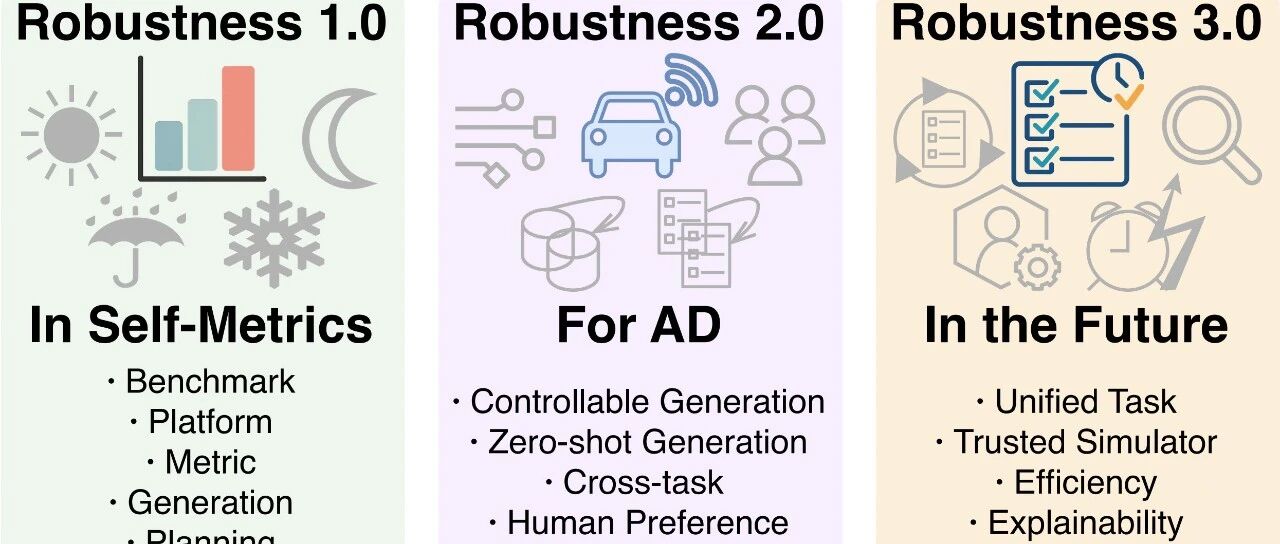
点击下方 卡片 ,关注" 自动驾驶之心 "公众号 戳我-> 领取 自动驾驶近30个 方向 学习 路线 >>直播和内容获取转到 → 自动驾驶之心知识星球 点击按钮预约直播 驾驶世界模型(DWM)因其能够显式建模车辆动力学特性、将多模态传感器输入融合为统一表征,并支持长时序推理的 核心能力,已引发学界与业界的广泛关注——为提升自动驾驶系统的安全性与鲁棒性展现出巨大潜力。 为此, 北京交通大学联合澳门大学、哈工大、新加坡南洋理工、清华、北航、小米汽车及 昆士兰大学提出了 自动驾驶中 的渐进鲁棒性感知世界模型综述。 本综述以鲁棒性为核心视角,对DWM进行了全面梳理: 首先概述了DWM的基础原理 及其在自动驾驶中的独特价值,随后按技术范式、架构设计及下游应用场景,对现有方法进行了体系化分类;进而创新 性地提出递进式鲁棒性分析框架,将DWM鲁棒性的发展历程划分为三个明确阶段(鲁棒性1.0至鲁棒性3.0)。 论文链接 : https://doi.org/10.36227/techrxiv.176523308.84756413/v1 分享介绍 今天,自动驾驶之心非常荣幸邀请到本文一作 北交贾飞阳博士 为大家分享驾驶世界模型的 ...

英伟达CES发了堆“怪物”,但跟你的电脑机箱已经毫无关系
3 6 Ke· 2026-01-07 01:00
Core Insights - The annual CES event in Las Vegas is currently showcasing significant advancements in AI technology, with NVIDIA taking center stage despite not releasing new graphics cards this year [1][3]. Group 1: NVIDIA's AI Innovations - NVIDIA introduced the Vera Rubin architecture, a new AI server weighing 2.5 tons, aimed at accelerating AI training and exploring new frontiers in AI technology [5][7]. - The Vera Rubin architecture features six redesigned chips, including the Vera CPU and Rubin GPU, which significantly enhance performance and efficiency [9][11]. - The Vera CPU integrates 88 custom ARM cores, achieving a bandwidth of 1.8 TB/s with GPUs, allowing it to function as an extended memory pool [13]. - The Rubin GPU, equipped with HBM4 memory, boasts a capacity of 288GB and a bandwidth of 22 TB/s, significantly reducing data transfer power consumption [13][15]. Group 2: Performance Metrics - The Vera Rubin architecture reportedly reduces inference token costs by 90% and increases computational performance by 5 times, while also decreasing the number of GPUs needed for training MoE models by 4 times [16][17]. - The transistor count for the Vera Rubin architecture has only increased by 1.7 times, indicating a significant leap over Moore's Law [17]. Group 3: Future Directions - NVIDIA is launching the Alpamayo platform, which is designed for autonomous driving and includes models, simulation tools, and datasets, positioning itself as a competitor to existing autonomous driving technologies [19][21]. - Alpamayo's end-to-end training system allows for adaptive responses to complex driving scenarios, enhancing its applicability beyond just autonomous vehicles to robotics and industrial systems [23]. - NVIDIA's new DLSS 4.5 technology aims to improve gaming graphics and frame rates significantly, reflecting the company's ongoing commitment to both AI and gaming sectors [25]. Group 4: Industry Perspective - The shift in NVIDIA's focus from gaming to AI technologies suggests a broader transformation in the tech industry, with the company now resembling an "electric company" for the AI era [27].


英伟达计划明年测试,机构看好26年特斯拉引领自动驾驶变革
Jin Rong Jie· 2026-01-07 01:00
Group 1 - The CEO of Nvidia, Jensen Huang, expressed confidence that a significant portion of cars will be autonomous or highly automated in the next decade [1] - Nvidia introduced the Alpamayo series of open-source AI models and tools aimed at the development of autonomous vehicles [1] - Nvidia plans to test a driverless taxi service by 2027 [1] Group 2 - CITIC Construction Investment is optimistic about Tesla leading the global physical AI transformation in smart driving and robotics by 2026 [1] - CITIC believes that breakthroughs in L3 conditional and L4 autonomous driving technology are expected within 2-3 years, accelerating adoption [1] - The Robotaxi business model is anticipated to become viable, with the industry value chain concentrating on intelligent driving solution providers and mobility platforms [1] - Companies with integrated hardware and software solutions, as well as Tier 1 suppliers, mobility platforms, operators, and autonomous components like lidar and drive-by-wire systems, are expected to see a revaluation of their technological attributes [1]

机构:关注汽车行业十大趋势
Zheng Quan Shi Bao Wang· 2026-01-07 00:54
东兴证券认为,国内汽车市场在政策刺激与技术创新双重驱动下,呈现出"电动化加速渗透、自主品牌 强势崛起"的鲜明特征,自主品牌智能化的优势是其销量增长的重要原因。在电动化渗透率持续提升的 背景下,汽车产业的竞争重心正逐步转向智能化领域,具备领先训练数据、训练设施、智驾生态领域的 头部企业有望获取更多市场份额。 2026年1月5日,中国汽车流通协会发布最新一期"汽车消费指数":2025年12月汽车消费指数为97.7,高 于上月,预计2026年1月汽车市场将呈现"开门红"的局面。从构成汽车消费指数的分指数看,2025年12 月需求分指数为90.3,较上月有所提升。 国元证券认为,从产业生命周期的视角来看,当前中国汽车产业正步入电动智能化浪潮的中后期,呈现 出传统燃油车、电动智能车以及以自动驾驶为代表的未来产业"三条产业曲线并存"的格局。在这一背景 下,汽车板块不再是单一赛道的投资领域,而是需要根据不同产业曲线所处的阶段,实施分层次、分节 奏的结构性投资布局。建议关注汽车行业十大趋势:(一)报废缺口提供中长期空间,以旧换新有望常态 化;(二)新势力推动中国汽车出口迈向结构升级新阶段;(三)"大众纯电+高端增程"趋势持续 ...
金融界财经早餐:央行部署今年工作!继续实施适度宽松的货币政策;中方正研究收紧对日稀土出口许可审查;国晟科技、嘉美包装等多只高位股停牌核查;(1月7日)
Sou Hu Cai Jing· 2026-01-07 00:43
Economic Policy and Market Overview - The People's Bank of China emphasized the importance of promoting high-quality economic development and reasonable price recovery in its monetary policy, utilizing various tools like reserve requirement ratio cuts and interest rate reductions to maintain liquidity and support balanced credit growth [1] - The Ministry of Commerce announced strengthened export controls on dual-use items to Japan, citing recent provocative statements from Japanese leaders regarding Taiwan, which are seen as a serious violation of China's sovereignty [1] Capital Market Developments - The China Securities Index announced adjustments to the CSI 1000, CSI 500, and CSI A500 indices, effective January 9, 2026, with companies like Chipone Technology and Mingyue Optical being added to the indices [3] - In December 2025, A-share new account openings reached 2.6 million, a 9% increase from November, with a total of 27.44 million new accounts opened throughout the year, marking a 10% year-on-year growth [3] Industry Insights - AI in healthcare is gaining traction, with Alibaba's AI model for early pancreatic cancer screening highlighted as a significant innovation, indicating a growing trend in AI applications across various medical fields [6] - The semiconductor industry is experiencing price increases, with Samsung and SK Hynix raising DRAM prices for servers, PCs, and smartphones by 60%-70% in Q1 2026 compared to Q4 2025 [7] Company Highlights - iFlytek reported extensive collaborations with over 500 robot manufacturers, leveraging its AI service platform for various types of robots [8] - BYD outperformed Tesla in sales across Europe's two largest electric vehicle markets, with a sevenfold increase in sales in Germany to 23,306 units, while Tesla's sales dropped to 19,390 units [9] - FiconTEC, a subsidiary of Robotech, signed a significant contract worth approximately €770,000 (about ¥63.08 million), which is expected to have a positive impact on the company's revenue [11] - MiniMax's IPO received overwhelming interest, with a subscription amount exceeding HK$253.3 billion and a public offering oversubscription rate of 1,209 times [13]

操盘必读:影响股市利好或利空消息_2026年1月7日_财经新闻
Xin Lang Cai Jing· 2026-01-07 00:39
Industry News - Star River Dynamics is set to implement the "Ceres-1 Sea Launch (Remote 7)" commercial rocket launch mission, code-named "Wanghaichao" [27] - China Securities Index announced adjustments to the samples of the CSI 1000, CSI 500, and CSI A500 indices, effective after the market closes on January 9, 2026. Notable inclusions are Chip Source Micro in the CSI 500 index, Mingyue Optical in the CSI 1000 index, and BGI Intelligent Manufacturing in the CSI A500 index [27] - Guotou Ruijin Fund Management announced that its Guotou Silver LOF will suspend trading due to significant price fluctuations from January 7, 2026, until 10:30 AM on the same day [27] - At CES 2026, NVIDIA CEO Jensen Huang stated that most cars worldwide will achieve autonomous or highly autonomous driving in the next decade [27] - The National Film Bureau's meeting emphasized the need to stimulate innovation in filmmaking and produce more quality films in 2026, while also promoting the international presence of Chinese cinema [27] Company News - Jiamei Packaging announced a cumulative increase of 230% in stock price from December 17, 2025, to January 6, 2026, and will be suspended for verification [29] - Guosheng Technology reported a cumulative increase of 370.2% in stock price from October 31, 2025, to January 6, 2026, and will also be suspended for verification [30] - Strong Brain Technology, a unicorn in brain-computer interfaces, completed financing of approximately 2 billion yuan [31] - Chip Source announced the completion of the acquisition of Zhudian Semiconductor [31] - Puni Testing expects a loss for the entire year of 2025 [31] - WuXi AppTec announced that 18 shareholders, including the third, fourth, and sixth largest, reduced their holdings by 2% from November 20, 2025, to January 5, 2026, and the reduction plan has been completed [31] - Shengke Communication announced that the National Integrated Circuit Industry Investment Fund plans to reduce its holdings by no more than 3% [32] - Chaoying Electronics announced an increase in investment for its AI computing high-end printed circuit board expansion project from 1.468 billion yuan to 3.315 billion yuan [33] - Fenglong Co. announced that it may apply for suspension of trading if its stock price continues to rise abnormally [34] - Hetai Machinery announced that Haitaijinhua reduced its holdings by 1.98% from December 4, 2025, to January 5, 2026 [35] - Western Materials reported that its second-largest shareholder, Xi'an Aerospace, reduced its holdings by 4.7991 million shares on January 5 [36] - Guankang Technology announced plans to acquire 100% of Jinzhou Liaojing Electronic Technology Co., and its stock will resume trading [37] - Times New Materials signed a sales contract for wind turbine blades worth approximately 3.32 billion yuan [37] - Baihua Medicine announced the termination of its control change plan, and its stock will resume trading [37] - Thinking Control announced the termination of its control change plan, and its stock will also resume trading [37] - Baotailong announced that its controlling shareholder was ordered to correct its failure to fulfill its commitment to increase holdings by the Heilongjiang Securities Regulatory Bureau [37] - The Shanghai Stock Exchange issued an inquiry letter to Yahui Long, requesting additional disclosure regarding its cooperation with Brain Machine Star Chain [37]
CES 2026,万物皆可汽车?
汽车商业评论· 2026-01-07 00:39
Core Insights - The CES 2026 is shifting focus from electric vehicles to "physical AI," which integrates sensors, computer vision, and actuators to enable machines to interact with and adapt to their environments [4][6][8] - The automotive industry is evolving from electrification to intelligence, with discussions centered on how vehicles can become autonomous "physical AI" entities [8][10] - Major companies like NVIDIA, Uber, and Sony Honda Mobility are showcasing advancements in autonomous driving technologies and smart vehicle systems [10][14][19] Automotive Innovations - NVIDIA introduced the Alpamayo platform, aiming for L4-level autonomous driving capabilities, marking a significant step in AI-driven vehicle technology [10][12] - Uber unveiled its luxury autonomous taxi, featuring personalized passenger experiences and advanced perception systems, with plans for public service by the end of the year [10][14] - Sony Honda Mobility is developing the AFEELA model, which aims to create a "creative entertainment space" within the vehicle, enhancing user experience beyond mere transportation [14][19] Smart Cockpit Developments - BMW is integrating Alexa and generative AI into its vehicles, enhancing user interaction and personalization [21][23] - Mercedes-Benz launched the electric GLC model in the U.S., featuring advanced AI integration and immersive audio systems [23][25] - LG's smart cockpit platform aims to evolve user experience through context-aware adjustments, although still in early deployment stages [25][27] Chinese Automotive Brands - Geely and Great Wall are the only major Chinese brands participating in CES 2026, showcasing their advancements in AI and smart driving technologies [27][19] - Geely's G-ASD system aims to enhance safety and confidence in complex driving scenarios, while Great Wall focuses on intelligent driving capabilities [15][19] Battery Technology Innovations - Donut Lab introduced the world's first solid-state battery for OEM vehicles, promising high energy density and rapid charging capabilities [39][41] - Lyten showcased lithium-sulfur battery technology with a clear commercialization timeline, targeting military and automotive applications [43] - ProLogium and Electra Vehicles presented advancements in battery management and solid-state technology, aiming to enhance safety and efficiency in electric vehicles [45][47]

特斯拉中国推出5年0息购车方案;小米辞退投放大熊经办人员,对许斐徐洁云通报批评;霸王茶姬店员「手拌奶茶」系摆拍!官方:辞退涉事员工
雷峰网· 2026-01-07 00:36
Group 1 - Apple is negotiating long-term DRAM supply agreements with Samsung and SK Hynix, as their current contracts are set to expire, with prices for 12GB LPDDR5X chips rising to $70, a 230% increase from early 2025 [5][6] - The ongoing DRAM shortage is causing significant pressure on major tech companies, including Microsoft and Google, to secure supply agreements, with some executives facing internal pressure to ensure supply [6] - If Apple cannot secure favorable DRAM pricing, it may face profit margin pressures for its upcoming iPhone models [6] Group 2 - Tesla China has launched a limited-time car purchase plan offering 5 years of 0% interest for Model Y L, with a down payment of 99,900 yuan and monthly payments starting at 3,985 yuan [11] - The new purchase plan aims to boost sales amid competitive market conditions, with additional incentives for trade-ins and old car scrappage [11] Group 3 - Great Wall Motors has confirmed the implementation of a standard two-day weekend policy starting in 2026, which is seen as a positive shift in employee work-life balance [13][14] - Employees expressed satisfaction with the change, celebrating the decision as a long-awaited improvement in their working conditions [14] Group 4 - Xiaomi has responded to a controversy involving a KOL by terminating the involved employee and issuing reprimands to senior management, emphasizing the importance of maintaining trust with its customer base [16][17] - The incident highlights the challenges companies face in managing public relations and maintaining brand integrity in the digital age [16] Group 5 - NIO's CEO highlighted the significant pressure from rising memory prices on the automotive industry, urging consumers to purchase vehicles sooner rather than later [21] - The company is currently managing the cost pressures without passing them onto consumers, but the situation remains dynamic [21] Group 6 - LG Display is reportedly planning to lay off over 1,000 employees at its Yantai factory, with compensation based on an "N+1" standard, indicating a significant restructuring in its LCD business [24][25] - This move follows previous signals of operational adjustments at the factory, reflecting broader trends in the display panel industry [25] Group 7 - Xiaomi's market capitalization has surpassed BYD, placing it among the top three global automotive companies, with a reported market value of $131.49 billion [31] - The company achieved significant growth in vehicle deliveries, with a 110% year-over-year increase in December, indicating strong market performance [31][32] Group 8 - The Korean government is implementing a 4.5-day workweek policy, providing monthly subsidies to companies that adopt this model, aimed at improving work-life balance [47][48] - This initiative reflects a broader trend in labor policy aimed at enhancing employee satisfaction and productivity [48]



1月7日早餐 | 美股存储股爆发
Xuan Gu Bao· 2026-01-07 00:04
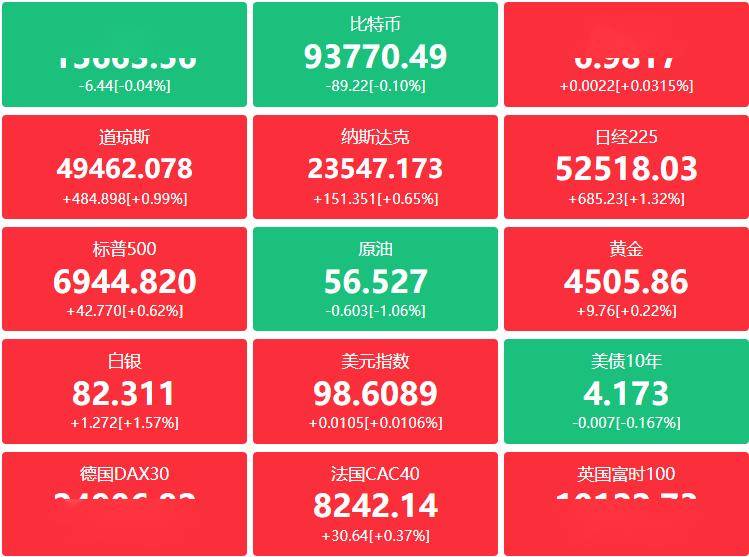
Market Performance - The three major US stock indices continued to rise, with the S&P 500 and Dow Jones reaching all-time highs, up 0.62% and 0.99% respectively, while the Nasdaq increased by 0.65% [1] - Amazon's stock rose over 3%, while Tesla fell more than 4% [1] - Micron Technology raised its third-quarter revenue guidance, leading to a 10% increase in its stock price, while Nvidia experienced two consecutive declines [1] Semiconductor and AI Sector - Nvidia's CEO Jensen Huang expressed optimism about AI systems driving storage demand, resulting in a nearly 28% surge in SanDisk's stock [1] - Intel launched the world's first 1.8nm AI PC chip, enhancing edge AI computing power to 180 TOPS, marking a breakthrough in performance and efficiency [4] - AMD introduced the MI440X at CES, targeting the enterprise AI data center market, positioning itself against Nvidia [5] Commodities and Metals - Nickel prices surged over 10% on the London Metal Exchange, marking the largest intraday increase since 2022, reaching $18,545 per ton, with a cumulative rise of over 20% in the past two weeks [9] - The Shanghai Futures Exchange saw nickel prices rise by 8%, closing at 147,720 yuan per ton [9] - Gold and silver prices also saw significant increases, with gold reaching a one-week high and silver rising over 6% [2] Domestic Developments - The Ministry of Commerce announced strengthened export controls on dual-use items to Japan, with reports indicating a tightening of rare earth export license reviews to Japan [6] - The National Data Bureau plans to introduce over 30 national standards in the data sector by 2026 [7] - The Henan Provincial Department of Culture and Tourism is seeking public opinion on a plan to build a modern cultural tourism industry system, aiming to create 20 new consumption scenarios [7] Investment Strategies - According to a report by Founder Securities, the average daily trading volume in the domestic market has rebounded to around 2.8 trillion yuan, indicating a renewed consensus among institutions on Chinese assets [8] - The report highlights that the fifth round of US-China negotiations has reduced external disturbances, contributing to a bullish sentiment in the market, with the Shanghai Composite Index achieving a 13-day consecutive rise [8] Logistics and Recycling - The Ministry of Commerce is promoting the construction of green, intelligent, and specialized sorting centers, aiming to enhance the recycling industry [10] - The market for sorting center construction is experiencing a golden development period driven by demand in e-commerce logistics and recycling sectors, with projections indicating a global market size exceeding $20 billion by 2030 [10] Cross-Border Payment - The recent national foreign exchange management meeting emphasized deepening foreign exchange facilitation reforms and supporting the development of cross-border e-commerce [11][13] - The cross-border payment sector is expected to transition from a "funds channel" to a "digital trade hub," with significant growth anticipated [13]

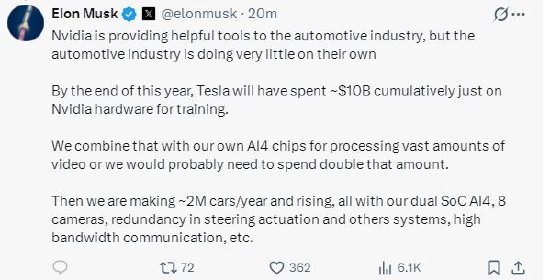
马斯克再评论英伟达自动驾驶AI:为汽车行业提供有用的工具
Xin Lang Cai Jing· 2026-01-06 23:39
Core Viewpoint - The release of NVIDIA's Alpamayo autonomous driving AI is not seen as a competitive threat to Tesla's Full Self-Driving (FSD) system, as the tools provided are primarily for aiding the development of Advanced Driver Assistance Systems (ADAS) rather than being fully functional systems themselves [1][4][5] Group 1: NVIDIA's Role and Tools - NVIDIA has released multiple generations of ADAS development kits and tools, which are intended to assist in the ADAS development process rather than serve as complete systems [1][4] - If companies successfully adopt these technologies and develop their own ADAS systems, it could be beneficial for the industry as a whole [1][4] - The construction of systems similar to FSD remains a highly complex, resource-intensive, and commercially risky endeavor, making it a significant achievement for any company to accomplish [1][5] Group 2: Tesla's Investments and Production - By the end of this year, Tesla's cumulative investment in NVIDIA hardware for training will reach approximately $10 billion [2][5] - Tesla combines this investment with its own AI4 chip to process large volumes of video data, potentially saving costs that could otherwise be double [2][5] - Tesla produces around 2 million vehicles annually, all equipped with dual SoC AI4 chips, eight cameras, steering control, and other redundant systems, indicating a robust and growing production capacity [2][5]