
股债跷跷板

Search documents
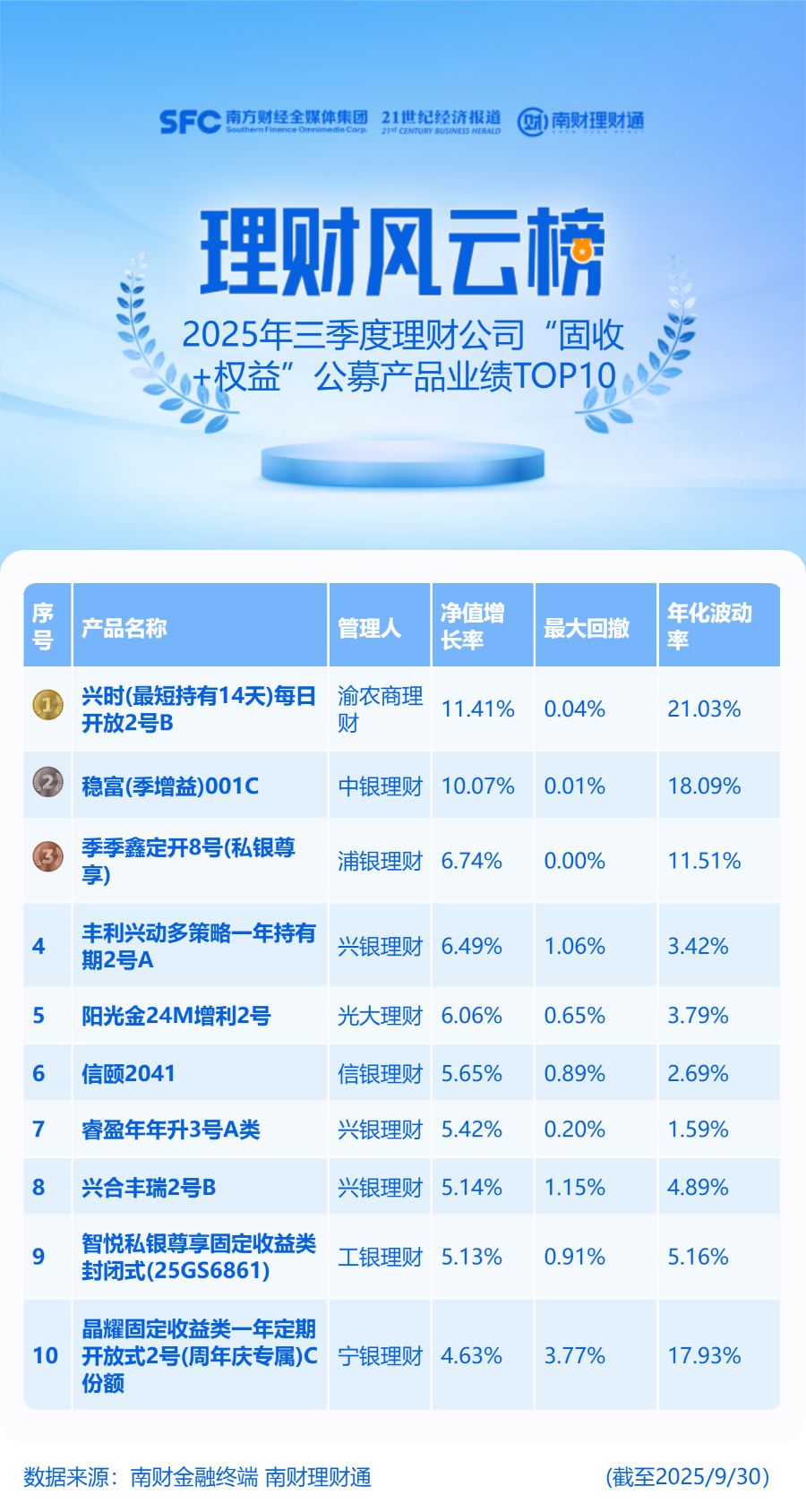
股债分化格局下:两款“固收+权益”产品三季度涨超10%
2 1 Shi Ji Jing Ji Bao Dao· 2025-10-22 07:52
Overall Performance - In Q3 2025, the capital market exhibited significant differentiation due to the "stock-bond seesaw" effect, with the equity market performing strongly while the bond market faced overall pressure [5] - The A-share market experienced a notable upward trend, with the CSI 300 index rising by 17.90% and the Wind All A index increasing by 19.46%, while the ChiNext index surged over 50%, highlighting a growth style dominated by sectors such as artificial intelligence and technology [5][6] Product Analysis - The "fixed income + equity" products generally had conservative equity positions, with many products holding less than 2% in equities, resulting in limited impact from the stock market's rise [6] - The top 10 products listed primarily came from eight wealth management companies, with the top two products achieving net value growth rates exceeding 10% and exhibiting low maximum drawdowns [6][7] - The top-ranked product, "Xing Shi (Minimum Holding 14 Days) Daily Open 2B" from Yunnan Rural Commercial Bank Wealth Management, was positioned to allocate 0-20% in equity assets but held no equity assets as of Q2 2025, with over 51.33% of its assets in cash and bank deposits [6][7] - The second-ranked product, "Stable Wealth (Quarterly Increment) 001C" from Bank of China Wealth Management, had a bond asset ratio of 71.22% as of June 2025, with a significant portion of its holdings in financial bonds, corporate bonds, and private placement bonds [7] - Looking ahead to Q4, the market sentiment remains relatively optimistic towards the equity market, while the bond market may present short-term trading opportunities after the Q3 correction, although further declines in yields are expected to be limited [7]

三季度银行理财缩水超1500亿
Di Yi Cai Jing Zi Xun· 2025-10-21 13:04
Core Insights - The banking wealth management market experienced significant fluctuations in Q3, with the total scale of existing wealth management products decreasing to 30.82 trillion yuan by the end of September, down 151.47 billion yuan from the end of June, and the average annualized return dropping to 2.47% [2][3] - The market saw a structural differentiation in product performance, with fixed-income products losing attractiveness compared to equity assets, leading to a shift in investor behavior [3][4] Market Performance - The overall wealth management market showed a "rise and fall" trend in Q3, with a notable increase in July and August followed by a significant decline in September, resulting in a total decrease of over 150 billion yuan compared to the end of Q2 [3] - The "stock-bond seesaw" effect was a major factor, as the equity market continued to recover, with the Shanghai Composite Index surpassing the 3,800-point mark, while the bond market experienced volatility [3][4] Product Performance - The average annualized return for closed-end fixed-income products was 2.73%, underperforming the benchmark by 0.12 percentage points, while open-end fixed-income products had an average return of only 2.54%, falling short of the benchmark by 0.28 percentage points [4][5] - Cash management products and fixed-income products saw average annualized returns of 1.45% and 2.48%, respectively, both declining from June [7] Structural Changes - Mixed and equity products performed well, with average annualized returns reaching 5.03% and 13.72%, respectively, significantly increasing by 1.89 and 9.97 percentage points from June [7] - The issuance of equity-related products surged, with 12 equity products issued by the end of September, a sixfold increase compared to the previous year, and 202 mixed products, up by 33 from the previous year [7] Future Outlook - The wealth management market is expected to continue expanding steadily, with an anticipated monthly increase of over 1 trillion yuan in October, driven by the optimization of product structures by wealth management subsidiaries [9] - The low-interest-rate environment is likely to sustain the growth of "fixed income plus" products, which are expected to remain a key growth driver in the wealth management market [8][9]
三季度银行理财缩水超1500亿
第一财经· 2025-10-21 12:36
Core Viewpoint - The banking wealth management market experienced significant fluctuations in Q3, with a notable decline in the total scale of wealth management products and a drop in average annualized returns, leading to structural differentiation among different products [3][4][5]. Group 1: Market Performance - As of the end of September, the total scale of bank wealth management stood at 30.82 trillion yuan, a decrease of 151.47 billion yuan compared to the end of June, with average annualized returns dropping to 2.47% [3][4]. - The market showed a "rise and fall" trend, with an initial increase in July and August followed by a significant decline in September, resulting in a total market size reduction of over 150 billion yuan [5][6]. - The "stock-bond seesaw" effect was a major factor, as the equity market continued to recover, leading to a shift in investor preference away from fixed-income products [6][7]. Group 2: Structural Changes in Products - Despite the overall pressure on returns, there was a structural differentiation in product performance, with cash management products averaging an annualized return of 1.45% and fixed-income products at 2.48%, both declining from June [10]. - In contrast, mixed and equity products performed well, with average annualized returns reaching 5.03% and 13.72%, respectively, significantly increasing from June [10][11]. - The issuance of products containing equity assets surged, with 12 equity products issued by the end of September, a sixfold increase compared to the previous year [10]. Group 3: Future Outlook - Looking ahead to Q4, the wealth management market is expected to continue its trend of steady expansion in scale, with a projected monthly increase in October potentially exceeding 1 trillion yuan [12][13]. - The low-interest-rate environment is anticipated to sustain the growth of "fixed income plus" products, which are expected to remain a key growth driver in the wealth management market [11][13].

涌入权益市场还是季节性波动?三季度银行理财缩水超1500亿
Di Yi Cai Jing· 2025-10-21 10:38
Core Insights - The bank wealth management market experienced significant fluctuations in Q3, with total outstanding scale decreasing to 30.82 trillion yuan, down 151.47 billion yuan from the end of Q2, and average annualized returns dropping to 2.47% [1][2] - The "stock-bond seesaw" effect led to a shift in investor preferences, with funds moving towards bank on-balance sheet assets rather than a large-scale transition to equity markets [2][3] - Despite the overall decline in wealth management returns, "fixed income plus" products and equity-related products showed strong performance, with average annualized returns of 5.03% and 13.72% respectively [7] Market Trends - The overall wealth management scale showed a "rise and fall" trend in Q3, with a notable drop in September after a rise in July and August, resulting in a total market decrease of over 150 billion yuan [2][3] - The bond market faced volatility, with fixed income products underperforming compared to equity assets, prompting some investors to redeem their wealth management products [2][3] - The average annualized return for closed-end fixed income products was 2.73%, while open-end fixed income products yielded only 2.54%, both underperforming their benchmarks [3][6] Product Performance - Cash management products and fixed income products saw average annualized returns decline to 1.45% and 2.48% respectively, influenced by the downward shift in bond yields [6] - In contrast, mixed and equity-related wealth management products experienced significant increases in returns, with mixed products rising by 1.89 percentage points and equity products by 9.97 percentage points compared to June [7] - The issuance of equity-related products surged, with 12 new equity products launched in 2023 compared to only 2 in the previous year, indicating a growing trend towards equity allocation [7] Future Outlook - The wealth management market is expected to continue its trend of steady expansion in scale, with October projected to see an increase of over 1 trillion yuan, driven by the optimization of product structures by wealth management subsidiaries [8] - The low interest rate environment is anticipated to keep "fixed income plus" products as a key growth driver in the wealth management sector, with expectations for the total wealth management scale to reach over 33.5 trillion yuan by the end of the year [8]
有色金属早报:逆周期调节持续加码,震荡为主-20251020
Ning Zheng Qi Huo· 2025-10-20 09:01
Report Industry Investment Rating No relevant information provided. Report's Core View - Due to the combination of the stock - bond seesaw and loose liquidity counter - cyclical adjustments, bond futures operations are more difficult, and the bond market shows obvious oscillation characteristics. The future trend of the bond market is still mainly influenced by these two factors [2]. - The economic data released recently indicates that the downward pressure on the economy is still large, which provides long - term support for the bond market. The government's counter - cyclical adjustment measures and the central bank's loose monetary policy are double - edged swords for the bond market. Loose liquidity is beneficial to the bond market, especially the short - end bond market [2]. - Geopolitical risks give way to economic downward risks, and the bond market may see more favorable factors driven by risk - aversion factors. The overall bond market remains oscillatory. Attention should be paid to the impact of the stock - bond seesaw on the bond market. If the upward momentum of the stock market weakens, the bond market may enter an upward channel again [3]. - Looking forward to the fourth quarter, the bond market may be in a pattern of oscillating with a slight upward trend [31]. Summary by Directory 1. Chapter 1: Market Review - The stock - bond seesaw logic has led the bond market into a continuous downward trend, but on the weekly level, it shows a high - level oscillatory trend. On the daily level, it is at the neckline position of the long - term high - level oscillation and has the need for an oscillatory rebound. The combination of abundant liquidity logic and the stock - bond seesaw logic makes bond market operations more difficult [9]. 2. Chapter 2: Overview of Important News - In September, China's CPI rose 0.1% month - on - month and fell 0.3% year - on - year. The core CPI rose 1% year - on - year, with the increase expanding for the fifth consecutive month. PPI remained flat month - on - month and fell 2.3% year - on - year, with the decline narrowing for two consecutive months [13]. - Premier Li Qiang emphasized the need to implement counter - cyclical adjustments more effectively, expand domestic demand, and create a first - class industrial ecosystem [13][15]. - In the first three quarters of this year, China's total goods trade import and export value was 33.61 trillion yuan, a year - on - year increase of 4%. The import and export growth rate accelerated quarter by quarter. In September, the total import and export value was 4.04 trillion yuan, a year - on - year increase of 8%, the highest monthly growth rate this year [15]. - In September, the added value of large - scale industrial enterprises increased by 6.5% year - on - year and 0.64% month - on - month. From January to September, it increased by 6.2% year - on - year [15]. - From January to September 2025, China's fixed - asset investment (excluding rural households) was 371,535 billion yuan, a year - on - year decrease of 0.5%. Among them, private fixed - asset investment decreased by 3.1% year - on - year. In September, fixed - asset investment (excluding rural households) decreased by 0.07% month - on - month [15]. - China's social consumer goods retail in September was 4,197.1 billion yuan, a year - on - year increase of 3.0%. From January to September, the total retail sales of social consumer goods was 36,587.7 billion yuan, a year - on - year increase of 4.5% [16]. 3. Chapter 3: Analysis of Important Influencing Factors 3.1 Economic Fundamental - In September, the added value of large - scale industrial enterprises increased by 6.5% year - on - year and 0.64% month - on - month. China's social consumer goods retail in September was 4,197.1 billion yuan, a year - on - year increase of 3.0%. The overall economic data shows that the endogenous driving force of the economy is strengthening, and the downward pressure on the economy has weakened. If counter - cyclical adjustments continue to increase, the economic fundamentals will be bearish for the bond market in the long run [17]. 3.2 Policy Aspect - The central bank will continue to implement a moderately loose monetary policy to ensure abundant liquidity, support consumption and investment, and maintain the stability of the financial market and the RMB exchange rate. In August, the M1 - M2 scissors gap narrowed, indicating an increase in economic activities. The growth rate of social financing stock slightly increased, and the monthly new social financing mainly relied on government bond issuance [19]. 3.3 Capital Aspect - Since July 25, DR007 has been continuously declining, and the cost of funds has decreased. The central bank will implement a moderately loose monetary policy to maintain abundant liquidity. The Fed's potential interest rate cuts in the second half of the year may provide more room for domestic monetary policy easing, but the adjustment of monetary policy still depends on domestic demand. The probability of an unexpectedly loose monetary policy is low, but it remains an option if necessary [22]. 3.4 Supply - Demand Aspect - The National Development and Reform Commission will issue the third batch of funds for consumer goods trade - in this July and formulate a detailed plan for the use of national subsidy funds. The special treasury bond funds for equipment renewal this year amount to 200 billion yuan, with the first batch of about 173 billion yuan allocated to about 7,500 projects in 16 fields. The issuance of special bonds has accelerated recently, and the market is waiting for the effects and implementation of relevant policies [24]. 3.5 Sentiment Aspect - The stock - bond cost - performance ratio has broken through the short - term oscillatory range and declined, indicating that the market pays more attention to the stock market and the risk appetite has increased. Although the stock - bond cost - performance ratio has slightly decreased recently, it is still in a high - level range. Whether it will continue to decline needs continuous observation. Short - term bonds are more affected by the capital aspect, while long - term bonds are more affected by the stock - bond seesaw [27]. 4. Chapter 4: Market Outlook and Investment Strategy - The international environment for China's A - shares has become extremely complex, and short - term fluctuations may increase, but the long - term upward trend is generally recognized. The impact of the stock - bond seesaw on the bond market has become more complex. Under the background of continuous Fed interest rate cuts, the combined effect of the stock - bond seesaw and liquidity logic makes bond market operations more difficult. In the fourth quarter, the bond market may be in a pattern of oscillating with a slight upward trend [31].
年内新发基金数量超去年全年 股基占比创近15年新高
Zheng Quan Shi Bao· 2025-10-19 22:30
Core Insights - The A-share market is experiencing a strong influx of funds through equity funds, with a total of 1,163 new funds established by October 19, 2025, surpassing the total of 1,135 for the entire year of 2024, indicating a robust recovery in the fund market [1] - The number of newly established equity funds has reached 661, with a total issuance scale of 339.396 billion yuan, accounting for 37.45% of the total issuance scale, marking the highest proportion in nearly 15 years since 2011 [1] - The high proportion of equity funds in 2025 reflects investors' desire for higher returns during a bull market and indicates that fund companies are responding to market demand by increasing the issuance of equity funds [1] Fund Issuance Trends - The total issuance scale for the year has reached 906.273 billion yuan, with seven products exceeding 6 billion yuan in initial fundraising, and 50 funds surpassing 3 billion yuan [1] - The top mixed FOF fund, Dongfanghong Yingfeng, has raised 6.573 billion yuan, leading the market, followed by several other funds with similar fundraising scales, indicating strong institutional interest in bond index tools and stable strategy products [2] - Passive index bond funds have become the mainstay in the 3 billion to 6 billion yuan range, with several bond ETFs achieving over 3 billion yuan in fundraising, highlighting the demand for low-volatility assets [2] Market Dynamics - The rebound in the equity market has led to increased issuance of active equity funds, with several products surpassing 2 billion yuan in scale, reflecting a growing demand for equity assets [3] - The issuance scale of bond funds has decreased compared to last year, as the attractiveness of the stock market increases amid narrowing interest rate space, demonstrating a "stock-bond seesaw" effect [3] - The structural changes in the fund issuance market indicate a shift in capital flow, with public funds becoming a significant channel for capital inflow into the A-share market, suggesting a potential continuation of the equity investment golden period [3]
理财遇冷?股强债弱、黄金大涨,三季度理财规模减少千亿
Nan Fang Du Shi Bao· 2025-10-17 10:04
Core Insights - The bank wealth management market experienced significant fluctuations in Q3 2025, with the total outstanding scale decreasing to 30.82 trillion yuan, a reduction of 151.47 billion yuan from the end of June [2][3] - The average annualized yield of wealth management products fell to 2.47%, down 0.18 percentage points from the end of June, influenced by bond market volatility [3][4] - In contrast, the A-share market showed strong performance, with the Shanghai Composite Index surpassing 3,800 points, and gold prices exceeding $4,000 per ounce during the National Day period, leading to a migration of funds among different asset classes [2][3] Wealth Management Market Overview - As of the end of September, the wealth management market saw a total of 7,865 new products launched in Q3, a decrease of 58 products compared to the previous quarter [3] - The market exhibited a "rise then fall" trend, with growth in July and August followed by a decline in September [3] - Seasonal factors contributed to the decline in September, as wealth management companies typically align product maturities with quarter-end liquidity assessments [3][6] Product Performance - Cash management and fixed-income wealth management products saw average annualized yields of 1.45% and 2.48%, respectively, both declining from June [4][5] - Conversely, mixed and equity-based wealth management products achieved average annualized yields of 5.03% and 13.72%, respectively, with significant increases of 1.89 and 9.97 percentage points from June [5][6] - Notable high-performing products included those linked to gold and technology sectors, with some achieving returns exceeding 100% [5][6] Asset Class Characteristics - The report emphasizes that no asset class can be deemed a "constant winner," highlighting the unique characteristics and cycles of each asset type [6][7] - Stocks are characterized as high-elasticity assets, while bonds are viewed as low-risk assets with limited yield potential [6][7] - Gold is identified as a safe-haven asset, influenced by various factors including the dollar's performance and geopolitical events [6][7] Investment Strategies - The "fixed income plus" products have gained popularity as they combine stable fixed-income assets with a small allocation to equities, allowing for potential enhanced returns [8] - A simulated portfolio consisting of 80% fixed income and 20% equity has shown superior performance during bullish markets while minimizing losses during downturns [8]

13家理财公司,9月规模回落8700亿!“含权”产品逆势增长
券商中国· 2025-10-17 07:20
Core Viewpoint - In September, bank wealth management products experienced a significant decline in scale after several months of net inflows, with a total reduction of approximately 870 billion yuan across 13 out of 14 major wealth management companies [2][5]. Group 1: Scale Changes in Wealth Management Products - As of the end of September, the total scale of the top 14 wealth management companies was 24.19 trillion yuan, a decrease of about 830 billion yuan from the end of August [5]. - The decline was primarily driven by a notable drop in fixed-income products, particularly pure bond wealth management products, which saw a reduction of approximately 6.7 trillion yuan [5][6]. - Among the 14 companies, state-owned banks accounted for over 75% of the total decline, with a combined decrease of about 6.54 trillion yuan [5][4]. Group 2: Performance of Different Product Types - Cash management products also saw a decline, with a total balance of 5.67 trillion yuan, down approximately 280 billion yuan from the previous month [6]. - Conversely, wealth management products with equity assets, such as "fixed income plus" and mixed products, experienced growth, with a total increase of about 110 billion yuan in September [6]. Group 3: Sales Channels and Strategies - The sales structure and channels have become crucial factors influencing the changes in wealth management scales, with many companies increasing their reliance on external sales channels [8]. - By the end of September, the external sales scale of the 14 wealth management companies exceeded 6.94 trillion yuan, with four companies having external sales accounting for over 50% of their total sales [8]. Group 4: Growth of Equity-Linked Products - The issuance of equity-linked wealth management products has seen a "volume growth" trend, with 49 existing equity products and 1,056 mixed products issued this year, significantly surpassing last year's figures [11]. - The interest in IPO investments has also increased, with wealth management companies participating in IPOs, such as the case of Chery Automobile's listing in Hong Kong [12]. Group 5: Future Strategies and Opportunities - To capitalize on the upward cycle of the stock market, wealth management companies are advised to optimize their strategies by increasing allocations to equity and other risk assets while maintaining a balanced approach [14]. - Multi-asset strategies are seen as a key solution, with a focus on diversifying revenue sources and controlling product value fluctuations [14].

银行理财规模再现跨季回落 含权产品逆势增长风景独好
Zheng Quan Shi Bao· 2025-10-16 19:01
Core Insights - The banking wealth management sector experienced a decline in net inflows at the end of Q3, with 13 out of 14 major wealth management companies reporting a decrease in balance, totaling approximately 870 billion yuan [1][2] Group 1: Overall Performance - The total scale of the top 14 wealth management companies was 24.19 trillion yuan at the end of September, down about 830 billion yuan from the end of August [2] - The decline in scale is primarily attributed to state-owned banks, which accounted for approximately 75% of the total decrease, with three companies alone (Agricultural Bank, Industrial Bank, and CCB) each seeing declines exceeding 100 billion yuan [2][3] Group 2: Product Categories - The most significant decline was observed in fixed-income pure bond products, which saw a reduction of about 670 billion yuan, with state-owned banks contributing approximately 440 billion yuan to this drop [2][3] - Cash management products also experienced a decline, with a total balance of 5.67 trillion yuan, down about 280 billion yuan from August and 570 billion yuan from the beginning of the year [3] Group 3: Market Trends - The stock market's performance in September positively impacted wealth management products with equity assets, leading to a growth of approximately 110 billion yuan in these products [3] - The number of wealth management companies participating in equity asset research has increased, with 23 companies conducting 168 research sessions since September [5] Group 4: Distribution Channels - Wealth management companies are increasingly focusing on external distribution channels, with a total external distribution scale exceeding 6.94 trillion yuan, and four companies reporting external distribution ratios of 50% or more [4] - Companies like China Merchants and Everbright have significantly increased their external distribution ratios, indicating strong channel expansion capabilities [4] Group 5: IPO Investments - There has been a notable increase in the issuance of wealth management products that include equity assets, driven by favorable policies and market conditions [6] - The number of wealth management products related to IPO investments has surged, with several new products launched in September alone [6]
信贷社融同步降温,货币宽松空间打开:金融数据速评(2025.9)
Huafu Securities· 2025-10-16 05:41
Credit and Financing Trends - New loans in September amounted to 1.29 trillion RMB, a year-on-year decrease of 300 billion RMB, with an average monthly decline of 3.067 billion RMB in Q3 compared to H1[2] - In September, new household loans totaled 389 billion RMB, down 111 billion RMB year-on-year, with short-term loans decreasing by 127.9 billion RMB[2] - New corporate medium to long-term loans reached 910 billion RMB, a slight year-on-year decrease of 50 billion RMB, indicating a stable growth trend amidst rising uncertainties in US-China trade relations[2] Social Financing and Monetary Policy - In September, total social financing reached 3.53 trillion RMB, but still saw a year-on-year decrease of 233.5 billion RMB due to a high base effect from the previous year[3] - New government bond financing was 1.19 trillion RMB, down 345.7 billion RMB year-on-year, reflecting a significant drop against last year's issuance peak[3] - M2 growth rate fell by 0.4 percentage points to 8.4% in September, while M1 surged by 1.2 percentage points to 7.2%[3] Economic Outlook and Risks - The divergence in credit and social financing remains unaddressed, with the real estate market still not bottoming out and local government debt pressures persisting[4] - The upcoming end of the second round of tariff easing in mid-November adds to the uncertainty in US-China trade, necessitating effective domestic demand stimulation[4] - A potential small interest rate cut of 10 basis points is anticipated to stabilize real estate market expectations and boost durable consumption[4]