
货币政策宽松

Search documents
宝城期货国债期货早报-20251203
Bao Cheng Qi Huo· 2025-12-03 03:42
Report Summary 1. Report Industry Investment Rating No industry investment rating is provided in the report. 2. Core Viewpoints - Short - term, the expectation of interest rate cuts has declined, while the long - term expectation of a loose monetary policy remains. Overall, treasury bond futures will mainly fluctuate and consolidate in the short term [1][5]. 3. Summary by Relevant Contents 3.1 Variety Viewpoint Reference - Financial Futures Stock Index Sector - For the TL2603 variety, the short - term view is "fluctuation", the medium - term view is "fluctuation", the intraday view is "weakening", and the reference view is "fluctuation and consolidation". The core logic is that the short - term expectation of interest rate cuts has declined, while the long - term loose expectation remains [1]. 3.2 Main Variety Price Market Driving Logic - Financial Futures Stock Index Sector - Yesterday, treasury bond futures fluctuated and slightly retraced. The manufacturing PMI in November showed strong resilience, so there is no strong need for a full - scale interest rate cut in the short term, and the upward momentum of treasury bond futures is insufficient. However, in the long run, the problem of insufficient effective domestic demand still exists. From the perspective of the monetary policy to stabilize demand, the future monetary policy environment tends to be loose, which strongly supports treasury bond futures. In general, treasury bond futures will mainly fluctuate and consolidate in the short term [5].
这就是“影子联储主席”的威压! 市场真金白银押注2026年更激进降息
Zhi Tong Cai Jing· 2025-12-03 02:53
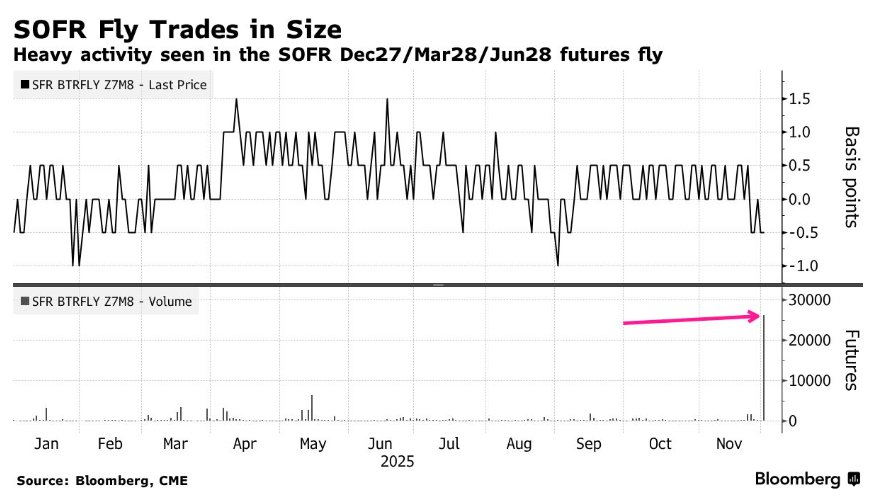
Group 1 - The core viewpoint of the articles indicates that traders are betting heavily on the potential for significant interest rate cuts by the Federal Reserve under a new chairman, likely Kevin Hassett, who is perceived as dovish [1][2][4] - The market is currently pricing in a greater than 90% probability of a 25 basis point rate cut at the December meeting, with expectations of cumulative cuts of 85 to 100 basis points by the end of next year [4] - The upcoming economic data, particularly the delayed non-farm payrolls report, is expected to influence market sentiment and could reinforce dovish bets if it confirms signs of weakness in the labor market [5] Group 2 - The SOFR futures market is seeing increased demand for short-term interest rate structures, reflecting traders' expectations of a more aggressive easing path by the Fed [1][2] - Recent trading activity in the SOFR options market indicates a significant buildup of positions betting on larger rate cuts by 2026, with notable transactions in specific strike prices [9][12] - The overall sentiment in the options market is leaning towards a more dovish Fed, with a notable increase in open interest for higher strike call options, suggesting a consensus on the likelihood of rate cuts [11][12]

国泰君安期货商品研究晨报-20251203
Guo Tai Jun An Qi Huo· 2025-12-03 02:30
1. Report Industry Investment Ratings There is no information about industry investment ratings in the provided content. 2. Core Views of the Report - Various commodities in the futures market show different trends. For example, gold's降息预期回升, and silver is加速冲刺,再创新高. Copper's price is supported by strong spot prices, while zinc has support at the lower level. Lead's price is supported by inventory reduction, and tin's supply is disrupted again [2][6][10]. - The market for some commodities is in a state of wide - range oscillation, such as iron ore, whose downstream demand space is limited and valuation is high;螺纹钢 and热轧卷板 are experiencing a multi - empty game in the market and wide - range oscillations [2][42][45]. 3. Summary by Related Catalogs 3.1 Precious Metals - **Gold**: With the recovery of interest - rate cut expectations, the prices of沪金2512 and黄金T+D increased by 1.05% and 1.15% respectively yesterday. The trend intensity is 1 [6]. - **Silver**: It is accelerating and hitting new highs. The prices of沪银2512 and白银T+D rose significantly, with daily increases of 4.46% and 4.72% respectively. The trend intensity is 1 [6]. 3.2 Base Metals - **Copper**: The spot price is strong, supporting the price. The沪铜主力合约 decreased by 0.40% yesterday. The global copper market is expected to face a supply shortage of 150,000 tons in 2026. The trend intensity is 1 [10][12]. - **Zinc**: There is support at the lower level. The沪锌主力收盘价 increased by 0.69% yesterday. The trend intensity is 1 [13]. - **Lead**: Inventory reduction supports the price. The沪铅主力收盘价 rose by 0.79% yesterday. The trend intensity is 0 [17]. - **Tin**: Supply is disrupted again. The沪锡主力合约 increased by 0.50% yesterday. The trend intensity is 0 [20]. - **Aluminum**: It is in a range - bound oscillation. The氧化铝 is still searching for the bottom, and the铸造铝合金 follows the electrolytic aluminum. The trend intensities of aluminum, alumina, and aluminum alloy are all 0 [23]. - **Platinum**: It is in a narrow - range oscillation. The trend intensity is 0 [26]. - **Palladium**: The price difference between NYMEX and London has widened, with the possibility of an upward movement. The trend intensity is 0 [27]. - **Nickel**: The fundamentals limit the upward elasticity, and it is in a low - level oscillation. The trend intensity is 0 [31]. - **Stainless Steel**: With high inventory, weak supply and demand, and cost limiting the downward space, it is in an oscillation. The trend intensity is 0 [31]. 3.3 Energy and Chemicals - **Carbonate Lithium**: Spot trading is weak, and the high - level oscillation continues. The trend intensity is 0 [36]. - **Industrial Silicon**: It is mainly in a weak operation. The trend intensity is - 1 [39]. - **Polysilicon**: It is in an oscillating market, and attention should be paid to subsequent warrant registration. The trend intensity is 0 [39]. 3.4 Ferrous Metals - **Iron Ore**: Downstream demand space is limited, and the valuation is high. The trend intensity is - 1 [42]. - **Rebar**: There is a multi - empty game in the market, and it is in a wide - range oscillation. The trend intensity is 0 [45]. - **Hot - Rolled Coil**: There is a multi - empty game in the market, and it is in a wide - range oscillation. The trend intensity is 0 [46]. - **Silicon Ferrosilicon**: It is in a wide - range oscillation. The trend intensity is 0 [50]. - **Manganese Silicide**: It is in a wide - range oscillation. The trend intensity is 0 [50]. - **Coke**: It is in a wide - range oscillation. The trend intensity is 0 [54]. - **Coking Coal**: It is in a wide - range oscillation. The trend intensity is 0 [54]. 3.5 Agricultural Products - **Palm Oil**: Wait for the confirmation of the inflection point and conduct range - bound operations for the time being [5]. - **Soybean Oil**: Driven by US soybeans is insufficient, and it is mainly in an oscillation [5]. - **Soybean Meal**: There is a lack of new sales, and US soybeans continue to fall, leading to an adjustment in the continuous contract. - **Soybean**: The spot price is stable, and the futures price is oscillating [5]. - **Corn**: It is in an oscillating operation [5]. - **Sugar**: India's sugar production has increased significantly [5]. - **Cotton**: Supply and demand are both strong [5]. - **Egg**: The volume of culling has increased, and the overall sentiment is strong [5]. - **Live Pig**: An increase in supply is coming, and the industrial logic is returning [5]. - **Peanut**: Pay attention to the spot price [5].
刚刚,全线大涨!美联储突发大消息!
天天基金网· 2025-12-03 01:25
上天天基金APP搜索777注册即可领500元券包,优选基金10元起投!限量发放!先到先得! 美联储降息预期持续升温。 关键时刻,又一家华尔街大行突然"撕报告"。美国银行全球研究(BofA Global Research)在最新发布 的报告中预测,美联储将在12月会议上降息25个基点。美银此前曾预测,美联储将在12月暂停降息。据 CME"美联储观察",截至北京时间12月3日07:00,美联储12月降息25个基点的概率已升至89.2%。 此前有消息称,白宫国家经济委员会主任凯文·哈西特(Kevin Hassett)已成为下届美联储主席的最热门 人选。哈塞特的货币政策立场偏向"鸽派",核心主张是尽快降息以规避美国经济衰退风险,其利率政策倾 向与美国总统特朗普高度一致,后者一直呼吁大幅降息。 美银调整预期的背景是,包括纽约联储主席、联邦公开市场委员会(FOMC)副主席约翰·威廉姆斯在内 的核心官员近日释放出鸽派信号,这进一步推高了市场对美联储提前降息的押注。 美银补充道:"我们认为,若美联储下周降息,将增加货币政策进入宽松区间的风险,眼下正值财政刺激 措施开始发力之际。" 与此同时,美联储下一任主席人选也传来最新进展 ...

刚刚,全线大涨!美联储,降息大消息!
券商中国· 2025-12-02 23:31
值得一提的是,美银此前曾预测,美联储将在12月议息会议上维持利率不变。 美银最新预计,美联储2026年6月和7月还会分别再降息25个基点,最终将终端利率降至3.00%—3.25%。 美银分析师在一份报告中表示:"我们对2026年进一步降息的预测基于(美联储)领导层的变动,而非我们对 经济的解读。" 美联储降息预期持续升温。 关键时刻,又一家华尔街大行突然"撕报告"。美国银行全球研究(BofA Global Research)在最新发布的报告中 预测,美联储将在12月会议上降息25个基点。美银此前曾预测,美联储将在12月暂停降息。据CME"美联储观 察",截至北京时间12月3日07:00,美联储12月降息25个基点的概率已升至89.2%。 与此同时,美联储下一任主席人选也传来最新进展。美东时间12月2日,美国总统特朗普表示,他计划在2026 年初公布美联储新任主席的人选。 特朗普同日暗示白宫国家经济委员会主任凯文·哈西特(Kevin Hassett)可 能是他的选择 。另外,号称"美联储传声筒"的Nick Timiraos透露,尽管美联储主席候选人面试仍在进行中,但 特朗普似乎已倾向于选择哈西特担任这一职位。此 ...

【黄金期货收评】宏观宽松政策发力贵金属市场走强 沪金涨0.01%
Jin Tou Wang· 2025-12-02 09:30
Core Viewpoint - The gold futures market is experiencing a strong upward trend, supported by macroeconomic factors and a weak dollar, despite short-term fluctuations due to profit-taking [2]. Group 1: Market Data - On December 2, the closing price for Shanghai gold futures was 958.42 yuan per gram, with a slight increase of 0.01% [1]. - The trading volume for the day was 313,720 contracts, while the open interest stood at 202,038 contracts [1]. - The spot price of gold in Shanghai was quoted at 956.30 yuan per gram, reflecting a discount of 2.12 yuan per gram compared to the futures price [1]. Group 2: Economic Indicators - The ISM Manufacturing PMI for the U.S. decreased by 0.5 points to 48.2 in November, marking the largest contraction in four months and remaining below the neutral level of 50 for nine consecutive months [1]. - The new orders index fell to its fastest contraction rate since July, and the backlog of orders saw the largest decline in seven months [1]. Group 3: Institutional Insights - The macroeconomic environment shows a clear divergence in U.S. economic momentum, with the overall PMI rising to a four-month high due to the services sector, while manufacturing faces pressures from weak new orders and record inventory backlogs [2]. - Federal Reserve officials are signaling a dovish stance, with support for a potential rate cut in December to address risks in the labor market, alongside a moderate decline in core PPI and manageable inflation pressures [2]. - The COMEX gold and silver inventories have significantly decreased, and holdings in SPDR Gold ETF and SLV Silver ETF have increased, indicating strong market sentiment and continued capital inflow [2].
债期中枢小幅下移
Guo Mao Qi Huo· 2025-12-01 05:15
1. Report Industry Investment Rating - Not provided in the report 2. Core Viewpoints - After the recent adjustment, the allocation value of bonds has started to emerge, with the yields of 10-year and 30-year treasury bonds approaching the levels when the central bank announced the restart of treasury bond trading in late October, increasing the attractiveness to allocation-oriented institutions [8] - The market will focus on the official PMI data for November and the Central Economic Work Conference in December, which may provide new directional guidance for the market [8] - In the short term, the pattern of a ceiling and a floor for bonds is difficult to break, and the yield of 10-year treasury bonds may remain in the range of 1.75% - 1.85%. If the expectation of an interest rate cut is strengthened at the beginning of next year, the bond market is expected to rise [8] - In the medium to long term, insufficient effective demand is the main challenge facing China's economic development. With the marginal decline of the economic pulling effect of land finance and debt-driven models, and the potential impact of trade frictions in the Trump 2.0 era, deflation is likely to continue, which is favorable for bond futures [8] - The coordinated strengthening of monetary and fiscal policies, with monetary policy taking the lead, creates a low-interest rate environment, and the logic of a bond bull market is expected to continue [8] 3. Summary by Relevant Catalogs 3.1 Main Viewpoints - Last week, treasury bond futures were relatively stable at the beginning of the week, but there was a significant turning point on Wednesday, with a sharp decline in the late trading. The decline of long-term contracts was significantly greater than that of short-term contracts. The 30-year treasury bond futures main contract had a single-day decline of 0.86%, and the 10-year, 5-year, and 2-year main contracts had declines of 0.36%, 0.22%, and 0.05% respectively [4] - The decline was mainly driven by news factors. The market rumor on Wednesday that the central bank's bond purchase scale this month was only 20 billion yuan, significantly lower than market expectations, and the large-scale fund redemption on the same day further exacerbated the market selling pressure. The low volatility background and fragile trading sentiment in the market amplified the decline [4] - Before the significant adjustment on Wednesday, the treasury bond market had been in a low-volatility sideways state for several weeks, lacking a clear trading theme. The traditional "stock-bond seesaw" effect did not appear, reflecting investors' lack of confidence in going long due to concerns about the lack of further monetary policy easing and the wait-and-see attitude towards the new regulations on public fund sales [4] 3.2 Liquidity Tracking - The report presents data and charts on open market operations (including currency issuance, currency withdrawal, and net currency issuance), medium-term lending facilities (including amount and price), reverse repurchase rates, various capital prices (such as deposit-based pledged repurchase rates, SHIBOR, Shanghai Stock Exchange pledged repurchase rates, and bond pledged repurchase rates), and spreads, as well as LPR, deposit reserve ratios, and treasury bond and US treasury bond yields and term spreads [10][12][19] 3.3 Treasury Bond Futures Arbitrage Indicator Tracking - The report provides data and charts on treasury bond futures basis, net basis, implied repo rate (IRR), and implied interest rate for 2-year, 5-year, 10-year, and 30-year treasury bond futures [45][53][60]
2026年宏观经济展望,增长动能从何而来?
Sou Hu Cai Jing· 2025-12-01 05:06
Economic Outlook - China is expected to maintain an economic growth target of around 5% for 2026, consistent with 2025, reflecting the central government's focus on stabilizing growth and promoting recovery [1] Consumption - From January to October 2025, total retail sales of consumer goods reached 41.2 trillion yuan, with a year-on-year growth of 4.3%, showing a slowdown from a peak of 5% in May [2] - The job market is showing signs of recovery, with the urban unemployment rate dropping to 5.10% in October 2025, and is expected to approach 5.0% [2] - The retail sales growth for 2026 is projected to be around 4.20%, indicating a moderate recovery despite structural pressures [2] Investment - Fixed asset investment (excluding rural households) from January to October 2025 was 408.914 billion yuan, down 1.7% year-on-year, primarily due to a significant decline in infrastructure and real estate investment [3] - Infrastructure investment is expected to rebound significantly in 2026, with a projected growth rate of approximately 5.50% [3] - Manufacturing investment is anticipated to recover to a growth rate of around 5.55% in 2026, supported by improved capacity utilization [3] Real Estate - Real estate investment is at a historical low, slightly above levels during the public health crisis, primarily due to weak sales [4] - The year-on-year growth rate of housing prices is showing signs of marginal recovery, with new residential prices down 2.60% and second-hand prices down 5.40% in October 2025 [4] - The decline in real estate investment is expected to narrow to -10.65% in 2026 [4] Exports - Total exports from January to October 2025 reached 221.146 billion yuan, with a year-on-year growth of 6.2%, despite uncertainties from U.S. tariff policies [5] - Exports to non-U.S. regions have shown strong growth, with significant increases to Africa (26.10%), the EU (7.50%), ASEAN (14.30%), and India (12.30%) [6] - The global economic recovery and potential easing of tariffs are expected to provide a more stable environment for exports in 2026 [5][6] Prices - The Consumer Price Index (CPI) rose by 0.2% year-on-year in October 2025, while the Producer Price Index (PPI) fell by 2.1% [7] - Both CPI and PPI are expected to improve, with PPI potentially turning positive in the first half of 2026 [7] Fiscal and Monetary Policy - Fiscal policy is expected to remain proactive, with a projected deficit rate increase from 4% to 4.5% in 2026, alongside an increase in special bond issuance [8] - Monetary policy is anticipated to remain moderately loose, with potential interest rate cuts of 10-20 basis points in 2026 [8] Overall Economic Assessment - The Chinese economy is projected to achieve around 5% growth in 2026, supported by policy measures, external demand recovery, and improving price levels [9]
Juno markets:黄金价格逼近五周高点,市场对降息预期持续升温
Sou Hu Cai Jing· 2025-11-28 06:15
周五,黄金价格攀升至每盎司约4,190美元,逼近近五周以来的高点,并有望实现连续第四个月的上涨。市场分析认为,这一趋势主要源于投资者对货币政 策进一步宽松的信心不断增强。 近期,多项因素共同推动了市场预期的转变。一方面,部分经济数据表现疲软,增强了市场对政策调整的预期;另一方面,多位具有影响力的官员也表达了 对进一步宽松立场的支持。这些因素共同作用,使得市场对短期利率下调的预期显著升温。 据市场观察,目前投资者对下个月利率下调的预期概率已超过80%,较一周前的30%大幅上升。与此同时,部分分析还指出,市场预计未来两年内可能还将 迎来多次利率调整。 值得关注的是,黄金市场的强劲表现不仅源于短期政策预期,也得益于结构性需求的支撑。近年来,央行持续购入黄金,同时,非主权机构资金也大量流入 相关交易基金,共同推动了黄金价格的长期上行。在这一背景下,有分析指出,黄金有望创下自1979年以来的最佳年度表现。 从市场情绪来看,投资者对政策走向的预判正逐步趋于一致。尽管部分经济数据发布存在滞后,但整体趋势已在一定程度上影响了资产配置行为。黄金作为 传统避险资产,其价格走势往往反映出市场对中长期经济环境与政策方向的判断。 此外 ...

白银表现暗藏玄机:涨幅力压黄金,太阳能革命引爆“沉默黑马”
Jin Shi Shu Ju· 2025-11-28 00:25
Core Viewpoint - Silver is gaining attention as a strong investment opportunity due to structural supply shortages and increasing demand from renewable energy technologies, particularly solar panels [2][5]. Group 1: Silver Price Performance - Since October 3, 2023, spot silver has surged 163% from a low of $20.67 per ounce to a historical high of $54.38 per ounce on November 13, 2023, followed by a correction of approximately 5.6% [2]. - In comparison, spot gold rose 142% from $1,813.90 per ounce on October 3, 2023, to a record of $4,381.21 per ounce on October 20, 2023, also experiencing a correction of about 5.0% [2]. - Although silver has not significantly outperformed gold, its stronger percentage increase occurred with less media attention compared to gold [2]. Group 2: Industrial Demand and Supply Dynamics - Industrial demand for silver is projected to increase from 644 million ounces in 2023 to 689.1 million ounces in 2024, with silver used in solar panels rising from 191.8 million ounces to 243.7 million ounces, marking a 158% increase from 94.4 million ounces in 2020 [6]. - The global solar capacity is expected to add approximately 600 gigawatts (GW) in 2024, reaching nearly 1,000 GW by 2030 [7]. - The International Energy Agency anticipates an addition of 4,000 GW of solar power capacity from 2024 to 2030 [8]. Group 3: Market Supply Shortages - By 2030, the demand from the solar sector alone could increase silver demand by nearly 150 million ounces annually, representing a 13% increase on top of the projected physical demand of 1.169 billion ounces in 2024 [9]. - The silver market is expected to face a significant supply gap of 501.4 million ounces in 2024, a substantial increase from 19.4 million ounces in 2023 [10]. - Most silver is produced as a byproduct of mining other metals, meaning supply growth is largely dependent on the economic conditions of those metals rather than silver's fundamentals [10]. - Predictions indicate that global silver production may decline from an expected 944 million ounces in 2023 to 901 million ounces by 2030, due to some mines anticipated to close before 2030 [11].
