新能源汽车

Search documents
汽车行业2026十大趋势:国央企整车企业迎来发展机遇、具身智能进入量产前夜
Xin Hua Cai Jing· 2026-01-08 07:18
Core Viewpoint - The Chinese automotive industry is at a critical juncture in the transition towards electric and intelligent vehicles, with three distinct industry curves coexisting: traditional fuel vehicles, electric intelligent vehicles, and future industries represented by autonomous driving. The year 2026 is anticipated to be a pivotal turning point for the industry, characterized by structural transformation driven by policy, market growth, technological breakthroughs, and global competition [1]. Group 1: Trends in the Automotive Industry - Trend 1: The "old-for-new" policy is expected to become a normalized tool, addressing the growing gap in vehicle replacement as the annual scrappage rate remains significantly lower than new car sales. This policy is projected to enhance market demand and support steady domestic consumption and industrial production [2]. - Trend 2: New automotive players are driving an upgrade in export structure, with Chinese automotive exports experiencing significant growth, becoming a "second growth curve." These companies are shifting from single vehicle exports to localized production, enhancing China's brand value and technological image in the global market [3]. - Trend 3: A clear differentiation is emerging between "mass-market pure electric" and "high-end range-extended" vehicles, with structural changes in market demand as the penetration rate of new energy vehicles exceeds 50%. The mainstream configuration for high-end SUVs/MPVs remains "large battery long-range range-extended" [4]. Group 2: Market Dynamics and Competitive Landscape - Trend 4: The industry is transitioning to a "late-stage mass market," where consumers prioritize brand reputation, after-sales support, and residual value certainty. Resources are increasingly consolidating around leading technology firms, enhancing conversion efficiency in mainstream price segments [5]. - Trend 5: State-owned enterprises are poised for growth opportunities as regulatory bodies strengthen the assessment of their new energy businesses, driving resources towards electric intelligence. These enterprises hold advantages in manufacturing systems and compliance, particularly in the realm of conditional autonomous driving [6]. - Trend 6: The penetration of new energy commercial vehicles is accelerating, with heavy-duty and light-duty trucks entering a rapid growth phase. The total cost of ownership for heavy trucks is now within a 1.5-2 year recovery period, while urban electric vehicle infrastructure is fully mature [7]. Group 3: Technological Advancements and Future Prospects - Trend 7: High-perception intelligent cockpit configurations are reshaping purchasing decisions, with smart features becoming a core competitive differentiator. The integration of advanced displays and intelligent seating systems is driving a new wave of competition in the market [8]. - Trend 8: Intelligent driving architecture is transitioning to an "end-to-end" model, enhancing the integration of perception and decision-making processes. The "equalization of intelligent driving" is facilitating advanced driving assistance features in lower-priced models [9][10]. - Trend 9: Three major commercial scenarios for autonomous driving are on the verge of mass production, including Robotaxi, mining autonomous vehicles, and unmanned logistics vehicles, with significant cost reductions and operational efficiencies being realized [11]. - Trend 10: Embodied intelligence is approaching mass production, with humanoid robots transitioning to dual-core intelligence. The automotive industry is well-suited for this technology due to the high degree of technical reuse, with several manufacturers planning to launch production in 2025 [12]. Overall, the Chinese automotive industry is expected to exhibit characteristics of multiple technological pathways, market structure differentiation, and accelerated intelligence implementation, supported by policy guidance and technological innovation, leading to high-quality development [13].
江淮50%控股这一车桥公司!要干啥?
第一商用车网· 2026-01-08 06:57
Group 1 - The core viewpoint of the article highlights the recent change in the investment structure of Hefei Meiqiao Automotive Transmission and Chassis System Co., Ltd., with Hefei Jianghuai Automobile Co., Ltd. becoming a new 50% controlling shareholder [1] - Jianghuai's acquisition aims to enhance the self-research and production capabilities of core components related to chassis and transmission, binding key technologies and production capacities for electric drive bridges, reducing costs, improving efficiency, and stabilizing the supply chain [3] - Hefei Meiqiao specializes in manufacturing vehicle axles, suspensions, and transfer cases, with an annual production capacity of 400,000 commercial vehicle axles, serving major automotive companies such as Jianghuai, Chery, and Foton [4]

从三组数据看中国EV发展潜能
Huan Qiu Shi Bao· 2026-01-08 06:02
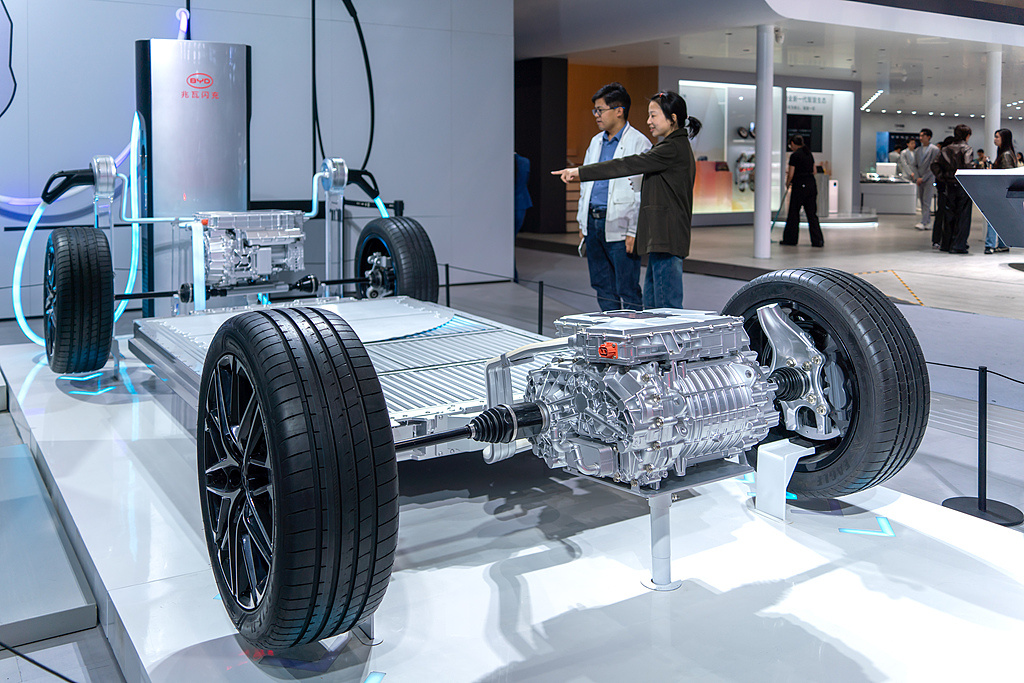
Core Insights - BYD has surpassed Tesla to become the world's largest electric vehicle manufacturer, selling 2.26 million pure electric vehicles in 2025 compared to Tesla's 1.64 million [1] - This shift signifies a symbolic moment for the rise of Chinese automotive companies, marking a transition from following to leading in the electric vehicle sector [1] Group 1: R&D Investment - BYD's revenue for the first three quarters of the year reached 566.27 billion yuan, with R&D expenses amounting to 43.75 billion yuan, representing 7.7% of its revenue [1] - BYD's R&D investment exceeds Tesla's by 10.9 billion yuan, with cumulative R&D spending surpassing 220 billion yuan [1] - The company employs over 120,000 R&D personnel across 11 research institutes, with more than 50,000 recent graduates hired in the last three years, of which over 70% hold master's or doctoral degrees [2] Group 2: Competitive Landscape - BYD's R&D expenditure as a percentage of revenue is comparable to that of international giants like Volkswagen and Toyota, which typically range from 3% to 5% [3] - The company has maintained a high R&D investment ratio, ensuring continuous breakthroughs in core technologies [3] - The success of BYD and other Chinese automakers is attributed to sustained high-intensity R&D investments driving technological and product upgrades [3] Group 3: Battery Technology - In 2022, global battery installations reached 1,046 GWh, a 32.6% increase year-on-year, with six of the top ten companies being Chinese, and BYD ranking second [5] - Chinese companies hold a 70% market share in global battery installations, indicating a strong position in the electric vehicle sector [5] - BYD's comprehensive coverage of the automotive manufacturing supply chain, including battery technology, provides a significant competitive advantage [5] Group 4: International Expansion - BYD's overseas sales reached 1.049 million units in 2025, a 145% increase year-on-year, accounting for over 22% of total sales [7] - The company is actively contributing to the electrification of markets like Brazil, where it has established local manufacturing facilities [7] - Despite facing restrictions in the U.S. market, BYD is focusing on expanding in developing regions, which represent about 40% of the global market share [9] Group 5: Future Outlook - Analysts suggest that BYD has the potential to surpass Toyota in global sales, with a current gap of approximately one million units [9] - The transition from internal combustion engines to electric vehicles is seen as an unstoppable trend, with BYD positioned to capitalize on this shift [9] - Geopolitical factors may influence the pace of expansion, but the overall trend towards electric vehicles remains strong [9]

年销量分化加剧:谁在领跑?谁已掉队?
Xin Jing Bao· 2026-01-08 06:02
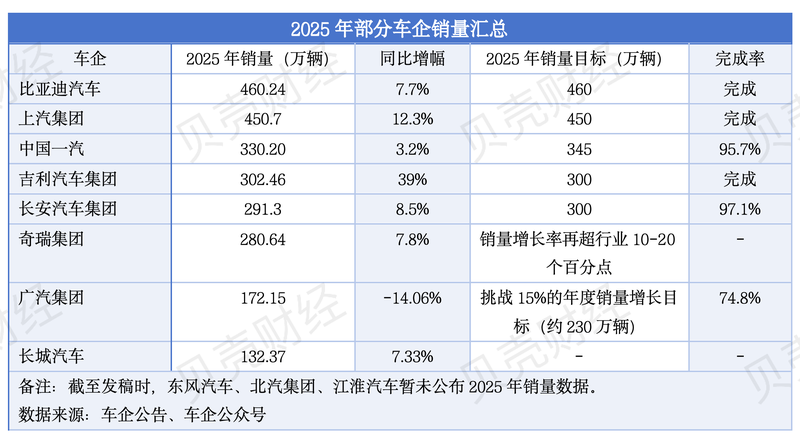
Core Insights - The Chinese automotive market in 2025 is characterized by "overall growth with internal differentiation," as the industry undergoes a deepening transition to new energy vehicles and increasing competition [1] Group 1: Overall Market Performance - Seven automotive groups reported positive sales growth in 2025, with four groups exceeding annual sales of 3 million vehicles: BYD, SAIC, FAW, and Geely [2][4] - BYD achieved sales of 4.6024 million vehicles in 2025, a year-on-year increase of 7.7%, and became the global leader in pure electric vehicle sales with 2.257 million units sold, surpassing Tesla's 1.636 million units [2][4] Group 2: New Energy Vehicle Segment - Geely's total sales reached 3.0246 million vehicles, a 39% increase, with its new energy vehicle sales growing by 90% to 1.6878 million units [4] - The new energy vehicle segment is becoming a critical growth driver, with companies like BYD and Geely leading the charge [11] Group 3: New Entrants and Market Dynamics - Among the new entrants, three companies—Leap Motor, Xiaopeng, and Xiaomi—successfully met their sales targets, while others faced challenges [6][7] - The new energy vehicle market is witnessing significant differentiation, with 40,000 units becoming a key sales threshold for new entrants [1][6] Group 4: International Market Expansion - Chery, SAIC, and BYD formed the "Million Vehicle Club" in overseas sales, each exceeding 1 million units, indicating strong global expansion [9][10] - BYD's overseas sales grew by 145% in 2025, marking a significant milestone as it expanded its presence across six continents and 119 countries [11] Group 5: Future Outlook and Industry Trends - The industry consensus for 2026 is that competition will intensify, with traditional automakers focusing on high-end and intelligent vehicles while new entrants seek differentiation through rapid technological advancements [1][12] - Companies are emphasizing the need for transformation to adapt to the evolving market landscape, with many highlighting the importance of innovation and reform [13][14]

锂钴研究-2026Q1正极排产解析-全年需求展望
2026-01-08 02:07
锂钴研究:2026Q1 正极排产解析,全年需求展望 20260107 摘要 2025 年全球新能源汽车销量达 2,110 万辆,同比增长超 20%,中国市 场受益于新能源商用车和购置税减免政策,增幅接近 30%。预计 2026 年中国新能源汽车销量同比增长约 17%,全球动力电池装机容量预计同 比增长约 30%。 2025 年储能电池出货量超 620GWh,同比增长超 70%。预计 2026 年全球储能电池出货量将超过 1TWh,并于 2027 年维持强劲装机状态。 整体电池需求预计同比增长 25.5%,达 2,900GWh 左右。 锂材料价格显著上涨,碳酸锂均价约 7.2 万元/吨,预计 2026 年均价将 超 10 万元/吨,一季度有望达 15 万元/吨,若复工节奏超预期,或冲击 20 万元/吨。锂矿供应虽有非洲、南美增量预期,但政策和政局不稳定 因素可能影响实际投放量。 三元材料产能过剩,有效产能超 300 万吨,实际需求仅百万吨级别。铁 锂方案逐渐被下游认可,海外企业也开始提升铁锂产品出货,这一趋势 将在未来几年继续增强。 Q&A 2026 年锂电池市场的整体预期如何? 根据初步统计,2025 年全球 ...

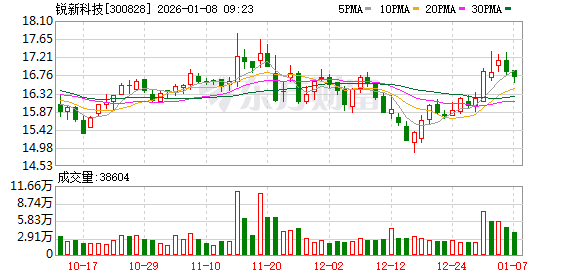
锐新科技:目前,公司已为零跑汽车提供产品,同时积极跟进安徽省内汽车类企业合作机会
Mei Ri Jing Ji Xin Wen· 2026-01-08 01:24
锐新科技(300828.SZ)1月8日在投资者互动平台表示,公司原材料主要以铝、铜为主,其短期价格上 涨会导致采购成本阶段性上升,但公司采用"以销定产、以产定购"的动态调整方式,有效降低了短期价 格上涨带来的影响。目前,公司已为零跑汽车提供产品,同时积极跟进安徽省内汽车类企业合作机会。 (文章来源:每日经济新闻) 每经AI快讯,有投资者在投资者互动平台提问:最近金属价格上涨对于贵司业务和利润影响有多大? 在安徽新能源汽车业务方面有无突破? ...

研判2025!中国信号链模拟芯片行业分类、产业链、市场规模、竞争格局和未来趋势分析:国产替代进程加速,高端产品技术瓶颈有望突破[图]
Chan Ye Xin Xi Wang· 2026-01-08 01:20
Core Viewpoint - The signal chain analog chip market in China is rapidly developing, with significant growth potential driven by domestic technological advancements, funding, and policy support, despite the dominance of international companies [1][6]. Industry Overview - Signal chain analog chips are crucial for processing various analog signals in the digital world, acting as a bridge between the physical and digital realms [2]. - The industry encompasses a wide range of products, including amplifiers, comparators, ADCs, DACs, and various interface products [3]. Industry Chain - The upstream of the signal chain analog chip industry includes semiconductor materials, wafer manufacturing, and semiconductor equipment, while the midstream focuses on production, and the downstream includes applications in communication, automotive electronics, industrial, consumer electronics, and medical devices [5]. Current Industry Status - The global market for signal chain analog chips has shown consistent growth from 2016 to 2022, with a contraction in 2023 due to the semiconductor industry's downturn, but is expected to recover in 2024, reaching a market size of $11 billion, a 4.8% increase year-on-year [6]. Competitive Landscape - The global market is dominated by major international players like Texas Instruments and Analog Devices, while domestic companies in China, such as SiRuPu and XinHai Technology, are emerging but still face challenges in technology and market share compared to their international counterparts [6]. Industry Development Trends - The industry is moving towards miniaturization, low power consumption, and high performance, driven by advancements in AI, electric vehicles, and industrial automation [9]. - The domestic replacement process is accelerating, particularly in high-end sectors, as the Chinese government investigates anti-dumping measures against imported analog chips [10][11]. - Demand for signal chain analog chips is expected to grow steadily due to the proliferation of consumer electronics and the increasing electronicization of vehicles, especially with the rise of autonomous driving technologies [12].





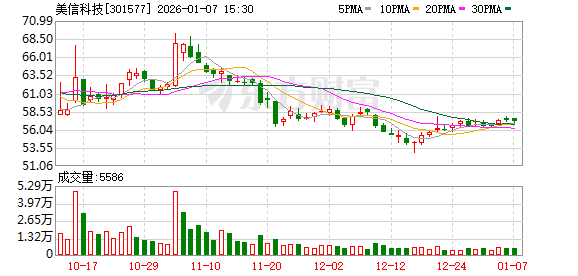
美信科技:公司产品主要应用在网络通信、新能源汽车、数据中心、AI服务器电源、工业电源、储能等领域
Mei Ri Jing Ji Xin Wen· 2026-01-08 01:06
Group 1 - The core viewpoint of the article is that the company, Meixin Technology, primarily focuses on applications in various sectors such as network communication, new energy vehicles, data centers, AI server power supplies, industrial power supplies, and energy storage, rather than aerospace [2] Group 2 - Investors inquired whether the company's products, including network communication, are applied in the aerospace sector [2] - Meixin Technology confirmed that their products are not specifically mentioned as being used in aerospace development [2]
财经观察:从三组数据看中国EV发展潜能
Huan Qiu Wang· 2026-01-07 22:39
Core Viewpoint - BYD has surpassed Tesla to become the world's largest electric vehicle manufacturer, selling 2.26 million pure electric vehicles in 2025 compared to Tesla's 1.64 million, marking a significant shift in the global EV market dynamics [1] Group 1: R&D Investment and Workforce - BYD's revenue for the first three quarters of the year reached 566.27 billion yuan, with R&D expenses amounting to 43.75 billion yuan, representing 7.7% of its revenue [2] - The company has over 120,000 R&D personnel across 11 research institutes, with more than 50,000 recent graduates hired in the last three years, of which over 70% hold master's or doctoral degrees [4] - BYD's R&D investment has consistently ranked first among A-share listed companies, with a cumulative investment exceeding 220 billion yuan [4] Group 2: Competitive Landscape and Market Position - BYD's R&D investment is significantly higher than that of Tesla by 10.9 billion yuan, indicating a strong commitment to innovation [2] - The company has achieved a remarkable 145% year-on-year growth in overseas sales, reaching 1.049 million units in 2025, which accounts for over 22% of its total sales [9] - BYD's strong position in the battery supply chain, being the second-largest in global battery installations, gives it a competitive edge in the EV market [7] Group 3: Global Market Trends and Future Outlook - The global market share of Chinese new energy passenger vehicles reached 68.4% in 2025, with a peak of 73.7% in November, reflecting the impact of R&D investments over the past decade [6] - The geopolitical landscape poses challenges for Chinese automakers, with significant tariffs imposed by the U.S. and EU on Chinese electric vehicles, pushing companies to focus on developing markets in Southeast Asia, Latin America, Africa, and the Middle East [12] - Analysts suggest that BYD has the potential to surpass Toyota in global sales, with a projected growth space of approximately 1x, contingent on the speed of EV adoption over traditional fuel vehicles [12]
多家车企公布2026销量目标
智通财经网· 2026-01-07 22:35
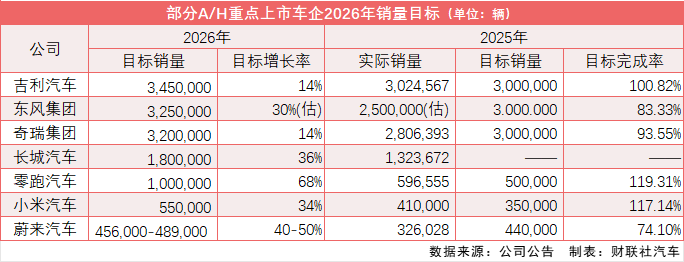
已连续多年未达成年度目标的长城汽车,下调了2026年员工持股计划业绩考核目标,将原计划中2026年 的汽车销量考核目标从不低于249万辆下调至不低于180万辆,较去年实际销量增长36%;净利润考核目 标(不低于100亿元)保持不变。 新能源汽车购置税减半政策的实施及"两新"补贴政策的调整延续,为2026年国内汽车市场带来了新的变 量。 在此背景下,多家车企相继披露的2026年销量目标呈现出截然相反的走势——尚处于全面智电转型、且 背负较大燃油车时代存量资产、销量基数较大的传统车企普遍给出了较为审慎的增长目标,而新造车企 业对市场估计则更为乐观。其中,在2025年均超额完成KPI的零跑、小米汽车今年销量目标的增幅分别 达到68%和34%;意欲在2026年实现全年盈利的蔚来汽车,年度目标增幅同样高达40-50%。 | | | 部分A/H重点上市车企2026年销量目标(单位:辆) | | | | | --- | --- | --- | --- | --- | --- | | 公司 | 2026年 | | 2025年 | | | | | 目标销量 | 目标增长率 | 实际销量 | 目标销量 | 目标完成率 | | 吉 ...