居民存款搬家

Search documents
周度策略行业配置观点:水流不会一息而止,良性正反馈机制正在逐步建立-20250817
Great Wall Securities· 2025-08-17 11:59
Group 1: Core Insights - The report highlights a significant shift in the Chinese stock market, with A-shares showing strong performance, particularly in the technology sector, driven by increased non-bank deposits and a shift in resident investment behavior [1][10][11] - The report notes that non-bank deposits increased by 4.69 trillion yuan year-to-date as of July, marking a new high since 2015, while resident deposits decreased by 1.11 trillion yuan in July, indicating a potential "money migration" towards the stock market [2][17][20] - The report emphasizes that the current market conditions resemble the early stages of a bull market, with small-cap stocks outperforming large-cap stocks and growth sectors leading over cyclical sectors [5][20] Group 2: Industry and Company Recommendations - The report recommends focusing on the copper-clad laminate (CCL) upstream sector, as the demand for high-frequency and high-speed materials is increasing due to AI server and chip requirements, with price increases already observed in the industry [6][23] - The banking sector is also highlighted for its stability amid potential macroeconomic risks, although it may not offer the same growth potential as the technology sector [6][23] - The report suggests that the strong performance of Tencent in Q2 2025, driven by AI integration across its core businesses, positions it as a key player in the technology sector [11][12]



策略周思考:何缘新高,指数贵吗?
Guoxin Securities· 2025-08-17 11:17
Group 1 - The report indicates that the current market index is not overly expensive, as the valuation metrics suggest there is still room for growth despite recent highs [1][10][17] - The analysis highlights that the "Sharpe ratio differential" between equity and bond funds is near zero, indicating potential for further upward movement in the market [1][17] - Recent data shows a significant decrease in household deposits, with a reduction of 1.11 trillion yuan in July, suggesting a shift of funds into the market [1][21] Group 2 - The report emphasizes that single valuation indicators reaching their peak should be approached with caution, as a lack of divergence in valuations typically signals a market top [2][28][30] - The current PB (Price-to-Book) ratio for the A-share market is below 80% of its historical range, indicating that the market is not excessively valued when viewed through this lens [2][31] - The report suggests that the "buy the dip" strategy is particularly effective during upward economic cycles, with specific entry points identified after a 15-20% pullback from previous highs [3][43][42] Group 3 - The report identifies sectors with high earnings growth potential, such as semiconductors and innovative pharmaceuticals, as suitable for the "buy the dip" strategy [3][43][47] - It notes that industries with a PEG (Price/Earnings to Growth) ratio below 1.5 and a projected growth rate above 30% are favorable for investment [3][52][47] - The analysis indicates that sectors with stable earnings and low volatility, such as food processing and pharmaceuticals, are also worth monitoring for investment opportunities [52][52]
投资策略周报:中期A股市场仍有充足空间和机会-20250817
HUAXI Securities· 2025-08-17 10:51
Market Review - The global stock indices experienced a broad increase, with the Shenzhen Component Index leading the global markets. The A-share market continued to strengthen, with overall investor risk appetite rising. The trading volume in both A-share markets and margin financing balances exceeded 20 trillion yuan. The Shanghai Composite Index recorded an "eight consecutive days of gains" and briefly surpassed 3700 points, reaching a nearly four-year high. The technology sector maintained strong performance, with significant gains in growth sectors such as AI, semiconductors, and robotics, leading to an 8.58% increase in the ChiNext Index and a 5.53% increase in the Sci-Tech 50 Index [1][2]. Market Outlook - The mid-term outlook for the A-share market remains optimistic, with ample space and opportunities. Firstly, despite increasing global trade uncertainties, the resilience of the Chinese economy is gaining broader international recognition. Following the tariff shock on April 7, high-risk preference funds have entered the A-share market. Secondly, households have accumulated substantial excess savings, indicating a potential influx of funds. As of the first half of 2025, household deposits deviated upwards from the trend line of 2011-2019 by over 50 trillion yuan, suggesting a large pool of potential incremental funds for the stock market. Thirdly, a new bull market has elevated household risk appetite, yet the ratios of total A-share market value to household deposits and circulating market value to household deposits remain at historically low levels, indicating that the migration of household deposits into the stock market is still in its early stages. Once market vitality is further stimulated, it will lead to a positive feedback effect of "household funds entering the market and gradual stock market growth" [2][4]. Industry Allocation - The report suggests focusing on the following areas for industry allocation: 1) New technologies and growth directions, such as domestic computing power, robotics, solid-state batteries, and pharmaceuticals; 2) Sectors benefiting from liquidity easing in the stock market, particularly large financial institutions. Thematic investments should pay attention to self-controllable technologies, military industry, low-altitude economy, and marine technology [2][4].

杨德龙:“居民存款搬家”给本轮牛市带来源源不断的增量资金
Xin Lang Zheng Quan· 2025-08-17 06:49
Core Viewpoint - The article discusses the recent financial performance of a specific company, highlighting significant revenue growth and strategic initiatives that are expected to enhance future profitability [1] Group 1: Financial Performance - The company reported a revenue increase of 25% year-over-year, reaching $2.5 billion in the last quarter [1] - Net income rose to $300 million, reflecting a 15% increase compared to the previous year [1] - The company's earnings per share (EPS) improved to $1.50, up from $1.30 in the same quarter last year [1] Group 2: Strategic Initiatives - The company plans to invest $500 million in technology upgrades to enhance operational efficiency [1] - A new product line is set to launch in Q3, which is expected to contribute an additional $200 million in revenue [1] - The company is expanding its market presence in Asia, targeting a 10% market share increase by the end of the fiscal year [1]
新增2.14万亿元流向A股?多家券商解读
券商中国· 2025-08-16 23:28
Core Viewpoint - The significant increase in non-bank deposits in July, reaching 2.14 trillion yuan, is attributed to the strong performance of the capital market, which has led to a shift of funds from bank deposits to non-bank financial institutions and potentially into the stock market [1][5][6]. Group 1: Non-Bank Deposit Growth - In July, non-bank deposits increased by 2.14 trillion yuan, the highest level recorded for this period since 2015, with a year-on-year increase of 1.39 trillion yuan [1][5]. - The growth in non-bank deposits is linked to investor behaviors such as transferring funds from banks to securities, especially during periods of stock market rallies [2][4]. - The total increase in non-bank deposits from January to July reached 4.69 trillion yuan, which is 1.73 trillion yuan more than the same period last year [3][4]. Group 2: Market Dynamics - The rise in non-bank deposits is seen as a reflection of increased financial investment activity, particularly as deposit rates decline and the relative attractiveness of fixed-income assets weakens [3][5]. - The stock market's recovery and declining interest rates are driving a "see-saw" effect between resident and non-bank deposits, with residents moving funds to non-bank institutions [3][4]. - The stock market's high trading volume has also contributed to the growth of margin deposits at securities firms, further supporting non-bank deposit increases [3][4]. Group 3: Investor Behavior - There is a distinction between high-net-worth investors entering the market and the general public, with the latter not significantly increasing their direct stock market participation [8][9]. - High-net-worth individuals are more actively investing, while retail investors are primarily channeling funds into bank wealth management products rather than directly into equities [8][9]. - The current market sentiment suggests that while there is optimism about capital market performance, the actual influx of retail investor funds remains limited compared to previous market peaks [9].


这波牛市就干这七个方向,足够了!
Mei Ri Jing Ji Xin Wen· 2025-08-16 09:33
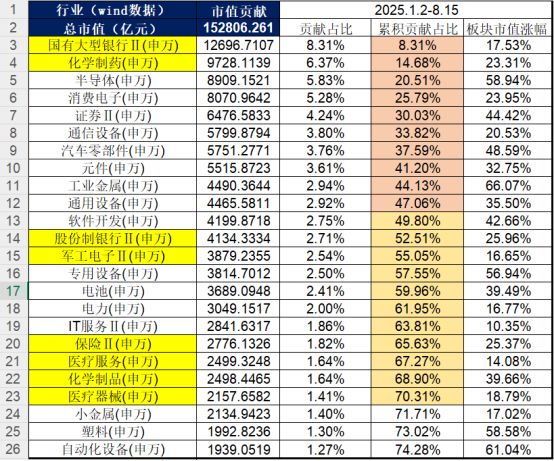
Group 1: Market Overview - The current bull market has seen 3,451 companies surpass last year's high, with 2,424 of them recording over 20% gains this year, indicating a strong market trend [1] - The total market capitalization of 124 secondary industries has increased from 87.17 trillion yuan at the beginning of the year to 102.45 trillion yuan, a growth of 15.28 trillion yuan [2] Group 2: Sector Contributions - The top ten sectors contributing to market capitalization growth include state-owned banks, chemical pharmaceuticals, semiconductors, consumer electronics, securities, communication equipment, automotive parts, components, industrial metals, and general equipment [2][3] - The banking sector (state-owned and joint-stock banks) contributed over 1.68 trillion yuan, while the medical sector (chemical pharmaceuticals, medical services, and devices) contributed approximately 1.44 trillion yuan, making them key drivers of the bull market [3] Group 3: Emotional Triggers - The Shanghai Composite Index is approaching a ten-year high, with significant resistance expected in the 3,700-3,750 point range due to historical sell-offs [5][7] - Recent news about a 1.1 trillion yuan decrease in household deposits and a 2.14 trillion yuan increase in non-bank financial institution deposits has sparked speculation about capital moving into the stock market, although this conclusion may be premature [7][8] Group 4: Future Market Divergence Points - The expiration of the "temporary suspension window" for US-China tariffs may introduce new market volatility, as recent negotiations have led to a 90-day delay in implementing tariffs [9] - The upcoming IPO of Yushu Technology, valued at 12 billion yuan, is expected to attract significant investment, with estimated frozen funds ranging from 35 billion to 50 billion yuan [10]
又出现大变动!美国准备不降息了?
大胡子说房· 2025-08-16 05:11
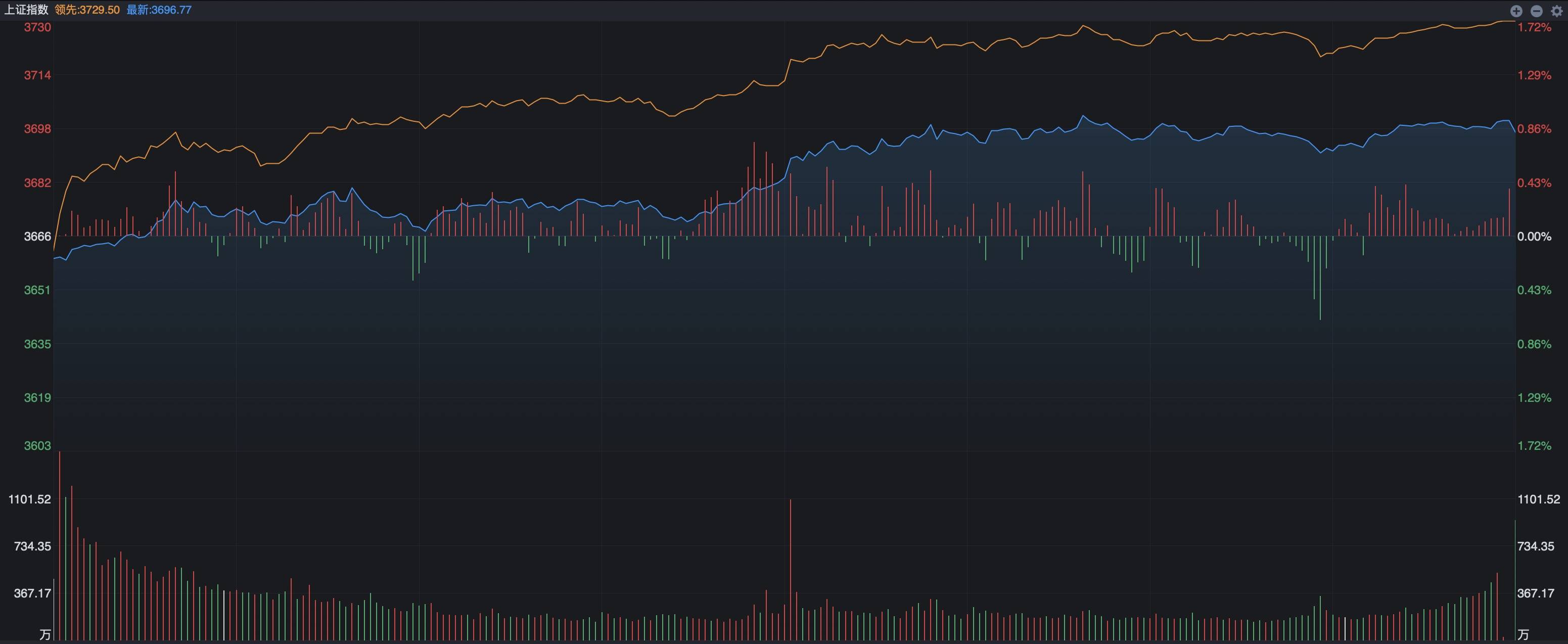
Core Viewpoint - The recent surge in the U.S. Producer Price Index (PPI) for August, which increased by 0.9%, significantly higher than the expected 0.2%, indicates a potential rise in inflation, impacting the Federal Reserve's interest rate decisions and creating uncertainty in global capital markets [1][4]. Group 1: Market Reactions - Following the PPI announcement, there was initial fear in the A-share market about the end of the current bull market, as evidenced by a significant drop in stock prices [1]. - Contrary to expectations, the A-share market rebounded strongly the next day, with major indices like the Shanghai Composite Index rising to nearly 3700 points, indicating resilience against negative news [1][3]. Group 2: Federal Reserve Dynamics - The Federal Reserve is currently divided into two factions regarding interest rate policies, with one side advocating for a cautious approach to rate cuts due to inflation concerns, while the other pushes for aggressive rate cuts [5]. - The outcome of this internal conflict will significantly influence whether the Fed will cut rates in September, with economic data losing its decisive impact on this decision [5][6]. Group 3: A-Share Market Characteristics - The A-share market has evolved into a liquidity-driven market, becoming less sensitive to external news and starting to exhibit independent trends [6]. - The push for increased direct financing by the government has historically led to bull markets within two years, suggesting a potential for sustained growth in the A-share market [8][9]. Group 4: Fiscal Stimulus and Market Growth - The recent fiscal stimulus, particularly from central government funds, has been a key driver of the A-share market's upward momentum, with significant investments from state-owned entities [9]. - The influx of capital from various sources, including consumer loans and relaxed regulatory measures, has further bolstered market liquidity, contributing to the current bullish sentiment [9][10]. Group 5: Future Market Outlook - For a sustained bull market, the return of resident deposits and corporate foreign exchange funds is crucial, with the potential for significant capital inflow if the stock market continues to perform well [11][12]. - The anticipated return of overseas corporate funds, estimated to be around 2 trillion, could provide substantial support for the A-share market, especially as the U.S. enters a period of potential interest rate cuts [12].

“存款搬家”信号出现,说明什么?
Sou Hu Cai Jing· 2025-08-16 04:18
Group 1 - The core point of the article highlights a significant increase in deposits at non-bank financial institutions, indicating a shift in residents' savings behavior [1] - In July, residents' deposits decreased by 1.11 trillion yuan year-on-year, while non-bank deposits increased by 2.1 trillion yuan, suggesting a trend of residents moving their savings [1][3] - The rise in A-shares, surpassing key resistance levels, has encouraged investors, leading to a potential influx of funds from banks to the stock market [3][4] Group 2 - The current A-share market trend is stable, with lower volatility compared to previous years, which may attract more external funds back into the market [4] - Regulatory changes and a significant drop in IPOs this year have fostered a more favorable environment for the stock market, enhancing investor confidence [4] - The movement of residents' savings from banks to investments is seen as a positive development, potentially boosting consumer spending and corporate performance [4]
暴涨!A股重大信号:居民存款“搬家”
Zhong Guo Ji Jin Bao· 2025-08-15 08:01
【导读】A股大涨,居民存款"搬家"? 大家好啊,昨天的跳水,原来是为了今天"倒车接人"!8月15日,A股继续上涨,沪指涨近1%,创业板大涨近3%!相信你们都还没有下车 吧! A股大涨 8月15日,A股市场全天低开高走,创业板指午后涨近3%。截至收盘,沪指涨0.83%,深成指涨1.6%,创业板指涨2.61%。 券商、金融科技股走强,长城证券(002939)3连板,指南针(300803)涨停创新高。 | 代码 | 名称 | | 涨幅% | 现价 | | --- | --- | --- | --- | --- | | 002939 | 长城证券 | R | 10.04 | 12.06 | | 601162 | 天风证券 | R | a'a2 | 5.54 | | 300028 | 东方财富 | R | 9.85 | 26.76 | | 601696 | 中银证券 | R | 8.67 | 18.18 | | eoooae | 湘财股份 | R | 6.70 | 11.78 | | 601099 | 大平洋 | R | 5.64 | 4.31 | | 000712 | 锦龙股份 | R | 5.58 | 15.33 ...

暴涨!A股重大信号:居民存款“搬家”
中国基金报· 2025-08-15 07:55
【导读】A股大涨,居民存款"搬家"? 中国基金报记者 泰勒 大家好啊,昨天的跳水,原来是为了今天"倒车接人"!8月15日,A股继续上涨,沪指涨近1%,创业板大涨近3%!相信你 们都还没有下车吧! A股大涨 8月15日,A股市场全天低开高走,创业板指午后涨近3%。截至收盘, 沪指涨0.83%,深成指涨1.6%,创业板指涨2.61%。 市场共4625只个股上涨,104只个股涨停,644只个股下跌。 | 880005 涨跌家数 | | | --- | --- | | 其中 涨停 | 104 | | 涨幅 > 7% | 228 | | 涨幅 5-7% | 223 | | 涨幅 3-5% | 627 | | 涨幅 0-3% | 3547 | | 跌幅 0-3% | 590 | | 跌幅 3-5% | 33 | | 跌幅 5-7% | 14 | | 跌幅 > 7% | | | 其中 跌停 | | | 上涨家数 | 4625 | | 下跌家数 | 644 | | 平盘停牌 | 155 | | 总品种数 | 5424 | | 总成交额 | 22728.38亿 | | 总成交量 | 148770.7 / | | 涨家增减 | ...