
成长风格

Search documents
近十年数据复盘!年末A股风格切换,谁在领跑?
天天基金网· 2025-11-20 08:38
Core Viewpoint - The article analyzes the performance of the A-share market in the last two months of each year over the past decade, highlighting that large-cap value and dividend styles tend to outperform, while small-cap and growth styles lag behind. Consumer and cyclical sectors show relatively better performance [1][7]. Market Performance Summary - In the last two months of each year, large-cap value and dividend styles have consistently outperformed small-cap and growth styles, indicating a trend in investor preference [7]. - The historical performance of major indices from 2015 to 2024 shows fluctuations, with significant gains in 2015 (e.g., Shanghai Composite Index up 4.6%) and notable declines in 2023 (e.g., Shanghai Composite Index down 1.5%) [2]. Leading Industries Summary - Over the past decade, the leading industries in the last two months have included: - 2015: Comprehensive, Social Services, Real Estate, Electronics, Beauty Care [4] - 2016: Oil & Petrochemicals, Construction Decoration, Steel, Retail, Building Materials [4] - 2017: Food & Beverage, Oil & Petrochemicals, Home Appliances, Steel, Coal [4] - 2018: Electronics, Comprehensive, Food & Beverage, Agriculture, Beauty Care [4] - 2019: Building Materials, Non-ferrous Metals, Electronics, Media, Automotive [4] - 2020: Non-ferrous Metals, Social Services, Power Equipment, Food & Beverage, Defense [4] - 2021: Media, Light Industry Manufacturing, Communication, Environmental Protection, Building Materials [4] - 2022: Food & Beverage, Social Services, Beauty Care, Retail, Media [4] - 2023: Coal, Machinery, Media, Communication, Comprehensive [4] - 2024: Retail, Banking, Comprehensive, Textile & Apparel, Oil & Petrochemicals [4] Investment Strategy Insights - Various institutions suggest strategies for the year-end market, emphasizing the importance of focusing on low-value sectors and potential rebounds in banking and non-bank financials. They recommend monitoring sectors like battery, photovoltaic equipment, energy metals, and chemical products for investment opportunities [8][9]. - The article suggests a balanced investment approach, combining dividend and technology strategies to optimize asset allocation while avoiding frequent trading to minimize costs and risks [9].


一图看懂:主动优选基金经理,在2025年3季报里都说了啥?
银行螺丝钉· 2025-11-19 13:56
Core Insights - The article provides an overview of fund managers' perspectives and strategies based on their recent quarterly reports, highlighting different investment styles and market outlooks [1][2]. Group 1: Fund Manager Perspectives - Fund managers express varying views on market conditions, with some maintaining optimism about equity assets due to low interest rates and the potential for corporate earnings recovery [17][18]. - Different investment styles are categorized, including deep value, growth value, balanced, and growth styles, each with distinct characteristics and focus areas [19][35][51]. Group 2: Deep Value Style - Deep value managers focus on low valuation metrics such as low P/E ratios and high dividend yields, primarily investing in sectors like finance, real estate, and energy [10][12]. - Historical performance shows that this style performed well in 2016-2017 and 2021-2024, while underperforming in 2019-2020 [15][16]. Group 3: Growth Value Style - Growth value managers prioritize companies with strong profitability and stable cash flows, often holding stocks for the long term [20][22]. - Concerns about market risks and valuation levels are noted, with some managers highlighting the extreme valuation disparities across sectors [22][24]. Group 4: Balanced Style - Balanced style managers seek a combination of growth and value, focusing on companies with favorable PEG ratios and exploring opportunities across various sectors [35][36]. - They emphasize the importance of maintaining a diversified portfolio while identifying high-quality investment opportunities [40][46]. Group 5: Growth Style - Growth style managers focus on high revenue and earnings growth, often investing in emerging industries such as AI, renewable energy, and technology [51][62]. - The article notes a shift in focus from technology to consumer sectors as the market stabilizes, with an emphasis on identifying companies with strong growth potential [55][58]. Group 6: Market Outlook - The overall market sentiment is cautiously optimistic, with expectations of continued structural opportunities despite potential short-term volatility [40][62]. - Fund managers are adjusting their portfolios in response to macroeconomic conditions, focusing on sectors with strong growth prospects and managing risks associated with high valuations [31][70].

中金:日历效应视角下 年末或可关注质量风格的配置机会
智通财经网· 2025-11-19 00:23
Group 1 - The report from CICC highlights the existence of calendar effects in the market, influenced by the rhythm of earnings disclosures, dividend events, and seasonal changes in institutional investors' risk preferences [1][3] - Small-cap style shows significant volatility in the first half of the year, with overall improvement in the second half; the small-cap style underperformed in April, with the CSI 2000 index excess returns of -2.3% and -2.2% [1][2] - Growth style exhibits a "high first, low last" characteristic, with significant excess returns in January and June-July, achieving a win rate of 90.9% [1][2] Group 2 - Quality style demonstrates a "strong at both ends" pattern, with January (excess return of 1.4%, win rate of 81.8%) and December (excess return of 0.5%, win rate of 80%) being the strongest months for quality style [2] - Dividend style performs well in April and August, with win rates of 83.3%, while June and October show significantly lower excess win rates [2][3] - The internal mechanisms of calendar effects are linked to the timing of earnings disclosures and dividend announcements, which influence investor focus and fund flows towards stocks with better fundamentals [3]
W131市场观察:大小盘交易活跃度趋势分化
Changjiang Securities· 2025-11-17 23:30
Market Overview - The Shanghai Composite Index closed at 3990.49, experiencing fluctuations throughout the week[1] - The average daily trading volume remained stable above 20 trillion CNY[1] Sector Performance - The consumer sector, particularly social services, agricultural products, and commercial trade, showed significant recovery in trading activity[1] - The healthcare and consumer staples sectors led the weekly gains, with excess returns of 3.78% and 3.38% respectively[26] Investment Style Trends - Small-cap stocks demonstrated sustained activity, while growth stocks generally experienced declines[5] - Institutional heavyweights across various indices saw weekly adjustments, with the fund overlap index down by 1.76%[20] Market Sentiment - The micro-cap stock index's trading heat continued to recover, indicating improved market sentiment[5] - The overall risk appetite in the market remains balanced and defensive, reflecting cautious investor behavior[1] Risk Considerations - The report emphasizes that historical data does not guarantee future performance, highlighting the potential for market volatility due to macroeconomic changes[34]
2025年以来,A股经历了哪些市场风格轮动?|投资小知识
银行螺丝钉· 2025-11-17 13:50
Group 1 - The core viewpoint indicates that the financing scale related to entrepreneurship and technology innovation reached a historical high in September, leading to some investors chasing prices, resulting in suboptimal returns [2] - In the fourth quarter, the market shifted to a strong value style, with overall increases observed in both high bank ratio and low bank ratio free cash flow stocks [2] - The fundamentals of the growth style remain sound, with the third quarter seeing a year-on-year profit growth of over 30% in the ChiNext and STAR Market [2] Group 2 - The decline in valuations is attributed to previously high valuations, with comparisons drawn to the market trends from 2013 to 2017, where various market segments experienced significant upward movements [3] - Investors are encouraged to adhere to low valuation buying and maintain patience to achieve returns [3]

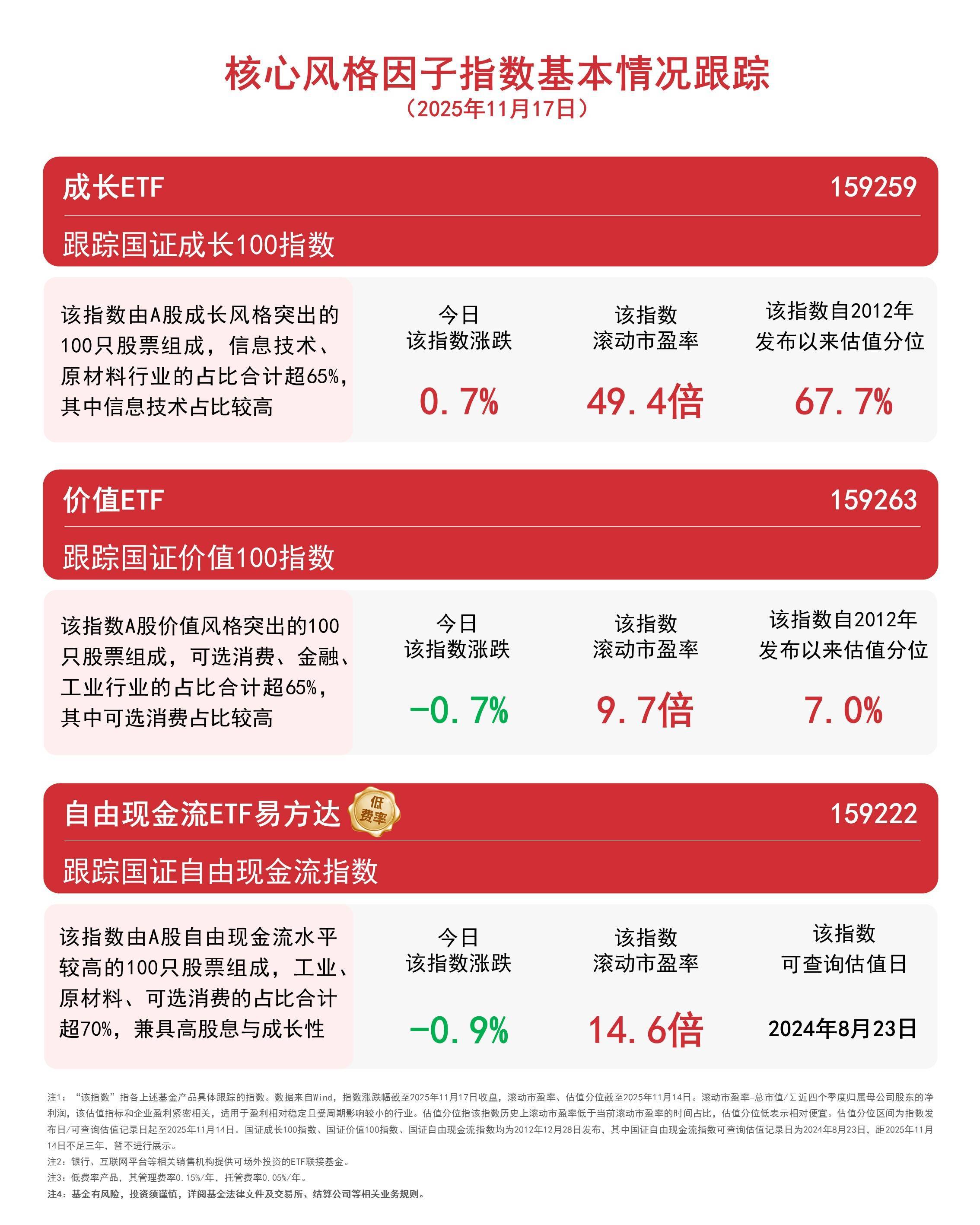
成长风格逆势上涨,关注成长ETF(159259)等投资价值
Sou Hu Cai Jing· 2025-11-17 10:01
Core Viewpoint - The market experienced fluctuations with a decline in major indices, while the growth style saw an increase, indicating a shift towards growth-oriented investments in the current economic environment [1]. Group 1: Market Performance - The National Certificate Growth 100 Index rose by 0.7%, while the National Certificate Value 100 Index and the National Certificate Free Cash Flow Index fell by 0.7% and 0.9% respectively [1]. - The Growth ETF (159259) recorded a net inflow of 110 million yuan last week, highlighting investor interest in growth stocks [1]. Group 2: Investment Opportunities - The National Certificate Growth 100 Index focuses on A-share stocks with prominent growth characteristics, aligning with the pulse of economic transformation [1]. - High-growth sectors such as electronics, communications, and computers have a significant representation in the index, making it a key area for investment [1]. - The Growth ETF (159259) is the only product tracking this index, providing investors with a tool to capitalize on growth style investment opportunities [1].
波动仍是市场底色,保持战略定力
China Post Securities· 2025-11-17 06:45
Market Performance Review - The A-share market experienced significant differentiation this week, with major indices showing mixed results. The CSI A50 index rose by 0.26%, while the Shanghai Composite Index slightly declined by 0.18%. In contrast, the ChiNext and STAR Market indices fell by 3.01% and 3.85%, respectively [3][11] - The consumer sector led the market, with significant gains in the comprehensive sector (6.99%), textiles and apparel (4.41%), retail (4.06%), beauty and personal care (3.75%), and pharmaceuticals (3.29%). Conversely, the communication and electronics sectors both dropped by 4.77% [12][30] A-share High-Frequency Data Tracking - The dynamic HMM timing model suggests a current market position leaning towards volatility, recommending a 10.4% allocation [15] - Personal investor sentiment has shown a slight recovery, with the sentiment index moving to 3.34% as of November 15, up from -1.9% on November 8 [20][22] - Financing sentiment fluctuated throughout the week, with financing transactions remaining stable and below 20% for four consecutive trading days [24] Future Market Outlook and Investment Views - The market is expected to continue its volatile pattern, with limited upward potential due to a lack of significant capital inflow and an increase in planned share reductions by listed companies [4][30] - The report suggests maintaining a growth style in investment strategy, focusing on sectors that meet the "turnaround + high growth" criteria, particularly in photovoltaic equipment and commercial industries positioned for growth [30]
机构突然落袋为安,散户该何去何从?
Sou Hu Cai Jing· 2025-11-15 00:40
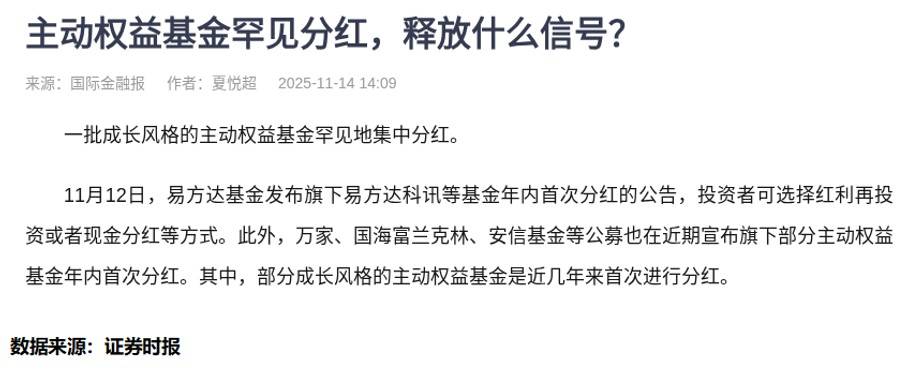
Group 1 - The recent trend of growth-style funds suddenly distributing dividends raises concerns about underlying motivations, suggesting a potential market peak [1][2] - Major fund companies like E Fund and Wanji have not distributed dividends for several years, making the recent actions appear suspicious, reminiscent of previous market peaks [2][3] - Growth funds typically rely on capital gains from selling stocks for dividends, indicating a strategy to convert unrealized gains into realized profits [3] Group 2 - The characteristics of successful stocks include high demand and the necessity of "washing" out speculative investors before price increases [3][5] - The current market environment is characterized by rapid shifts in hot stocks, with algorithmic trading causing swift price movements across sectors [5][7] - The presence of significant capital movements before stock price increases is a common indicator of potential bull stocks, which may not be easily recognizable to average investors [7] Group 3 - The collective dividend distribution by funds suggests that smart money is adjusting positions, indicating a proactive strategy rather than a reactive one [7][8] - Investors are advised to be cautious of fund names that may mislead, as "growth" may not reflect actual performance [8] - Monitoring capital movements is deemed more critical than traditional technical analysis, emphasizing the importance of using quantitative tools to identify market trends [8]

年末或可关注质量风格的配置机会,自由现金流ETF(159201)近20个交易日合计“吸金”超15亿元
Mei Ri Jing Ji Xin Wen· 2025-11-14 01:59
Group 1 - The report by CICC summarizes the calendar effect exhibited by mainstream styles in the A-share market, highlighting that the growth style portfolio shows significant excess returns in January and June/July, with a win rate of 90.9% [1] - The quality style demonstrates a "strong at both ends" pattern, with January (excess return of 1.4%, win rate of 81.8%) and December (excess return of 0.5%, win rate of 80%) being the advantageous months for this style [1] - The 800 quality index also performs relatively well in January and December, indicating strong seasonal trends for quality stocks [1] Group 2 - On November 14, the Free Cash Flow ETF (159201) experienced a slight decline of approximately 0.5%, while leading stocks such as Huaren Health, Hailu Heavy Industry, and CIMC Vehicles showed gains [1] - The Free Cash Flow ETF has seen net inflows in 19 out of the last 20 trading days, totaling over 1.5 billion yuan, indicating significant capital attraction [1] - The latest scale of the Free Cash Flow ETF reached 6.464 billion yuan, marking a new high since its inception and outperforming similar products [1] Group 3 - The Free Cash Flow ETF (159201) and its linked funds (A: 023917; C: 023918) closely track the National Index of Free Cash Flow, selecting stocks with positive and high free cash flow after liquidity, industry, and ROE stability screening [1] - The index is characterized by high quality and strong risk resistance, making it suitable for core portfolio allocation and long-term investment needs [1] - The fund management fee is set at an annual rate of 0.15%, and the custody fee at 0.05%, both representing the lowest rates in the market, maximizing benefits for investors [1]
科技方向多点开花,A500ETF易方达(159361)、科创板50ETF(588080)标的指数走强
Mei Ri Jing Ji Xin Wen· 2025-11-13 07:09
Group 1 - The A-share market is experiencing a rebound, with major indices showing strength, particularly in the battery and non-ferrous metal sectors, while the ChiNext and STAR Market indices have also seen significant gains [1] - As of 14:27, the CSI A500 index rose by 1.2%, the STAR Market 50 index increased by 0.7%, and the ChiNext index surged by 2.2%, with substantial capital inflows into related ETFs [1] - The international interest in the A-share market is growing, with foreign investors' holdings increasing from over 3 trillion yuan at the end of 2020 to over 3.5 trillion yuan currently [1] Group 2 - The CSI A500 index consists of 500 stocks with large market capitalization and good liquidity, focusing on industry balance and leading companies, with a high proportion of emerging industries [2] - The STAR Market 50 index is composed of 50 stocks from the STAR Market, with over 65% of its weight in the semiconductor industry [2] - The ETFs tracking these indices, such as the E Fund A500 ETF, STAR Market 50 ETF, and ChiNext ETF, offer a low management fee of 0.15% per year, providing diverse investment options for investors [2]