大类资产配置

Search documents
华商基金孙志远:在合适的时点选合适的人 助力更好持基体验
Zhong Guo Jing Ji Wang· 2025-11-24 02:57
Core Viewpoint - The article highlights the advantages of Fund of Funds (FOF) in addressing common challenges faced by ordinary investors, such as difficulty in selecting funds and holding them long-term, with the launch of Huashang HuiXiang Multi-Asset Allocation 3-Month Holding Mixed Fund (FOF) as a solution [1][3]. Group 1: Fund Overview - Huashang HuiXiang Multi-Asset Allocation 3-Month Holding Mixed Fund (FOF) is being issued by Huashang Fund, a well-established public fund company with nearly 20 years of experience [1][5]. - The fund aims to provide long-term stable returns through a diversified asset allocation strategy, with equity allocation set between 5%-30% and the ability to invest in Hong Kong Stock Connect stocks [3][5]. - The fund has a minimum holding period of 3 months to encourage long-term investment habits among investors [3][5]. Group 2: Fund Manager Profile - The fund will be managed by Sun Zhiyuan, who has 13.6 years of experience in the securities industry, including 6.7 years in securities investment and 6.9 years in research and analysis [2]. - Sun Zhiyuan's investment philosophy focuses on providing a good investment experience even for investors entering at the worst market timing, emphasizing a combination of absolute and relative returns [2][5]. - Under his management, the Huashang Anyuan Stable Progress One-Year Holding Mixed Fund (FOF) ranked second in its category for A-class shares and first for C-class shares over the past year [2][6]. Group 3: Company Strengths - Huashang Fund has received multiple top ratings, including a 5A rating for three-year comprehensive fund management from Tianxiang Investment Consulting [5][8]. - The company has demonstrated strong performance in both active equity and fixed-income funds, ranking second in absolute returns for active equity funds over the past seven years and first for active fixed-income funds [5][8]. - The combination of Sun Zhiyuan's management experience and Huashang Fund's robust research capabilities positions the new fund to potentially offer a professional investment perspective and improved holding experience for investors [5].
润达基金王维:主观与量化结合 创造稳健收益
Zhong Guo Zheng Quan Bao· 2025-11-23 20:06
Core Insights - Guangdong Rundar Private Equity Fund Management Co., Ltd. has established a unique investment research framework combining top-down and bottom-up approaches, aiming to optimize risk-adjusted returns for investors [1][2] Investment Strategy - The company employs a dual selection method for stock picking, leveraging both subjective and quantitative analysis to enhance investment decision-making [1][2] - The investment team consists of experienced professionals from leading fund companies, contributing to a robust investment framework [1] Research Framework - The top-down research framework focuses on macro policies, industry trends, and micro fundamentals to identify investment opportunities [2] - Quantitative analysis is utilized to assess price-volume relationships, cash flow inertia, momentum strength, and market correlation, aiding in the valuation of investment portfolios [2] Quantitative Strategies - Rundar Fund has developed a "neural network model" for quantitative trading strategies, including timing strategies, index enhancement strategies, and subjective stock selection strategies [2][3] - The company has diversified its quantitative strategies to cover a broader range of market indices and self-developed indices [3] Risk Management - The firm emphasizes risk control through scientific methods to optimize risk-adjusted returns, particularly in quantitative timing strategies [3][4] - Subjective investment risk management involves adjusting asset allocation and utilizing derivatives for hedging purposes [4] Market Outlook - The A-share market is expected to experience a gradual upward shift in its volatility center, driven by economic transformation and capital market reforms [4][5] - The company identifies structural opportunities in sectors supported by the "14th Five-Year Plan," particularly in technology innovation, high-end manufacturing, and green low-carbon initiatives [5] Investment Focus - Specific investment opportunities include artificial intelligence, quantum technology, integrated circuits, new energy, military industry, energy storage, and new transportation equipment [5] - The company believes that the valuation of technology stocks should consider future growth potential rather than solely relying on current price-to-earnings ratios [5]
关键时刻!最新研判来了
Zhong Guo Ji Jin Bao· 2025-11-23 11:51
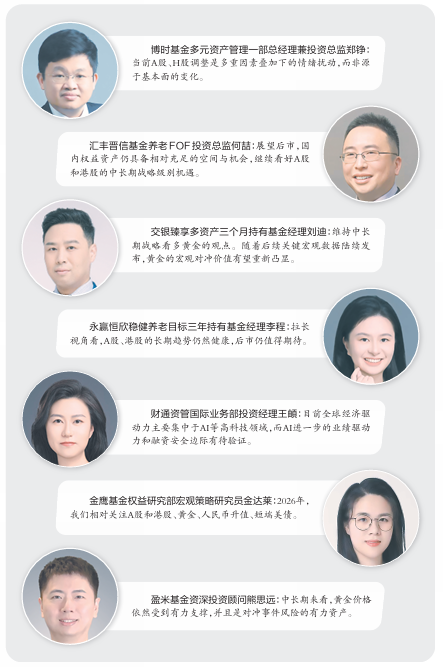
Group 1: Global Market Overview - Recent global market turmoil is attributed to multiple factors, including the Federal Reserve's mixed signals on interest rate cuts, leading to increased volatility across asset classes [3][4][5] - Concerns over AI sector sustainability and geopolitical tensions have also contributed to the decline in various asset prices, particularly in the tech sector [4][5][6] Group 2: A-shares and H-shares Outlook - The current adjustments in A-shares and H-shares are seen as emotional disturbances rather than fundamental changes, with expectations for policy support and foreign capital inflow remaining positive [6][7] - Analysts maintain a long-term optimistic view on A-shares and H-shares, anticipating a healthy recovery despite potential short-term volatility [6][7][8] Group 3: Gold Market Analysis - The outlook for gold remains positive due to anticipated global monetary expansion, although its risk-return profile may decline as economic conditions stabilize [9][10] - Analysts highlight that gold serves as a hedge against rising debt levels and geopolitical risks, reinforcing its long-term investment appeal [10][11] Group 4: Oil Market Projections - The oil market is expected to experience a range-bound trading pattern, with prices projected between $60 and $70 per barrel due to weak demand and OPEC's production strategies [14][15] - Geopolitical factors and supply-demand dynamics will continue to influence oil prices, with a cautious outlook for significant price increases [15][16] Group 5: Investment Opportunities - A-shares are viewed as having superior investment value, with a focus on sectors like technology and high-end manufacturing, while also considering defensive positions in high-dividend stocks [16][17] - Analysts suggest that the current market environment favors a diversified approach, balancing risk and return across various asset classes [17][18] Group 6: Risks to Monitor - Key risks include potential economic data surprises from the U.S. and geopolitical developments that could impact market sentiment and liquidity [18][19] - The end of the U.S. government shutdown has not alleviated concerns over liquidity, and ongoing uncertainties in economic performance may affect global asset markets [19][20]

关键时刻!最新研判来了
中国基金报· 2025-11-23 11:44
Group 1 - The recent global market turmoil is attributed to multiple factors, including the Federal Reserve's mixed signals on interest rate cuts, concerns over AI sector sustainability, and geopolitical tensions affecting supply chains [4][5][6]. - A-shares and H-shares are viewed as having long-term strategic opportunities despite recent adjustments, with expectations for policy support and foreign capital inflow remaining intact [8][9]. - The outlook for A-shares and H-shares is positive, with analysts suggesting that the current market environment presents a window for investment [8][9][10]. Group 2 - Gold is expected to remain a strong asset in the medium to long term, supported by global monetary expansion and increasing central bank purchases [11][12][13]. - Analysts predict that the global stock market will continue to trend upwards, driven by liquidity and risk appetite, although caution is advised regarding inflation and geopolitical risks [14][15][16]. - The oil market is anticipated to experience a range-bound trading pattern, influenced by geopolitical factors and supply-demand dynamics [17][18][19]. Group 3 - A-shares are considered to have superior investment value, with a focus on high-growth sectors such as technology and advanced manufacturing, while also incorporating defensive strategies [20][21]. - The investment landscape for 2026 is expected to favor A-shares, H-shares, gold, and short-term U.S. Treasuries, as global liquidity conditions remain favorable [21][22]. - Attention should be paid to liquidity and geopolitical risks, particularly in light of potential economic data releases and the Federal Reserve's policy decisions [23][24][25].

大类资产早报-20251121
Yong An Qi Huo· 2025-11-21 01:33
| 指数表现 | A股 | 沪深300 | 上证50 | 创业板 | 中证500 | | --- | --- | --- | --- | --- | --- | | 收盘价 | 3931.05 | 4564.95 | 3008.29 | 3042.34 | 7061.95 | | 涨跌(%) | -0.40 | -0.51 | -0.40 | -1.12 | -0.85 | | 估值 | 沪深300 | 上证50 | 中证500 | 标普500 | 德国DAX | | PE(TTM) | 14.14 | 12.03 | 32.17 | 25.98 | 18.06 | | 环比变化 | -0.02 | 0.01 | -0.27 | -0.41 | 0.09 | | 风险溢价 | 沪深300 | 上证50 | 中证500 | 标普500 | 德国DAX | | 1/PE-10利率 | 3.70 | 5.77 | -0.38 | -0.24 | 2.82 | | 环比变化 | 0.00 | 0.00 | 0.00 | 0.11 | -0.04 | | 资金流向 | A股 | 主板 | 中小企业板 | 创业板 | 沪 ...
2025搜狐财经年度论坛即将举办,吴晓求、刘纪鹏、阎学通、吴向东等20余位嘉宾共探中国经济韧性
Sou Hu Cai Jing· 2025-11-20 10:21
Core Insights - The Sohu Finance Annual Forum will be held on November 27, 2025, in Beijing, featuring over twenty experts from academia, industry, and investment sectors discussing key topics such as macro policies, industrial upgrades, corporate internationalization, capital market reforms, and international dynamics [2][6] - The forum aims to address the challenges of restoring consumer confidence and enhancing economic resilience amid global geopolitical shifts and domestic structural transformations [2][3] Industry Insights - The morning session will focus on practical insights from industry experts regarding policy guidance, market mechanisms, and corporate strategies, particularly addressing the "involution and efficiency trap" [3] - The real estate sector is transitioning from high-leverage expansion to high-quality operations, with discussions on industry breakthroughs and future trends led by prominent figures from major real estate companies [3][4] - In the consumer sector, companies like Xiaobuxiang will share strategies for achieving growth through product innovation and organizational change despite price competition and weak demand [4] Financial Sector Insights - The financial investment segment will feature seasoned professionals discussing asset allocation, pharmaceutical and biotechnology sectors, chip technology, and gold as a hedge against uncertainty [4] - The afternoon session will delve into macroeconomic resilience and strategic directions, with discussions on the evolution of the global macroeconomic landscape and the transformation of China's capital market towards a more regulated and transparent wealth management system [5] - Experts will also explore new consumption drivers and the potential of emerging trends like concerts and IP blind boxes to stimulate significant consumer spending [5] Forum Impact - The Sohu Finance Annual Forum has evolved into a significant high-end financial dialogue platform, aiming to break down information barriers, promote cross-sector collaboration, and connect policies with market dynamics, which is crucial for China's economic development [6]
绝对收益产品及策略周报(251110-251114):上周126只固收+基金创新高-20251120
GUOTAI HAITONG SECURITIES· 2025-11-20 09:26
- The report introduces a macro timing-driven stock-bond 20/80 rebalancing strategy and a stock-bond risk parity strategy, both enhanced by industry ETF rotation. The stock-bond 20/80 rebalancing strategy achieved a YTD return of 8.28%, while the stock-bond risk parity strategy achieved a YTD return of 3.40%[4][30][39] - The macro timing model predicts the Q4 macro environment as "Inflation". Based on this, the stock-bond 20/80 rebalancing strategy and risk parity strategy are constructed to optimize asset allocation under inflationary conditions[24][30][31] - The industry ETF rotation strategy is built using multi-factor models, including historical fundamentals, expected fundamentals, sentiment, technical indicators, and macroeconomic factors. The strategy recommends focusing on ETFs such as the Guolian Semiconductor ETF, Guotai Securities ETF, Guotai Communication Equipment ETF, GF New Energy Vehicle Battery ETF, and Huaxia Animation Game ETF[25][27][28] - The report evaluates the performance of quantitative fixed-income+ strategies, including PB profitability, high dividend yield, small-cap value, and small-cap growth factors. Under a non-timing 20/80 rebalancing strategy, small-cap value achieved a YTD return of 11.72%, while small-cap growth achieved a YTD return of 11.56%. When combined with macro timing, small-cap value achieved a YTD return of 12.32%, and small-cap growth achieved a YTD return of 13.17%[4][39][42] - The inverse cycle configuration strategy combines PB profitability and small-cap value or small-cap growth factors under a 20/80 quarterly rebalancing framework. Both combinations achieved a YTD return of 5.74%[39][42] - The report provides detailed backtesting results for various strategies, including annualized volatility, maximum drawdown, and Sharpe ratios. For example, the macro timing-driven stock-bond 20/80 rebalancing strategy has an annualized volatility of 3.53%, a maximum drawdown of 1.78%, and a Sharpe ratio of 1.72[30][39][42] - The quantitative fixed-income+ strategies are tested under different configurations, including non-timing 10/90 and 20/80 monthly rebalancing, macro timing 20/80 monthly rebalancing, and inverse cycle 20/80 quarterly rebalancing. The report provides net value curves and drawdown charts for these strategies[39][40][42]
申万宏源证券:大类产品新策略 金融科技新趋势
Xin Lang Zheng Quan· 2025-11-20 01:35
Core Insights - The conference focused on the importance of multi-asset allocation strategies in the current economic and market environment, emphasizing the shift in investor demand towards diversified wealth management solutions [2][3] - The launch of the "Shenxiang·Custody Operation Service Platform" marks a significant step in the company's commitment to financial innovation and digital transformation [3] Group 1: Conference Overview - The "2026 Capital Market Investment Annual Conference" was held in Shanghai, featuring discussions on index investment, asset allocation strategies, and the impact of technology on investment [1][2] - The event included three keynote speeches and two roundtable discussions, providing valuable insights for investors [1] Group 2: Keynote Presentations - The first keynote by MSCI's Zhao Piwei discussed index investment and innovation, highlighting the new global private equity return tracking index as a case study [2] - The second keynote by Professor Wu Fei from Shanghai Jiao Tong University focused on the structure and investment strategies of family offices, offering unique perspectives for investors [2] - The third keynote by Shen Siyu from Shenwan Hongyuan analyzed market trends and investment strategies using factor models, providing practical guidance for investors [3] Group 3: Roundtable Discussions - The roundtable discussions featured experts from various sectors, including brokerage, banking, and private equity, sharing insights on asset allocation strategies and innovative investment tools [3] - The discussions emphasized the importance of adapting to the current macroeconomic environment and leveraging new technologies in investment practices [3] Group 4: Platform Launch - The "Shenxiang·Custody Operation Service Platform" was officially launched, designed to enhance operational efficiency and security in fund custody services [3] - The platform is noted for its autonomous control and intelligent collaboration capabilities, reflecting the company's commitment to providing high-quality financial services [3]

招商期货大类资产配置周报(2025年11月10日-2025年11月14日):10月国内货币信贷增速有所放缓-20251117
Zhao Shang Qi Huo· 2025-11-17 06:43
1. Report Industry Investment Rating No information provided in the document. 2. Core Views of the Report Market Logic - Overseas: The US government ended over 40 days of shutdown this week, but the release of key economic data is still delayed. September non - farm payrolls and Q3 GDP data are expected to be announced in the next two weeks. October employment and inflation data may be distorted, hindering the Fed's policy guidance. The market believes there is a higher probability that the Fed will not cut interest rates in December. The end of the shutdown could theoretically boost market risk appetite as fiscal policy can continue to play a role. The TGA account has increased by thousands of billions during the shutdown, exceeding one trillion dollars, and its release is expected to boost the US economy [6]. - Domestic: In October, the year - on - year growth rates of M1 and M2 both declined. M1 growth dropped from 7.2% to 6.2%, and M2 growth slightly fell to 8.2%. The gap between them widened again, indicating a decrease in capital activation. New social financing was 815 billion yuan, with a growth rate of 8.5% (previous value 8.7%). Government bond net financing was 489.3 billion yuan, a significant year - on - year decrease. Credit contraction, especially the weakness of long - term household loans, was the main drag, related to real estate spending. M1 growth decline was affected by weak overall social financing, slower corporate capital activation, and the transfer of household deposits to non - bank institutions. M2 growth was pressured by the slowdown of fiscal expenditure and government bond issuance. The current low - interest - rate environment may promote the conversion of deposit structure to demand deposits, supporting M1, while the future trend of M2 still depends on credit issuance rhythm and the implementation of loose policies such as policy - based financial tools [7]. - In October, the industrial added - value growth rate slowed from 6.5% to 4.9%, and the service production index dropped to 4.6%, the lowest point of the year, indicating weakened production momentum. This decline was dragged down by both external and internal demand. Externally, export growth slowed; internally, the manufacturing PMI dropped to 49.0%, lower than market expectations, and weak investment and consumption were mutually confirmed, highlighting insufficient effective demand. Industry performance was significantly differentiated. Traditional industries were affected by the "anti - involution" policy, with significantly reduced operating rates, while high - tech manufacturing industries such as railway and ship transportation equipment and integrated circuits maintained high - speed growth [8]. - From a meso - perspective, this week's high - frequency economic activity index was active, at a high level in recent years. In building materials, the demand for PVC and glass improved. The operating rate of copper rods rebounded from a low level. The operating rate of photovoltaic glass has been declining rapidly since the "anti - involution" policy was proposed, but it gradually stabilized in late October, stopping the previous rapid decline [8]. - Under the influence of multiple factors such as the Fed's hawkish signals, global stock markets fluctuated significantly this week, driving the adjustment of multiple assets such as precious metals and digital currencies. As long as global fiscal and monetary policies remain loose, the technology theme still has investment value, and cyclical investments in resource - based sectors such as non - ferrous metals and chemicals are also timely. Precious metals should be used as a hedging tool to prevent tail risks [8]. Logic of Major Asset Classes | Major Asset Class | Logic | Allocation Suggestion | | --- | --- | --- | | Stocks | Medium - to - long - term logic: Global fiscal and monetary policies work together; domestic PPI and industrial enterprise profits have bottomed out, and "anti - involution" promotes recovery; capital flows, with deposit and wealth - management funds transferring, and foreign capital waiting to enter due to RMB appreciation; stable global demand and improved Sino - US relations lay the foundation for increased risk appetite. Short - term logic: Changes in Sino - Dutch and Sino - Japanese relations affect market risk appetite; valuations have reached extremely high levels in the past three years, and further increases require improved profit expectations; the probability of a Fed rate cut in December has decreased. | Long - term overweight, neutral allocation in November, with structural opportunities [9] | | Bonds | Medium - to - long - term logic: Limited room for domestic interest - rate cuts; the "unified large market" (including "anti - involution") promotes inflation and economic improvement; the stock - bond seesaw effect. Short - term logic: Bond yields have risen significantly compared to mid - year; the central bank has restarted treasury bond trading; the economic momentum in Q4 lacks explosive power. | Long - term underweight, neutral allocation in November [9] | | Commodities | Medium - to - long - term logic: Fiscal and monetary policies boost the economy, and PPI will turn positive next year; the Fed cuts interest rates, and the US dollar weakens; short - duration attributes with lower elasticity than stocks. Short - term logic: Weak demand; weak policy expectations in Q4. | Long - term overweight precious metals and non - ferrous metals. Precious metals will fluctuate from November to December, non - ferrous metals will be relatively strong, and there are trading opportunities in "anti - involution" related varieties [9] | Sector Logic - Precious metals: Still worth long - term allocation from a major asset allocation perspective to hedge against currency credit risks. Silver generally follows gold with more elastic upward pulses. This week, silver rose significantly, and precious metals as a whole soared and then回调ed significantly on Friday night, mainly due to the impact of global risk - asset fluctuations on liquidity. Long - term allocation can continue despite the lack of short - term drivers [14]. - Base metals: Metals such as copper, aluminum, zinc, and tin face supply disruptions, with a tight medium - to - long - term supply situation, and there are more technology - related narratives (AI, robots, etc.) on the demand side, so they are still regarded as bullish. Basic metals are breaking through and rising. New - energy metals such as lithium carbonate have rebounded significantly recently due to the "anti - involution" policy, and polysilicon and industrial silicon are also subject to supply - side regulation, and their subsequent market trends are expected to continue [15]. - Black commodities: The current situation is influenced by the "anti - involution" policy and the arrival of the peak season, remaining relatively warm. The NDRC requires coal supply guarantee, changing the logic of production cuts due to safety inspections, so coal prices are weak, but it can still be bought on dips based on the peak - season and "anti - involution" logic [15]. - Energy and chemicals: Pay attention to the impact of raw materials on the overall valuation of the sector. Recently, crude oil prices have strengthened due to the situation in Venezuela. Without the expansion of the conflict, there is no condition for continuous upward movement, but also no continuous downward momentum under the background that OPEC+ is about to stop increasing supply, so it is expected to fluctuate with short - term strength. For downstream chemical products, after the "anti - involution" policy, there is an expectation of long - term profit expansion, but no short - term drivers [15]. - Agricultural products: In the oil sector, the differentiation continues, with P showing a reverse spread and rapeseed - soybean showing a positive spread, with a medium - term oscillatory trend and both supply and demand increasing. Protein meal is oscillating strongly in the short term with relatively low valuation, and its medium - term trend depends on South American production, with a weak expectation. Corn is under pressure from autumn harvest and oscillating weakly. The supply - demand pressure of live pigs has eased, and the futures price is expected to oscillate within a range; the demand for eggs has declined, and the futures price is expected to oscillate downward. In the short term, the expected increase in production in the Northern Hemisphere has become a reality for sugar, and it is still searching for a bottom; in the long - term, the global sugar market is in an increasing - production cycle and is regarded as bearish. For cotton, the latest USDA data in October has a negative impact on global cotton prices, and domestic commercial cotton inventories are higher than last year, so it is oscillating weakly in the short term; in the long - term, domestic cotton prices are at a relatively low level with no effective drivers, and macro - level disturbances should be monitored [16]. 3. Summary by Directory 01 Core Views - Overseas and domestic economic situations, production and demand conditions, and major asset and sector investment logics are comprehensively analyzed, and corresponding investment suggestions are provided [6][7][8][9][14][15][16]. 02 Quantitative Analysis - The weights of major asset sub - sectors in the current and previous periods are presented. The recent one - week, one - month, year - to - date, and three - month returns, valuations, volatilities, trend smoothness, and speculation degrees of stocks, bonds, and commodities are also given. It is also mentioned that the correlation between major asset classes has increased recently, while the correlation within the commodity sector has decreased [19][20][21][22]. 03 Macro Overview - Domestically, in October, the unemployment rate of non - local household registration decreased significantly, the manufacturing PMI declined significantly, the M1 growth rate decreased, and the gap between M1 and M2 widened again. Both CPI and PPI rebounded. Overseas, the US PMI in October increased moderately [26][30][32][33][35]. 04 Meso Data - Based on the comparison of meso - level data of each module with the same period in the past five years, scores are given according to the degree of change. Economic activity indicators have returned to normal levels. In the real - estate sector, multiple indicators are at the bottom, while the demand for glass and PVC has increased [41][42][45].
中金2026年大类资产展望:超配中国股票与黄金 标配美股与美债
智通财经网· 2025-11-17 00:40
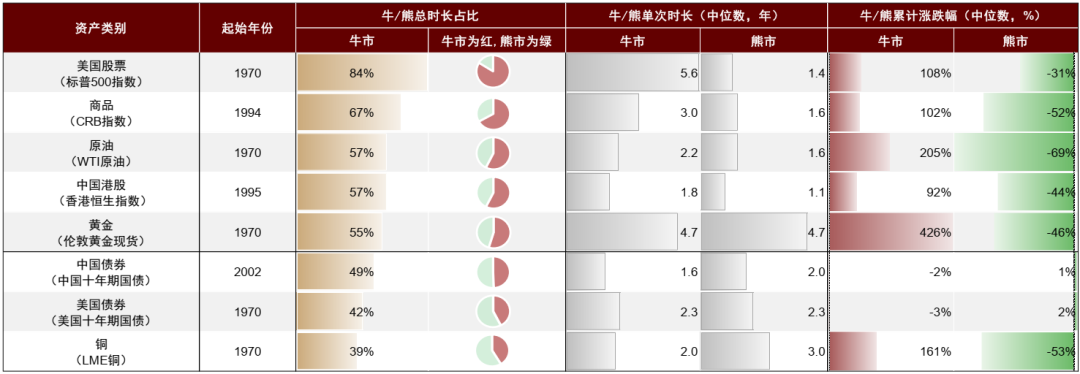
Group 1 - The article discusses the importance of identifying market tops for Chinese stocks and gold, emphasizing that economic and policy signals are crucial for making accurate predictions [1][10][40] - It highlights that the U.S. stock market has a long bull market duration, while Chinese stocks experience more frequent bull-bear switches, making timing more critical for Chinese stocks [5][10] - The analysis indicates that gold's bull and bear markets are lengthy with low switching frequency, suggesting that identifying tops is also significant for gold [1][5] Group 2 - Four key factors are identified that could potentially alter the bull market trends for stocks and gold in 2026: growth direction, tightening policies, high valuations, and geopolitical shocks [2][39] - The current economic conditions in China are characterized as a "weak recovery," while the U.S. is moving towards "stagflation," which could impact the performance of stocks and gold differently [2][41] - The article suggests that while there are no immediate signals indicating a top for the current bull markets, high valuations for gold may lead to increased volatility in the future [26][36][40] Group 3 - The asset allocation recommendation includes overweighting Chinese stocks and gold, while maintaining a neutral position in U.S. stocks and bonds, and adjusting commodity exposure to neutral [3][4] - The rationale for these recommendations is based on the ongoing AI technology wave and liquidity conditions benefiting Chinese stocks, while gold is supported by the current monetary policy environment [3][4] - The article notes that despite potential volatility, there are no clear signals indicating a market top for Chinese stocks or gold at this time [25][36]