智驾平权

Search documents
四维图新(002405) - 002405四维图新投资者关系管理信息20250527
2025-05-27 12:02
Industry Trends - The trend of "smart driving equality" is becoming crucial in the industry, with mid-to-high-level assisted driving transitioning from a "value-added service" to a "key competitive factor" for mass-market vehicles [2] - Mid-level assisted driving features are expected to become standard in vehicles priced around 100,000 RMB, promoting the widespread adoption of assisted driving technology [2] - The automotive chip industry in China is rapidly developing, driven by the dual forces of smartization and domestic substitution [3] Business Performance - The compliance business achieved a growth rate of 150% in 2024, with Q1 2025 also showing over 100% growth [4] - The revenue for the intelligent cloud segment in 2024 is projected to be 2.254 billion RMB, reflecting a year-on-year growth of 28.96% [4] - The company aims to deepen cooperation with cloud service providers to enhance data compliance capabilities [4] Product Development - The company is transitioning from a map provider to a data and model infrastructure provider for intelligent driving [5] - The SoC chip shipments have reached 90 million units, while MCU chip shipments have surpassed 70 million units [9] - The latest SoC product, AC8025AE, has been released, offering a complete solution for parking and L2+ intelligent driving [10] Financial Outlook - The company anticipates significant losses in the short term due to talent investment, R&D costs, and intense price competition [14] - Revenue growth is expected to exceed 12% in 2024, with plans to add 3 million basic vehicle units and 600,000 integrated products by Q1 2025 [14] - The company is focused on improving operational efficiency through cost control and organizational optimization [14] Regulatory Environment - Recent regulations from the Ministry of Industry and Information Technology aim to rectify disorder in the intelligent connected vehicle industry, promoting high-quality development [8] - The company has established a strong position in the map and data compliance sectors, which are essential for the assisted driving system [8] Efficiency Metrics - The company's revenue per employee is approximately 1.68 million RMB, reflecting a year-on-year increase of over 50% [12] - The company has improved its employee efficiency from 780,000 RMB per employee to 1.68 million RMB over the past three years [7]

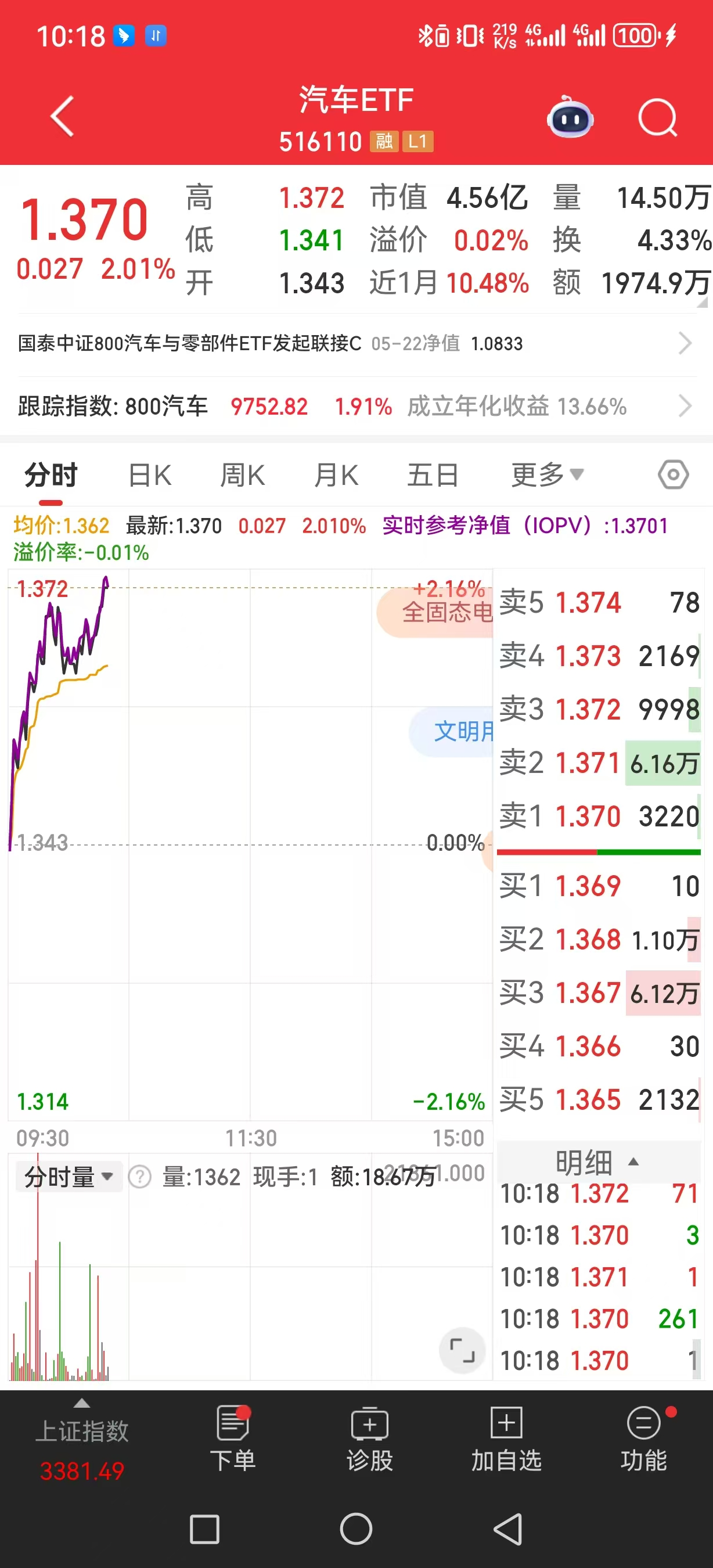
一季度全球新能源车销量突破400万辆,汽车ETF(516110)涨超2%
Mei Ri Jing Ji Xin Wen· 2025-05-23 03:04
Core Viewpoint - The global sales of new energy vehicles (NEVs), including battery electric vehicles (BEVs), plug-in hybrid electric vehicles (PHEVs), and hydrogen fuel cell vehicles, are projected to reach 4.02 million units in Q1 2025, representing a 39% year-on-year growth [1][4]. Fundamental Analysis - Global NEV sales are expected to account for 18.4% of total automotive sales in Q1 2025, driven by favorable policies such as vehicle trade-in programs [4]. - In April, the retail sales of NEVs in China reached 905,000 units, showing a year-on-year increase of 33.9% and a penetration rate of 51.5% [4]. - Domestic NEV penetration rates for independent brands reached 72.8%, while luxury and joint venture brands had penetration rates of 23.5% and 6.8%, respectively [4]. Technical Analysis - The trend of smart technology is identified as a key driver for the upward cycle of NEVs, with over 20 automakers integrating advanced AI models into their vehicles [5]. - The penetration rate of L2-level assisted driving features in new vehicles is projected to reach 57.3% by 2024, indicating a growing adoption of smart driving technologies [5]. - The automotive parts sector is expected to see differentiated revenue and profit growth, particularly in the smart driving supply chain, with L2.5 and above smart driving models anticipated to enter a rapid growth phase by 2025 [5]. Financial Analysis - Public funds have significantly increased their holdings in the automotive sector, with the automotive industry being the most heavily weighted sector in Q1 2025 [7]. - The current allocation of funds in the automotive sector is at a historical high, indicating strong institutional confidence in the long-term fundamentals of the industry [7]. Market Outlook - The long-term outlook for the automotive sector remains positive, particularly in the areas of smart driving and smart cockpit technologies [9]. - The mid-term indicators suggest an improving fundamental trend in the automotive industry, supported by increased allocations from public funds [9].

聚焦技术创新生态系统,AITX助力汽车产业高质量发展
Zhong Guo Jing Ji Wang· 2025-05-22 06:25
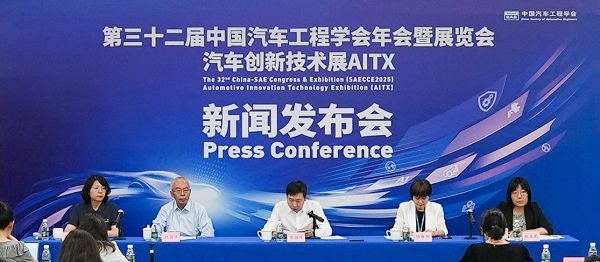
Core Viewpoint - The Automotive Innovation Technology Exhibition (AITX) focuses on automotive technology and innovation ecosystems, emphasizing professional, business, and ecosystem aspects, particularly in electrification and intelligence [1][3]. Group 1: Event Overview - The 32nd Annual Conference and Exhibition of the China Society of Automotive Engineers (SAECCE 2025) and the AITX press conference were held on May 20, featuring over 120 planned meetings and participation from more than 200 leading automotive companies showcasing their latest technologies [1][3]. - AITX aims to become the largest and most influential global automotive innovation technology exhibition by 2030, serving as a catalyst for accelerating automotive technology innovation [5][6]. Group 2: Industry Development - China's automotive industry has shown positive growth, with production and sales exceeding 10 million units for the first time in the first four months of 2025, including 4.429 million units of new energy vehicles, marking a year-on-year growth of 48.3% [3]. - The penetration rate of new energy vehicles reached 42.7%, indicating a new phase of comprehensive market development for electric vehicles [3]. Group 3: Technological Challenges - The development of automotive technology faces challenges, particularly in solid-state batteries, which are still in the research and pilot testing stages, with significant issues related to material stability and lifecycle yet to be resolved [4]. - Advanced levels of autonomous driving (L3 and above) are still in the verification and demonstration stages, requiring substantial breakthroughs in technology, user acceptance, and safety management [4]. Group 4: Exhibition Highlights - AITX will feature eight thematic exhibition areas, including intelligent networking, new energy systems, and automotive materials, with expectations to double the exhibition area and participant scale compared to previous years [5][6]. - The event will also include a comprehensive conference system with a focus on energy-saving technologies, new energy vehicles, and intelligent connected vehicles, fostering a full-chain communication ecosystem [5][6].
理想汽车之后,这家新势力也踏上盈利之路
财富FORTUNE· 2025-05-21 13:14
图片来源:视觉中国 近期,新势力车企4月交付成绩陆续公布,零跑继3月首次登顶后,再度蝉联榜首。 今年1月,零跑汽车发布盈利预告称,公司2024年第四季度实现净利润转正,提前一年达成单季度盈利 目标。这标志着零跑汽车成为继理想汽车之后,第二家实现盈利的造车新势力。但需注意的是,零跑 2024年全年净亏损为28.2亿元。 根据其官方微博,零跑4月交付量为41039台,同比增长173%,增速创新高。这种销售势头延续到了本 月,5月前5天,零跑全系订单超18000台,其中5日单日订单便突破3700台。 5月19日,零跑汽车发布2025年第一季度财报,期内,零跑销量为87552台,同比增长162%,营收达百 亿,同比增长187.1%,毛利率14.9%,创历史新高。 在去年四季度单季盈利后,零跑汽车的净利润环比由盈转亏,今年一季度零跑归属母公司净亏损1.3亿 元人民币。但相比2024年同期亏损额10.1亿元,已大幅收窄。 资本市场上,2025年开年以来,零跑汽车港股股价已近乎翻倍,体现出现阶段投资者对其前景仍持积极 态度。 在这轮股价上涨前,零跑曾度过了一段艰难时期。2022年,零跑在"蔚小理"之后成为第四家登陆港股的 ...
地平线机器人-W(09660.HK)港股公司首次覆盖报告:智能驾驶解决方案龙头 软硬协同构筑核心竞争力
Ge Long Hui· 2025-05-21 06:06
Core Viewpoint - Horizon Robotics is a leading supplier of advanced driver assistance systems (ADAS) and high-level autonomous driving solutions, benefiting from the expanding market for intelligent driving solutions driven by the trend of driving equality [1][2] Group 1: Market Growth and Revenue Projections - The company is expected to achieve revenues of 3.644 billion, 5.618 billion, and 8.190 billion CNY from 2025 to 2027, with year-on-year growth rates of 52.9%, 54.2%, and 45.8% respectively [1] - The global and Chinese intelligent driving solutions market is projected to reach 1,017.2 billion and 407.0 billion CNY by 2030, with a CAGR of 49.2% and 49.4% from 2023 to 2030 [1] Group 2: Competitive Positioning - The company is one of the few suppliers that can provide both chips and algorithms, enhancing its core competitiveness [2] - The hardware offerings include the J6P and HorizonCell, providing 1,120 TOPS of computing power, positioning the company among the top tier in domestic computing power [2] - The company has established a strong customer base, with products already integrated into models from Li Auto, NIO, and Chery, and has entered partnerships with BYD, Chery, and Bosch [2] Group 3: Product Development and Market Strategy - The company is accelerating its efforts in the high-level autonomous driving market, particularly in urban NOA (Navigation on Autopilot) solutions, with plans to launch HSD in 2025 [1][2] - The company currently holds a 35.9% market share in the Chinese OEM ADAS market, ranking first, and aims to increase its presence in the urban NOA market [1]

智能汽车ETF(159889)收涨1.63%,汽车智能化渗透提速或驱动板块分化
Mei Ri Jing Ji Xin Wen· 2025-05-20 09:33
Core Viewpoint - The smart automotive sector is experiencing accelerated penetration of intelligent technology, which is expected to drive differentiation within the industry, particularly in the automotive parts sector [1]. Group 1: Industry Insights - The Special Vehicle Industry Innovation Development Conference was held in Shiyan, Hubei from May 15 to 17, focusing on the implementation of new energy and intelligent technology, emphasizing industry chain collaboration and global layout [1]. - Data indicates that by 2024, the penetration rate of new energy special vehicles in China is projected to reach 29.8% [1]. - The automotive parts sector is expected to see a divergence in revenue and profit growth from Q4 2024 to Q1 2025, with the intelligent driving industry chain performing notably well [1]. Group 2: Market Trends - Benefiting from the increase in intelligent driving penetration, sectors such as intelligent chassis, domain control, and sensors are expected to see performance growth surpassing the industry average [1]. - The penetration rate of L2.5 and above intelligent driving models is anticipated to enter a rapid growth phase by 2025 [1]. - The passenger vehicle market is accelerating its phase-out, with leading domestic automakers and new force car companies expected to expand their market share [1]. Group 3: Commercial Vehicle Outlook - In the commercial vehicle segment, new energy buses are maintaining high demand supported by subsidy policies, while the heavy truck market shows resilience in both domestic and international demand [1]. - Gas and new energy heavy trucks are likely to continue benefiting from market conditions [1]. Group 4: ETF and Index Information - The Smart Automotive ETF (159889) rose by 1.63%, tracking the CS Smart Automotive Index (930721), which is compiled by China Securities Index Co., Ltd. and includes listed companies involved in intelligent driving and vehicle networking [1].
地平线机器人-W(9660.HK):软硬一体 向高而行 开启智驾新征程
Ge Long Hui· 2025-05-19 14:06
Core Viewpoint - The company is a leading player in the domestic third-party intelligent driving chip and solution market, with advanced integrated hardware and software technology, strategic positioning, and business model [1] Company Positioning - The company is positioned as an algorithm software company disguised as a chip manufacturer, focusing on intelligent driving solutions, aiming to become the Wintel of the robotic era [1] - The company has grown into the leading third-party intelligent driving solution provider in China since shifting its strategy in 2019 [1] - The company’s full-stack hardware and software products include chips, underlying software (BPU and toolchain), and algorithms, with the Zhengcheng series of intelligent driving chips holding the largest market share domestically [1] Financial Performance - The company is expected to deliver approximately 2.9 million units in 2024, with total revenue projected at 2.38 billion yuan, a year-on-year increase of 53.6%, and a gross margin of 77.3% [1] - Revenue from technology licensing and service business is expected to reach 1.65 billion yuan, with a gross margin of 92% [1] - Revenue for 2025 is projected to reach 3.41 billion yuan, a year-on-year increase of 43.1%, and 5.8 billion yuan in 2026, a year-on-year increase of 70.1% [3] Industry Trends - The intelligent driving sector is experiencing a shift towards increased penetration and self-sufficiency in the supply chain, which is becoming a key competitive factor in the automotive industry [2] - The penetration rate of mid-to-high-end intelligent driving configurations in passenger vehicles is expected to rise significantly, with new vehicle penetration projected to increase from approximately 10% in 2024 [2] Competitive Advantages - The company’s core competitive advantage lies in its unique integrated hardware and software model, which covers high-tech barriers and high-value-added segments of the industry [2] - The company is well-positioned to establish market dominance as the trend of intelligent driving equity develops [2] Investment Value - The market's perception of the company's investment value is primarily focused on its leading position in self-sufficient intelligent driving chips, despite concerns about potential limitations from OEMs developing their own chips [2] - The company’s intelligent driving software algorithm capabilities may be undervalued, with the HSD high-end intelligent driving solution expected to reshape market perceptions in 2025 [2] Future Growth Potential - The company is expected to achieve a compound annual growth rate of 50% over the next 3-5 years, with total revenue projected to reach 12 billion yuan by 2028 and net profit exceeding 1 billion yuan [3] - Long-term projections suggest that if the company can achieve 6 million units of high-end intelligent driving solutions and a 20%-25% global market share in mid-to-low-end intelligent driving, revenue could reach 30 billion yuan, resulting in nearly 10 billion yuan in profit [3]
从极氪科技(ZK.US)财报看行业分化:盈利能力持续增强,验证强者恒强逻辑
Ge Long Hui· 2025-05-19 09:34
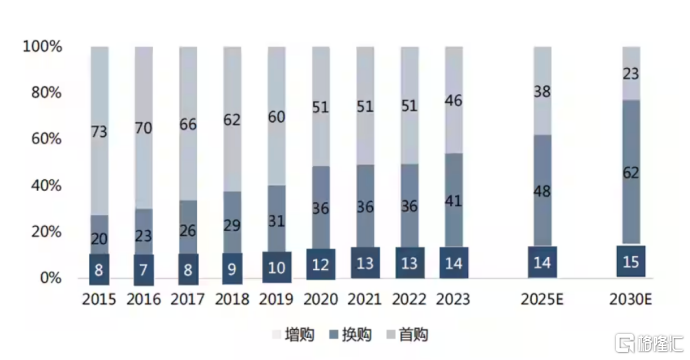
Core Viewpoint - The domestic automotive market in 2024 is characterized by "differentiation," with the new energy vehicle (NEV) sector showing a dual differentiation in sales and profits, highlighting the importance of identifying long-term players amidst rapid market changes [1] Group 1: Company Performance - Zeekr Technology reported Q1 2025 total revenue of 22 billion yuan, with vehicle sales revenue of 19.1 billion yuan, a year-on-year increase of 16.1% [1] - The gross margin for vehicle sales reached 16.5%, up by 3.4 percentage points year-on-year, while the comprehensive gross margin hit a historical high of 19.1% [1] - Zeekr Technology achieved a profit of 510 million yuan in Q1, marking three consecutive quarters of profitability [1] Group 2: Market Positioning - Zeekr and Lynk & Co have clear brand positioning, with Zeekr focusing on the luxury market above 300,000 yuan and Lynk & Co targeting the high-end market above 200,000 yuan [2] - The sales volume for Zeekr Technology reached 114,011 units in Q1, with April sales at 41,316 units, reflecting a year-on-year growth of 18.7% [2] - The product matrix includes models like Zeekr 001, 009, 007GT, and Lynk & Co 900, which have significant market influence [2] Group 3: Consumer Trends - The future of the automotive market is expected to see a shift towards replacement purchases, with an estimated 80% of car buyers opting for upgrades by 2030 [4] - The Z generation, comprising 250 million people with a consumption scale of 5.97 trillion yuan, is emerging as a key demographic for the NEV market [4] - The Zeekr 007GT is positioned as a luxury tech vehicle for young consumers, addressing diverse needs such as personal enjoyment and family travel [4] Group 4: Technological Innovation - Zeekr Technology is enhancing its competitive edge through technological advancements, including the "Qianli Haohan" intelligent driving solution and the integration of the Thor chip in new models [7] - The company is addressing consumer concerns about range anxiety with the "Shen Dun Jin Zhuang" battery technology, which will undergo further upgrades this year [7][8] - Zeekr is also improving charging efficiency and building an ecological charging network to enhance user experience [8] Group 5: Global Expansion - Zeekr has established a positive reputation in emerging markets such as Hong Kong, Macau, and Southeast Asia, while Lynk & Co has been successful in the European market [8] - The integration of resources between Zeekr and Lynk & Co is expected to enhance product offerings in terms of quality, technology, and cost [8] - The current era presents both opportunities and challenges for the NEV industry, with a focus on companies that can achieve sustainable growth through scale, technology, and ecosystem [8]
对话禾赛科技CEO李一帆:禾赛没有一天选择过代工
2 1 Shi Ji Jing Ji Bao Dao· 2025-05-16 12:49
Group 1 - The trend of intelligent driving is leading to more advanced features being integrated into lower-priced vehicles, with safety becoming a critical focus [1] - The "LiDAR" technology is now available in vehicles priced around 120,000 yuan, exemplified by the Leapmotor B10, which utilizes Hesai's ATX [1] - Hesai Technology launched the "Thousand Eyes" perception solution for L2 to L4 level intelligent driving, offering three different combinations tailored for mainstream L2 level auxiliary driving systems [1] Group 2 - Hesai also introduced a series of automotive-grade LiDAR products, including ETX ultra-long-range LiDAR, AT1440 ultra-high-definition LiDAR, and FTX pure solid-state blind-spot LiDAR [1] - Hesai is recognized as the leading player in the domestic LiDAR industry, with major clients including Li Auto, Xiaomi Auto, and BYD, with Li Auto equipping all its models with Hesai's LiDAR this year [1] - On the international front, Hesai announced a significant long-term exclusive partnership with a top European OEM, marking the largest order in the overseas front-end production LiDAR sector to date [2]
从蔚来到新势力,图达通拓展量产版图
Jing Ji Guan Cha Bao· 2025-05-16 11:37
Group 1 - NIO officially launched the new ES6 and EC6 models on May 16, 2025, with reservations now open, and plans to release the new ET5 and ET5T models by the 25th [2] - The 2025 NIO "5566" series models have significant improvements in cabin experience and intelligent driving chip technology, with over 60% of NIO's total sales in 2024 coming from this series [2] - The new models are equipped with the TUTDONG Falcon series LiDAR, utilizing 1550nm wavelength technology, which offers a detection range of 500 meters and high-precision point cloud imaging, enhancing the luxury and accessibility of NIO's intelligent driving experience [2] Group 2 - TUTDONG has achieved a breakthrough in market expansion by securing a targeted order from another domestic new energy vehicle company, which focuses on the economic market segment priced between 100,000 to 200,000 yuan [2] - The order will utilize TUTDONG's Robin series products based on the 905nm technology platform, which has already been mass-produced in NIO's flagship ET9 model [3] - TUTDONG has established a clear "dual-track" strategic layout, with 1550nm technology targeting the high-end market and 905nm technology entering the broader economic vehicle sector, allowing for a competitive advantage in both segments [3]