
人民币国际化

Search documents
刘勇:香港开闸稳定币,投资者需警惕风险
和讯· 2025-09-28 08:31
Core Insights - Hong Kong is actively embracing the emerging financial landscape of stablecoins, with the first batch of stablecoin issuer license applications closing on September 30, 2025, and expected to be issued by early 2026, positioning Hong Kong to capture a share of the over $250 billion stablecoin market [3][7] - The opening of the stablecoin market in Hong Kong aims to attract global issuing institutions, enhance international financial competitiveness, and explore new pathways for the internationalization of the Renminbi [3][4] - The U.S. stablecoin market is experiencing significant developments, with Tether planning to sell a 3% stake for approximately $20 billion, potentially raising its valuation to $500 billion, and the introduction of a U.S. regulated dollar stablecoin [3][4] Summary by Sections Hong Kong Stablecoin Market - The first batch of stablecoin issuer licenses is expected to be issued in early 2026, with 77 institutions expressing interest or entering sandbox testing as of the end of August 2025 [7] - The implementation of the stablecoin regulation in Hong Kong provides a clear legal framework and regulatory guidance, enhancing investor protection and attracting global stablecoin issuers [7][8] U.S. Stablecoin Developments - The global stablecoin annual transaction volume surpassed $25 trillion by August 2025, exceeding the total transactions of Visa and Mastercard combined [4] - The U.S. government is actively promoting stablecoin development, partly due to increasing debt pressures, with the "Genius Act" signed into law to establish a federal "strategic Bitcoin reserve" and "national digital asset reserve" [5][4] Financial Implications and Risks - Stablecoins are viewed as a tool to alleviate U.S. debt pressure, with predictions that if the dollar stablecoin market reaches $2 trillion, it could become a significant buyer of U.S. Treasury bonds [5] - Concerns exist regarding the potential for stablecoins to disrupt the existing U.S. dollar-dominated international payment system and the challenges they pose to the internationalization of the Renminbi [5][11] Regulatory and Market Reactions - The market has seen significant price increases in stocks related to stablecoins, driven by clearer regulatory policies and the potential for blockchain technology to enhance cross-border payment efficiency [8] - Caution is advised regarding the speculative nature of stablecoins, as many investors may lack the necessary knowledge to assess the true value and risks associated with these assets [8][12] Recommendations for Stablecoin Development - The book "Stablecoins: Reshaping the Global Financial Order" suggests a gradual approach to developing offshore Renminbi stablecoins, starting with Hong Kong and expanding to free trade zones [6][11] - The need for a cautious approach to stablecoin implementation is emphasized, with a focus on pilot programs and risk management to prevent financial instability and fraud [6][10]


美联储降息对A股市场的影响|一财号每周思想荟(第37期)
Sou Hu Cai Jing· 2025-09-28 07:08
Group 1: Holiday Consumption Trends - The "Golden Week" during the National Day holiday is expected to see a significant increase in travel, with a projected 130% year-on-year growth in the number of travelers compared to last year [1] - The strong start signals that this year's holiday could be a major driver for domestic demand and consumer spending [1] - Policies encouraging paid leave and flexible holiday arrangements are anticipated to alleviate the pressure of concentrated travel during peak periods, promoting a more balanced distribution of consumption over time [1] Group 2: Policy and Market Dynamics - Current policy direction focuses on creating new consumption scenarios rather than just short-term stimulus measures like distributing consumption vouchers [2] - The optimization of holiday arrangements at the national level has provided institutional support for holiday economies, enhancing flexibility and rationality in planning travel [2] - The integration of various sectors such as culture, sports, and health into the holiday economy reflects a shift from traditional tourism and shopping to a more comprehensive consumption ecosystem [2] Group 3: Marketing Strategies - Recent marketing failures highlight a shift from traffic-driven strategies to value-driven approaches, emphasizing the importance of genuine brand value over superficial attention [3] - The need for brands to engage in two-way communication with consumers is critical, moving away from one-sided messaging to fostering dialogue and empathy [3] - Long-term brand value construction is essential, as short-term profit motives have led to significant backlash in recent marketing campaigns [3] Group 4: Financial Market Implications - The anticipated interest rate cuts by the Federal Reserve are expected to accelerate foreign capital inflow into the A-share market, enhancing the attractiveness of RMB assets [5] - The rate cuts will provide the Chinese central bank with more operational space for monetary policy, potentially leading to more proactive measures to boost investor confidence [5] - A recovery in external demand could support export growth, contributing to a moderate economic recovery in the fourth quarter and providing a solid foundation for the A-share market [5] Group 5: Digital Currency and Internationalization - The establishment of a digital RMB international operation center is expected to significantly enhance the internationalization of the RMB by improving cross-border payment efficiency and reducing transaction costs [6] - This center aims to create a new pathway for RMB internationalization, transitioning from trade settlement and financial investment to a model that prioritizes payment facilitation [6] - The initiative is also expected to increase the acceptability of the RMB in international markets, further promoting its use [6]
境外投资机构积极“试水”债券回购 资产流动性管理“再添利器”
Jing Ji Guan Cha Wang· 2025-09-28 06:25
Core Viewpoint - The recent announcement by the People's Bank of China, the China Securities Regulatory Commission, and the State Administration of Foreign Exchange to support foreign institutional investors in bond repurchase operations is expected to enhance the liquidity management of RMB-denominated bonds and promote the internationalization of the RMB [2][3]. Group 1: Impact on Foreign Institutional Investors - The opening of bond repurchase operations to foreign institutional investors will better meet their liquidity management needs and enhance the attractiveness of RMB bonds internationally [2][3]. - Foreign investors, such as multi-strategy funds, have expressed a strong demand for liquidity management in RMB bonds, which will be facilitated by the new repurchase operations [3]. - The new policy addresses three major pain points previously faced by foreign investors when raising funds through bond sales: instability in investment strategies, increased transaction costs, and heightened investment risks [4][5]. Group 2: Operational Details and Concerns - Foreign institutional investors are particularly interested in the operational details of bond repurchase, including the transferability of underlying bonds and compliance with international practices [6]. - The bond repurchase business will initially allow for buyout-style repurchases, with plans to introduce pledge-style repurchases in the future, addressing differences in operational practices between China and international markets [6][7]. - Concerns regarding the delivery versus payment (DVP) settlement mechanism and the adequacy of repurchase limits to meet liquidity management needs have been raised by foreign investors [7]. Group 3: Regulatory Framework and Future Prospects - The repurchase limit for sovereign institutions and RMB clearing banks is set at 100% of their bond holdings, while other foreign investors will have an initial limit of 80%, with potential adjustments in the future [7]. - The central bank is also promoting the acceptance of domestic bonds as eligible collateral in Hong Kong and global markets, further enhancing the operational space for RMB bonds as liquidity management tools [8].
美元疲软成定局?人民币破7.1背后的国际博弈
Xin Hua Cai Jing· 2025-09-28 05:48
2025年三季度,伴随美联储降息及美国经济降温,美元指数承受下行压力,这为人民币带来被动升值动 能。此外,国内股市保持强势,外资加速流入,这在带动结汇需求增加的同时,也在改善汇市情绪。接 下来,"稳中有升""双向波动"仍将是人民币汇率走势的主基调。 统计数据显示,截至发稿,三季度人民币对美元中间价累计上涨434个基点报7.1152,涨幅为0.6%;在 岸人民币兑美元上涨311个基点报7.1345,涨逾0.43%;离岸人民币兑美元上涨139个基点报7.1435,涨 幅约0.19%。 多重因素支撑走强 未来仍将以稳为主 今年以来,外汇形势复杂多变,风险挑战明显增加。上半年,人民币兑美元汇率呈现先跌后涨走势;进 入8月下旬,人民币汇率出现较大幅度升值,临近九月底,涨幅有所收窄。 9月17日,人民币兑美元汇率创下去年11月以来新高,在岸人民币兑美元盘中升破7.11关口,离岸人民 币兑美元盘中一度涨破7.09关口。9月18日凌晨,美联储完成年内首次降息,美元指数先跌后涨,升幅 较为有限;人民币兑美元汇率保持小幅升值,一度实现"三价合一"。 中信证券首席经济学家明明表示,8月下旬,在美元指数偏弱运行创造了相对温和的外部环 ...
【财经分析】美元疲软成定局?人民币破7.1背后的国际博弈
Xin Hua Cai Jing· 2025-09-28 03:15
Group 1 - The core viewpoint of the articles indicates that the RMB is experiencing upward pressure due to multiple factors, including the Federal Reserve's interest rate cuts and a cooling U.S. economy, which has led to a passive appreciation of the RMB [1][2][3] - As of the third quarter, the RMB against the USD has shown a cumulative increase of 434 basis points, with a rise of 0.6% in the middle rate, 311 basis points in the onshore rate, and 139 basis points in the offshore rate [1][2] - The RMB's appreciation is supported by a favorable external environment, strong domestic equity market performance, and increased foreign capital inflow, which has improved market sentiment [2][3] Group 2 - The future outlook suggests that the RMB will maintain a stable trajectory, with "steady growth" and "two-way fluctuations" being the main themes of its exchange rate movement [1][4] - Factors contributing to the RMB's strength include the Fed's interest rate cuts, ongoing U.S.-China trade negotiations, and China's proactive measures against external economic pressures [3][4] - The attractiveness of RMB assets is increasing, driven by the Fed's easing cycle, which is expected to channel funds into non-U.S. markets, particularly emerging markets and high-yield assets [6][7] Group 3 - The internationalization of the RMB is progressing, with significant developments in cross-border payment infrastructure and digital currency initiatives, marking a new phase in its global monetary role [7][8] - The RMB's position as the sixth most active currency in global payments, with a share of 2.93%, reflects its stable development in the international payment system [8] - The ongoing geopolitical economic risks are creating a strategic opportunity for the RMB's internationalization, as the trend of dollar dominance is expected to face long-term pressure [8][9]
自贸区离岸债券市场发展探析
Xin Lang Cai Jing· 2025-09-28 01:26
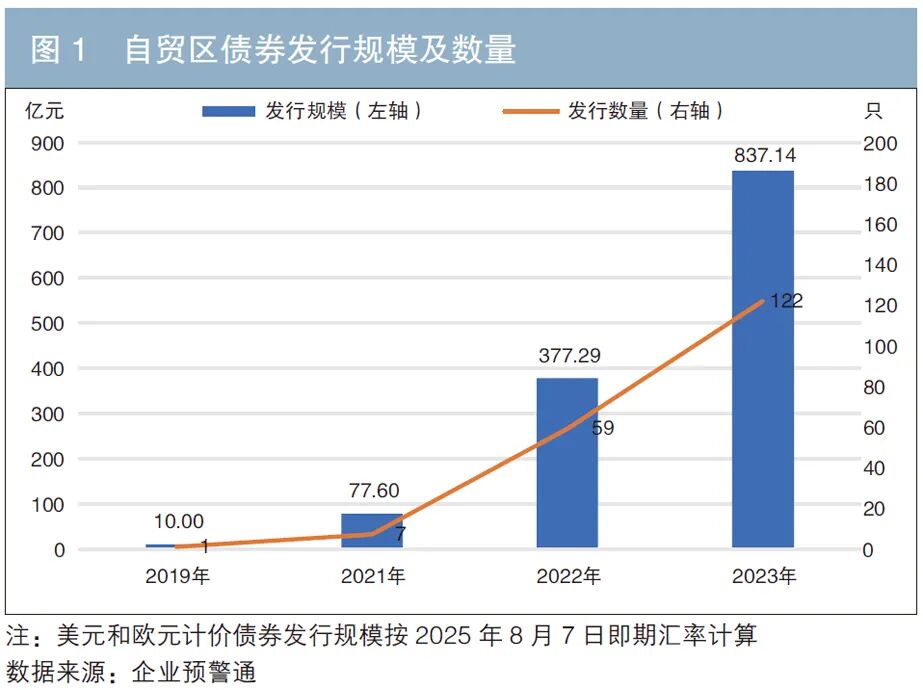
Core Viewpoint - The development of Free Trade Zone (FTZ) bonds in China has evolved since the establishment of the Shanghai Free Trade Zone in 2013, highlighting the need for diversified issuers and a robust credit rating system to promote high-quality growth in the FTZ bond market [1][2][3] Development Stages - The FTZ bond market can be categorized into several stages: 1. **Incubation Period (Sep 2013 - Apr 2016)**: Establishment of the Shanghai FTZ and initial policy support for cross-border financing [4] 2. **Exploration Period (May 2016 - Oct 2019)**: Implementation of guidelines for bond registration and issuance, leading to the first FTZ bond issuance [4] 3. **Development Period (Nov 2019 - Jun 2023)**: Rapid growth in bond issuance, particularly by local state-owned enterprises, reaching a peak in 2022 [5] 4. **Adjustment Period (Jul 2023 - Present)**: Regulatory tightening and a slowdown in bond issuance, with only one bond issued in 2023 [5][6] Market Characteristics - **Increasing Market Size**: The issuance scale of FTZ bonds grew from 1 billion RMB in 2019 to 83.714 billion RMB in 2023, driven by favorable financing conditions compared to offshore dollar bonds [7] - **High Concentration of Issuers**: The majority of FTZ bonds (180 out of 189) were issued by domestic entities, with local government financing vehicles being the primary issuers [9] - **Investor Composition**: The market is predominantly supported by domestic banks, with the RMB being the most active currency for transactions [12] - **Interest Rates**: FTZ bonds typically have slightly higher interest rates than domestic bonds, influenced by investor structure and issuance methods [13] Recommendations for Market Development - **Diversification of Issuers**: Encourage a wider range of issuers beyond state-owned enterprises and support sectors like technology and green development [17] - **Enhancement of Credit Rating Systems**: Improve the credit rating framework to boost investor confidence and attract international capital [18] - **Development of Secondary Market**: Establish a dedicated electronic trading platform for FTZ bonds to enhance liquidity and market efficiency [19] - **Regulatory Framework Improvement**: Strengthen legal and regulatory frameworks to clarify rights and obligations, ensuring market integrity and investor protection [20][21]
地缘经济论 | 第十一章 地缘经济新形势下的国际货币体系演变
中金点睛· 2025-09-28 01:03
Core Viewpoint - The evolution of currency forms is driven by both private and state influences, with current trends indicating a shift from a dollar-dominated international monetary system towards a multipolar framework, emphasizing the importance of real economic competitiveness and technological innovation over mere capital account openness [2][3][19]. Group 1: Evolution of Currency Forms - Currency can be understood through two dimensions: commodity money vs. credit money, and private money vs. state money [4][5]. - The historical transition from commodity money to credit money reflects the need for efficient payment systems, with modern banking systems evolving into public-private partnerships supported by government credit [4][6]. - Recent developments in digital currencies highlight the competition between state-backed central bank digital currencies (CBDCs) and private cryptocurrencies, with the latter often seen as extensions of existing monetary systems [5][6][8]. Group 2: Trends in International Monetary System - The international monetary system has been significantly influenced by globalization and financialization, but recent geopolitical tensions and financial crises have accelerated trends of de-globalization and de-financialization [3][19][21]. - The shift towards bilateral and limited multilateral trade cooperation indicates a decline in the relative importance of financial assets compared to real assets, which may have profound implications for the international monetary system and the internationalization of the renminbi [19][20][24]. Group 3: Digital Currency Dynamics - Platform currencies, such as WeChat Pay and Alipay, leverage network effects to gain systemic importance, disrupting traditional banking models and creating new payment channels [9][10]. - Central bank digital currencies (CBDCs) can either serve as cash substitutes or as interest-bearing assets, with their impact on the financial system largely dependent on whether they pay interest [11][14]. - Stablecoins, which are pegged to high liquidity assets like the US dollar, operate similarly to narrow banking models, emphasizing the need for high-quality reserves to maintain stability [15][18]. Group 4: US Cryptocurrency Strategy - The US faces challenges in maintaining the dollar's status as the world's primary reserve currency amid rising concerns over its long-term creditworthiness [34][36]. - The US government's strategy to utilize stablecoins as a means to reinforce dollarization reflects an attempt to monetize fiscal deficits while expanding the demand for US Treasury securities [35][40]. - However, the effectiveness of this strategy may be hindered by competition from other currencies and the inherent vulnerabilities of stablecoins, which are subject to market dynamics and regulatory scrutiny [42][43]. Group 5: Future of the International Monetary System - The international monetary system is likely to evolve towards a multipolar structure, with the renminbi's internationalization being driven by real economic strength and technological advancements rather than solely by capital account liberalization [2][19][52]. - The geopolitical landscape and economic policies will play crucial roles in shaping the future dynamics of global currency competition and cooperation [24][52].

美损失越来越惨重,为何?瑞士向我国运黄金,沙特开始向我国借钱
Sou Hu Cai Jing· 2025-09-27 15:03
先说说美国自己的问题吧。特朗普上台后推的那些关税政策,本来想护着本土产业,结果适得其反。高关税一加,贸易伙伴们不乐意了,进口成本涨,通胀 压力大增,高盛直接把2025年美国经济衰退概率从20%调到35%。 关税平均率预期从10%拉到15%,这不光打压了出口,还让美元在国际支付里的份额缩水。2025年1月和2月,美元跨境支付占比分别掉到50.17%和48.95%, 贸易融资里虽还有81%,但也开始松动。 巴黎银行的货币策略主管彼得·瓦萨直言,美元指数今年开局这么弱,是80年代中期以来头一遭。说白了,美国贸易赤字和财政赤字双双爆表,债务占 GDP125%,谁还敢放心大胆地买美债? 各国央行这几年动作可不小,尤其是减持美债这事儿。拿中国来说,2025年减持力度明显加大。从1月到7月,持仓量从年初的8000多亿美金一路往下走,7 月单月甩掉257亿,持仓只剩7307亿,这是2009年2月以来最低点。 整个上半年,中国减持为主,3月掉189亿,4月82亿,5月也减了点,2月虽增了235亿,但整体趋势是往下。 不是中国一个人这么干,日本和英国7月还增持了点,但法国也跟着减,全球抛售潮让美债收益率曲线陡峭起来,美国融资成本 ...
刘世锦:中国资本市场增量资金来源,或已发生转折性变化
Zheng Quan Shi Bao Wang· 2025-09-27 08:07
Group 1 - The core viewpoint is that the source of incremental funds for China's capital market has undergone a transformative change, driven by the accumulation of significant social net wealth and low bank savings rates, leading to a shift towards capital market investments [1][8] - Liu Shijun emphasizes that the current economic challenges are primarily due to insufficient consumption rather than investment, highlighting a structural deviation in consumption patterns compared to international averages [2][3] - The need for structural reforms in three key areas is identified to effectively expand consumption, focusing on housing for new citizens, pension system reforms, and facilitating the flow of production factors between urban and rural areas [6][5] Group 2 - The capital market is expected to enter a new development phase, with a focus on nurturing large, globally competitive technology firms and a multitude of innovative small and medium enterprises [8] - Liu Shijun suggests that the capital market can enhance resource utilization efficiency, increase investors' income, and support pension expenditures in an aging society, thereby promoting consumption through wealth effects [8] - The recommendation includes implementing a balanced import-export strategy to enhance the international status of the RMB, shifting from a reliance on dollar reserves to increasing the use of RMB in global trade [8]
委内瑞拉黄金拒归还引连锁反应!中国银行频频出手,打造亚洲托管新格局
Sou Hu Cai Jing· 2025-09-27 07:58
彼时,美元作为全球储备货币的垄断地位持续数十年,靠的是美国强势的金融系统与印钞机背书。长期 依赖意味着长期脆弱:一旦政治关系紧张,资产被"非市场化"处置的可能就变为现实。自去年开始,许 多国家央行加快了买黄金的节奏,因为黄金不同于美元国债,不能轻易凭一纸令下被没收,它是全球公 认的硬通货,是对抗金融武器化的天然盾牌。 在这种气氛中,一条看似技术性的消息具有象征意义。九月,外媒报道称中国央行正通过上海黄金交易 所与友好国家商谈,邀请它们将黄金储备存放在中国的保税仓库,而且据说已经有东南亚国家表现出了 兴趣。托管地点的转移,不只是物流安排,它背后指向"信任"的迁徙。把黄金放谁那,就等于把命脉塞 谁兜里——托管方的选择,其实是地缘政治与金融安全的投票。 定价权与钥匙的去与留 过去西方掌握了全球的黄金定价与托管体系:伦敦金库与纽约联储是黄金储备的集中地,伦敦的"良好 交割"标准与欧美的跨境清算网络相互嵌套,构成了一个难以撼动的惯性结构。许多国家甚至习惯了把 黄金留在海外,既便于交易,又兼顾声誉。可一旦托管与政治绑定,托管变成"寄存",金虽在账上,钥 匙却不在手里。 相比之下,中国提出"你们可以放我这",发行的是另一张 ...
