即时零售

Search documents
“北京印象”花束正式亮相 美团闪购联合全国花艺师创作发布
Bei Jing Shang Bao· 2025-07-24 15:46
Group 1 - The event "Beijing Impression" bouquet launch aims to promote a new green consumption concept and lead trends in floral consumption by integrating traditional aesthetics with modern vitality [1][2] - The "Beijing Impression" bouquet brand was created through a nationwide collection of 225 floral designs inspired by Beijing's historical culture and modern features, resulting in the selection of 6 unique bouquets [1] - The event supports the high-quality development of the floral industry and contributes to the construction of a garden city in Beijing [1] Group 2 - Meituan Flash Purchase reported an annual flower transaction volume exceeding 10 billion yuan, with over 200,000 flower shops operating on the platform and more than 150 million consumers purchasing flowers [2] - The platform collaborates with cultural institutions like the Summer Palace and the Palace Museum to support talented floral artists and designers, integrating traditional Chinese aesthetics into modern orders [2] - The launch of the "Beijing Impression" bouquet represents a new exploration in the cultural innovation and development of the floral industry through instant retail [2]

【西街观察】外卖大战不玩“0元购”玩什么
Bei Jing Shang Bao· 2025-07-24 14:53
Core Viewpoint - The competition in the food delivery industry is evolving from a price war to a more sustainable model that emphasizes technology, supply chain capabilities, and user experience rather than solely relying on subsidies and discounts [1][2][4]. Group 1: Regulatory Environment - Following discussions with the State Administration for Market Regulation, local market regulators are urging food delivery platforms to rectify their practices, particularly targeting chaotic price wars, such as the complete removal of "0 yuan purchase" promotions in Shanghai [1]. - The shift in focus from aggressive subsidies to more reasonable pricing strategies is necessary for the industry's long-term health [2]. Group 2: Competitive Strategies - The competition is expected to transition towards a systematic approach that integrates technology, supply chain efficiency, delivery effectiveness, and enhanced user experience [2]. - Platforms are encouraged to utilize data and AI to create differentiated subsidy strategies that consider the operational costs and capabilities of various merchants [2]. Group 3: Innovations and New Models - New initiatives like Meituan's "Raccoon Canteen" and JD's "Seven Fresh Kitchen" are emerging, leveraging their supply chain resources to connect high-quality dining brands with consumers, thus ensuring quality in food delivery [3]. - The industry is witnessing a resurgence in competition, with a focus on innovative solutions rather than just price reductions, as the market for instant retail in China expands [4].
外卖“三国杀”:补贴烽火下的流量暗战与行业变局
Bei Ke Cai Jing· 2025-07-24 12:39
Core Viewpoint - The regulatory authorities are taking measures to curb "involution" competition among food delivery platforms, promoting a healthier and more orderly industry development [2][35]. Group 1: Regulatory Actions - On July 22, the Zhengzhou Market Supervision Administration held administrative talks with Ele.me, Meituan, and JD.com, prohibiting "involution" competition and encouraging rational participation in competition [2]. - The State Administration for Market Regulation (SAMR) previously held talks with the same three platforms, requiring them to further standardize promotional behaviors [2][4]. - SAMR has exposed typical cases of "involution" competition in the quality sector and will continue to innovate regulatory methods and strengthen the publicity of results [2][35]. Group 2: Market Competition Dynamics - The food delivery market has seen a resurgence of competition, with JD.com launching a "quality delivery" initiative, breaking the long-standing duopoly of Meituan and Ele.me [3][4]. - From May to July, the number of instant retail orders surged from 100 million to 250 million, primarily driven by non-food categories and lower-tier markets [4][16]. - The competition has intensified with Meituan and Alibaba launching aggressive promotional campaigns, including "0 yuan purchase" and "25 yuan off 11 yuan" offers [3][4]. Group 3: Impact on Businesses - Many merchants are experiencing a significant increase in order volume, with some stores reporting daily orders exceeding 600 [8][24]. - However, the increase in orders has led to a decline in in-store purchases, with merchants expressing concerns about the sustainability of this business model [22][24]. - Merchants are now utilizing multiple platforms to maximize order volume, as the competition has made it less about choosing between Meituan and Ele.me [25][39]. Group 4: Future Market Trends - The competition is evolving into a "three-way battle" among Meituan, Alibaba, and JD.com, with potential entrants like Douyin and Pinduoduo eyeing the market [39]. - The subsidy strategies are shifting from "burning money for users" to "subsidies to leverage ecosystems," indicating a more strategic approach to competition [39]. - The market share dynamics are changing, with Meituan's share decreasing from 80% to 60%, while Alibaba and JD.com are increasing their shares to 30% and 10%, respectively [40].


超20万家花店“闪购卖花”,美团闪购发布产业链优化升级方案
Zhong Guo Jin Rong Xin Xi Wang· 2025-07-24 11:58
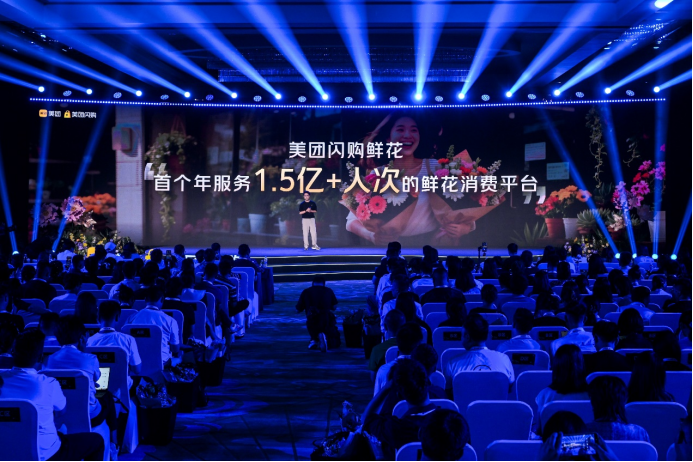
Core Insights - Over 150 million consumers have purchased flowers through Meituan's instant retail platform, making it the preferred online flower shopping platform [1][3] - The flower industry faces challenges such as operational volatility, strong uncertainty, price competition, and supply-demand mismatches [3][4] - Meituan's instant retail has become the first online flower consumption platform with an annual consumption scale exceeding 10 billion yuan [3][4] Group 1: Industry Challenges and Opportunities - The flower economy symbolizes love and beauty, emerging as a new highlight in consumer spending and a medium for spreading floral culture [3] - Meituan is exploring deeper into the industry chain to address pain points and support industry prosperity [3][4] - The company has launched a comprehensive optimization plan aimed at enhancing product diversity, optimizing the industry ecosystem, and supporting merchant operations [3][4] Group 2: Product Diversity and Pricing Strategy - One major reason for price competition is the insufficient diversity of flower products, which fails to stimulate new consumer demand [4] - Meituan aims to increase product diversity by leveraging big data to identify trends and design higher-quality bouquets, resulting in an increase in the variety of flower materials from fewer than 5 to over 50 [4][5] - Despite a downward trend in flower material prices, Meituan's average transaction price for flowers has risen, allowing merchants to escape price competition and achieve higher returns [4][5] Group 3: Technological and Operational Enhancements - Meituan has introduced a forecasting tool for transaction scale during promotional events, achieving over 98% accuracy to help merchants manage inventory and pricing [5] - The company has initiated a supply chain service optimization pilot, reducing flower material costs by over 20% and providing quality assurance for merchants [5][6] - AI tools such as image recognition and AI shopping assistants have been implemented to enhance operational accuracy and efficiency for merchants [5][6] Group 4: Merchant Support and Growth - Meituan is committed to providing more opportunities for efficient, high-quality flower shops, including features like "pre-delivery photo" and compensation for discrepancies [6] - The proportion of flower orders with pre-delivery photos has exceeded 80%, enhancing the purchasing experience for consumers [6] - The number of flower shops achieving over 1 million yuan in annual transactions has doubled to over 2,000 compared to two years ago [6]
0元奶茶终结后,外卖大战还会怎么打?
3 6 Ke· 2025-07-24 09:20
Core Viewpoint - The intense competition in the food delivery market has attracted regulatory scrutiny, with major platforms like Meituan, JD, and Ele.me being warned against "selling below cost" as they engage in aggressive subsidy wars to capture market share [1][2][9] Group 1: Unsustainable Consumption Battle - The food delivery war is primarily driven by subsidies, which have led to a situation where high delivery order volumes do not translate into profits for merchants, creating a "loss-leader" scenario [1][2] - Merchants face overwhelming demand, with some reporting order volumes exceeding their operational capacity, leading to significant pressure on resources and costs [1][2] - The reliance on external platforms for delivery has resulted in a dual standard for food quality, where in-store dining uses fresh ingredients while delivery orders may use cheaper, pre-prepared options [2][11] Group 2: Market Dynamics and Future Directions - The competition has shifted focus from sheer order volume to the quality and sustainability of growth, with industry leaders recognizing the pitfalls of irrational competition [9][10] - Meituan has established a significant market share advantage, with a ratio of approximately 7:2:1 against Ele.me and JD in the food delivery sector [12] - JD is contemplating the future role of its food delivery service, considering whether to separate it from its main platform to enhance quality perception [15][17] Group 3: Supply Chain and Quality Wars - As the subsidy wars cool down, a new focus on quality and supply chain management is emerging, with JD emphasizing self-operated models and direct sourcing to ensure quality control [20][22] - Meituan's strategy revolves around platform aggregation, enhancing food safety and delivery efficiency through better management of delivery personnel [22][25] - The competition is not just about food delivery but also about positioning in the broader local service and retail market, with "instant retail" seen as a key growth driver [22][26]
被“搁置”的盒马,出路在哪儿?
3 6 Ke· 2025-07-24 05:14
Core Insights - Hema, as a pioneer of Alibaba's new retail strategy, initially showed strong momentum in business innovation but struggled to achieve profitability before the departure of its founder, Hou Yi [1][2] - After the leadership change to Yan Xiaolei, Hema shifted its focus to profitability by closing most stores and concentrating on Hema Fresh, leading to a significant turnaround with adjusted EBITA turning positive for the first time in FY2025 [2][5] - Hema's sales reached 75 billion yuan, surpassing Yonghui's 73.2 billion yuan, positioning it as the third-largest supermarket in China [2][5] Business Strategy - Hema's initial strategy involved a multi-format approach with up to 12 different business models, including Hema Fresh and Hema X membership stores, but this led to high costs and unclear business models [4][5] - The high-end positioning of Hema X membership stores conflicted with the company's low-price rapid expansion strategy, resulting in a limited number of openings and eventual discounting measures [3][4] - The company has now adopted a dual strategy focusing on high-end market penetration and down-market expansion through Hema Fresh and Hema NB community stores [5][8] Market Position and Competition - Hema's growth comes amid a decline in traditional supermarkets, with a reported 28.6% drop in average foot traffic for large supermarkets since 2019, while community supermarkets and convenience stores have seen growth [5][8] - Hema plans to open 100 new Hema Fresh stores by 2025, targeting first and second-tier cities, and aims to expand its Hema NB stores to over 1,000 locations [8][9] - The company is leveraging its supply chain advantages, with over 60% of Hema NB's products being private label, although this has resulted in lower profit margins compared to Hema Fresh [9][10] Future Outlook - Hema's future hinges on its ability to integrate into Alibaba's instant retail ecosystem, as the company has not yet fully aligned with Alibaba's strategic focus on instant retail [6][7] - The competitive landscape is intensifying, with major players like Alibaba, JD, and Meituan focusing on instant retail, which poses challenges for Hema's growth strategy [5][6] - Hema's current business model aims to balance profitability in the high-end market while aggressively expanding in the lower-end market, creating a complete commercial loop [9][10]
延边电商这十年→勇闯跨境“新蓝海”
Sou Hu Cai Jing· 2025-07-24 04:53
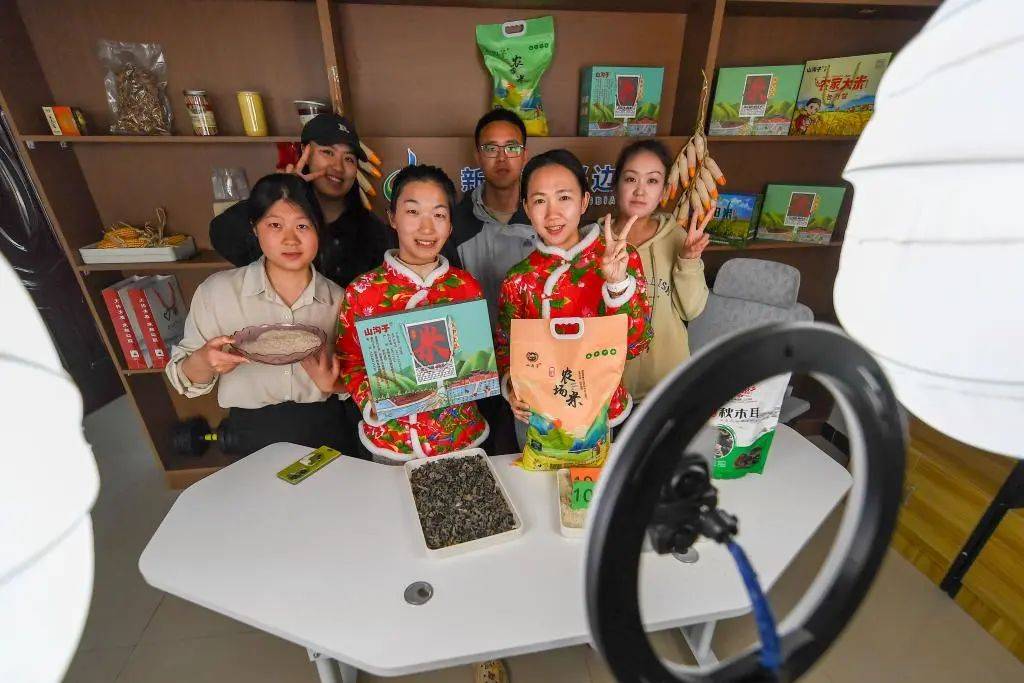
Core Insights - The article highlights the significant growth and transformation of the e-commerce sector in Yanbian over the past decade, driven by local entrepreneurs and the integration of traditional products into online platforms [1][9]. E-commerce Development - Yanbian's e-commerce has evolved from selling local specialties like pickled vegetables to a broader market, achieving a network retail sales figure of 18.85 billion yuan in 2024, marking a 16% year-on-year increase and ranking third in the province [1]. - The region has created 137 e-commerce demonstration projects with a total funding of 160 million yuan, achieving full coverage of national e-commerce rural demonstration counties [4]. Integration with Traditional Industries - E-commerce serves as a catalyst for the integration of primary, secondary, and tertiary industries, with Yanbian collaborating with major platforms like Taobao and Douyin to enhance business synergies [5]. - The rise of live-streaming e-commerce has been pivotal, with initiatives leading to 790,000 orders and 290 million likes during promotional events [7]. Cross-Border E-commerce - Yanbian is leveraging its geographical advantages with 12 border ports, accounting for 90% of the province's cargo volume, to develop a cross-border e-commerce ecosystem [8][9]. - The region has established a cross-border e-commerce comprehensive pilot zone, with trade volume reaching 4.36 billion yuan in the first half of the year, reflecting a 60.4% increase [9]. Future Outlook - The future of Yanbian's e-commerce is focused on deepening collaborations with various platforms and exploring new avenues such as live-streaming, cross-border e-commerce, and instant retail, aiming to promote local flavors nationwide and globally [9].
全渠道数据复盘:2025上半年消费市场底层变化与增长变量
3 6 Ke· 2025-07-24 04:02
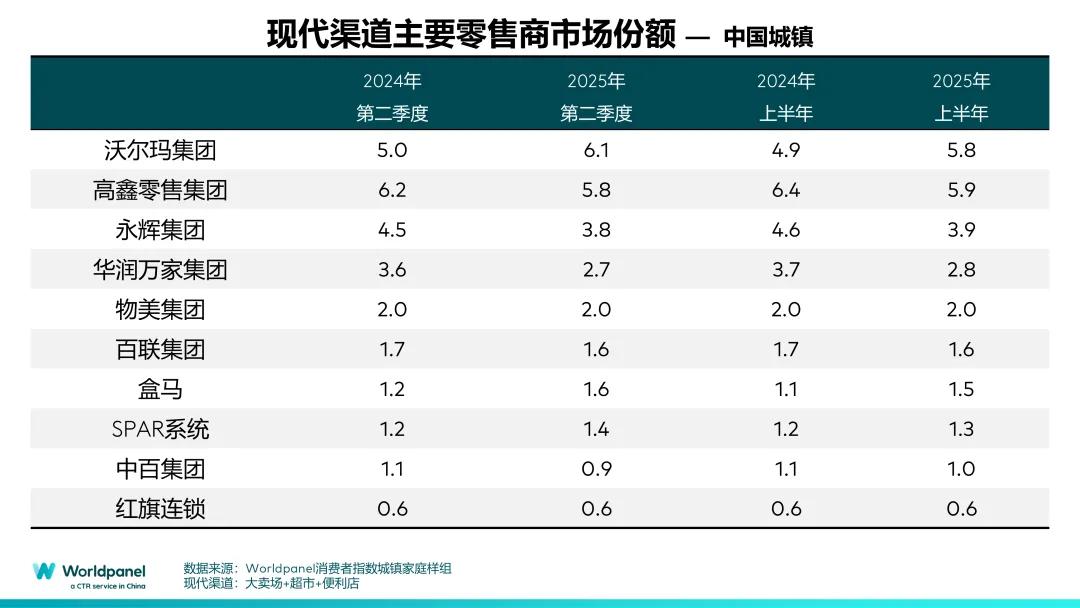
Group 1: Market Overview - The consumer goods market in urban China is expected to grow by 2.5% year-on-year in the first half of 2025, indicating a stable upward trend [1] - Beverage sales remain the main driver of the fast-moving consumer goods market, with a year-on-year growth of 5.6%, particularly in juice and functional drinks [1] - The retail sales of consumer goods increased by 5.0% year-on-year in the first half of this year, with final consumption expenditure contributing over 50% [1] Group 2: Out-of-Home Consumption - The out-of-home consumption market saw a year-on-year increase of 8.7% in customer traffic across cities [2] - The demand for emotional value, social needs, and entertainment experiences is driving the rapid adoption of new scenarios and technologies [2] Group 3: Offline Channels - Convenience store sales decreased by 3.6% year-on-year, while small supermarkets grew by 7.3%, indicating a stable performance in modern channels [3] - Major retailers showed a mixed performance, with Walmart leading in the second quarter, while the top ten retailers' market share declined by 1.1 percentage points [4][7] Group 4: Membership Stores - Membership stores have seen a year-on-year penetration rate increase of 3.6%, with Sam's Club showing significant growth in the East and South regions [8] - Sam's Club plans to open its largest store in Beijing by the end of 2025, aiming to attract customers with a "shopping + micro-vacation" model [8] Group 5: Discount Retail - Discount retailers are exploring new formats, with a focus on leisure food stores achieving a penetration rate exceeding 25% [10] - Traditional supermarkets are accelerating their transformation into hard discount formats, with regional players like "小百惠" and "家家悦" showing rapid growth [11] Group 6: Online Channels - E-commerce sales grew by 6.9% year-on-year in the first half of 2025, with Douyin's penetration rate increasing by 5.6 percentage points [12] - The 618 shopping festival saw a 2.9 percentage point increase in online channel penetration, with Douyin performing particularly well [14] Group 7: Conclusion - The fast-moving consumer goods market is experiencing a mild recovery, with consumers being price-sensitive while also valuing experiential and quality aspects [15] - The integration of online and offline channels is reshaping the consumer landscape, with a focus on product value, experiential value, and brand differentiation [16]
消费时评丨告别“低价” 让即时零售回归品质和服务初心
Xiao Fei Ri Bao Wang· 2025-07-24 03:17
Core Viewpoint - The Chinese Chain Operation Association has issued a proposal to regulate the instant retail market, urging platform companies to stop using covert methods to force merchants into price subsidies, and for merchants to avoid short-sighted behaviors like price competition and subsidy-driven traffic acquisition [1][2] Group 1: Market Dynamics - The "subsidy war" has become a norm in the instant retail industry, leading to a distorted competitive landscape where platforms leverage their monopolistic positions to coerce merchants into subsidies [1][2] - Merchants, while appearing to participate voluntarily, are actually trapped in a situation where "no subsidy means no traffic," undermining market fairness [1][2] - The imbalance in profit distribution, where platforms impose excessive subsidy burdens on merchants, poses a serious threat to the healthy development of the market [1] Group 2: Impact on Merchants and Consumers - Merchants engaging in the "subsidy frenzy" may experience short-term traffic boosts, but this ultimately compromises their investment in core capabilities like R&D, quality control, and service [2] - Consumers may seem to benefit from the "subsidy war," but they face hidden costs such as poor service quality and delayed deliveries as merchants cut corners to survive [2] - The reliance on subsidies dulls consumers' perception of the true value of products and services, leading to a market where quality is compromised [2] Group 3: Recommendations for Industry Health - To break the "low-price" deadlock and restore a healthy ecosystem, there needs to be a consensus on compliance and self-regulation among platforms, eliminating unfair practices like "traffic coercion" and respecting merchants' autonomy and profit margins [2][3] - Quality and service should be the foundation of instant retail, with a shift in focus towards enhancing product freshness, precise response to special needs, and strengthening trust in after-sales service [3] - The industry must move away from unsustainable subsidies towards a model based on compliance, quality, and innovation, which will enable sustainable development and market vitality [3]
零售商集体“练内功”,从商品“卷”到前置仓
第一财经· 2025-07-24 01:25
Core Viewpoint - Retailers are transitioning into a phase of internal improvement after facing challenges such as store expansion, e-commerce competition, and high costs in the first half of 2025. Companies like Yonghui Supermarket and Bubugao are undergoing significant store adjustments and upgrades [1][4]. Group 1: Learning and Store Adjustments - The success of Pando's operations has inspired other retailers to adopt similar practices, with companies like Bubugao and Yonghui Supermarket making substantial store adjustments. Yonghui has opened its 100th store modeled after Pando, indicating a trend towards adopting successful regional retail strategies [4][5]. - The retail industry is witnessing a surge in learning from successful membership store models like Sam's Club and Costco, with traditional retailers focusing on product development and consumer-oriented service strategies [4][5]. Group 2: Performance and Financial Impact - Bubugao's half-year performance forecast indicates a net profit of 180 million to 220 million yuan, a year-on-year increase of 331.18% to 382.55%, attributed to restructuring and operational efficiency improvements [5]. - In contrast, Yonghui Supermarket anticipates a net loss of 240 million yuan for the first half of 2025 due to ongoing strategic transformations and store adjustments, including the closure of 227 underperforming stores [6]. Group 3: Supply Chain Competition - The retail landscape is evolving with new formats such as membership and discount stores, leading to intensified competition focused on high-quality, cost-effective products. The supply chain battle has become particularly pronounced in the first half of 2025 [8][9]. - Companies like Lianhua and Zhongbai are launching discount stores, while Sam's Club and Dailongfa are expanding their membership offerings, emphasizing the importance of unique products and competitive pricing [9][10]. - Speed in delivery is becoming a critical factor, with retailers aiming to enhance their logistics capabilities to meet consumer demands for faster service, transitioning from next-day delivery to half-hour delivery [10][11].