
品牌化

Search documents
趋势研判!2025年中国茧丝被行业分类、产业链、市场规模、细分格局、竞争格局及行业发展趋势分析:市场规模增长,高质量消费步伐加快[图]
Chan Ye Xin Xi Wang· 2025-07-18 01:39
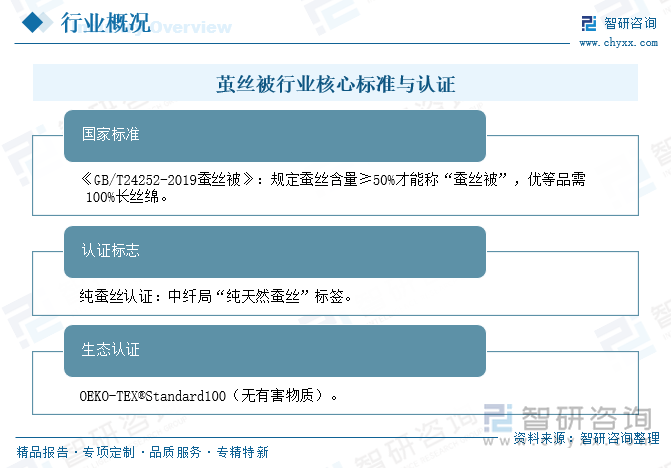
Core Insights - The silk quilt industry in China is experiencing significant growth, with the market size expected to reach approximately 26 billion yuan in 2024 and 28.5 billion yuan in 2025, driven by rising consumer spending and demand for high-quality bedding products [1][6][8] - There is a notable shift towards mid-to-high-end silk quilts, with 50% of consumers opting for antibacterial and anti-mite features in 2024, an increase of 10 percentage points from 2022 [8] - The industry is moving towards standardization and branding, supported by government policies and technological advancements, which will enhance market diversity and expand overseas markets [15] Industry Overview - The silk quilt is defined as a quilt filled with silk made from silkworm cocoons, typically encased in cotton, silk, or blended fabrics, known for its lightweight, warmth, moisture absorption, and skin-friendly properties [2][4] - The core industry standard for silk quilts is the national standard GB/T24252-2019, with certifications for "pure natural silk" and OEKO-TEX® Standard 100 for ecological safety [2] Market Dynamics - The silk quilt market is characterized by a concentration of market share among well-known brands, with leading manufacturers benefiting from brand recognition and comprehensive sales channels [12] - Major companies in the industry include Mercury Home Textiles, Fuanna, and Boyang Home Textiles, which are recognized for their product technology, high R&D investment, and strong quality control [12][14] Competitive Landscape - The silk quilt industry is a traditional and significant sector in China, with a competitive landscape dominated by established brands that leverage their market position and technological capabilities [12] - The industry is categorized into three tiers based on brand strength and market presence, with top-tier companies focusing on technology upgrades and international branding to enhance global competitiveness [12] Future Trends - The silk quilt industry is expected to continue evolving with ongoing policy support and technological upgrades, leading to further standardization and branding efforts [15] - The market is anticipated to diversify, with an emphasis on expanding into international markets as domestic economic recovery progresses [15]


国货美妆“出海”火爆 品牌化、科技化、高性价比成大势
Guang Zhou Ri Bao· 2025-07-11 10:02
Core Insights - The beauty industry is a rapidly growing segment in cross-border e-commerce, with significant opportunities for Chinese beauty brands to expand globally [1] Group 1: Market Trends - The global beauty and personal care market is projected to reach $677.19 billion by 2025 and exceed $799.07 billion by 2030, with oral care, beauty devices, and bathing products being the top three segments [1] - The demand for home beauty devices is expected to grow explosively after 2023, indicating a "blue ocean" market for brands focusing on technology and performance [2] Group 2: Brand Strategies - JOVS, a personal care brand, has successfully entered 35 countries since its launch in 2018, emphasizing the importance of a strong supply chain and high-performance products [2] - Yangbo Trading Co., a leader in the nail care industry, maintains over 20% annual revenue growth by understanding customer needs and leveraging social media for marketing [3] Group 3: Localization Efforts - Companies are increasingly focusing on localization to meet the specific demands of different markets, including product preferences and language requirements [4] - Effective localization strategies involve understanding local customer preferences and deploying localized marketing teams to enhance brand presence [4] Group 4: Market Opportunities - The U.S. beauty and personal care market is expected to reach $85.44 billion by 2029, with significant growth also anticipated in the UK, Germany, and Japan [5] - High-growth beauty categories on Amazon include anti-aging devices and multifunctional styling tools in North America, and eco-friendly bathing tools in Europe [5]
2025箱包品类选品参考报告
Sou Hu Cai Jing· 2025-07-09 04:46
Core Insights - The report highlights the explosive growth of the bag category on the Shopee platform, driven by brand influence and consumer preference for quality and brand recognition [1][6]. Women's Bag Market - The tote bag segment is a significant growth driver, with a year-on-year GMV increase of 15%-20%, reflecting modern women's demand for large-capacity, multifunctional bags [2]. - Brand performance in women's bags is notably strong, with tote and crossbody bags seeing brand GMV growth exceeding 60%, while clutches and wallets also show substantial brand growth of 50%-60% and 30%-40%, respectively [2][12]. - The overall market for clutches, wallets, and backpacks is growing slowly, in the range of 0%-5%, indicating a stabilization in demand for these categories [2]. Men's Bag Market - The men's bag market is characterized by a functional orientation, with backpacks leading the growth at 15%-20%, followed by waist & chest bags and laptop bags at 10%-15% [3]. - Brand performance in men's bags is impressive, with laptop bags showing a brand growth rate of 40%-50%, and backpacks at 30%-40%, indicating a shift towards brand preference among male consumers [4][16]. Travel Bags and Related Categories - The recovery of the global travel market has spurred growth in travel bags and accessories, with overall GMV growth of 15%-20% [5]. - Brand travel bags are experiencing exceptional growth, with luggage brand GMV increasing by 70%-80% and travel accessories by 30%-40%, significantly outpacing the overall market [5][20]. Market Trends - The overall trend in the bag market is moving towards "branding and segmentation," with consumers increasingly valuing functionality, design, and brand value [6]. - The women's bag market emphasizes a balance of aesthetics and practicality, while the men's market focuses on functionality and quality, and the travel segment prioritizes professional design and user experience [6].


一位厂二代无班可接之后
投中网· 2025-07-09 02:12
Core Viewpoint - The article highlights the transformation of the manufacturing industry in Yiwu, focusing on the journey of a young entrepreneur, Zhang Xiaojie, who has successfully navigated the challenges of a saturated market by innovating product designs and understanding consumer needs [4][5][10]. Group 1: Entrepreneurial Journey - Zhang Xiaojie, born in 1996, is a second-generation factory owner who has achieved sales of 200 million through innovative product offerings [4][6]. - He faced the challenge of "no class to inherit" as his father's factory struggled in a highly competitive market, prompting him to carve out a new path [5][12]. - The article illustrates Zhang's approach to entrepreneurship, which involves continuous market research and consumer feedback to drive product innovation [7][8]. Group 2: Product Innovation - Zhang's products, such as a redesigned ice bucket and microwave heating cover, are based on consumer insights and address common pain points [6][8]. - The article details the iterative process of product development, from initial concept to market launch, which typically takes about three months [7][8]. - Zhang's success is attributed to his ability to identify gaps in the market and create unique products that stand out from competitors [10][21]. Group 3: Market Dynamics - The Yiwu manufacturing landscape has shifted from low-cost, high-volume production to a focus on quality, design, and brand differentiation [21][23]. - Zhang's strategy includes setting higher price points for his products to maintain healthy profit margins, contrasting with the traditional low-cost competition [21][22]. - The article notes that many second-generation factory owners face similar challenges and opportunities, indicating a broader trend of transformation within the industry [23]. Group 4: Industry Trends - The article emphasizes the importance of adapting to new consumer behaviors and market channels, as seen in Zhang's approach to e-commerce and social media [9][23]. - It highlights the shift in Yiwu's manufacturing from generic products to personalized and branded offerings, reflecting a significant industry evolution [21][23]. - The narrative suggests that the future of manufacturing in Yiwu lies in innovation and the ability to respond to changing consumer demands [23].

中餐离世界级品牌还有多远
Jing Ji Ri Bao· 2025-07-09 00:08
Group 1 - The core viewpoint of the articles highlights the rapid expansion of Chinese restaurant brands overseas, with a significant increase in the number of Chinese restaurants globally, reaching nearly 300,000 from 2019 to 2024 [1] - The motivation for this expansion is driven by the potential of the international market, which offers new opportunities compared to the highly competitive domestic market [1] - Current trends show that Chinese restaurants are moving towards branding and chain development, aiming to break the cycle of having many types of cuisine without strong brand recognition [1] Group 2 - Challenges faced by Chinese brands in international expansion include supply chain issues, localization, and standardization, which are critical for successful overseas operations [2] - The process of adapting to local markets is essential for survival, as demonstrated by Panda Express, which modified traditional dishes to cater to American tastes while maintaining a balance between authenticity and localization [3] - The ultimate goal of Chinese cuisine's international expansion is to serve as a cultural ambassador, conveying Chinese values and lifestyle through food, thus enhancing global influence and recognition [3]
“海南鲜品”出海记:热带水果的全球“鲜”行之路
Zhong Guo Xin Wen Wang· 2025-07-07 10:04
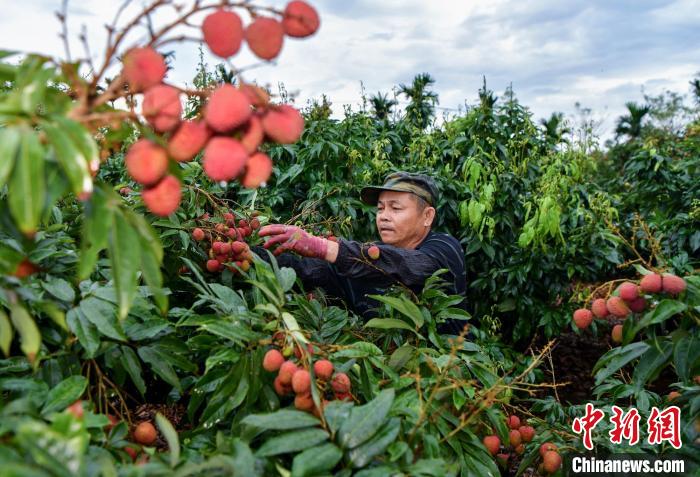
Core Insights - The article highlights the rapid growth and international expansion of Hainan's tropical fruits, particularly lychee, mango, and melon, under the influence of the Hainan Free Trade Port initiative [1][9]. Group 1: Market Performance - In the first five months of this year, Haikou Customs inspected 696 batches of fruits with a total value of 110 million yuan, marking a year-on-year increase of 134.3% and 75.39% respectively [1]. - Hainan's early-maturing lychee has gained a competitive edge in both domestic and international markets, with its price trends serving as a barometer for China's lychee pricing [3][4]. Group 2: Quality and Production - Hainan's unique climate conditions, including long sunlight hours and abundant rainfall, contribute to the superior quality of its tropical fruits, such as the Guifei mango and lychee [3]. - The average yield of lychee in Hainan is over 3,000 pounds per acre, which is approximately 33% higher than that of ordinary orchards, due to advanced agricultural practices [4]. Group 3: Export and Pricing - Hainan lychee has received positive feedback from European and Middle Eastern customers, with retail prices reaching 40 euros per kilogram, significantly exceeding expectations [5]. - The successful export of Sanya wax apple to Canada has established it as a regular export item, with plans to expand into Southeast Asia, the Middle East, and Europe [7]. Group 4: Brand Development - The "Hainan Fresh Products" brand, established in September 2022, is becoming a key vehicle for Hainan's tropical fruits to enter global markets, with various companies collaborating to enhance brand visibility and market reach [9]. - Innovative products, such as mango ice cream developed by Hainan Xi Yuan Agriculture, are being introduced to diversify the product matrix under the "Hainan Fresh Products" brand [9].
一位厂二代无班可接之后
Hu Xiu· 2025-07-07 05:35
Core Viewpoint - The article highlights the transformation of the manufacturing industry in Yiwu, focusing on the entrepreneurial journey of a young factory owner, Zhang Xiaojie, who has successfully navigated the challenges of a highly competitive market by innovating and adapting to consumer needs [2][38]. Group 1: Industry Overview - Yiwu is characterized by a dense presence of advertisements and a vibrant small commodity market, reflecting the city's practical and efficient business culture [2][4]. - The manufacturing sector in Yiwu has evolved from traditional, low-margin production to a focus on innovation, quality, and branding, moving away from price competition [38][39]. - The article discusses the historical context of Yiwu's manufacturing boom, noting that the city once had over 26,000 industrial enterprises, dominating various product categories in China [18][20]. Group 2: Zhang Xiaojie's Entrepreneurial Journey - Zhang Xiaojie, a second-generation factory owner, faced the challenge of reviving his family's business in a saturated market, where traditional low-cost production was no longer viable [15][19]. - He has achieved significant sales, reaching 200 million yuan, by identifying consumer pain points and innovating product designs, such as a new ice mold and microwave cover [7][12][28]. - Zhang's approach includes leveraging social media and consumer feedback to inform product development, demonstrating a shift towards a more consumer-centric business model [8][9][11]. Group 3: Market Dynamics and Competition - The article illustrates how Zhang and other entrepreneurs have carved out niche markets by avoiding direct competition and focusing on unique product features and consumer needs [14][38]. - The competitive landscape has shifted, with new entrants adopting innovative strategies to differentiate themselves, as seen with other entrepreneurs like Jin Xindong, who transformed traditional products into unique offerings [13][35]. - Zhang's experience reflects a broader trend in Yiwu, where manufacturers are increasingly prioritizing design and branding to maintain profitability in a challenging market [39][40].

当“九省通衢”遇上跨境电商,武汉的产业带升级战
Sou Hu Cai Jing· 2025-06-30 13:56
Core Insights - The cross-border e-commerce landscape is shifting from Shenzhen to Wuhan, with many companies relocating to Wuhan due to its robust industrial ecosystem, talent pool, and policy support [2][14] - Companies like Pan Sheng Technology, Huagong Guanghe, and NIIMBOT are leveraging unique strategies to thrive in the competitive market, focusing on customization, innovation, and user feedback [4][5][6] Group 1: Industry Trends - Wuhan is emerging as a new hub for cross-border e-commerce, with local companies rapidly growing and diversifying their product offerings [2][15] - The presence of major platforms like Amazon is crucial for these companies, providing access to a vast customer base and facilitating global market entry [14][16] Group 2: Company Strategies - Pan Sheng Technology has carved out a niche in the customized PC market, achieving a 93.9% compound monthly growth rate on Amazon's US site in Q1 [2][4] - Huagong Guanghe is innovating by adapting industrial laser equipment for home use, targeting the DIY market in Europe and the US [5][9] - NIIMBOT has expanded its global footprint through Amazon, achieving annual revenue exceeding 100 million yuan with a growth rate between 36% and 100% [8][9] Group 3: User-Centric Approaches - Companies emphasize the importance of user feedback in product development, with strategies in place to quickly iterate based on customer insights [10][11] - Pan Sheng Technology utilizes a CRM system to understand customer needs, leading to tailored products for different markets [11][12] - De Xun Electronics has established a user data center to enhance product design and responsiveness to customer complaints [10][12] Group 4: Talent and Infrastructure - Wuhan's educational resources, with over 130,000 students in relevant fields, are vital for sustaining the growth of cross-border e-commerce [15][16] - The city's logistics capabilities, including a dual-hub airport and extensive international freight routes, significantly reduce shipping costs for e-commerce businesses [15][16]


“现代营销学之父”菲利普·科特勒:新时代的营销要牢记这10点
3 6 Ke· 2025-06-30 03:41
Group 1 - The world is undergoing rapid changes, leading to the decline of some old companies and the emergence of new ones. Companies must adapt to these changes to avoid crises [1] - Marketing is crucial for economic growth, as a strong marketing industry directly influences the speed of economic growth and determines which products and services succeed in the market [4] - Marketing operates in two ways: companies can freely decide on pricing and sales methods, or the government can set basic rules to guide marketing decisions [5] Group 2 - Marketing is essential for business growth, as many companies know how to produce products but struggle with marketing them effectively [6] - The marketing mix should expand from the traditional 4Ps (Product, Price, Place, Promotion) to 7 elements, including Service, Incentives, Communication, Distribution, and Brand [7] - Companies must undergo digital transformation and focus on serving a broader range of stakeholders, including customers, employees, suppliers, and communities [8] Group 3 - Companies should have dedicated roles for customer management, product management, and brand management, requiring both professional skills and entrepreneurial spirit [10] - Collaboration between the Chief Financial Officer (CFO) and Chief Marketing Officer (CMO) is vital for addressing marketing funding issues [11] - Brands hold significant value and must evolve with market changes, emphasizing the importance of brand identity and consumer perception [12][15] Group 4 - Successful brands, like Starbucks, focus on providing unique customer experiences and differentiating themselves from competitors [13][14] - Branding is essential across various products and services, with the concept of brand being applicable even to basic items like fruits and water [14] - Effective marketing should prioritize human-to-human (H2H) interactions, emphasizing emotional connections over purely transactional relationships [16][17]

粤东小镇小豆腐要做成大产业,非遗工艺如何“种豆得豆”
Di Yi Cai Jing· 2025-06-25 09:59
Core Viewpoint - The traditional production model of Chitian tofu in Heyuan City, Guangdong, primarily relies on small workshops, which limits the industry's potential for growth and standardization [1][2]. Group 1: Industry Overview - Chitian tofu, a type of salt-brine tofu, is a traditional Hakka product from Chitian Town, Heyuan City, and has been included in the fifth batch of intangible cultural heritage listings in the city [1]. - The production of Chitian tofu is dominated by approximately 50 to 60 small workshops, producing around 80,000 to 100,000 pieces of tofu daily [1][2]. Group 2: Challenges and Opportunities - The main challenge facing the Chitian tofu industry is the lack of standardized production processes, which restricts capacity and prevents the full realization of brand value [1][3]. - The local government is actively seeking investment from food companies in Shenzhen and Guangzhou to modernize and scale the tofu production industry [2]. Group 3: Raw Material Supply - The availability of high-quality local green soybeans is a significant constraint, as local production is limited, leading to reliance on cheaper, more abundant soybeans from Northeast China [2][3]. - As of the third quarter of 2024, Heyuan City's soybean production was reported at 4,344 tons, reflecting a 7.0% increase, but the fragmentation of farmland remains a challenge for scaling up soybean cultivation [3]. Group 4: Future Development Directions - The local government aims to establish a large-scale soybean planting base, which will extend beyond Chitian Town to surrounding areas, to support the Chitian tofu industry [3]. - There is a need to diversify the product offerings beyond the current focus on steamed tofu, with potential for developing products like tofu skin and ready-to-eat meals [3][4].