
存款搬家

Search documents
宏观点评:“天量”居民存款到期,影响几何?-20260120
GOLDEN SUN SECURITIES· 2026-01-20 08:32
Group 1: Macroeconomic Overview - The maturity scale of long-term deposits for residents and enterprises in 2026 is estimated at CNY 58.3 trillion, an increase of CNY 5.6 trillion compared to 2025[1] - Among this, the maturity scale for the resident sector is CNY 37.9 trillion, up CNY 4.3 trillion from 2025, marking the highest level in five years[3] - In 2026, 54% of the total deposits will mature in the first quarter, with over 60% of resident deposits maturing in the same period[5] Group 2: Impact on Banking Sector - The re-pricing of maturing deposits is expected to reduce banks' liability costs by approximately CNY 550 billion, leading to a 31 basis point decrease in interest rates paid by banks[6] - However, the potential "deposit migration" could disrupt the stability of banks' liabilities, necessitating close monitoring of the reallocation of deposits[6] Group 3: Asset Market Implications - The large-scale maturity of deposits is likely to bring incremental funds to the equity market, potentially benefiting the stock market, especially during the first quarter[7] - The impact on the bond market remains uncertain, as the actual allocation of funds will depend on the speed of credit decline and the relative speed of deposit outflows[8]
金改前沿丨超50万亿定期存款将到期,谁将承接这“泼天的财富”?
Xin Hua Cai Jing· 2026-01-20 05:32
Group 1 - The core viewpoint of the article is that a significant wave of residential time deposit maturities is expected in 2026, with estimates suggesting the amount could exceed 50 trillion yuan, leading to discussions on where this capital will flow [1][2][3] - Various research institutions have projected the scale of maturing deposits in 2026, with estimates ranging from 50 trillion yuan to as high as 75 trillion yuan, indicating a consensus on the impending large-scale maturity of time deposits [2][3] - The continuous decline in deposit interest rates contrasts sharply with the upcoming maturity peak, with some banks offering one-year deposit rates below 1%, leading to a structural shift towards shorter-term deposits [2][3] Group 2 - The decline in deposit attractiveness is prompting discussions on potential outflows from the banking system, with expectations that a significant portion of maturing deposits will be reallocated to wealth management products, insurance, and funds [3][4] - Insurance products, particularly participating insurance, are gaining popularity as they offer a combination of guaranteed and floating returns, with a current guaranteed return rate of approximately 1.75% [4] - There is also a trend of early mortgage repayments as a potential destination for funds, given the current interest rate environment where mortgage rates are higher than deposit rates [5]
多省公布数据!浙江人均存款超17万,广东12万仅为全国均值,河北定期存款占比超80%,今年数十万亿存款到期利好A股?
Jin Rong Jie· 2026-01-20 04:47
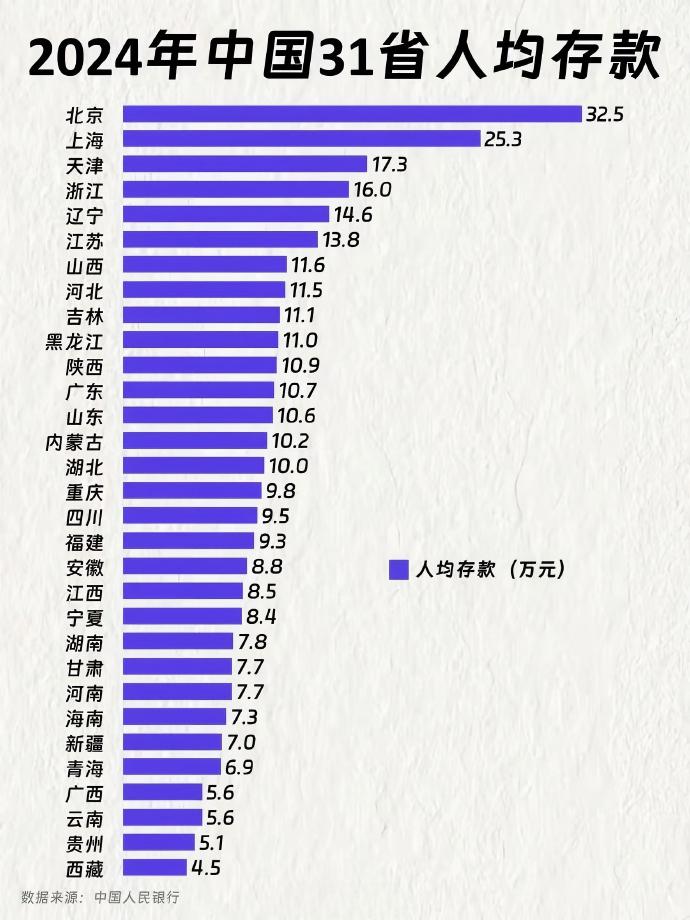
Group 1 - The core viewpoint of the articles highlights the significant increase in household savings across several provinces in China, with a notable trend towards higher savings rates and a preference for fixed-term deposits over loans [1][2][4]. - As of the end of 2025, household deposits in Guangdong reached 15.12 trillion yuan, growing by 9.34% year-on-year, while Zhejiang's household deposits increased to 11.85 trillion yuan, with a growth rate of nearly 10% [2][4]. - The average household savings per capita in Zhejiang is projected to be 17.77 million yuan, significantly higher than Guangdong's 11.83 million yuan, indicating a disparity in savings behavior among provinces [4][5]. Group 2 - The overall household deposit balance in China reached 167 trillion yuan by the end of 2025, reflecting a year-on-year growth of 9.71%, with a per capita savings estimate of 118,900 yuan [4][5]. - The trend of "deposit migration" is being discussed in the context of potential capital market investments, as a large amount of fixed-term deposits are set to mature in 2026, although most deposits are expected to remain in the banking system due to stable risk preferences [6][8]. - The stock market has seen a bullish trend, with the Shanghai Composite Index reaching a 10-year high, driven by increased trading volumes and investor interest, particularly from high-income groups [6][8].

2026开年洞察:全球资产重估与政策博弈下的投资新坐标
Sou Hu Cai Jing· 2026-01-20 04:06
Macro Changes - The market's rise at the beginning of 2026 is fundamentally a continuation of the global "easing consensus" from 2025, but three marginal changes are disrupting this trend [3] - The U.S. political cycle is intensifying the clash with monetary policy, as Trump pressures the Federal Reserve to lower interest rates, leading to heightened market expectations for a rate cut [3][7] - The expansion of "shadow banking" in the U.S. has shifted from a hidden concern to a significant variable, with money market funds and private credit rapidly growing, which could amplify liquidity and asset bubbles [4] Policy Dynamics - The Federal Reserve faces three constraints: persistent inflation, political pressure, and the balance between shrinking and expanding its balance sheet [7] - The European Central Bank and other global central banks are signaling potential policy shifts in response to U.S. monetary policy changes, indicating a global interconnectedness in policy decisions [8] Asset Implications - U.S. Treasury yields may steepen if rate cuts occur, but long-term rates could remain suppressed due to fiscal deficits [9] - The U.S. stock market is supported by liquidity expectations, but shadow banking could increase volatility through retail leverage [9] - Gold prices are expected to rise due to declining real interest rates and increased demand for safe-haven assets [9] Investment Shifts - China's "deposit migration" reflects a shift in asset allocation from risk-free to risk-return matching, impacting A-shares, Hong Kong stocks, and the bond market [11] - A-shares are transitioning from "stock game" to "incremental drive," with significant capital moving into equity markets, benefiting high-dividend and growth sectors [11] - Hong Kong stocks are experiencing dual elasticity, attracting both domestic and foreign investments due to improving fundamentals and lower financing costs [12] Conclusion - The global market in 2026 represents a struggle between normalized policy interventions and spontaneous market dynamics, with shadow banking and deposit migration indicating a new era for emerging market assets [13] - Investors should focus on policy-sensitive assets, growth-oriented investments, and safe-haven assets to navigate the evolving landscape [13]


险资增量或打破传统“红利低波”框架,成长性红利α属性逐步凸显
Sou Hu Cai Jing· 2026-01-20 01:34
在"存款搬家"的宏观趋势下,保险负债端正经历着显著的资金涌入,长江证券预计,2026年保险资金将为资本市场带来超1.2万亿元的增量资 金。 兴业证券指出,未来成长性红利的α属性将逐步凸显:在"保险新准则"+"公募新规"的新环境下,部分资金除了保证最低收益率外还有跑赢基准 的需求,所以需同时考量红利股用于支撑未来估值的业绩增速。 因此,这些资金对"业绩增长+预期股息回报"的要求,从过去两年的"0+5"(即对业绩成长没有要求,但有最低的股息率要求)转变至如今 的"3+3",意味着降息环境下资金对红利股的成长性也有所要求(不能大幅跑输成长股),同时也给予成长性红利股一定的风险溢价,对其目 标股息率有所降低。 8.78% 7.16% 28.18% Dil 2 方式 F 300收益 中证红利全收益 红利低波(全) 会收益 数据来源: Wind,截至2026.1.16 中证红利质量全收益指数基日以来表现 589% 489% 389% 289% 189% 89% -11% 2016-05-26 2018-10-23 2021-03-22 2023-08-17 2026-01-16 2013-12-31 中证红利质量全收益 ...

A股趋势与风格定量观察20260118:信贷与资金面改善,维持震荡偏强观点-20260118
CMS· 2026-01-18 14:36
Quantitative Models and Construction Methods 1. Model Name: Deposit Migration Signal - **Model Construction Idea**: The model is designed to identify the phenomenon of "deposit migration," where household deposits decrease while non-bank deposits increase, using monthly deposit data[5][13][14] - **Model Construction Process**: 1. Calculate the proportion of newly added household deposits and non-bank deposits to total deposits for a given month: - $ \text{Household Deposit Share} = \frac{\text{Cumulative New Household Deposits (12 months)}}{\text{Cumulative New Total Deposits (12 months)}} $ - $ \text{Non-Bank Deposit Share} = \frac{\text{Cumulative New Non-Bank Deposits (12 months)}}{\text{Cumulative New Total Deposits (12 months)}} $ 2. Compare the current month's values with the average of the previous three months: - If the current month's value is greater than the average, it is considered "rising"; otherwise, it is "falling"[13][14] 3. Define the "deposit migration" signal as a scenario where the household deposit share decreases while the non-bank deposit share increases[14] 4. Evaluate the performance of the signal by analyzing the average return and win rate of the All-A Index one month after the signal is triggered[14][15] - **Model Evaluation**: The model effectively identifies periods of increased equity market activity driven by deposit migration, but its effectiveness may diminish when funds migrate to non-equity assets, such as bonds[14] 2. Model Name: Short-Term Timing Strategy - **Model Construction Idea**: This model integrates macroeconomic, valuation, sentiment, and liquidity indicators to generate weekly timing signals for the equity market[19][20] - **Model Construction Process**: 1. **Macroeconomic Indicators**: - Manufacturing PMI > 50 indicates economic expansion, providing a positive signal - Credit impulse and M1 growth rates are compared to historical percentiles to assess economic strength[19][22] 2. **Valuation Indicators**: - PE and PB ratios are compared to their historical percentiles; high percentiles indicate overvaluation, providing cautious signals[19][22] 3. **Sentiment Indicators**: - Beta dispersion, volume sentiment scores, and market volatility are analyzed to gauge market sentiment[20][22] 4. **Liquidity Indicators**: - Money market rates, exchange rate expectations, and leverage financing trends are used to assess liquidity conditions[20][22] 5. Combine the signals from the above indicators to generate an overall timing signal (optimistic, neutral, or cautious)[19][20] - **Model Evaluation**: The model demonstrates strong performance, with an annualized return of 16.65% and a maximum drawdown of 15.05%, significantly outperforming the benchmark strategy[21][24] 3. Model Name: Growth-Value Style Rotation Model - **Model Construction Idea**: This model identifies periods to overweight growth or value styles based on macroeconomic, valuation, and sentiment factors[28][29] - **Model Construction Process**: 1. **Macroeconomic Factors**: - Growth is favored when the earnings cycle slope is steep and the credit cycle is strengthening - Value is favored when the interest rate cycle is high[28][30] 2. **Valuation Factors**: - Growth is favored when the PE valuation gap is narrowing - Value is favored when the PB valuation gap is widening[28][30] 3. **Sentiment Factors**: - Growth is favored when turnover and volatility differences between growth and value are high[29][30] 4. Combine the signals from the above factors to determine the allocation between growth and value styles[28][30] - **Model Evaluation**: The model achieves an annualized return of 13.30% with a maximum drawdown of 43.07%, outperforming the benchmark strategy[29][31] 4. Model Name: Small-Cap vs. Large-Cap Rotation Model - **Model Construction Idea**: This model uses 11 effective rotation indicators to determine the relative attractiveness of small-cap and large-cap stocks[32] - **Model Construction Process**: 1. Key indicators include financing purchase balance changes, thematic investment sentiment, PB dispersion, and trading volume of small-cap indices[32][34] 2. Signals are aggregated to generate a composite rotation signal, which determines the allocation between small-cap and large-cap stocks[32][34] - **Model Evaluation**: The model consistently generates positive annual excess returns, with a 2026 year-to-date excess return of 2.88%[33][34] --- Model Backtesting Results 1. Deposit Migration Signal - Average return of All-A Index one month after signal: 1.72% - Win rate: 64.9% - Median return: 1.88%[15] 2. Short-Term Timing Strategy - Annualized return: 16.65% - Annualized volatility: 14.80% - Maximum drawdown: 15.05% - Sharpe ratio: 0.9802 - Monthly win rate: 66.46%[21][24] 3. Growth-Value Style Rotation Model - Annualized return: 13.30% - Annualized volatility: 20.76% - Maximum drawdown: 43.07% - Sharpe ratio: 0.6098 - Monthly win rate: 58.60%[29][31] 4. Small-Cap vs. Large-Cap Rotation Model - Annualized return: 20.60% (composite signal) - Annualized excess return: 12.95% - Maximum drawdown: 40.70% - Monthly win rate: 50.11%[34][36]

罕现“双零费率”,银行理财需高质量揽客
Zhong Guo Ji Jin Bao· 2026-01-18 12:35
Core Viewpoint - The banking wealth management market is experiencing a "fee reduction wave" with the rare occurrence of "double zero rates" for investment management and sales service fees, driven by factors such as "deposit migration" and the "New Year marketing push" [1][2]. Group 1: Fee Reduction Trends - The banking wealth management market has seen significant fee reductions, with examples including Ningyin Wealth Management offering zero sales service fees and eight products with zero floating management fees [2]. - Some products from China Zhongyuan Bank have also adjusted both investment management and sales service fees to 0.00% per year, sparking discussions in the industry despite the products being terminated shortly after [2]. - The fee reduction trend is attributed to the continuous decline in deposit rates, prompting banks to attract funds through more appealing wealth management products [2][3]. Group 2: Implications of Fee Reductions - Fee reductions can rapidly increase scale and market share for wealth management companies, but over-reliance on price competition may erode overall industry profits and weaken long-term research and innovation capabilities [3]. - The challenge lies in balancing customer satisfaction with the sustainable development of the company, as excessive focus on low fees could lead to "low fee, low efficiency" scenarios that harm brand reputation [3]. Group 3: Future Strategies for Wealth Management Companies - With limited further fee reduction space, wealth management companies are encouraged to optimize product structures and diversify fee mechanisms to enhance competitiveness [4]. - Companies should explore various types of wealth management products, such as "low volatility + stable return" themes and "fixed income +" enhanced products, while also considering flexible management fees based on holding periods [4]. - Leading wealth management firms are increasingly collaborating with local commercial banks to penetrate county and lower-tier markets, expanding customer reach and reducing acquisition costs [4]. Group 4: Importance of Research and Reputation - Continuous improvement in research capabilities is essential for wealth management companies to build a positive reputation and maintain scale in a competitive environment [5].
万亿存款搬家进行时:2026年的A股,慢牛正在成形
Xin Lang Cai Jing· 2026-01-18 12:18
Core Viewpoint - A significant shift in bank deposits is occurring, which may influence the A-share market in 2026, as investors seek new avenues for their funds due to declining deposit rates and changing market dynamics [2][3]. Group 1: Changes in Deposit Behavior - The scale of household deposits in China has exceeded 140 trillion yuan, reflecting a defensive posture amid uncertainty [2]. - From the second half of 2025 to 2026, deposit rates are expected to decline, leading to a reassessment of the long-term return advantages of equity assets [2][3]. Group 2: Market Dynamics and Investment Strategies - The movement of funds from bank deposits does not equate to a rush into stock trading; rather, it indicates a gradual, layered, and long-term capital flow [3]. - The consensus for the A-share market in 2026 is shifting towards a "slow bull" or "long bull" market, driven by changes in the funding structure, policy objectives, and declining risk-free rates [3][4]. - The new main sources of incremental capital are expected to be pension funds, insurance funds, and index funds, which will lead to a more stable market environment [3]. Group 3: Investment Opportunities - Three categories of investment opportunities are identified: 1. High dividend and stable cash flow assets such as banks, insurance, and utilities, which may attract low-risk preference funds [3]. 2. Core sectors aligned with long-term trends, including high-end manufacturing, AI infrastructure, semiconductors, and renewable energy, which present structural opportunities despite short-term volatility [4]. 3. Indexation and concentration in leading companies, with an emphasis on selecting the right industries and companies over speculative trading [5]. Group 4: Market Outlook - The transition of trillions in deposits is viewed as a long-term trend rather than a short-term market catalyst, suggesting a more gradual upward trajectory for the A-share market [5][6]. - The market is expected to avoid extreme volatility and instead follow a steady growth path, emphasizing asset allocation and long-term holding strategies [5][6].

非银存款同比少减2.84万亿元,券商分析师解读
券商中国· 2026-01-18 09:38
Core Viewpoint - The financial data for December 2025 indicates a decrease in non-bank deposits by 330 billion yuan, with a year-on-year reduction of 2.84 trillion yuan, raising market concerns about the implications for the stock market and financial institutions [1][2][3]. Group 1: Non-Bank Deposit Trends - Non-bank deposits decreased by 330 billion yuan in December, which is significantly lower than the average reduction of 532.7 billion yuan in 2022 and 2023, indicating a notable shift in market dynamics [2]. - Analysts attribute the high year-on-year reduction to a low base effect from December 2024, when non-bank deposits saw a historic drop of 3.17 trillion yuan due to regulatory changes [1][2]. - The overall non-bank deposit scale reached 34.5 trillion yuan by the end of December, accounting for 10.5% of total deposits, reflecting a slight decrease in proportion compared to previous years [2]. Group 2: Market Influences - The reduction in non-bank deposits is partly attributed to seasonal factors, such as the return of funds to deposits from off-balance-sheet products and the influence of a vibrant stock market [3][4]. - Analysts suggest that the capital market's performance, particularly the "924" market rally, has led to significant capital inflows, impacting the overall deposit landscape [3][5]. - The trend of "deposit migration" continues, but the pathways and timing of fund flows may become more complex due to varying asset return expectations and market conditions [3].

25年12月金融数据:存款搬家进行到哪一步了?
Ping An Securities· 2026-01-17 11:06
Group 1: Financial Data Overview - In December 2025, new social financing (社融) amounted to 22,075 billion RMB, a year-on-year decrease of 6,462 billion RMB, but higher than the market expectation of 18,200 billion RMB[2] - New RMB loans totaled 9,100 billion RMB, a year-on-year decrease of 800 billion RMB, exceeding market expectations by 2,306 billion RMB[2] - The overall social financing growth rate fell to 8.3%, down 0.2 percentage points from November's 8.5%[3] Group 2: Credit and Loan Trends - Corporate loans increased by 5,800 billion RMB year-on-year, with short-term loans up by 3,900 billion RMB and medium to long-term loans up by 2,900 billion RMB[4] - In contrast, household short-term loans decreased by 1,611 billion RMB and medium to long-term loans decreased by 2,900 billion RMB, indicating a slowdown in consumer spending[4] - The total amount of corporate medium to long-term loans in December was 3,300 billion RMB, close to levels seen in 2021 but lower than the 10,000 billion RMB levels of 2022-2023[4] Group 3: Deposit and Monetary Trends - M1 growth rate fell to 3.8%, down 1.1 percentage points, while M2 growth rate rose to 8.5%[5] - Non-bank deposits saw a significant increase of 28,400 billion RMB, while household deposits increased by 3,900 billion RMB[6] - The increase in non-bank deposits was influenced by a low base effect from the previous year and a rise in wealth management products, which grew by 21,000 billion RMB in December[6] Group 4: Market Implications and Strategies - The trend of "deposit migration" is accelerating, with indicators showing increased household deposit activity and a shift towards wealth management and insurance products[7] - The stock market showed signs of recovery in January 2026, with increased retail investor participation and a high level of margin financing[7] - The bond market is expected to maintain a volatile pattern, with potential for structural monetary policy adjustments and a focus on credit growth in the first quarter[9]