新旧动能转换

Search documents
工业硬核托举十万亿,山东“头号工程”书写高质量发展答卷
Feng Huang Wang Cai Jing· 2026-01-05 00:36
Core Insights - Shandong has officially become the third province in China, and the first in the north, to surpass a GDP of 10 trillion yuan, marking a significant milestone in its economic development [2][4] - The province is focusing on industrial economy as a core support for its growth, implementing a "head project" strategy to enhance new-type industrialization [4][6] Industrial Foundation - Shandong's industrial sector is diverse, comprising 41 major industrial categories and 603 subcategories, with 18 manufacturing categories ranking in the top five nationally [4] - In 2024, the province's industrial added value grew by 8.3%, exceeding the national average by 2.5 percentage points, with revenues from industrial enterprises approaching 12 trillion yuan [4] - The province aims to add approximately 600 billion yuan in industrial output in 2025, continuing its growth trajectory from 2024 [4][9] Innovation and Technology - The proportion of high-tech industry output in Shandong's industrial sector increased from 53.32% in 2024 to 55.2% in the first half of 2025, indicating a shift towards innovation as a primary driver of growth [5] - Shandong has established a robust innovation ecosystem, with the coverage rate of R&D institutions in industrial enterprises rising from 13.3% in 2020 to nearly 40% in 2025 [9] Digital Transformation - The province has achieved over 95% coverage of digital transformation among industrial enterprises, with a deep transformation rate exceeding 47% [12] - Shandong is actively promoting the integration of digital and real economies, leveraging advancements in artificial intelligence and big data to enhance productivity [10][11] Chain Long System - Shandong has implemented a "chain long system" to optimize industrial chains, increasing the number of key industrial chains from 11 to 19, which enhances coordination and resource allocation [7][8] - The province's industrial chain enterprises generated nearly 11 trillion yuan in revenue, accounting for over 90% of the total industrial output [9] Future Outlook - Looking ahead to the 14th Five-Year Plan, Shandong aims to deepen the integration of industrial and digital economies, focusing on high-quality development and the construction of a modern industrial system [14]
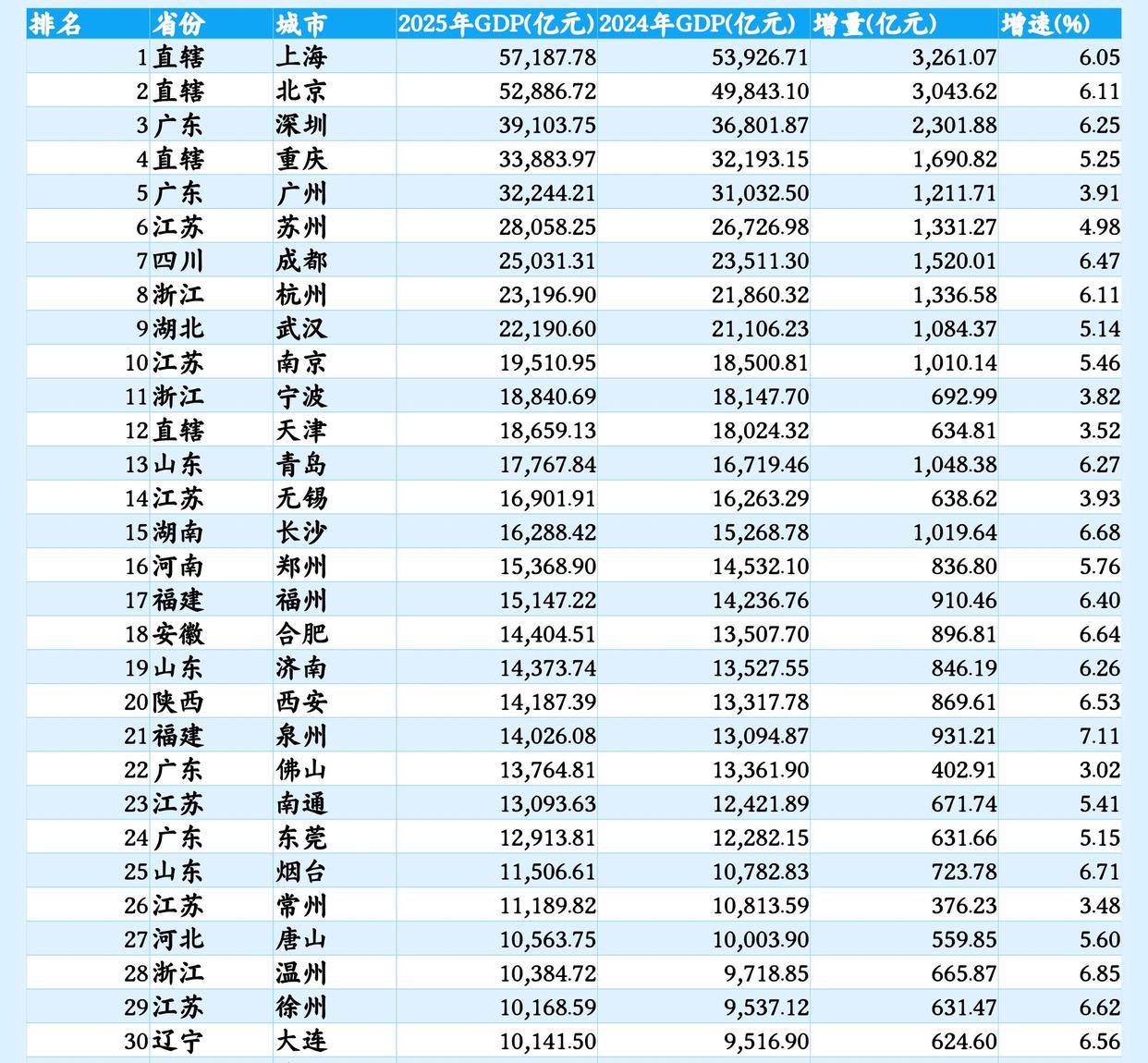
2025年GDP30强城市预测:苏州超2.8万亿,宁波远超郑州,唐山第27
Sou Hu Cai Jing· 2026-01-04 17:06
Core Insights - The economic landscape of China's cities is expected to undergo significant changes by 2025, with a clear division between leading cities and emerging regional players [1] - A competitive race among cities is anticipated, driven by varying growth rates and economic performances [1] Economic Forecasts - The top cities by GDP in 2025 are projected to be: - Shanghai: 57.19 trillion yuan, up from 53.93 trillion yuan, an increase of 3.26 trillion yuan - Beijing: 52.89 trillion yuan, up from 49.84 trillion yuan, an increase of 3.04 trillion yuan - Shenzhen: 39.10 trillion yuan, up from 36.80 trillion yuan, an increase of 2.30 trillion yuan [2] - Other notable cities include: - Chengdu: 25.03 trillion yuan, with a growth of 1.52 trillion yuan - Hangzhou: 23.20 trillion yuan, with a growth of 1.34 trillion yuan - Wuhan: 22.19 trillion yuan, with a growth of 1.08 trillion yuan [2] Growth Engines - Quanzhou leads with a remarkable growth rate of 7.11%, followed by cities like Changsha, Yantai, Wenzhou, and Xuzhou, showcasing strong industrial vitality [2] - The Yangtze River Delta cities, particularly Suzhou, are expected to demonstrate resilience, with Suzhou's GDP projected to exceed 28 trillion yuan [3] Regional Dynamics - Central and Western cities are rising, with Chengdu expected to surpass 25 trillion yuan, and both Wuhan and Changsha showing significant growth [4] - Qingdao is highlighted for its strong performance in Northern China, with a projected GDP of 17.77 trillion yuan [4] Challenges for Traditional Cities - Cities like Guangzhou, Foshan, and Tianjin are experiencing slower growth, indicating a need for industrial upgrades and transformation [5] - Zhengzhou faces increasing competition, with its GDP growth lagging behind that of Ningbo, which is expanding its lead [5] Overall Economic Landscape - The 2025 forecast outlines a new economic map for China, with core cities in the Yangtze River Delta and Guangdong-Hong Kong-Macau Greater Bay Area leading, while competition among regions intensifies [6] - The ability to adapt to new production forces and transition between old and new economic drivers will be crucial for cities' rankings [6]

中国银河证券:保持必要强度,优化支出方向
Xin Lang Cai Jing· 2026-01-04 04:24
中国银河证券研究表示,中央经济工作会议指出,要继续实施更加积极的财政政策。全国财政工作会议 对2026年财政政策进行了进一步部署。当前,国内经济底层逻辑正在从土地财政全面转向因地制宜发展 新质生产力,这个过程中财政政策的重要性愈发显现。从2023年内增发国债到2024年发行超长期特别国 债再到2025年提高狭义赤字率,财政政策在新旧动能转换过程中发挥了重要作用。展望2026年,中国银 河证券认为财政政策呈现以下特征:一是扩大支出盘子,保持必要支出强度,预计广义赤字率与2025年 基本持平;二是优化支出方向,尤其加大对于内需和科技的支持力度,灵活运用超长期特别国债和财政 贴息等工具;三是财政靠前发力,保持"早发快用"节奏,力争"十五五"元年取得良好开局。 ...

标普全球发布2026年展望:全球能源化工发展面临结构性分化
Zhong Guo Hua Gong Bao· 2026-01-04 02:51
Core Insights - The S&P Global report highlights a structural divergence in the global energy and chemical industries, driven by the collision of AI revolution, energy transition, and geopolitical factors, indicating that while the industry shows resilience, the circumstances across different segments will vary significantly [1] Supply Chain Challenges - The report emphasizes the geopolitical-driven restructuring of supply chains and demand mismatches in the energy and commodities markets, with a notable shift in the global propane import market, where the U.S. market share has declined while the Middle East and Canada have gained advantages [2] - The global PVC industry faces dual pressures of production cuts and trade flow reversals, reshaping the supply chain due to high energy costs in Europe and potential overcapacity in Asia [2] - In the energy transition sector, the demand for stable electricity from AI data centers is prompting tech giants to reassess the strategic value of nuclear power, while outdated transmission networks hinder the large-scale integration of renewable energy [2] Investment Landscape - The macro credit environment shows stark contrasts within the energy and chemical sectors, with strong financing demand in areas like AI data centers, power facilities, critical mineral extraction, and LNG supply chains, while traditional chemical manufacturing faces refinancing pressures and weak demand [3] - The report warns of a "double-edged sword" effect surrounding the investment boom in AI and energy transition, where high market expectations could lead to credit tightening and capital pullback if economic benefits or technological advancements fall short [3] Emerging Market Opportunities and Challenges - Emerging market countries with key mineral resources are positioned to benefit directly from the surge in global electric vehicle and energy storage demand, while some developing economies show growth potential due to lower dependence on the U.S. market [4] - However, emerging markets aiming to develop manufacturing face significant challenges, including the need to invest in automation and AI technologies to enhance industrial competitiveness, as well as navigating external policies like carbon tariffs from developed economies [4] - The report identifies three key areas of opportunity: stable base-load energy supporting AI computing, critical resources driven by energy transition, and regional supply chain opportunities arising from geopolitical restructuring [4] Future Industry Dynamics - The report concludes that the era of universal industry prosperity is over, and future winners will be those who can accurately identify advantageous segments within the supply chain, adapt to changes in geopolitical trade, and effectively manage both energy and capital costs [5] - Understanding and leveraging the "non-uniformity" of the divergence trend will be crucial for capturing genuine growth opportunities in the evolving landscape [5]
C-REITs扩围扩容-市场化启新篇
Sou Hu Cai Jing· 2026-01-02 18:35
Core Insights - REITs serve as effective financial tools during economic transitions, facilitating the conversion of old and new growth drivers and supporting economic and financial market development [2] - The C-REITs market in China has expanded its pilot scope, covering various sectors including clean energy, affordable housing, and data centers, leading to significant investment and asset revitalization [2] - By the end of 2025, 78 REITs are expected to be listed, with a total issuance scale of 213.77 billion, indicating substantial growth and effectiveness in the market [3] Market Overview - As of 2023, China's commercial real estate market reached approximately 18.5 trillion RMB, reflecting a year-on-year growth of 6.2%, despite a projected decline in commercial property investment in 2024 [4] - The use of REITs is seen as a necessary measure to address challenges in the commercial real estate sector, particularly in generating stable cash flows from existing commercial assets [4] Development Challenges - The REITs issuance process faces challenges such as a lack of professional talent, significant performance fluctuations, and inconsistent quality of application materials [5] - The secondary market experiences issues like speculative behavior, high volatility, and discrepancies between performance and market value, highlighting the need for improved information disclosure [5] Market Optimization - Strengthening information disclosure is crucial for attracting long-term investors and ensuring market stability, which is foundational for the development of the C-REITs market [5] - Continuous enhancement of regulatory enforcement and timely punishment of violations are essential for maintaining market integrity [5] Market Expansion - The C-REITs market encourages private enterprises to utilize REITs for asset revitalization, with successful examples from companies like JD.com and others in various sectors [6][7] - The establishment of C-REITs platforms by state-owned and mixed-ownership enterprises is increasing, particularly in sectors like clean energy and infrastructure [7] - Future improvements in mechanisms such as ETFs and cross-border connectivity are expected to enhance the openness of China's C-REITs market [7]
潍坊马上红: 产业骏马齐奔腾,潍坊双向赋能启新程
Xin Lang Cai Jing· 2026-01-02 02:41
Core Viewpoint - Weifang is poised to become a trillion-yuan city during the "15th Five-Year Plan" period, aiming to establish itself as a significant economic growth hub in northern China and a model for the integration of modern agriculture and advanced manufacturing [1][12]. Group 1: Economic Development Goals - Weifang aims to enter the ranks of trillion-yuan cities and become a regional sub-center city during the "15th Five-Year Plan" [1]. - The city is focusing on becoming a national model for the integration of modern agriculture and advanced manufacturing [1][12]. Group 2: Advanced Manufacturing Growth - Weifang's high-tech output in its high-tech zone reached 90.9%, with R&D investment accounting for 7.4% of GDP [5]. - The city has established four trillion-yuan industrial clusters in power equipment, new-generation information technology, food industry, and high-end chemicals [5]. - Weifang has been recognized as a top 100 park for high-quality development and advanced manufacturing [5]. Group 3: Agricultural Innovation - Weifang has developed advanced agricultural technologies, including AI systems for real-time monitoring and optimization of crop growth [9]. - The city has achieved a significant reduction in reliance on imported vegetable seeds, moving from 70% dependence to 70% self-research [10]. - Weifang is recognized as a national model city for modern facility agriculture, with a focus on technological innovation in agriculture [10]. Group 4: Talent and Innovation Ecosystem - The city has established long-term cooperation mechanisms with numerous research institutions and universities, enhancing the talent pool in high-tech sectors [6]. - Weifang has 2,239 high-tech enterprises and 4,036 technology-based SMEs, with high-tech industries accounting for 61.39% of the city's output [6]. Group 5: Future Development Plans - The city plans to accelerate project construction and improve the business environment, focusing on rural revitalization, urban renewal, and marine economy [11]. - Weifang aims to strengthen its position as a national agricultural modernization model and a city of advanced manufacturing during the "15th Five-Year Plan" [12][13].

回望2025:有色/贵金属最值得关注的N个时刻
Sou Hu Cai Jing· 2026-01-01 00:18
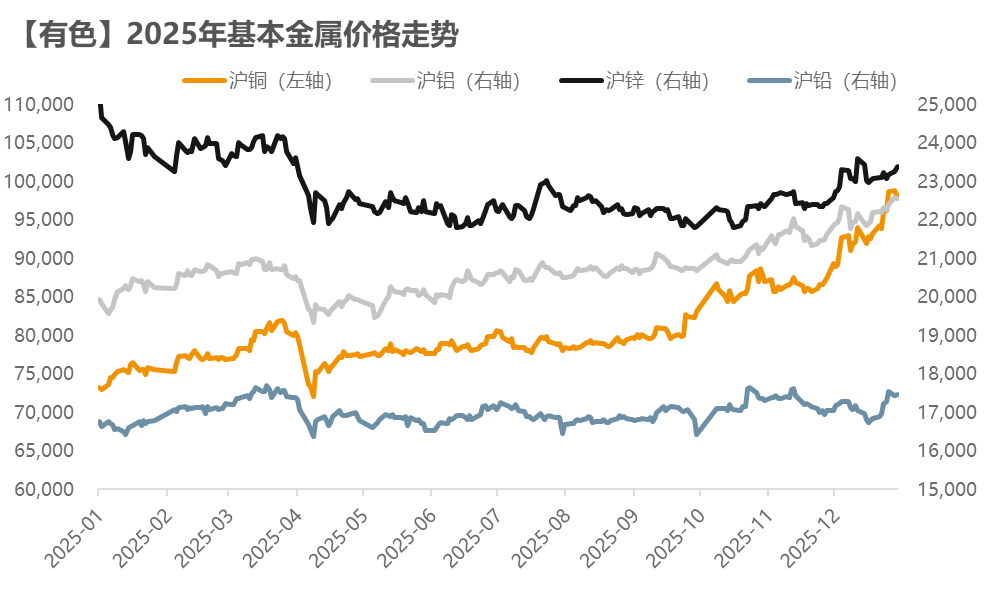
Core Insights - The year 2025 witnessed significant market movements in the non-ferrous and precious metals sectors, driven by geopolitical events and macroeconomic factors, leading to record price increases for gold and silver [3][4]. Copper Market - In late November to December 2025, copper prices surged, reaching historical highs of $12,960 per ton on the LME and over ¥100,000 per ton in Shanghai [5]. - The copper supply faced constraints due to structural issues, including declining resource grades and insufficient capital expenditure, alongside natural disasters [5]. - Demand for copper remained robust, driven by the dual forces of new energy and AI, leading to a three-phase price increase throughout the year [5]. - The investment strategy for 2026 suggests maintaining a focus on copper until mid-year, then diversifying into both copper and aluminum investments [5]. Aluminum Market - In early November 2025, aluminum prices rose sharply, driven by a significant increase in trading volume and a shift of capital from copper to aluminum [9]. - The rise in aluminum prices was supported by a tight supply situation and a growing belief in aluminum's long-term potential as a substitute for copper [9]. - The outlook for aluminum remains bullish, with expectations of a widening global primary aluminum deficit by 2026 [9]. Alumina Market - In July 2025, alumina prices experienced a notable increase despite a backdrop of oversupply, influenced by delayed market responses and macroeconomic sentiment [11]. - The market dynamics indicated a potential for further price declines in 2026, driven by cost pressures and competitive market conditions [11]. Zinc Market - In the fourth quarter of 2025, zinc prices began to rise due to domestic supply shortages and a shift in market dynamics towards replenishing inventories [13]. - The zinc market is transitioning from a bear market to a structural bull market, with expectations of a 2% increase in global zinc demand in 2026 [13]. Gold Market - From January to April 2025, gold prices surged due to geopolitical tensions and economic uncertainties, reaching $3,500 per ounce [17]. - The latter part of 2025 saw gold prices peak at $4,381 per ounce, driven by political pressures on the Federal Reserve and economic instability [22]. Silver Market - In late 2025, silver prices broke through a significant resistance level, reaching $80 per ounce, supported by high trading volumes and low domestic inventories [23]. - The price dynamics were characterized by strong investor interest and significant deviations from equilibrium price levels [23].
年底了,果然开始有更多好消息了
大胡子说房· 2025-12-31 10:17
Group 1 - The core message of the article emphasizes the positive impact of recent policy changes on the real estate market, particularly the reduction of the value-added tax (VAT) for housing sales, which aims to lower transaction costs and stimulate consumption [1][2] - The VAT exemption for properties held for over two years and the reduction from 5% to 3% for properties held for less than two years will significantly decrease the financial burden on home sellers, potentially saving them tens of thousands of yuan [1] - The government's focus on stimulating consumption is further supported by the early allocation of 625 billion yuan in special bonds for consumer goods, indicating a strong commitment to boosting domestic demand [2][4] Group 2 - The article highlights the importance of increasing income levels as a fundamental solution to enhance consumption, with major companies like JD, ByteDance, and BYD announcing salary increases, signaling a positive trend in wage growth [2][4] - The establishment of national venture capital funds targeting hard technology sectors is expected to inject substantial capital into the market, with a focus on artificial intelligence, quantum technology, and other advanced fields, potentially mobilizing trillions in social capital [4][5] - The article notes a shift in the economic landscape, moving from reliance on real estate and manufacturing to a focus on technological innovation and industrial upgrades, reflecting a broader transformation in wealth accumulation and economic growth strategies [24][32]

鲁西集团:锚定一流 破局向新
Zhong Guo Hua Gong Bao· 2025-12-31 06:31
Core Viewpoint - Lu Xi Group has successfully transformed from a traditional chemical enterprise into a modern, international, and comprehensive chemical company, focusing on high-end new materials during the 14th Five-Year Plan period, amidst various challenges such as global industrial chain restructuring and carbon neutrality goals [1][4][24]. Group 1: Transformation and Development - Lu Xi Group has evolved from a small nitrogen fertilizer company established in 1976 to a leading player in the chemical industry, achieving significant breakthroughs in technology innovation, green transformation, and project construction [1][4]. - The company has invested a total of 17.7 billion yuan over the past five years, establishing 12 key projects, including a 1 million tons/year caprolactam and nylon 6 production facility, and the world's largest single 400,000 tons/year silicone monomer production unit [5][6]. - By the end of the 14th Five-Year Plan, Lu Xi Group has built over 70 chemical installations, producing more than 1,000 tons of chemical products annually, with leading positions in formic acid and polycarbonate production [6][24]. Group 2: Innovation and Technology - Lu Xi Group has made significant advancements in innovation, including the development of a high-efficiency formic acid hydrogen production technology, which has been recognized as a domestic leader [9][10]. - The company has established a complete product system covering 18 types of catalysts, achieving an annual output value exceeding 400 million yuan through joint research and independent innovation [10][11]. - Lu Xi Group has over 1,000 patents and has established long-term cooperative relationships with prestigious universities and research institutions to accelerate the application of innovative results [11][24]. Group 3: Management and Efficiency - The company has implemented a digital management system across production, procurement, and sales, achieving 100% online business processes and enhancing decision-making efficiency by 40% through a streamlined management structure [14][15]. - Lu Xi Group has adopted a cost control philosophy, achieving annual cost reductions exceeding 70 million yuan through various optimization measures [15][18]. - The company emphasizes talent as a primary resource, implementing incentive mechanisms to stimulate innovation and efficiency [11][15]. Group 4: Safety and Environmental Protection - Lu Xi Group prioritizes safety and environmental protection, achieving a 98.7% hidden danger rectification rate through a grid-based safety management model [18][19]. - The company has made strides towards becoming a zero-emission park, with 100% wastewater recycling and solid waste resource utilization rates [19][20]. - Lu Xi Group has developed a carbon peak and carbon neutrality action plan, aiming for a carbon emission intensity of 3.5 tons per 10,000 yuan of output value by 2025, which is 1.4% lower than the target [20][24]. Group 5: Global Cooperation and Market Expansion - Lu Xi Group has actively participated in international cooperation, showcasing its clean energy development plans at the China-Africa Cooperation Forum and establishing partnerships with Nigerian enterprises [23][24]. - The company has seen a 91% year-on-year increase in exports of chemical and fertilizer products, with its formic acid market share in Japan rising to 22% [23][24]. - Lu Xi Group aims to become a global leader in the chemical new materials industry, focusing on high-end, intelligent, and green development [25].

21社论丨锚定中国的世界新坐标
21世纪经济报道· 2025-12-31 01:30
Core Viewpoint - The article emphasizes China's significant advancements in various sectors, particularly in technology and global governance, as it transitions into a new phase of development in 2026, marking the beginning of the 15th Five-Year Plan [1][2]. Group 1: Economic and Technological Advancements - In 2025, China transitioned from a phase of "technological catch-up" to "running alongside and leading" in artificial intelligence, showcasing breakthroughs in large models and a strong presence in the AI open-source ecosystem [1]. - The country has made strides in domestic AI chip production, breaking free from supply chain constraints, and is actively participating in a new global technological and industrial revolution [1]. - China's global governance initiatives, including the global development, security, and civilization initiatives, reflect its commitment to enhancing its role in international governance and providing stability in global trade [2]. Group 2: Strategic Economic Policies - The 20th Central Committee highlighted the need for China to navigate a complex development environment, balancing opportunities and risks during the 15th Five-Year Plan period [3]. - The Central Economic Work Conference emphasized the importance of internal economic stability and structural reforms to address external challenges, focusing on the conversion of new and old growth drivers [4][5]. - A dual approach of policy support and reform innovation is necessary to stabilize the economy and promote growth, with a focus on enhancing domestic demand and creating a robust domestic market [5]. Group 3: Social and Human Development - The article advocates for a shift in development philosophy from GDP-centric growth to a focus on national income and overall human well-being, emphasizing the importance of investing in people [6]. - The goal is to ensure that the benefits of economic growth are shared broadly, enhancing the quality of life and dignity of individuals [6][7]. - The government is encouraged to create an environment that aligns national strategies with individual welfare, fostering a system that promotes both management and empowerment [7].