
AI芯片

Search documents
麻烦不断!天普股份董事会“换血”收监管问询,此前刚被立案调查
Hua Xia Shi Bao· 2026-01-16 09:32
Group 1 - The new controlling shareholder, Zhonghao Xinying, has taken over Tianpu Co., leading to a board reshuffle and subsequent inquiries from the Shanghai Stock Exchange regarding the qualifications of newly appointed directors and senior management [2][3][4] - The inquiry highlighted that most of the new appointees lack relevant experience in the automotive parts industry, which contradicts previous announcements stating there would be no asset injection plans within 12 months [4][5] - Following the announcement of the change in control, Tianpu's stock price experienced a significant drop, closing at the daily limit down on January 15 and continuing to decline on January 16 [2][3] Group 2 - The Shanghai Stock Exchange has requested clarification on the implications of the new appointments for Zhonghao Xinying's independent IPO plans, as the new management's roles may conflict with prior commitments to maintain independence [5][6] - Tianpu Co. was originally focused on rubber hoses and components for the automotive sector, but the change in control raises the possibility of a shift towards AI chip production, given Zhonghao Xinying's expertise in that field [6][7] - The stock price of Tianpu Co. surged by 1631.7% in 2025, driven by market speculation regarding the potential for Zhonghao Xinying to leverage Tianpu as a vehicle for its IPO [6][7] Group 3 - The company has been placed under investigation by regulators due to inconsistencies between its recent actions and prior disclosures, which may lead to significant repercussions for the involved parties [9] - The new board of directors has been established, replacing the previous secretary who was implicated in the discrepancies, indicating a shift in governance [9]



天岳先进涨超17% 台积电业绩超预期且指引积极 公司积极拓展碳化硅应用
Zhi Tong Cai Jing· 2026-01-16 03:20
Group 1 - Tianyue Advanced (02631) saw a significant increase of over 17%, reaching a new high of 70.4 HKD per share, with a current trading price of 68.4 HKD and a transaction volume of 314 million HKD [1] - Zhejiang Securities' report highlights Tianyue Advanced's active expansion into silicon carbide (SiC) applications in emerging fields, indicating long-term growth potential [1] - The report identifies three key areas for SiC application: 1. AR Glasses: SiC materials are expected to be ideal for next-generation AR glasses due to their high refractive index and lightweight properties, leading to better display performance [1] 2. AIDC: With the surge in AI computing demand, SiC power devices can significantly enhance server power efficiency, aligning with the trend of data centers transitioning to 800V high-voltage architectures driven by giants like NVIDIA [1] 3. Advanced Packaging: Single crystal SiC's thermal conductivity is 2-3 times higher than silicon, making it an ideal material for intermediary layers, potentially providing new thermal management solutions for CoWoS packaging [1] Group 2 - TSMC's Q4 2025 performance exceeded expectations, marking the seventh consecutive quarter of double-digit growth, with net profit soaring 35% year-on-year to approximately 16 billion USD, setting a historical record [2] - TSMC's gross margin has surpassed 60% for the first time, and the company has significantly raised its capital expenditure guidance for 2026 to 52-56 billion USD, nearly 40% higher than previous estimates [2] - The report from Huaxin Securities indicates that SiC materials meet the performance requirements for AI chips, with major AI clients leading the upgrade of intermediary layer materials [2]

锡:高位整理
Guo Tai Jun An Qi Huo· 2026-01-16 02:09
Group 1: Investment Rating - No investment rating information is provided in the report. Group 2: Core View - The tin market is in a high-level consolidation [1]. Group 3: Summary by Directory Fundamental Tracking - **Price Data**: The closing price of the Shanghai Tin main contract was 433.000 with a daily increase of 4.80%, and the night - session closing price was 418.860 with a decrease of 3.27%. The price of the LME Tin 3M electronic - disk futures was 52.775 with a decrease of 2.27% [2]. - **Trading Volume and Open Interest**: The trading volume of the Shanghai Tin main contract was 592,217, an increase of 187,519 from the previous day, and the open interest was 38,481, a decrease of 3,924. The trading volume of the LME Tin 3M electronic - disk was 2,851, an increase of 1,315, and the open interest was 23,960, an increase of 401 [2]. - **Inventory Data**: The inventory of Shanghai Tin was 9,526, an increase of 2,419, and the inventory of LME Tin was 5,925, a decrease of 5. The cancellation warrant ratio of LME Tin was 6.57%, a decrease of 0.38% [2]. - **Spot Price**: The SMM 1 tin ingot price was 426,000, an increase of 20,500 from the previous day. The Yangtze River Non - ferrous 1 tin average price was 435,000, an increase of 25,000 [2]. - **Industry Chain Price**: The 40% tin concentrate (Yunnan) price was 414,000, an increase of 20,500. The 60% tin concentrate (Guangxi) price was 418,000, an increase of 20,500 [2]. Macro and Industry News - The State - owned Assets Supervision and Administration Commission of the State Council will strengthen the role of state - owned enterprises as the main body of technological innovation and cultivate leading technology enterprises [2]. - Goldman Sachs plans to issue at least $12 billion in bonds [3]. - The People's Bank of China has lowered the policy tool interest rate by 0.25 percentage points, and there is still room for reserve requirement ratio cuts and interest rate cuts this year [4]. - The demand for AI chips remains strong, TSMC's Q4 net profit increased by 35%, and its full - year capital expenditure in 2025 reached $40.9 billion [5]. Trend Strength - The tin trend strength is 0, indicating a neutral outlook. The trend strength ranges from - 2 (most bearish) to 2 (most bullish) [6].
国产GPU又杀出一匹黑马!成立不到一年,两款芯片量产落地
量子位· 2026-01-15 08:53
Core Viewpoint - The article discusses the transformation of the domestic AI chip market, emphasizing that performance metrics are no longer the sole focus; instead, the ability to solve business pain points and lower application barriers is crucial for determining the value of AI chips [2]. Group 1: Market Dynamics - The market logic is shifting, where performance indicators serve merely as an "entry ticket" [2]. - The evaluation system for domestic AI chips is being restructured as the demand transitions from "experimental testing" to "mass production" [5]. Group 2: Company Overview - ChipBridge Semiconductor, established in March 2025, is a new player in the domestic GPU market, founded by a team with extensive experience in the semiconductor industry [6]. - The company has launched the Sinexus X200 and S200 series, which are mass-produced products designed for core applications like AI training and inference [8]. Group 3: Competitive Advantage - ChipBridge's strength lies in providing not just a chip with independent intellectual property but also a comprehensive domestic intelligent computing cluster solution [9]. - The company emphasizes long-term usability and operational value of domestic computing power, moving away from the traditional "box model" of hardware delivery [12][13]. Group 4: Industry Application - The solutions offered by ChipBridge cover the entire lifecycle from planning and design to deployment and operation, addressing the needs of various sectors such as manufacturing, healthcare, education, finance, and government [20][22]. - The focus is on enhancing the efficiency of computing power utilization and reducing total cost of ownership (TCO) [22]. Group 5: Future Outlook - The decision-making power regarding computing resources is shifting from IT teams to business departments, indicating a move towards value-driven resource allocation [16][19]. - ChipBridge aims to create an open, collaborative ecosystem for domestic computing power, facilitating the transition from "usable" to "easy to use" [22][24].
1月15日主题复盘 | 市场大幅缩量,光刻胶、半导体强势,锂电池反弹
Xuan Gu Bao· 2026-01-15 08:32
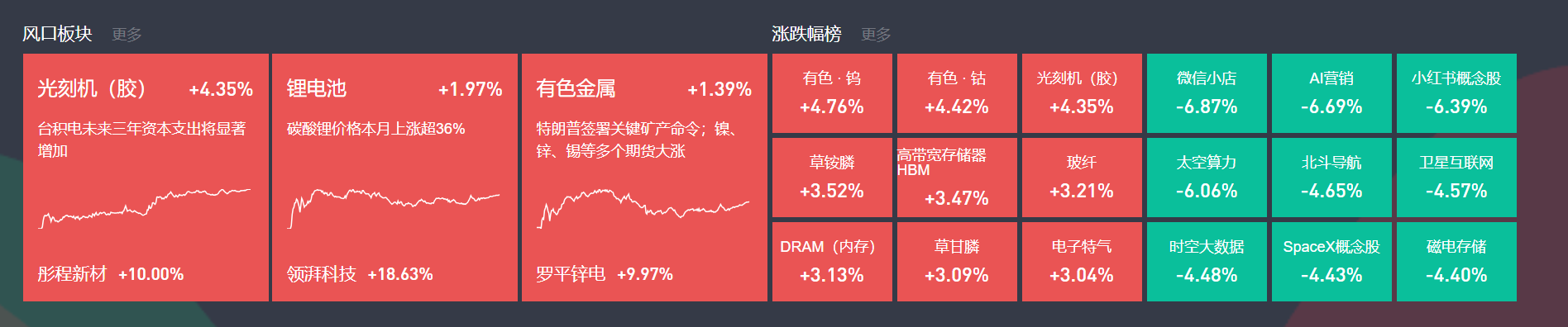
Market Overview - The Shanghai Composite Index experienced fluctuations throughout the day, while the ChiNext Index rebounded after hitting a low. Semiconductor stocks strengthened in the afternoon, with photolithography machines and photoresists leading the gains, resulting in multiple stocks like Tongcheng New Materials and Kangqiang Electronics hitting the daily limit. The tourism sector was active, with stocks like Zhongxin Tourism and Shaanxi Tourism also reaching the daily limit. The non-ferrous metals sector saw gains, with stocks like Zinc Industry and Luoping Zinc Electric hitting the daily limit. Overall, more stocks declined than rose, with over 3,100 stocks in the Shanghai and Shenzhen markets in the red, and today's trading volume decreased by over 1 trillion to 2.94 trillion [1]. Hot Topics Photolithography Resins - The photolithography resin sector saw significant gains today, with stocks like Tongcheng New Materials, Baiao Chemical, and Dongcai Technology hitting the daily limit, while Su Da Weige and Shanghai Xinyang saw increases of over 15%. According to Frost & Sullivan, the domestic photolithography resin market is expected to reach 15.03 billion yuan by 2028, with a compound annual growth rate of 18.5% [4][5]. Lithium Batteries - The lithium battery sector rose today, with Lingpai Technology increasing by over 18%, and stocks like Keheng Co., Xianhui Technology, and Honggong Technology rising by over 10%. Tianfeng Securities predicts that the demand for power and energy storage batteries will reach 1,872 GWh and 2,236 GWh in 2025 and 2026, respectively, with year-on-year growth of 45% and 25% [6][7]. Domestic Chips - The domestic chip sector performed well today, with stocks like Sanfu Co., Unisoc, Wenkai Co., and Kangqiang Electronics hitting the daily limit. TSMC's latest quarterly results showed a significant increase in AI chip demand, with a 35% year-on-year growth in net profit for Q4 2025. TSMC expects sales in Q1 2026 to be between $34.6 billion and $35.8 billion, exceeding market expectations of $33.22 billion [9][10][11]. Longxin Technology - Longxin Technology has received IPO acceptance, being the fourth-largest DRAM manufacturer globally and the largest in China. The company plans to raise 29.5 billion yuan for production line upgrades and next-generation technology development, with expectations to complete most equipment installations by the end of 2027, which may boost domestic equipment demand and market share [12].
天普股份跌停!中昊芯英团队掌权引质疑
Shang Hai Zheng Quan Bao· 2026-01-15 07:07
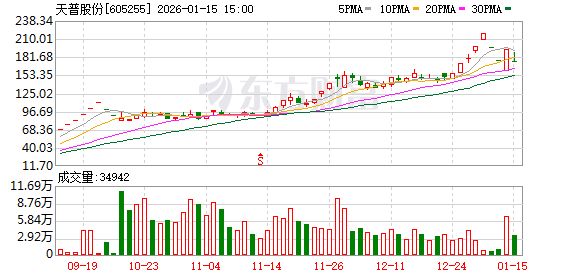
Core Viewpoint - The recent changes in the board of directors at Tianpu Co., Ltd. have raised concerns regarding the independence of the company and its acquisition partner, Zhonghao Xinying, especially in light of their conflicting statements about maintaining the company's core automotive parts business and the independence of personnel [2][4][5]. Group 1: Board Changes and Market Reaction - Tianpu Co., Ltd. held its first extraordinary shareholders' meeting of 2026 on January 14, where a new board of directors was elected, including members with ties to Zhonghao Xinying [2][4]. - Following the announcement, Tianpu's stock price fell sharply, hitting the daily limit down to 174.83 yuan per share by January 15 [2]. - The new board includes Yang Gongyifan as chairman and other members who lack experience in the automotive parts sector, raising questions about the company's strategic direction [4][5]. Group 2: Regulatory Scrutiny - The Shanghai Stock Exchange issued an inquiry to Tianpu regarding the rationale behind the new board appointments and the independence of the company in light of Zhonghao Xinying's IPO plans [4][7]. - The inquiry specifically requested clarification on whether the new appointments would affect the company's existing business operations and if they align with the company's interests [4][7]. - Tianpu is currently under investigation by the China Securities Regulatory Commission due to unusual stock price fluctuations and potential omissions in disclosures [7]. Group 3: Concerns Over Independence - The appointment of key management personnel from Zhonghao Xinying, including the former secretary and CFO, contradicts previous commitments to maintain the independence of Tianpu's management [5][7]. - There are concerns that these appointments may hinder Zhonghao Xinying's independent IPO plans, which were previously stated to be unrelated to Tianpu [5][7]. - The market is closely monitoring whether these changes will lead to a shift in Tianpu's business focus towards AI and technology sectors, as speculated since the control change began in August 2025 [5].
国芯科技跌2.01%,成交额2.00亿元,主力资金净流出9.87万元
Xin Lang Cai Jing· 2026-01-15 03:50
Group 1 - The core viewpoint of the news is that Guoxin Technology's stock has experienced fluctuations, with a recent decline of 2.01% and a total market value of 10.51 billion yuan [1] - As of January 15, Guoxin Technology's stock price is 31.28 yuan per share, with a trading volume of 200 million yuan and a turnover rate of 1.88% [1] - The company has seen a year-to-date stock price increase of 3.06%, but a decline of 4.69% over the last five trading days [1] Group 2 - Guoxin Technology is engaged in providing IP licensing, chip customization services, and self-developed chips and modules, primarily in the fields of information security, automotive electronics, and industrial control [1] - The revenue composition of Guoxin Technology includes 42.19% from self-developed chips and modules, 28.54% from chip customization services, and 0.70% from IP licensing [1] - As of September 30, the number of shareholders for Guoxin Technology is 25,700, a decrease of 3.43% from the previous period [2] Group 3 - For the period from January to September 2025, Guoxin Technology reported a revenue of 259 million yuan, a year-on-year decrease of 44.92%, and a net profit attributable to the parent company of -127 million yuan, a decrease of 0.03% [2] - Since its A-share listing, Guoxin Technology has distributed a total of 120 million yuan in dividends, with 59.99 million yuan distributed over the past three years [3]

李彦宏,下一个超级IPO
3 6 Ke· 2026-01-15 00:05
Core Viewpoint - Baidu's Kunlun Chip is set to go public, marking a significant IPO in the Chinese semiconductor industry, as the company aims to capitalize on the rising demand for computing power in China [1][4][8]. Group 1: Company Background and Development - Kunlun Chip, originally part of Baidu's AI chip division, was spun off in 2021 with an initial valuation of 13 billion RMB [1][6]. - The chip development began in 2011, with a team formed from top companies like Qualcomm and Tesla, leading to the launch of the first Kunlun chip in 2018, which achieved a computing power of 260 Tops [2][3]. - By 2021, Kunlun Chip became an independent entity, rapidly advancing with multiple product generations and significant market deployments [3]. Group 2: Financial Performance and Market Position - Kunlun Chip has secured major contracts, including a significant order from China Mobile, with projected sales reaching 3.5 billion RMB in 2025 and 6.5 billion RMB in 2026 [7][9]. - The company has attracted a diverse range of investors, including BYD and various venture capital firms, enhancing its financial backing and market credibility [6][7]. Group 3: IPO Significance and Market Context - The IPO is anticipated to elevate Kunlun Chip's profile among clients and investors, potentially increasing Baidu's market valuation significantly [7][9]. - The current IPO wave in the semiconductor sector, highlighted by successful listings of competitors like Wallen and Moore Threads, underscores the urgency for Baidu to capitalize on its market position [8][9]. - Analysts suggest that if Kunlun Chip achieves a valuation similar to that of Cambricon, Baidu's stake could be worth up to 22 billion USD, representing a substantial portion of its total market value [9].

韩国芯片赢麻了,利润增长两倍多,净利过万亿,被质疑联手涨价
Sou Hu Cai Jing· 2026-01-14 16:56
Core Viewpoint - The profits of South Korea's two major memory chip companies are expected to surge significantly by 2025, reversing the profit decline trend of the country's largest smartphone manufacturer, indicating a strong performance in the memory chip sector [1][3]. Group 1: Profit Forecast - The two major South Korean memory chip companies are projected to earn over 300 trillion Korean won (approximately 1.4 trillion RMB) in profits by 2025, which is 75% higher than the annual revenue of China's largest tech company and over 20 times its net profit [3]. - One company is expected to see a profit increase of 2.5 times, while the other is projected to grow by 2.2 times [1]. Group 2: Price Surge and Market Dynamics - The significant profit increase in 2025 is attributed to a sharp rise in memory chip prices, particularly DRAM, with the price of a 16GB memory module increasing from 400 RMB to 1000 RMB, a rise of 1.5 times [3]. - The price surge is driven by the demand for HBM chips used in AI applications, which has diverted production capacity away from DRAM chips, leading to a tightening supply and skyrocketing prices [3]. Group 3: Competitive Landscape - There are speculations that the price increase may be influenced by a coordinated effort among U.S., South Korean, and Japanese memory chip companies, reminiscent of past price-fixing allegations against South Korean firms [5]. - As global memory chip prices rise, Chinese memory chip companies are also benefiting, reversing their previous losses and potentially allowing for increased investment in R&D to catch up technologically with U.S. and South Korean firms [5]. Group 4: Impact on Consumer Electronics - The surge in memory chip prices is expected to negatively impact the smartphone and PC industries, with estimates suggesting a significant reduction in memory capacity for Chinese smartphones, particularly in the mid-range segment, which may revert to 4GB from the previously common 12GB [5]. - This reduction in memory capacity, combined with the use of outdated processors in low-end smartphones, may lead to decreased sales, pushing consumers towards flagship or second-hand models instead [7].
受产品单价下降等影响 沪硅产业预计2025年业绩亏损
Zheng Quan Shi Bao Wang· 2026-01-14 11:21
Core Viewpoint - The company, Hu Silicon Industry, anticipates a significant loss in net profit for the fiscal year 2025, projecting a loss between -1.53 billion to -1.28 billion yuan, which represents an increase in losses compared to the previous year [1] Industry Overview - The global semiconductor market is expected to reach a size of 772 billion dollars in 2025, reflecting a growth of 22.5% year-on-year, driven primarily by AI applications and data center infrastructure demand, while consumer electronics and industrial electronics remain weak [1] - In the silicon wafer sector, global semiconductor silicon wafer shipment area is projected to grow by approximately 5.4% year-on-year in 2025, with 300mm wafers benefiting from advanced processes and AI chip demand, while 200mm and below wafers are expected to decline by about 3% due to weak demand [2] Company Performance - Hu Silicon Industry's sales of 300mm silicon wafers increased by over 25% compared to the same period in 2024, but revenue growth was limited to about 15% due to competitive pricing pressures [2] - The company is currently in a capacity ramp-up phase for its expansion projects, which is affecting short-term profitability but is expected to support long-term sustainable development through investments in high-spec and specialized products [3] - The company has faced challenges with its subsidiaries, Okmetic OY and Shanghai Xin'ao Technology Co., Ltd., which primarily deal with 200mm and below silicon wafers, leading to performance below expectations and potential goodwill impairment [3] Strategic Focus - The company aims to continue focusing on 300mm silicon wafer technology advancements and accelerate the development of high-end silicon-based materials through ongoing projects [4] - The completion of recent financing efforts is expected to inject new momentum into the company's technological breakthroughs, capacity enhancement, and market expansion [4]
