
资产配置

Search documents
增强组合抗风险能力 “固收+”差异化策略拉开身位
Zhong Guo Zheng Quan Bao· 2025-08-27 22:02
Core Viewpoint - The performance of "fixed income +" products has significantly diverged in the second half of the year, with those leaning towards equities and convertible bonds showing notable gains, while those focused on pure bonds have lagged behind [1][3][4] Group 1: Performance of "Fixed Income +" Products - "Fixed income +" products with higher equity and convertible bond allocations have seen substantial performance increases, with some funds achieving returns over 20% since the second half of the year [2][4] - Specific funds such as Huashang Shuangyi A and Jinying Yuanfeng A reported returns of 24.71% and around 20% respectively, with high equity allocations exceeding 40% [2][4] - Conversely, funds primarily invested in pure bonds, like Fangzheng Fubang Hongyuan A, have underperformed, with long-duration bonds leading to negative returns since July [3][4] Group 2: Market Trends and Strategies - The current market environment, characterized by a strong equity market and weak bond market, has led to a higher acceptance of "fixed income +" products, particularly those with convertible bonds [4][5] - Fund managers are advised to dynamically adjust the allocation of the "+" component based on market trends and risk preferences, enhancing the risk-adjusted returns of the portfolio [6][7] - The focus on multi-asset strategies and the exploration of various "fixed income +" investment strategies have become prevalent in the public fund industry [7][8] Group 3: Asset Allocation Insights - Successful "fixed income +" funds have shown a tendency to overweight sectors such as metals, military, TMT, and healthcare, while underweighting cyclical and financial sectors [4][5] - The strategy of using convertible bonds has proven effective, with funds capturing significant gains from high-performing stocks [2][4] - The importance of dynamic asset valuation and the ability to hedge against market fluctuations are emphasized for optimizing returns in "fixed income +" portfolios [6][8]
公募REITs大派“红包” 高股息属性凸显配置价值
Shang Hai Zheng Quan Bao· 2025-08-27 18:45
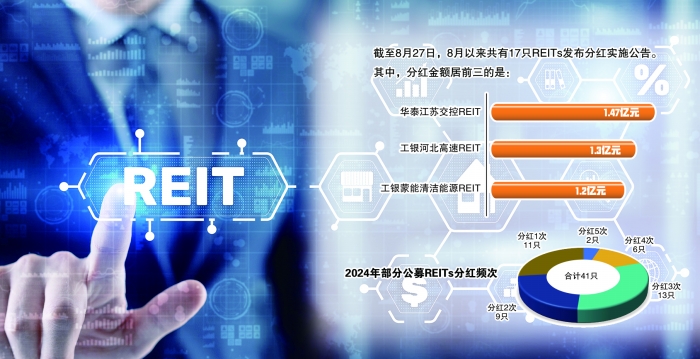
Core Viewpoint - Public REITs are gaining attention from investors due to their high cash dividend distribution and low volatility in dividends, providing a strong supplement to high-yield assets in the market [2][4]. Summary by Sections Dividend Announcements - As of August 27, 17 public REITs have announced dividend distributions in August, with a total payout exceeding 767 million yuan. Notable distributions include 130 million yuan from Industrial Bank's North Highway REIT and 120 million yuan from Industrial Bank's Mengneng Clean Energy REIT [2][3]. - Three additional REITs are set to distribute dividends in September, with the Huatai Jiangsu Expressway REIT expected to distribute 147 million yuan [2]. Dividend Rates - The dividend rates for certain REITs are notably high, with Industrial Bank's Mengneng Clean Energy REIT at 11.24%, Huatai Jiangsu Expressway REIT at 8.18%, and Guotai Junan Jinan Energy Heating REIT at 5.13% [3]. Frequency of Dividends - Many public REITs are generous with their distributions, often conducting multiple dividend payouts within a year. For instance, several REITs have already executed their second dividend distribution this year since August [3][4]. - The Huatai China Communications REIT has distributed dividends 13 times since its establishment in April 2022, with its second distribution occurring in August [4]. Market Appeal and Asset Allocation - The high dividend yield of public REITs is increasingly recognized by investors for its positive role in asset allocation. Research indicates that public REITs can achieve a distribution ratio exceeding 90%, with many exceeding 97% [4]. - The overall scale of public REITs in public fund of funds (FOF) has reached 196 million yuan by the end of the second quarter, nearly doubling from the previous year [5]. - Incorporating public REITs into investment portfolios can reduce volatility, and as the REIT market expands, it is expected to attract more capital [5].

秋季市场券商前瞻:科技主线与资金活水共舞
Zheng Quan Shi Bao· 2025-08-27 17:40
Core Insights - Multiple brokerages are optimistic about the continuation of policies and improvement in liquidity, expressing confidence in the long-term revaluation trend of Chinese assets [1][2] - The global asset allocation is gradually becoming more diversified and decentralized [1] Group 1: Economic Outlook - The domestic fiscal policy has exceeded expectations in its richness, with improved liquidity for residents, government, and markets, and a continuation of a growth-stabilizing policy stance is expected [2] - The chief macroeconomic analyst at Huatai Securities warns of potential declines in the credibility of the US dollar, suggesting investors should actively allocate to scarce assets like equities [2] - The domestic liquidity is expected to remain clear in Q4, with market focus shifting to whether earnings can follow the recovery in valuations and sentiment [2] Group 2: Market Dynamics - Trading funds are experiencing sustained net inflows, with activity levels reaching the highest since 2016, and there is still room for active foreign capital to increase positions in A-shares [4] - The net inflow of funds into A-shares this year is approximately 2.1% of the free float market value, indicating a slight net inflow status [4] - There is a potential shift of resident funds from bank wealth management products to non-bank wealth management products and capital markets [4] Group 3: Sector Focus - The Chinese capital market is entering an unprecedented new phase, requiring new thinking to understand future market dynamics [5] - The large technology sector is expected to continue to strengthen its resource allocation function, resembling the structural characteristics of the Nasdaq market [6] - Analysts suggest focusing on sectors benefiting from the recovery of overseas manufacturing, capital goods under accelerated investment, and insurance and brokerage firms expected to benefit from bottoming capital returns [6]

月内公募基金发行数量创年内新高
Zheng Quan Ri Bao· 2025-08-27 16:12
Group 1 - The public fund issuance continues to show a strong momentum, with 158 funds planned for issuance in August, a 6.04% increase from 149 in July, marking a new monthly record for the year and maintaining over 140 funds issued for two consecutive months [1] - The increase in fund issuance indicates two key signals: a faster pace of product supply in the industry and a more diverse product matrix being offered to investors for better risk-return matching [1] - Equity funds dominate the issuance structure, with 127 out of 158 new funds being equity-related, accounting for 80.38% of the total, including 96 stock funds and 31 mixed funds [1] Group 2 - The rise in equity fund issuance is driven by three main factors: optimized market regulations, recovery in equity asset net values boosting investor confidence, and proactive fund managers increasing supply of equity funds [2] - In contrast, bond fund issuance has decreased, with only 23 funds issued in August, a 28.13% decline from July, attributed to market adjustments and poor performance of bond funds [2] - FOF (fund of funds) issuance has significantly rebounded, with 6 products launched in August, a 500% increase from July, reflecting a growing demand for professional asset allocation amid market uncertainties [2] Group 3 - A total of 66 public fund institutions participated in fund issuance in August, with 23 institutions issuing more than 2 funds each [3] - Bosera Fund led the issuance with 8 funds, primarily in equity, followed by Huaxia Fund and Huitianfu Fund with 7 funds each, focusing on equity and mixed funds respectively [3] - The competitive landscape shows a concentration among top institutions with diversified strategies, as 7 other institutions issued at least 5 funds each [3]
公募“限购潮”来了,投资者如何应对?
Guo Ji Jin Rong Bao· 2025-08-27 15:45
Core Viewpoint - The public fund industry is experiencing a "purchase limit wave," with several leading funds announcing restrictions on large subscriptions due to strong market performance and to protect existing investors' interests [1][4][6]. Group 1: Market Trends - Since August, a total of 409 funds have announced the suspension of subscriptions or large subscriptions, indicating a significant trend in the market [4]. - Major fund companies like E Fund, Huatai-PB, and Southern Fund have implemented purchase limits on their high-performing products, reflecting a shift towards quality-driven growth rather than scale-driven growth [3][6]. Group 2: Reasons for Purchase Limits - The purchase limits help control fund size, preventing excessive inflows that could dilute returns and affect management efficiency [7]. - They also protect existing investors from short-term arbitrage and ensure that the interests of current holders are safeguarded [8]. - The measures are in response to regulatory requirements, promoting a dynamic balance between fund size and performance [9]. Group 3: Investor Implications - The direct impact of these limits is the restriction on large subscriptions, which may lead investors to seek alternative products [9]. - Investors are advised to maintain a rational perspective on fund returns, focusing on both beta and alpha returns, and to establish a more balanced asset allocation framework [10]. - The scarcity of high-performing funds due to purchase limits may drive investors to pursue other similar products, potentially leading to overheated market sentiment [10].
金融机构:如何适应低利率?
2025-08-27 15:19
Summary of Key Points from Conference Call Records Industry Overview - The records primarily discuss the financial services industry, focusing on banking, insurance, and public funds in low-interest rate environments across Japan, the Eurozone, and the United States [1][3][6][19]. Core Insights and Arguments - **Asset Allocation Changes in Low-Interest Environments**: Financial institutions generally reduce loan allocations and increase holdings in bonds and cash deposits. For instance, Japanese banks significantly decreased loans post-financial crisis, while U.S. banks during the Great Depression also shifted towards bonds and cash [1][3][4][5]. - **Insurance Companies' Strategies**: Insurance firms tend to adopt conservative investment strategies, favoring high-rated bonds to ensure stable returns. In contrast, public funds actively adjust their portfolios to increase equity assets for higher returns [1][6][12]. - **Japanese Insurance Sector Adjustments**: Japanese insurance institutions increased their allocation to securities, particularly government and local bonds, in response to declining yields. The allocation of interest rate bonds rose from 4% to 49.7% between 1990 and 2012 [8][11]. - **Eurozone Insurance Institutions' Response**: Eurozone insurers increased their equity and bond allocations while reducing holdings in AAA-rated bonds, opting for lower-rated assets to enhance returns [12]. - **Public Fund Growth**: In low-interest environments, money market funds and long-term bond funds have seen rapid growth, with overseas public funds and passive index products performing well [1][21]. Additional Important Insights - **Banking Sector Characteristics**: The banking sector's main characteristic in low-interest environments is the reduction of loan allocations and an increase in bond holdings. For example, by the end of 2011, bonds accounted for 25.6% of Japanese banks' assets, up approximately 16 percentage points from 1997 [5][4]. - **Impact of Government Bond Issuance**: The Japanese government's large-scale issuance of bonds since the 1990s has led to a significant increase in bond allocations by insurance institutions, as corporate bond supply remained low due to regulatory constraints [9][10]. - **Trends in Fund Industry**: The fund industry has shown a trend towards higher foreign investment ratios, with Japanese public funds increasingly adopting passive index strategies since 2010 [15][17]. - **Adjustments in Asset Allocation**: In response to economic conditions, banks and insurance institutions adjust their asset allocations, with banks increasing credit allocations if the real estate market stabilizes, while insurance firms focus on increasing their bond allocations in downturns [2][20]. This summary encapsulates the key points and insights from the conference call records, highlighting the strategic shifts in asset allocation among financial institutions in response to low-interest rate environments.
鹏华策略优选: 鹏华策略优选灵活配置混合型证券投资基金2025年中期报告
Zheng Quan Zhi Xing· 2025-08-27 15:17
Fund Overview - The fund is named Penghua Strategy Preferred Flexible Allocation Mixed Securities Investment Fund, managed by Penghua Fund Management Co., Ltd. and custodied by Industrial and Commercial Bank of China [2][3] - The fund aims for long-term capital appreciation and excess returns while effectively controlling risks through a flexible selection of investment strategies [2][3] Investment Strategy - The fund employs an asset allocation strategy that considers macroeconomic variables such as GDP growth rate, CPI trends, M2 levels, and interest rates to assess the economic cycle and adjust asset allocation among stocks, bonds, and cash [2][4] - Stock investments involve a two-step process: strategy selection and individual stock analysis, focusing on market leaders and stocks benefiting from significant industry changes [3][4] - The fund also utilizes various strategies for bond investments, including duration strategy, yield curve strategy, and credit strategy, to enhance returns [5][6] Financial Performance - As of June 30, 2025, the fund's total net asset value is approximately CNY 510.1 million, with a net asset value per share of CNY 2.811 [10][24] - The fund achieved a realized income of CNY 14.7 million and a profit of CNY 2.2 million during the reporting period [10][11] - The fund's net value growth rate for the period is 2.03%, outperforming the benchmark growth rate of 0.62% [21][12] Management Report - The fund manager emphasizes a focus on high-quality assets with competitive advantages and long-term growth potential, maintaining a consistent investment style [21][20] - The fund's portfolio is primarily concentrated in the financial, consumer goods, and industrial sectors [21] - The management reports a positive outlook for the A-share market, indicating potential for upward movement and opportunities outweighing risks [21][22] Custodian Report - The custodian, Industrial and Commercial Bank of China, confirms compliance with relevant laws and regulations, ensuring no actions detrimental to the interests of fund shareholders [26]


4点几星级,有一笔钱该如何配置?|第403期直播回放
银行螺丝钉· 2025-08-27 14:05
Group 1 - The core viewpoint of the article emphasizes that the current investment environment is at a 4.3-star level, which is still a reasonable stage for asset allocation, especially for those who have recently added funds [4][37] - The A-share market has shown a significant recovery since mid-2022, with the overall rating fluctuating between 4.3 and 5 stars, indicating a strong market performance [4][5] - The longest bear market in the last decade occurred from 2022 to 2024, providing ample investment opportunities during brief periods of 5-star ratings [7][9] Group 2 - The article outlines a three-step asset allocation strategy for investors at the 4.3-star level, starting with assessing whether the funds are long-term and unused [16][17] - It suggests determining the stock-bond allocation ratio, recommending a maximum stock allocation of "100 minus age" for long-term funds, ensuring a minimum of 30% in stocks [19][21] - The article highlights that there are still undervalued stocks available for investment, particularly in value-style indices, and mentions the ongoing updates of common index valuation tables [22][27] Group 3 - The "Monthly Salary Treasure" investment combination is presented as a balanced asset allocation option, maintaining a stock-bond ratio of approximately 40:60, suitable for the current market stage [28][36] - The combination has undergone two rebalancing adjustments since 2024, with the first adjustment in early 2024 leading to a significant increase in stock value [33][34] - The article concludes that if the market reaches a 3-star level, it may be prudent to pause investments in stock funds, as alternative strategies may become more favorable [40][41]

鹏华动力LOF: 鹏华动力增长混合型证券投资基金(LOF)2025年中期报告
Zheng Quan Zhi Xing· 2025-08-27 13:38
Core Viewpoint - The report outlines the performance and investment strategy of the Penghua Dynamic Growth Mixed Securities Investment Fund (LOF) for the first half of 2025, highlighting its focus on high-growth, undervalued stocks while managing risks through dynamic asset allocation between stocks and bonds [1][2][3]. Fund Overview - Fund Name: Penghua Dynamic Growth Mixed Securities Investment Fund (LOF) - Fund Manager: Penghua Fund Management Co., Ltd. - Fund Custodian: Agricultural Bank of China Co., Ltd. - Total Fund Shares at Period End: 1,284,776,120.21 shares - Fund Net Asset Value at Period End: 1,157,612,350.62 RMB - Fund Share Net Value at Period End: 0.901 RMB [1][3][4]. Investment Strategy - The fund employs a combination of top-down and bottom-up investment strategies, focusing on strategic asset allocation and dynamic adjustments based on market conditions [3][4]. - The investment strategy emphasizes selecting stocks with high growth potential and sustainable profitability, particularly those that are undervalued relative to their growth prospects [3][4][5]. - The fund utilizes a quantitative model for dynamic asset allocation, adjusting the proportion of stocks and bonds based on market conditions [2][3][4]. Financial Performance - Realized income for the period was -34,075,181.59 RMB, while the profit for the period was 102,032,146.76 RMB - The weighted average net value profit rate for the period was 9.13%, and the fund share net value growth rate was 9.48% [1][3][4]. - Cumulative net value growth rate since inception is 263.25% [1][3][4]. Market Analysis - The report indicates that the A-share market is currently in a reasonable valuation range, with overall risk premiums returning to historical averages, suggesting potential for future growth [14][15]. - The fund's portfolio is primarily focused on sectors such as pharmaceuticals and electronics, which have shown significant performance [15][16]. - The outlook for the second half of 2025 anticipates continued market volatility, with a focus on structural opportunities within the market [16][17]. Risk Management - The fund aims to mitigate systemic risks associated with stock investments by adjusting the allocation between stocks and bonds based on market conditions [8][9]. - The fund employs various investment strategies, including duration strategies and relative value exploration, to ensure the safety and liquidity of the bond portfolio [8][9]. Management and Compliance - The fund management adheres to strict compliance with relevant laws and regulations, ensuring fair treatment of all investment portfolios [13][19]. - The custodian, Agricultural Bank of China, confirms that the fund management has operated within legal frameworks and has not engaged in any actions detrimental to the interests of fund shareholders [19].

当下几类资产的相对性价比如何?
HTSC· 2025-08-27 13:33
1. Report's Industry Investment Rating No industry investment rating was provided in the report. 2. Core Views of the Report - The relative value advantage of the domestic stock market over bonds has declined but remains relatively high compared to historical levels. Strategically, investors can continue to rely on the negative correlation between stocks and bonds for portfolio allocation, and tactically, the dynamic weight allocation still favors overweighting stocks [1][2][8]. - Since August, the increase in Hong Kong stocks has significantly lagged behind that of A - shares, possibly due to liquidity differences. There may be potential catch - up opportunities for Hong Kong stocks when the Fed turns dovish, and the indicative significance of the AH premium may be weakened [2][19]. - Globally, A - share valuations are still relatively low and may have significant room for improvement from perspectives such as the stock market capitalization/GDP ratio [2][27]. - In the US stock market, during the interest - rate cut cycle, small - and medium - cap and cyclical sectors, which are more sensitive to interest rates, may perform relatively well in the short term, while leading technology stocks with strong earnings may remain the long - term main theme [1][2][33]. 3. Summary by Relevant Catalogs Market Condition Assessment - Domestic: New and second - hand housing transactions have marginally stabilized, export throughput has maintained resilience, and price trends are differentiated. The central bank has continuously supported the liquidity, and the Fed's expected interest - rate cut provides room for subsequent incremental monetary policies. Fiscal policy may see a window of opportunity around the junction of the third and fourth quarters. Real estate policies continue to boost demand [3][45][47]. - Overseas: The US economy has maintained resilience. Powell's dovish speech signaled a possible interest - rate cut in September. The US 8 - month Markit composite PMI reached a 9 - month high [46]. Configuration Suggestions - **Large - scale assets**: The Fed's dovish stance steepens the US Treasury yield curve, benefiting global cyclical assets. It is advisable to use gold as a defensive position. A - shares are expected to be active in the short term and re - evaluated in the long term. The US Treasury yield curve is more likely to steepen, and short - end operations have higher certainty. The volatility of US stocks may increase in the short term, and it is recommended to hedge risks. Commodity sentiment has generally improved [4][39]. - **Domestic bond market**: The current bond market has weak coupon protection, high speculation, and strong sentiment - driven characteristics. Interest rates are likely to have an upper limit. It is recommended to look for opportunities after October and focus on curve steepening transactions. Avoid some volatile bond varieties [39]. - **Domestic stock market**: Near - term events may disrupt the market, but the overall environment remains favorable. Investors are advised to focus on the "hard technology" theme and explore "anti - involution" sub - themes. Increase trading flexibility if certain signals appear [40]. - **US Treasury bonds**: The market's expectation of an interest - rate cut has increased. It is expected that there will be at least two interest - rate cuts this year. Short - term trading may revolve around interest - rate cut expectations, and long - term, the probability of a steepening yield curve is higher. Band trading is recommended, with higher certainty at the short end [41]. - **US stocks**: After the Fed turns dovish, cyclical sectors may perform well in the short term, but there may be回调 risks. Technology stocks may remain the long - term main theme. It is recommended to hedge risks and wait for opportunities after Nvidia's earnings report [41]. - **Commodities**: The expectation of interest - rate cuts and the weakening of the US dollar have warmed commodity sentiment. Mineral stocks may have greater elasticity. Gold is expected to be strong, oil prices have bottomed out but are bearish in the long term, and copper prices may fluctuate in the short term [44]. Follow - up Concerns - **Domestic**: China's official and S&P Global manufacturing PMI for August, and the Shanghai Cooperation Organization Tianjin Summit [61]. - **Overseas**: The US second - quarter real GDP annualized quarterly rate revision, July existing home sales index monthly rate, July core PCE price index annual and monthly rates, and other economic data from the US, Eurozone, UK, and Japan [61].