
资产配置

Search documents
理财收益持续下滑 理财“特种兵”转战“新三金”配置
Di Yi Cai Jing· 2025-08-26 04:59
Core Insights - The phenomenon of "financial special forces" reflects the challenges faced by investors in the current low-interest-rate environment, where high-frequency trading among various financial products yields minimal returns [1][2][4] - The shift from single-asset investments to diversified asset allocation is becoming increasingly important as investors seek stability and growth in their portfolios [1][6][12] Group 1: Financial Market Trends - The decline in bank deposit interest rates has led to a surge in bank wealth management products, with many investors transitioning from traditional savings to wealth management strategies [2][6] - The average performance benchmark for open-ended wealth management products decreased by 0.03 percentage points to 2.27%, while closed-end products saw a decline of 0.04 percentage points to 2.51% [4][5] - The bond market has been experiencing a weak and volatile trend, contributing to a general decline in wealth management product yields since July [4][5] Group 2: Investment Strategies - The "new three golds" investment strategy, which combines money market funds, bond funds, and gold ETFs, is gaining popularity among younger investors seeking a balanced approach to risk and return [1][7][12] - The allocation strategy for the "new three golds" typically involves 30%-40% in money market funds, 40%-50% in bond funds, and 10%-20% in gold ETFs, allowing for flexibility based on individual risk tolerance [8][10] - The "new three golds" approach has shown potential for higher returns compared to traditional fixed deposits, with estimates suggesting an additional earning of 1,500 to 3,500 yuan on a 100,000 yuan investment over a year [10][11] Group 3: Market Adaptation - The concept of diversified asset allocation is becoming mainstream among ordinary investors, moving beyond high-net-worth individuals to the general public [6][12] - The "Watanabe Wife" investment model from Japan, which emphasizes overseas investments and diversified asset allocation, is being adopted in China as a response to the low-interest-rate environment [6][12] - Recent market dynamics have led to a shift in investment preferences, with many young investors replacing gold ETFs with more growth-oriented index funds or actively managed equity funds [11][12]


一个跟踪市场的另类情绪指标,中证红利40日收益差跌破-10%,意味着什么?
Sou Hu Cai Jing· 2025-08-26 04:34
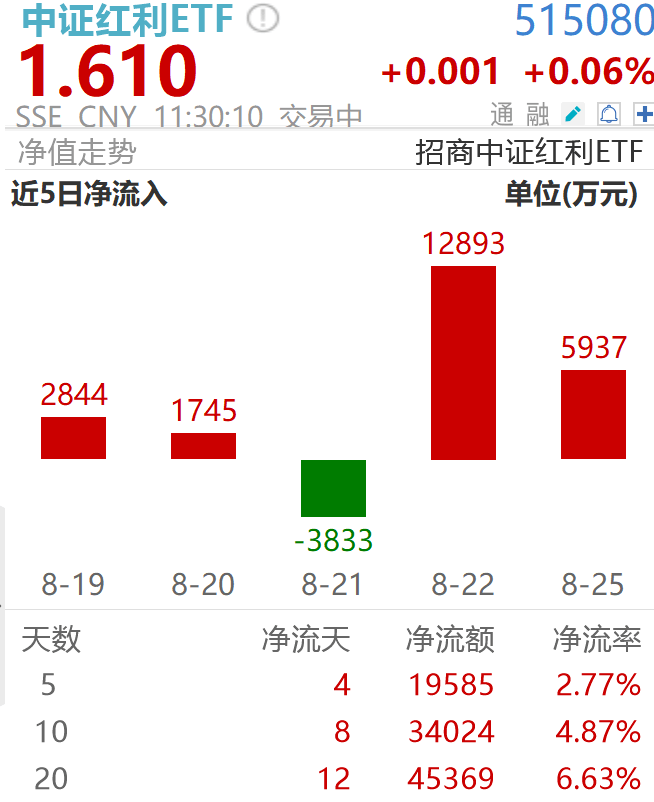
Core Insights - The recent decline of the 40-day return difference of the CSI Dividend Index to -10.28% indicates a historically extreme level of underperformance compared to the broader market [1][3] - Despite this underperformance, there is a notable influx of capital into dividend assets, suggesting that investors are taking advantage of the current market sentiment and fundamentals [1][3] Group 1: Market Signals - The drop below -10% in the return difference is a significant "contrarian signal," indicating a potential shift in the relative attractiveness of dividend assets [3] - The current level of -10.28% suggests that dividend stocks have been under pressure for too long, creating a potential opportunity for investors [3] Group 2: Capital Inflows - The CSI Dividend ETF (515080) has seen substantial net subscriptions, with recent inflows of 129 million and 59 million, totaling nearly 340 million over ten trading days, indicating strong demand [1] - This trend reflects a strategic move by investors to capitalize on the perceived value in dividend assets amidst market fluctuations [1][3] Group 3: Fundamental Changes - The ongoing earnings season has seen 288 companies announce mid-term dividend plans, with a total proposed payout of approximately 164.7 billion, signaling improved profitability and cash flow [3] - The increasing focus on dividends aligns with current policy directions encouraging shareholder returns, enhancing the appeal of dividend stocks as cash flow assets [3] Group 4: Investment Strategy - The attractiveness of dividend assets is rising due to their defensive nature and long-term return potential, making them a critical component of investment strategies [5] - Investors are encouraged to consider dollar-cost averaging or phased investments in the CSI Dividend ETF (515080) and related dividend quality products for a balanced approach [9]
理财收益持续下滑,理财“特种兵”转战“新三金”配置
Di Yi Cai Jing· 2025-08-26 04:03
Core Insights - The phenomenon of "financial special forces" reflects the challenges faced by investors in the current low-interest-rate environment, where high-frequency trading among various financial products yields minimal returns [1][2][4] - The shift from single-asset investments to diversified asset allocation is becoming increasingly important as investors seek stability and growth in their portfolios [1][6][12] Group 1: Market Trends - The decline in bank deposit interest rates has led to a surge in bank wealth management products, with many investors transitioning from traditional savings to wealth management strategies [2][6] - The average performance benchmark for open-ended wealth management products decreased by 0.03 percentage points to 2.27%, while closed-end products saw a drop of 0.04 percentage points to 2.51% [4][5] Group 2: Investment Strategies - The "new three golds" strategy, which combines money market funds, bond funds, and gold ETFs, is gaining popularity among younger investors as a balanced approach to wealth management [7][8][10] - Different asset allocation models are being proposed, such as conservative, balanced, and aggressive configurations, to cater to varying risk appetites among investors [8][11] Group 3: Performance and Expectations - Investors are experiencing anxiety over the performance of wealth management products, with reports of significant declines in returns, particularly for products that initially offered high yields [4][5] - The overall yield for wealth management products is expected to trend downward due to falling bond yields and the maturation of previously high-yield assets [5][10]

奇妙的“账户温差”: 为何养老理财产品在普通账户更受欢迎
Zhong Guo Zheng Quan Bao· 2025-08-25 22:18
Core Insights - The growth of personal pension accounts is lagging behind ordinary accounts, indicating that investors view these products primarily as high-quality ordinary investment options rather than dedicated pension products [1][2] - The development of pension wealth management is constrained by three main factors: insufficient sales push, lack of significant yield advantage over insurance products, and a prevailing investor preference for safety over returns [2][3] - Enhancing the investor holding experience is crucial for the development of pension wealth management, as it helps investors recognize the value of long-term investments [3][4] Sales Push Factors - Sales personnel are more actively promoting insurance products compared to wealth management products, which is influenced by sales incentive mechanisms [2] - The yield performance of wealth management products has not shown a significant advantage over insurance products in recent times [2] - Consumers prioritize safety in their pension savings, leading them to favor deposits and insurance products over riskier wealth management options [2][6] Investor Experience Enhancement - Improving the holding experience for investors is essential to help them appreciate the benefits of long-term investment and compound growth [3] - There is a significant potential difference in returns between low-yield savings products and slightly higher-yield wealth management products over a long investment horizon [3] - Financial institutions should focus on understanding client needs and designing products accordingly to enhance the long-term investment experience [3][4] Product Performance and Market Dynamics - Wealth management companies are confident in their product competitiveness, especially as both insurance and wealth management sectors face challenges in obtaining high-quality assets [4] - Wealth management products may gain competitive advantages over public funds due to better asset acquisition capabilities and investment strategy flexibility [4] Asset Allocation Strategies - Current personal pension account allocations are primarily based on investor self-decision rather than professional asset allocation services [6] - Professional institutions can stimulate the pension wealth management market by providing scientific and systematic asset allocation services tailored to individual client needs [6] - Recommendations for a balanced asset allocation strategy can help clients optimize their pension funds, moving away from solely relying on low-yield savings [6]
奇妙的“账户温差”:为何养老理财产品在普通账户更受欢迎
Zhong Guo Zheng Quan Bao· 2025-08-25 20:08
Core Viewpoint - The growth of personal pension accounts in wealth management products is lagging behind that of ordinary accounts, indicating that investors are primarily attracted by product performance rather than pension-specific benefits [1][2]. Sales Push Factors - Sales personnel are more actively promoting insurance products compared to wealth management products, which is influenced by sales incentive mechanisms [1][2]. - The relative lack of significant advantages in yield performance of wealth management products compared to insurance products has also hindered growth [1][2]. Consumer Preferences - Safety is prioritized by consumers when it comes to pension savings, leading them to favor deposits and insurance products over riskier wealth management products and funds [2][5]. - Investors show a higher acceptance of target-risk pension products compared to target-date products, reflecting a cautious approach towards long-term investments [2]. Enhancing Investor Experience - Improving the holding experience for investors is crucial for the development of pension wealth management, helping them recognize the value of long-term investments [2][3]. - A small difference in annual yield between savings and wealth management products can lead to significant disparities in returns over a 30-year period due to compounding effects [2]. Asset Allocation Strategies - Wealth management companies should focus on understanding customer needs to design products that consider clients' risk tolerance and net value fluctuations [3][4]. - Professional institutions providing systematic asset allocation services can stimulate the growth potential of the pension wealth management market [3]. Comprehensive Asset Allocation Solutions - Companies are exploring comprehensive asset allocation plans for clients, suggesting specific ratios for savings, insurance, funds, and wealth management to optimize returns [4].
资管一线 | ETF迈入“超级配置时代” 挖掘细分赛道投资机遇
Xin Hua Cai Jing· 2025-08-25 15:47
Group 1: Industry Trends and Developments - The global economy is undergoing a restructuring phase, creating new opportunities in capital markets, particularly in index investment [1] - The ETF market is entering a "super allocation era," with significant growth in transaction volume and acceptance among new generation investors [2] - The innovation drug sector is transitioning from a "valuation lowland" to an "innovation highland," with potential for a 20% annual profit growth over the next decade [4] Group 2: Investment Strategies and Opportunities - Investment strategies should focus on identifying opportunities in industries recovering from intense competition, rather than chasing hot sectors [7] - A "core + satellite" investment structure is recommended, using broad-based indices as a foundation while incorporating high-growth sectors for balanced risk and return [6] - The low-altitude economy is emerging as a new growth point for the military-civilian integration of the aerospace industry, supported by favorable policies [5] Group 3: Sector-Specific Insights - The robotics industry is accelerating due to the smart wave and supportive policies, with investment opportunities linked to order fulfillment and domestic substitution [4] - The renewable energy sector is characterized by a "full-chain collaboration" approach, optimizing the supply chain and creating new demand for materials like copper [6] - The ETF market is seeing a shift towards more differentiated strategies, including factor-based and fixed-income enhanced ETFs, indicating a diversification of investment approaches [3][2]
盈利、情绪和需求预期:市场信息对宏观量化模型的修正——数说资产配置系列之十一
申万宏源金工· 2025-08-25 08:01
Group 1 - The article discusses a macro quantitative framework that combines economic, liquidity, credit, and inflation factors for asset allocation and industry/style configuration [1][3] - The framework has been adjusted based on the changing mapping of macro variables to assets, with a focus on economic and liquidity indicators [1][5] - The performance of aggressive portfolios since 2013 shows an annualized return of approximately 8.5%, with a 0.6% excess return compared to the benchmark [3][5] Group 2 - The article highlights the impact of macroeconomic conditions on industry and style configurations, incorporating credit sensitivity into the analysis [5][7] - The macro-sensitive industry configuration has shown varying performance, with a notable decline since 2022, indicating the need for adjustments in selection criteria [7][10] - The article emphasizes the importance of market expectations in influencing macroeconomic indicators and their relationship with asset performance [13][18] Group 3 - The Factor Mimicking model is introduced to capture market expectations regarding macro variables, using a refined stock pool for better representation [19][20] - The construction of the Factor Mimicking portfolio aims to reflect the market's implicit views on economic, liquidity, inflation, and credit variables [19][23] - The article discusses the need for additional micro mappings to enhance the representation of macro variables, particularly in relation to corporate earnings and valuations [28][30] Group 4 - The article outlines the adjustments made to the macro variables based on market expectations, focusing on economic, liquidity, and credit dimensions [34][36] - The revised indicators are expected to improve asset allocation strategies, particularly in the context of equity markets [39][40] - The performance of the revised industry and style configurations indicates a positive impact from incorporating market expectations into the analysis [46][54]

东海证券晨会纪要-20250825
Donghai Securities· 2025-08-25 05:49
Group 1: Federal Reserve Insights - The Federal Reserve Chairman's dovish remarks may strengthen interest rate cut expectations, emphasizing the importance of asset direction sustainability [6][8] - The global stock markets mostly rose, with A-shares leading, while major commodity futures such as oil, gold, copper, and aluminum also increased [6][8] - The U.S. labor market appears balanced but carries rising hidden risks, with Powell indicating that the unemployment rate, although slightly up to 4.2%, remains at a historically low level [11][12] Group 2: Company Reports - Zhongsheng Pharmaceutical (002317) is experiencing steady growth in its core traditional Chinese medicine business, with successful procurement outcomes for its flagship products [17][20] - Lingrui Pharmaceutical (600285) reported a revenue of 2.099 billion yuan in the first half of 2025, a year-on-year increase of 10.14%, driven by both internal development and external expansion [21][24] - Yangjie Technology (300373) achieved a revenue of 3.455 billion yuan in the first half of 2025, reflecting a year-on-year growth of 20.58%, with significant contributions from automotive electronics and AI server sectors [26][30] Group 3: Market Trends - The domestic equity market showed a strong performance, with a daily average trading volume of 25.477 billion yuan, indicating a positive market sentiment [7][33] - The semiconductor sector led the market with a 7.66% increase, while defensive sectors like agriculture and consumer goods faced declines [37] - The overall market is expected to maintain upward momentum, with significant inflows of large capital into growth sectors [33][34]
「黄金+」:你投资组合的压舱石
Sou Hu Cai Jing· 2025-08-25 04:37
Group A - Gold has emerged as one of the best-performing assets in recent years, with a 28% increase in 2024 and over 25% since 2025, leading financial institutions to launch "Gold+" multi-asset strategy products [1] - The "Gold+" strategy is increasingly recognized by asset management institutions and favored by individual investors, indicating a shift in gold's role from a tactical tool for asset allocation to a strategic core holding [1] Group B - Gold should be viewed as a strategic core holding for macro hedging, currency hedging, and achieving stable long-term returns, rather than a tactical tool for short-term gains [1] - The current macro environment and external shocks significantly impact the overall performance of RMB assets (equities, fixed income) beyond the variables of individual assets [1] Group C - Over the past 20 years, gold has provided an annualized return of over 10% when calculated in RMB, outperforming most mainstream assets over 10-year and 5-year periods [3] - The long-term returns of gold are primarily driven by global GDP growth and physical gold demand, including central bank purchases, financial investments, gold bars and coins, jewelry, and technological uses [3] Group D - Gold serves as a global pricing asset that does not rely on any country's or institution's credit backing, making it a hedge against currency fluctuations [6] - In the context of global monetary expansion, gold can act as a hedge against all credit currencies [6] Group E - Historical data shows that when traditional stock-bond portfolios (50% stocks, 50% bonds) experience a downturn due to systemic risks, gold tends to perform well, providing investors with a buffer against risk [9] - Gold's demand is diverse and driven by global factors, resulting in low correlation with domestic assets, effectively reducing the impact of systemic risks on traditional stock-bond portfolios [9]

「黄金+」:你投资组合的压舱石
华尔街见闻· 2025-08-25 04:09
Group 1 - The core viewpoint is that gold is transitioning from a "tactical tool" for short-term gains to a "strategic core" for long-term investment, as evidenced by its significant price increase of 28% in 2024 and over 25% since 2025 [1][2] - The current macroeconomic environment and external shocks, such as tariffs and geopolitical conflicts, have a greater impact on RMB assets than on individual asset variables, indicating a need for a strategic approach to asset allocation [2] - Gold has provided a long-term annualized return of over 10% over the past 20 years, outperforming most mainstream assets in 10-year and 5-year dimensions, driven by global GDP growth and diverse demand sources [6][8] Group 2 - Gold serves as a hedge against currency fluctuations, being a globally priced asset that does not rely on any country's credit, making it a valuable tool in the context of global currency overproduction [10] - Historical data shows that gold performs well during market corrections in traditional stock-bond portfolios, providing a buffer against systemic risks due to its low correlation with domestic assets [11][12]
