产业升级

Search documents
【环球财经】多元突围与韧性生长——科特迪瓦经济转型的密码
Xin Hua She· 2025-09-04 13:51
Economic Growth and Recovery - Côte d'Ivoire has achieved an average economic growth rate of 7% over the past decade, emerging from the devastation of civil wars to become a leading economy in Sub-Saharan Africa [1] - Following the end of conflicts in 2011, the government implemented a national development plan that led to an average GDP growth of approximately 9.6% from 2012 to 2015 [5][6] Agricultural Sector and Cocoa Industry - Côte d'Ivoire is the world's largest cocoa producer, contributing 40% of global cocoa beans, but has historically been trapped in low-value raw material exports [7] - The government aims to achieve 100% local processing of cocoa beans by 2030, with current local conversion rates at about 33% [10] - A new state-owned cocoa processing plant, capable of processing 50,000 tons annually, has recently commenced operations [10] Infrastructure Development - Côte d'Ivoire is the second-largest economy in the West African Economic Community and is actively enhancing its infrastructure to become a regional economic hub [13] - The country has a total road length of 82,500 kilometers, accounting for 50% of the total road length in the West African Economic and Monetary Union [16] - The Abidjan port, the largest container port in West Africa, has increased its annual throughput from 1.2 million to 2.5 million standard containers after upgrades [16] Private Sector Activation - The government has adopted a "flooding the market" approach to stimulate the private economy through policy relaxation and market opening [17] - In 2023, over 25,000 new businesses were registered in Côte d'Ivoire, reflecting a vibrant entrepreneurial environment [17] - The collaboration between public and private sectors has resulted in an average economic growth rate of 6.5% from 2021 to 2023, despite global challenges [17]


市场监管总局:我国正牵头制定脑机接口相关国际标准
Zhong Guo Xin Wen Wang· 2025-09-04 11:43
Core Viewpoint - China is leading the development of international standards for brain-computer interfaces, which is crucial for enhancing the competitiveness of its manufacturing industry and supporting high-quality development [1][2]. Group 1: National Standards Development - Since the 14th Five-Year Plan, the State Administration for Market Regulation has released over 4,000 national standards in key industries such as integrated circuits, new materials, and new energy vehicles, playing a significant role in modernizing the industrial system and ensuring supply chain stability [1]. - In the field of intelligent manufacturing, 491 national standards have been published to assist enterprises in their digital and intelligent transformation [1]. - The solar photovoltaic sector has seen the release of 221 national standards, which help prevent irrational competition and promote high-quality industry development [1]. Group 2: International Standards Initiatives - During the 14th Five-Year Plan, China has taken on 26 technical secretariats in international standard organizations and proposed 880 international standard proposals in areas like new energy vehicles and aerospace [2]. - The conversion rate of advanced applicable international standards to Chinese standards exceeds 90%, with 4,210 standards being adapted [2]. - China is actively promoting international standard exchanges through platforms like the Hongqiao International Economic Forum and the Qingdao International Standardization Conference [2]. Group 3: Impact of International Standards - International standards enhance the international competitiveness of industries, particularly in emerging technologies such as artificial intelligence and brain-computer interfaces, with Chinese experts leading the development of key international standards in these areas [2][3]. - The establishment of international standards for new business models supports the growth of the digital economy and technology innovation, exemplified by the first global standard for eldercare robots [3]. - International standards facilitate international trade by providing unified technical specifications for major trade products, such as lithium-ion batteries [3]. - Standards related to carbon data tracing and carbon footprint accounting contribute to sustainable development by addressing cross-border comparability and verification challenges [3]. Group 4: Future Directions - The focus will be on converting more technological achievements into international standards and enhancing practical exchanges with other countries to continuously support high-quality development in the manufacturing sector [4].
宏观政策需加码扩内需、降成本|宏观晚6点
Sou Hu Cai Jing· 2025-09-04 10:19
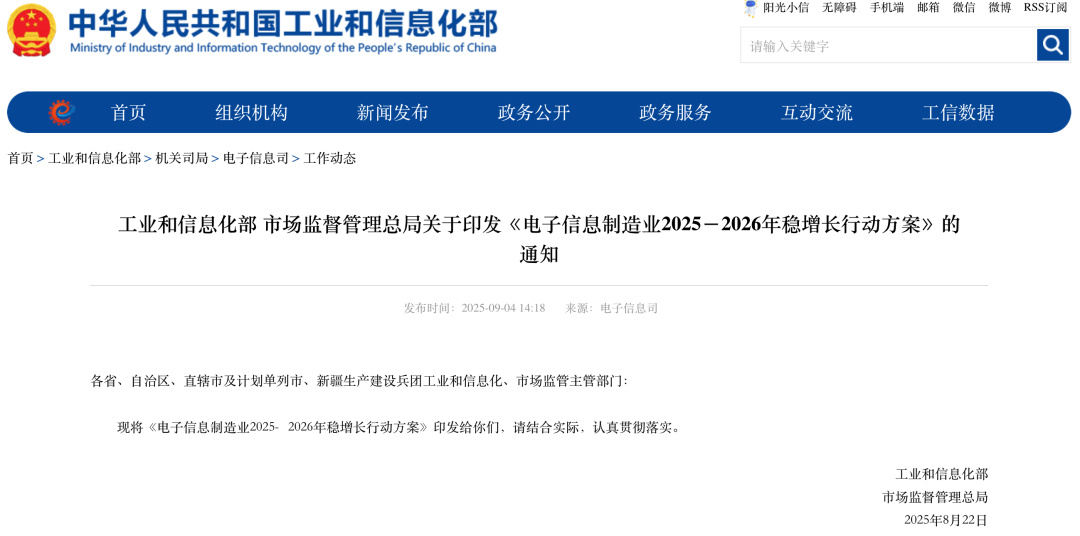
Group 1: Macro News - The Ministry of Industry and Information Technology and the State Administration for Market Regulation have released the "Action Plan for Stable Growth of the Electronic Information Manufacturing Industry 2025-2026," which includes 16 specific measures aimed at promoting industrial upgrades, enhancing the high-quality supply system, and fostering economic circulation [1] - The plan focuses on three main areas: promoting industrial upgrades, deepening the construction of a high-quality supply system, and driving the integration of technological and industrial innovation [1] Group 2: Renewable Energy Development - The National Energy Administration is actively researching policy measures to promote the development of deep-sea offshore wind power and solar thermal power, emphasizing the acceleration of new models and new business formats in renewable energy [2] - The administration aims to leverage a series of supportive policies to facilitate the growth of emerging industries in the renewable energy sector [2] Group 3: Local Government Debt - In August, local government bond issuance reached 977.6 billion yuan, exceeding the previously announced issuance plan of 940.8 billion yuan [5] - Five provinces (municipalities) issued over 50 billion yuan in bonds, with Anhui leading at 92.7 billion yuan, followed by Guangdong at 92.1 billion yuan and Zhejiang at 76.0 billion yuan [5]
离开增长和规模,谈生意属于“耍流氓”
创业家· 2025-09-04 10:14
Core Viewpoint - The article emphasizes that discussing business without considering growth and scale is misleading, comparing business scale to a pyramid where the base represents more common businesses that can generate profit, while the top represents the dreams of a few that are harder to monetize [1]. Investment Insights - Wu Shichun, the founder of Meihua Venture Capital, is expected to invest no less than 1.5 billion in the second half of the year [5]. - The article highlights a learning and networking event led by Wu Shichun, aimed at exploring new growth engines through innovation in various industries [2][8]. Event Details - The event will take place from September 21 to 23, featuring deep engagement with industry leaders and entrepreneurs, focusing on technology innovation and commercialization strategies [10][19]. - Participants will have opportunities for one-on-one mentorship, project presentations, and networking with over 100 entrepreneurs [10][18]. Industry Focus - The event covers multiple sectors including robotics, smart manufacturing, low-altitude economy, satellite communication, and the integration of technology with consumer products [20][21][22][23]. - The article mentions that Meihua Venture Capital has invested in over 600 companies, with a total fund management scale exceeding 10 billion [12].

锚定长期价值 宏润建设拟斥1.5亿-3亿元回购股份
Quan Jing Wang· 2025-09-04 09:02
Group 1 - The company plans to repurchase A-shares using self-raised funds and special loans, with a total amount between 150 million and 300 million yuan, and a maximum repurchase price of 9.00 yuan per share, to enhance investor confidence and long-term value [1] - The company has secured a special loan of 270 million yuan from Industrial and Commercial Bank of China, with a term not exceeding 36 months, and the repurchase funds will not significantly impact its operational and debt repayment capabilities [1] - The company holds "Double Special Double First-Class" qualifications, which enhance its market competitiveness in urban rail transit and underground comprehensive pipe gallery sectors, particularly in the Yangtze River Delta region [2] Group 2 - In the first half of 2025, the company focused on major infrastructure projects, with new contracts totaling 2.273 billion yuan, of which urban rail transit, municipal engineering, and highway projects accounted for 84.87% [3] - The company's main business achieved operating revenue of 2.116 billion yuan in the first half of 2025, an increase of 11.98% year-on-year, and net profit attributable to shareholders was 132 million yuan, up 6.11% year-on-year [3] - The company's renewable energy business revenue grew by 94.18% year-on-year, turning a profit, indicating strong growth momentum [3] Group 3 - The company is actively investing in the humanoid robot sector through the establishment of Hongrun Times Technology Co., Ltd. and strategic investment in Jingzhi Technology (Shanghai) Co., Ltd., aligning with trends in smart manufacturing and industrial upgrading [4]

事关芯片、人工智能终端、锂电池等领域,两部门联合发文
Sou Hu Cai Jing· 2025-09-04 08:44
Core Viewpoint - The Ministry of Industry and Information Technology and the State Administration for Market Regulation have issued the "Action Plan for Stable Growth of the Electronic Information Manufacturing Industry (2025-2026)", which outlines 16 specific measures to promote industrial upgrading, enhance the high-quality supply system, facilitate economic circulation, and drive technological and industrial innovation integration [1][3]. Group 1: Expected Goals - The average growth rate of the value-added in the computer, communication, and other electronic equipment manufacturing industries is projected to be around 7% from 2025 to 2026, with the annual revenue growth rate of the electronic information manufacturing industry expected to exceed 5% when including related fields such as lithium batteries and photovoltaics [3]. - By 2026, it is anticipated that the revenue scale and export ratio will maintain the top position among 41 industrial categories, with five provinces achieving over 1 trillion yuan in electronic information manufacturing revenue, and the server industry scale exceeding 400 billion yuan [3]. - The domestic market penetration rate for color televisions of 75 inches and above is expected to exceed 40%, while personal computers and mobile phones will advance towards higher levels of intelligence and premium quality [3]. Group 2: Industrial Upgrading and Innovation - The plan emphasizes promoting high-end electronic complete machines and enhancing product supply levels, focusing on key areas and industry applications, and continuously strengthening the supply level of electronic products [3]. - It encourages the integration of artificial intelligence terminals with end products, developing a grading method and standards for the intelligence of AI terminals, and promoting innovative applications of AI terminals across various regions [3]. Group 3: Quality Development and Consumption Expansion - The plan aims to eliminate "involution" competition in the photovoltaic sector and achieve high-quality development by legally addressing low-price competition in photovoltaic products [4]. - It supports the orderly layout of photovoltaic and lithium battery industries at the local level, implements quality management for photovoltaic modules and lithium battery products, and strengthens policy coordination with investment, finance, and safety [4]. - To expand consumption scenarios, the plan proposes improving the design level of smart products for the elderly and increasing the supply of high-quality terminal products for smart health and elderly care [4].
创投月报 | 金雨茂物:八个月六只基金合募超26亿 成长期项目投资占比超80%
Xin Lang Zheng Quan· 2025-09-04 07:33
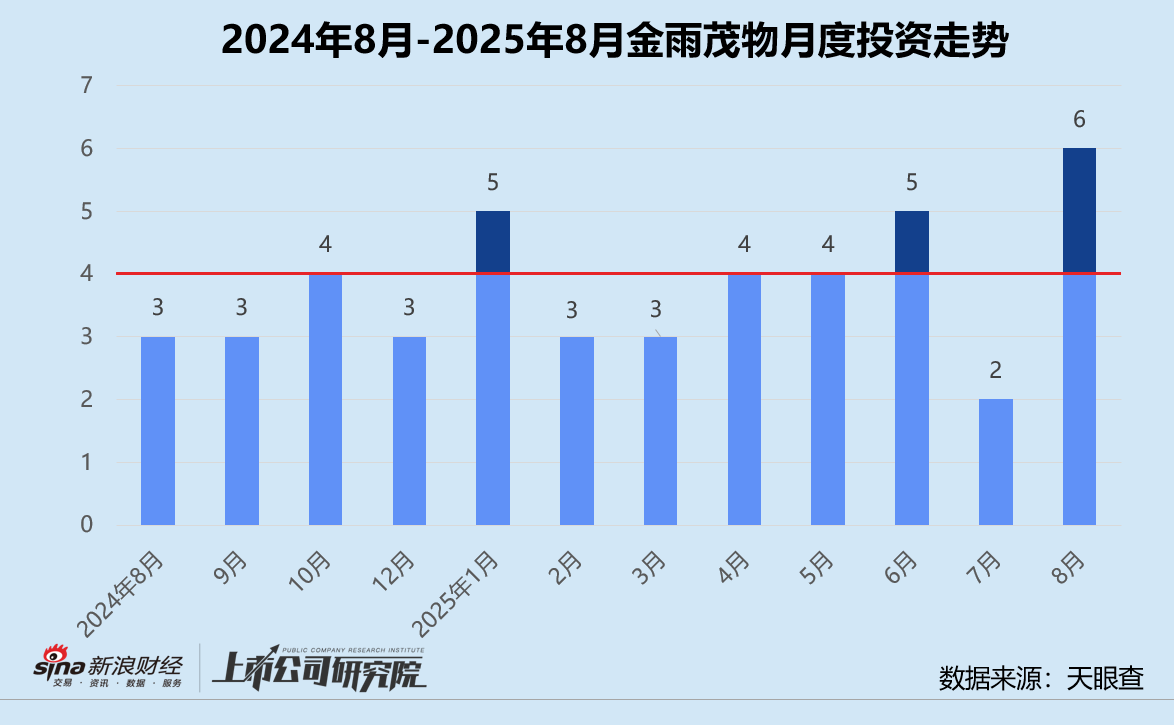
Group 1 - The number of newly registered private equity and venture capital fund managers in August 2025 dropped to 5, a decrease of nearly 70% compared to July, and a 64.3% decline year-on-year [1] - A total of 368 new private equity and venture capital funds were registered, showing a year-on-year growth of 25.2%, but a slight month-on-month decrease of 1.9% [1] - The domestic primary equity investment market recorded 565 financing events, with a year-on-year increase of 28.4% and a month-on-month increase of 2.4%, while the total disclosed financing amount reached approximately 35.178 billion yuan, up 32.8% year-on-year [1] Group 2 - Jin Yu Mao Wu, established in 2004, has a fund management scale exceeding 16 billion yuan and has invested in over 300 companies, with more than 30 successfully listed [3] - The company focuses on strategic emerging industries such as new materials, intelligent manufacturing, new energy, and health care [3] - As of the end of August 2025, Jin Yu Mao Wu registered 6 funds with a total registered capital of 2.666 billion yuan [3] Group 3 - The Suzhou Jin Yu Intelligent Venture Capital Partnership, with a total scale of 1 billion yuan, focuses on early, growth, and mature stage companies in emerging and frontier equipment fields [4] - Jin Yu Mao Wu's investment activity has shown a "structural surge under a stable tone," with a significant increase in investment events in the second half of 2024 and early 2025 [4][6] - The company primarily invests in growth stage projects, with 83.3% of investments in A and B rounds [6] Group 4 - Jin Yu Mao Wu's investment strategy aligns with the trends of "high-end, intelligent, and green" industrial upgrades, focusing on advanced manufacturing and enterprise services [8] - The company has a strong local presence in Jiangsu, which is beneficial for leveraging local resources and capturing quality companies [10] - Investments are also made in regions like Beijing, Hubei, and Shenzhen to diversify risks and enhance collaborative effects [10] Group 5 - Commer Pharmaceutical, a one-stop CDMO enterprise, completed a financing round of several million yuan, with funds aimed at business development and R&D platform construction [12] - Jin Yu Mao Wu participated in Commer's A round financing in 2022, and the current investment is through a city-level industrial fund managed by Jin Yu Mao Wu [12]
福建宁德:博士后人才为高质量发展注入创新动能
Zhong Guo Jing Ji Wang· 2025-09-04 06:42
Group 1 - The postdoctoral teams in Ningde City are driving innovation and research in various industries, including new energy materials, digital economy, biopharmaceuticals, and agricultural technology [1][3] - The establishment of 11 postdoctoral innovation practice bases and 9 postdoctoral research stations has facilitated collaboration between private enterprises and research institutions [1][2] - The local government incentivizes innovation by offering up to 300,000 yuan to award-winning teams in the national postdoctoral innovation and entrepreneurship competition [1][3] Group 2 - The Fujian province has seen significant advancements in traditional industries, with postdoctoral teams achieving notable technological breakthroughs, such as the gas diffusion layer technology for proton exchange membrane fuel cells [2][3] - The collaboration between Fujifa Aquatic Co. and over 30 universities and research institutes has fostered a synergistic innovation model, enhancing the development of the aquaculture industry [2][3] - The postdoctoral research station at Fujifa has completed five national and provincial projects since its establishment in 2018, focusing on major diseases affecting yellow croaker [2][3] Group 3 - The establishment of postdoctoral research stations in rural revitalization has led to advancements in tea quality improvement and aquaculture, with companies like Pinpin Tea and Minwei Industry seeing a 15% increase in output value [3][4] - The focus on high-value development of by-products in aquaculture, such as collagen and fish oil phospholipids, is contributing to economic benefits and farmer income [3][4] - Ningde has created a virtuous cycle of talent-driven innovation, with nearly 25% of postdoctoral researchers being female, supported by specific policies for women's research [3][4] Group 4 - Ningde's postdoctoral teams have received 17 provincial-level natural science fund grants and 23 provincial-level research project grants, with 286 patents granted and 58 papers published [4] - The region ranks high in the number of high-level talents, with 75 recognized at the provincial level and 4 awarded as national outstanding postdoctoral researchers [4] - The transformation of research outcomes into practical applications is providing continuous momentum for modern development in Ningde [4]
【财经分析】印尼抗议浪潮平息 经济仍具韧性
Xin Hua Cai Jing· 2025-09-04 05:47
Core Insights - Indonesia is experiencing a wave of protests, but the stock market is at a near five-year high, indicating underlying economic resilience despite short-term challenges such as currency depreciation and weak consumer demand [1][4]. Economic Challenges - The Indonesian rupiah has depreciated by 0.17% in the past month and 6.42% over the past year, with the current exchange rate at 16,414.5 IDR per USD [2]. - Consumer Price Index (CPI) has shown a slight decrease of 0.08% month-on-month, with an annual inflation rate of 2.31%, reflecting weakened consumer purchasing power [2]. - Domestic travel during the Ramadan period saw a decrease of approximately 47 million people compared to 2024, indicating reduced consumer spending [2]. Trade Performance - Indonesia's imports fell by 5.86% year-on-year in July, marking the largest decline since May 2024, while the country maintained a trade surplus of $4.17 billion for 63 consecutive months, driven by coal, palm oil, and steel exports [3]. - The trade outlook may face uncertainties due to potential impacts from the US-Indonesia tariff agreement and declining coal prices [3]. Stock Market Dynamics - The Jakarta Composite Index closed at 7,885.86 points on September 3, reflecting a 20.96% increase over the past six months, indicating strong market performance despite recent protests [4]. - Economic fundamentals, proactive monetary policy, and valuation recovery are driving the stock market's upward trend [4]. - The stock market is considered undervalued based on the original Buffett indicator, with an expected annual return of +10.9% over the next eight years [5]. Long-term Outlook - Indonesia's large market size and significant role in global commodity trade enhance its resilience against external risks, with food self-sufficiency being a highlight of the economy this year [6]. - The manufacturing sector is expected to benefit from ongoing upgrades, supported by demographic advantages and deepening cooperation with major economies like China [5][6].
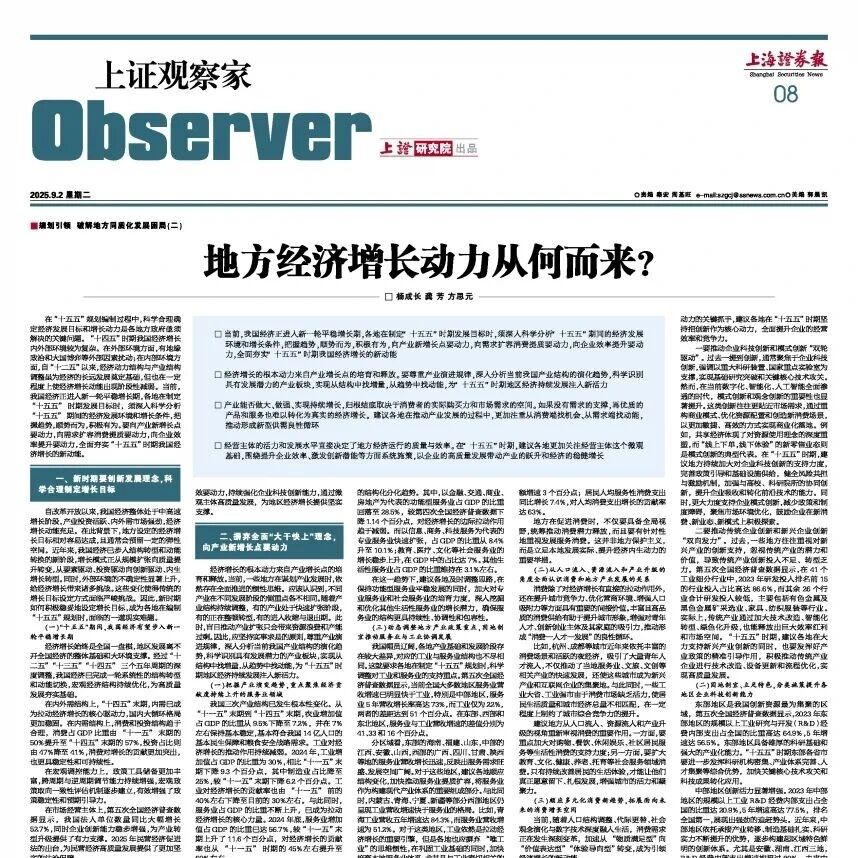
申万宏源杨成长:地方经济增长动力从何而来?
申万宏源证券上海北京西路营业部· 2025-09-04 02:32
Core Viewpoint - The article emphasizes the need for local governments to scientifically analyze the economic development environment and growth conditions during the "14th Five-Year Plan" period, focusing on new growth points in industries, expanding demand, and improving enterprise efficiency to solidify new economic momentum for the "15th Five-Year Plan" period [5][6][9]. Group 1: Economic Growth and Development Goals - The article highlights that China is entering a new phase of stable economic growth, necessitating a careful determination of growth targets by local governments [6][7]. - It notes that internal demand has become the core driving force for economic growth, with consumption's contribution to GDP increasing from 50% at the end of the "11th Five-Year Plan" to 57% at the end of the "14th Five-Year Plan" [7]. - The article stresses the importance of setting realistic growth targets that are neither overly ambitious nor pessimistic, based on local resources and industrial foundations [8][9]. Group 2: Industry Development and Innovation - The article suggests that economic growth fundamentally relies on the cultivation and release of new industrial growth points, urging local governments to respect industrial evolution and identify promising sectors [11][12]. - It points out the significant shift in China's industrial structure, with the service sector's contribution to GDP rising to 56.7% by the end of 2024, while the industrial sector's contribution is declining [11][12]. - The article recommends focusing on enhancing the service sector's role in economic growth, particularly in lower-tier cities where its importance is often overlooked [12][14]. Group 3: Consumption and Demand Expansion - The article emphasizes the critical role of consumer purchasing power and market demand in driving economic growth, advocating for a focus on consumption-driven opportunities [15][16]. - It distinguishes between goods consumption and service consumption, noting that service consumption has a more direct local economic impact [16]. - The article highlights the need to adapt to changing consumer trends, particularly among younger and older demographics, to stimulate new consumption growth [18][19]. Group 4: Enterprise Development and Innovation - The article underscores the importance of enterprise vitality and development levels in determining local economic quality and efficiency, advocating for systematic policies to enhance enterprise efficiency and innovation [19][20]. - It calls for a dual focus on technological and model innovation to improve enterprise competitiveness, especially in the context of digital transformation [20][22]. - The article stresses the need for tailored strategies to enhance innovation capabilities across different regions, considering their unique industrial bases and development stages [23][24].