
人民币升值

Search documents
管涛:众口一词的人民币升值“真相”|立方大家谈
Sou Hu Cai Jing· 2026-01-11 14:53
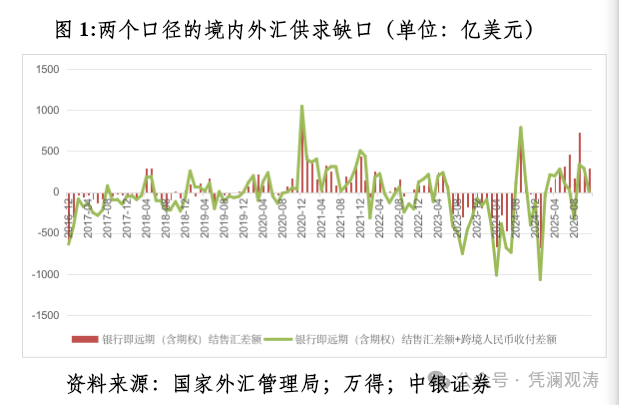
Core Viewpoint - The article discusses the recent strengthening of the RMB against the USD, highlighting that the narrative around RMB appreciation lacks substantial data and theoretical support, despite claims from foreign investment banks about its structural undervaluation and potential asset revaluation in China [1][2][4]. Exchange Rate Trends - From July 2023 to February 2025, the RMB faced overall pressure, with a notable shift to a surplus in bank foreign exchange settlements starting March 2025, accumulating a surplus of $273.3 billion by November 2025 [2][4]. - In November 2025, the bank's foreign exchange settlement surplus was $29.7 billion, a modest increase from the previous month, indicating a lack of strong market consensus on RMB appreciation [2][4]. Market Behavior - The improvement in the foreign exchange situation is attributed more to a decrease in the motivation to purchase foreign currency rather than an increase in the willingness to settle foreign exchange [4]. - The average settlement rate for foreign currency receipts increased to 54.6% from July 2023 to February 2025, while the payment rate decreased to 58.8%, suggesting a natural hedging against exchange rate risks rather than a bullish sentiment towards RMB [4]. Real Effective Exchange Rate (REER) - The RMB's real effective exchange rate (REER) has depreciated by 16.7% since March 2022, contrasting with the appreciation of other major currencies, indicating a complex relationship between REER and nominal exchange rates [7][11]. - Despite the depreciation of the REER, it does not necessarily imply that the RMB is undervalued or will appreciate, as historical data shows inconsistent relationships between REER movements and nominal exchange rates [7][18]. Trade Balance and Economic Indicators - China has maintained a significant trade surplus, while Japan has faced trade deficits since 2021, yet China's overall current account surplus remains within international warning limits [12][15]. - The article emphasizes that while a trade surplus may suggest RMB undervaluation, domestic economic conditions, such as low inflation and nominal growth rates, could indicate overvaluation [15][23]. Impact on Corporate Earnings - Analysis of A-share listed companies from 2015 to 2022 shows that a higher percentage of non-financial firms reported net exchange gains during depreciation years compared to appreciation years, suggesting that RMB appreciation may not necessarily benefit corporate earnings [21][23]. - The shift from net external debt to net external assets for Chinese firms raises concerns that significant RMB appreciation could lead to net exchange losses, adversely affecting corporate profitability [23].

中信建投:有色行情仍未结束
Xin Lang Cai Jing· 2026-01-11 11:50
Group 1: Market Overview - Recent focus in the Chinese capital market is on the RMB exchange rate and non-ferrous metal trends [1][22] - The A-share market opened strong, with the Shanghai Composite Index surpassing 4100 points, marking a 10-year high, while the H-share market experienced slight adjustments [8][24] - The strong performance in the equity market is contrasted by a pullback in the bond market, with the 10-year government bond yield reaching 1.9% [10][26] Group 2: Non-Ferrous Metals - The non-ferrous metal market, particularly copper and aluminum, is expected to maintain strong performance, driven by strategic resource pricing and unexpected monetary easing in the U.S. [2][22] - Copper prices are projected to continue rising, with a target of $13,000 not being the peak for this cycle, and a favorable outlook for 2026 [2][22] - The essence of the non-ferrous market is seen as a reflection of the global shift in pricing and order, with copper expected to take over from gold [2][22] Group 3: Currency Outlook - There is a bullish outlook on the appreciation of the RMB, driven by the return of funds to China and a revaluation of RMB assets [2][22] - The short-term stability of the RMB exchange rate is anticipated, with discussions on appreciation likely to coincide with peaks in foreign exchange settlements [2][22] Group 4: Economic Policies and Data - The People's Bank of China is expected to continue implementing a moderately loose monetary policy, focusing on high-quality economic development and reasonable price recovery [18][37] - Recent economic data shows a positive trend, with December CPI and PPI both increasing by 0.2%, indicating improvements in various sectors [19][38] - The government is taking measures to combat "involution" in sectors like photovoltaics, batteries, and food delivery platforms [36][37] Group 5: Commodity Performance - Geopolitical risks have led to a resurgence in gold and oil markets, with gold prices breaking through $4,500 per ounce and copper prices exceeding $13,000 [16][32] - The oil market is experiencing a rebound driven by geopolitical premiums rather than fundamental improvements, with global oversupply limiting long-term price increases [35][32]


摩根士丹利邢自强:人民币年内仍有升值空间
Sou Hu Cai Jing· 2026-01-10 11:11
Group 1 - The core viewpoint is that the recent appreciation of the RMB is driven by the depreciation of the USD and seasonal factors related to exports and consumption before the Spring Festival [1][2] - The RMB is expected to have room for appreciation this year, with a short-term forecast of around 6.8 in the first and second quarters, although there is uncertainty for the end of the year [1][2] - It is emphasized that China cannot rely solely on RMB appreciation to address issues such as internal competition, local government incentives, and fiscal and tax system problems [1][2]
人民币汇率会继续升值吗?邢自强回应
第一财经· 2026-01-10 10:11
1月10日,在"2026年中国首席经济学家论坛"上,摩根士丹利中国首席经济学家邢自强表示,近期人 民币升值主要受美元贬值及春节前出口和消费季节性因素推动。人民币今年仍有升值空间,短期内一 季度、二季度可能在6.8左右,但年底仍存在不确定性。他强调,中国要解决经济内卷、地方政府激 励及财税体系问题,不可能仅依赖人民币升值实现经济平衡。 ...
柳钢股份:人民币升值能有效降低进口资源采购成本
Zheng Quan Ri Bao· 2026-01-09 12:12
(文章来源:证券日报) 证券日报网讯 1月9日,柳钢股份在互动平台回答投资者提问时表示,人民币升值能有效降低进口资源 采购成本,对公司盈利创效有一定的效果。 ...

时隔近4个月,A股成交额再度突破3万亿
2 1 Shi Ji Jing Ji Bao Dao· 2026-01-09 07:21
Core Viewpoint - The A-share market has experienced a strong rally, with all three major indices rising and the Shanghai Composite Index surpassing the 4100-point mark for the first time in 10 years, indicating a significant increase in investor sentiment and market activity [1]. Trading Volume - The trading volume in the A-share market has exceeded 30 trillion yuan for the first time in nearly four months, with a total transaction amount of 30,000 billion yuan on January 9 [1]. - Since the beginning of 2026, the market has maintained a trading volume of over 25 trillion yuan for four consecutive trading days, with January 9 alone seeing a half-day trading volume of over 20 trillion yuan [1]. - Historical data shows that there have only been six instances where the daily trading volume exceeded 30 trillion yuan, with the most recent occurrences in October 2024 and August 2025 [1][2]. Market Sentiment and Future Outlook - Analysts suggest that the surge in trading volume and market activity may lead to further upward momentum, although this phase of growth may be characterized by irrational exuberance, with less correlation to earnings and value [5]. - Despite potential fluctuations during the upward trend, the overall stock market is expected to remain strong until the end of the global economic boom cycle [5]. - The current rally is described as structural, with certain popular sectors likely to continue reaching new highs, while less popular sectors may need to wait for market rotation opportunities [5].

时隔近4个月,A股成交额历史第6次突破3万亿
21世纪经济报道· 2026-01-09 07:18
Market Overview - The A-share market experienced a strong rally on January 9, with all three major indices rising. The Shanghai Composite Index increased by 0.92%, surpassing the 4100-point mark for the first time in 10 years, marking a 16-day consecutive rise [1] - The ChiNext Index rose by 0.77%, driven by surges in AI application themes, particularly in the film, short drama, and gaming sectors. Other leading sectors included commercial aerospace, humanoid robots, and small metal concepts, while the photovoltaic and large financial sectors weakened [1] Trading Volume and Investor Sentiment - Since the beginning of 2026, the market has maintained a trading volume exceeding 2.5 trillion yuan for four consecutive trading days, with today's half-day volume surpassing 2 trillion yuan, indicating a rapid increase in investor sentiment [3] - Historical data shows that such high trading volumes are rare in A-share history, with only six instances of daily trading volumes exceeding 3 trillion yuan. The most recent occurrence was on October 8, 2024, with a volume of 34,835.43 billion yuan [3][4] Market Dynamics and Economic Analysis - Economist Pan Helin stated that the current performance of the A-share market indicates a transition into a full bull market phase, driven by the appreciation of the yuan and the return of global capital. He noted that the upward trend in A-shares is still within a reasonable range compared to global markets [9] - Pan further analyzed that once trading volumes exceed 3 trillion yuan, market sentiment will likely push the market higher. This phase of growth may be less correlated with earnings and value, representing a typical characteristic of a bull market [9] Structural Characteristics of the Bull Market - Despite the bullish trend, Pan cautioned that fluctuations may occur during the bull market, with potential for short-term adjustments. However, the overall market is expected to remain strong until the end of the global economic prosperity cycle [10] - The current bull market is characterized as structural, with certain popular sectors likely to continue reaching new highs, while less popular sectors may need to wait for market rotation opportunities [10]

黄金成全球规模最大的储备资产:申万期货早间评论-20260109
申银万国期货研究· 2026-01-09 00:37
Group 1 - The article highlights that gold has become the largest reserve asset globally, surpassing the value of U.S. Treasury securities held overseas, with a value of $3.93 trillion compared to $3.88 trillion for U.S. debt [1] - The macroeconomic environment is supportive of precious metals, with easing inflation pressures and expectations of interest rate cuts from the Federal Reserve, which are expected to sustain the long-term upward trend of gold prices [2][19] - The supply of silver remains tight, with industrial demand, particularly from the photovoltaic sector, driving investment interest, while platinum demand is also expected to rise due to its use in hybrid vehicles and hydrogen energy [2][19] Group 2 - Lithium carbonate contracts continue to reach new highs, with strong terminal demand and a weekly production increase of 259 tons to 22,420 tons, despite anticipated declines in the production of ternary materials and lithium iron phosphate in January 2026 [3][23] - The social inventory of lithium carbonate has decreased by 168 tons to 109,605 tons, indicating a potential for upward price movement despite short-term price fluctuations [3][24] - The rubber market is experiencing price stability due to supply constraints and steady tire production, with expectations of a strong performance in rubber prices [4][16] Group 3 - The restructuring of China National Petroleum Corporation and China Aviation Oil Group is approved by the State Council, indicating a trend towards strategic and professional consolidation among state-owned enterprises [8] - The U.S. government is intervening in the financial market by purchasing $200 billion in mortgage-backed securities to lower mortgage rates, which is seen as a form of quantitative easing [6]


大类资产月度策略(2026.1):股汇共鸣迎暖春,债市避锋待转机-20260108
Guoxin Securities· 2026-01-08 06:31
Group 1 - The report highlights a "wide monetary + wide credit" environment, indicating stable credit expansion momentum and low risks of tightening financial conditions, which supports macroeconomic performance and asset markets [1][11] - In December, the major stock indices in China rose, reinforcing the consensus of a "slow bull" market, with small-cap stocks outperforming large-cap stocks, driven by increased ETF inflows [2][27] - The report suggests a shift in market style from a "dumbbell" approach favoring micro-cap and dividend value stocks to a more balanced "olive" shape favoring mid-cap stocks [2][27] Group 2 - The bond market showed signs of pressure, with the 10-year government bond yield declining faster than fundamental indicators, indicating accumulated adjustment risks [3][27] - The report notes that the Chinese yuan has returned to the "6" range, supported by external factors such as the weakening US dollar and internal economic recovery momentum [3][27] - Commodity markets displayed strength overall, with significant performance in precious metals like gold, driven by factors such as geopolitical risks and central bank purchases [4][27] Group 3 - The report recommends asset allocation strategies, suggesting a higher allocation to equities under an aggressive scenario (30% stocks, 70% bonds) and a more conservative approach (15% stocks, 85% bonds) [4][22] - Global asset allocation models indicate a preference for equities in various countries, with specific allocation percentages for major markets like the US, Germany, and Japan [22][23] - The report emphasizes the importance of monitoring market sentiment indices, which can provide insights into investor behavior and market trends [50][57]
A股开盘速递 | A股集体低开 沪指跌0.2% 光刻机等板块走强
智通财经网· 2026-01-08 01:40
Group 1 - The A-share market opened lower, with the Shanghai Composite Index down 0.2% and the ChiNext Index down 0.63%. The sectors showing gains included photolithography machines, brain-computer interfaces, and pharmaceuticals, while non-ferrous metals, storage chips, and rare earth permanent magnets saw declines [1] - CITIC Securities predicts a higher probability of market fluctuations trending upwards after the start of the year, emphasizing the need for a balance between external and internal demand. They suggest focusing on sectors with low heat and concentrated holdings that are gaining attention, such as chemicals, engineering machinery, electric equipment, and new energy [1] - Zhongtai Securities maintains a cautiously optimistic view on the technology sector, suggesting that the market may experience increased volatility due to factors like tax periods and credit issuance. They recommend focusing on specific sub-sectors with strong logic, such as robotics and non-bank financials, while being cautious about crowded sectors like commercial aerospace [2] Group 2 - Dongfang Securities notes that the Shanghai Composite Index is experiencing slight fluctuations as it approaches the 4100-point mark, but this does not hinder the potential for future upward movement. They highlight that the "14th Five-Year Plan" includes controlled nuclear fusion as a strategic technology direction, indicating significant investment opportunities in this area [3]