
即时零售

Search documents
所有生意,都值得被即时零售重做一遍
3 6 Ke· 2025-07-14 13:04
Core Insights - The rise of instant retail signifies a fundamental shift in consumer behavior and business models, emphasizing "instant delivery" as a new standard rather than just an online presence [1][11] - Instant retail addresses the inherent pain points of traditional e-commerce, such as resource waste and the need for immediate satisfaction, thus reshaping the value chain [2][11] Market Growth and Data - The market size for instant retail surged to 650 billion in 2023, marking a year-on-year increase of 28.89%, with projections of reaching 850 billion in 2024 and potentially exceeding 2 trillion by 2030 [3] - Major players are competing fiercely, with Meituan's daily non-food orders surpassing 20 million and Taobao's flash sales achieving over 80 million daily orders within two months of launch [3] Competitive Landscape - The instant retail sector has become a battleground for major companies, each leveraging their unique strengths to enhance infrastructure and service levels [4] - Meituan focuses on a vast local merchant network and delivery capacity, while JD.com emphasizes quality and competitive pricing through its self-operated supply chain [5][6] - Alibaba aims to integrate its extensive brand resources with local delivery networks to optimize resource allocation and enhance user engagement [6] Technological Advancements - The backbone of instant retail's efficiency is driven by technology, including smart infrastructure like front warehouses and automated logistics systems [7] - Data intelligence plays a crucial role in understanding consumer behavior and optimizing inventory management, enhancing the overall user experience [7][8] Future Trends - The boundaries of instant retail are expanding, with potential growth into various categories such as clothing, home goods, and even virtual products [9] - Sustainability and technological innovation will be key focuses, with electric delivery vehicles and AI-driven solutions becoming integral to operations [10] - The competitive landscape will continue to evolve, with a focus on supply chain efficiency and ecosystem collaboration as companies seek to differentiate themselves [10]


外卖大战不敢喊停:京东发起、淘宝接盘,美团绝不能输
3 6 Ke· 2025-07-14 11:32
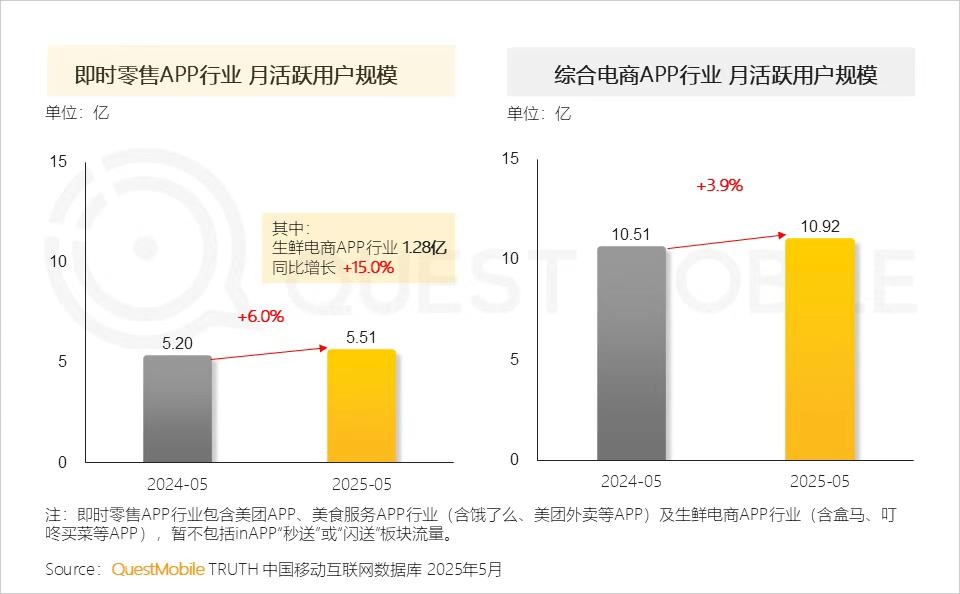
Core Insights - The competition in the instant retail and food delivery market is intensifying, with significant increases in active users and order volumes across platforms [1][3][4] - Major players like Meituan and Alibaba are launching aggressive promotional campaigns, including a new promotional event called "Super Saturday" to drive user engagement [3][4][15] - The shift from food delivery to broader instant retail services is underway, with platforms aiming to capture a larger share of the market by expanding their offerings beyond just food [6][22] Group 1: Market Dynamics - As of May 2025, the active user base for instant retail apps has reached 551 million, outpacing traditional e-commerce apps in growth [1] - Meituan reported over 150 million daily orders for instant retail, while Alibaba's Taobao Flash Sale and Ele.me announced over 80 million daily orders, excluding self-pickup and zero-cost purchases [4][9] - The competitive landscape has shifted significantly since Taobao Flash Sale's entry, disrupting the previous market equilibrium [9][15] Group 2: Strategic Moves - Alibaba is integrating Ele.me and Fliggy into its Chinese e-commerce business, indicating a strategic pivot to enhance its market position [3][9] - Meituan's promotional strategies include offering a large number of "0 Yuan Purchase" vouchers, primarily for chain restaurant products, to attract users [4][9] - The platforms are leveraging high-frequency demand for food delivery to drive user acquisition and engagement, with significant increases in active user rates during peak meal times [10][12] Group 3: Financial Implications - The intense competition is expected to lead to substantial financial losses for major players, with projections indicating losses of 41 billion RMB for Alibaba and 26 billion RMB for JD in the next year [15] - The marketing expenditures for e-commerce platforms are shifting towards food delivery as a more efficient customer acquisition channel, with Alibaba's 50 billion RMB subsidy plan seen as part of this strategy [14][15] - The long-term impact of sustained low-price promotions may alter consumer price expectations and purchasing behavior, potentially complicating future profitability [17][21] Group 4: Future Outlook - The transition from food delivery to non-food instant retail is seen as a natural progression, with significant growth in non-food categories such as groceries and household cleaning products [22] - The competition is expected to continue throughout the summer, with platforms vying for dominance in the instant retail space [24][27] - The ongoing battle among major players highlights the increasing importance of becoming comprehensive service platforms to avoid competitive disadvantages [25][26]


每经热评︱0元奶茶、爆单弃领……即时零售补贴盛宴,还能撑多久?
Mei Ri Jing Ji Xin Wen· 2025-07-14 10:16
Core Viewpoint - The intense competition among major internet companies like Meituan, Alibaba, and JD.com in the instant retail sector is leading to unsustainable subsidy wars, which may result in resource wastage and long-term negative impacts on the industry [1][2][4] Group 1: Impact on Consumers - Consumers are experiencing a surge of attractive offers such as "0 yuan milk tea," but this has led to instances of wasted resources, with many orders going unclaimed [1] - The phenomenon of "fake demand" is emerging, where consumer impulsiveness driven by subsidies does not translate into actual consumption [1] Group 2: Impact on Delivery Workers - Delivery workers are facing increased workloads due to the surge in orders, with some reporting delivery counts as high as 80 to 100 orders in a single day, leading to potential health risks [1][2] Group 3: Impact on Small Businesses - Small businesses may benefit from increased traffic due to platform subsidies, but they also bear part of the subsidy costs, leading to situations where order volume increases without corresponding revenue growth [2] - The influx of orders can degrade service quality, negatively affecting consumer perception and long-term brand viability for small businesses [2] Group 4: Impact on Platforms - Platforms are under significant financial pressure due to high subsidy costs, which could lead to short-term profit declines and potential stock price impacts [2] - For instance, Morgan Stanley estimates that Alibaba's investment in related businesses has reached approximately 10 billion yuan, with further increases expected, raising questions about the sustainability of this subsidy model [2] Group 5: Broader Industry Implications - The ongoing subsidy wars are affecting the entire retail ecosystem, with competitors like Pinduoduo and Kuaishou potentially feeling the pressure to join the fray, which could lead to further industry "involution" [3] - The focus on order volume growth over value creation could undermine the long-term benefits for consumers, delivery workers, businesses, and platforms alike [3][4] Group 6: Recommendations for Sustainable Growth - To avoid a detrimental cycle of competition, platforms should prioritize technological innovation and service quality rather than relying solely on price-based strategies [3][4] - Regulatory bodies and industry associations should implement reasonable policies to mitigate the negative effects of excessive competition, ensuring consumer rights and protecting the interests of small businesses and delivery workers [3][4]

北水动向|北水成交净买入82.43亿 外卖补贴下平台订单量增长显著 北水抢筹美团(03690)及阿里(09988)
智通财经网· 2025-07-14 10:03
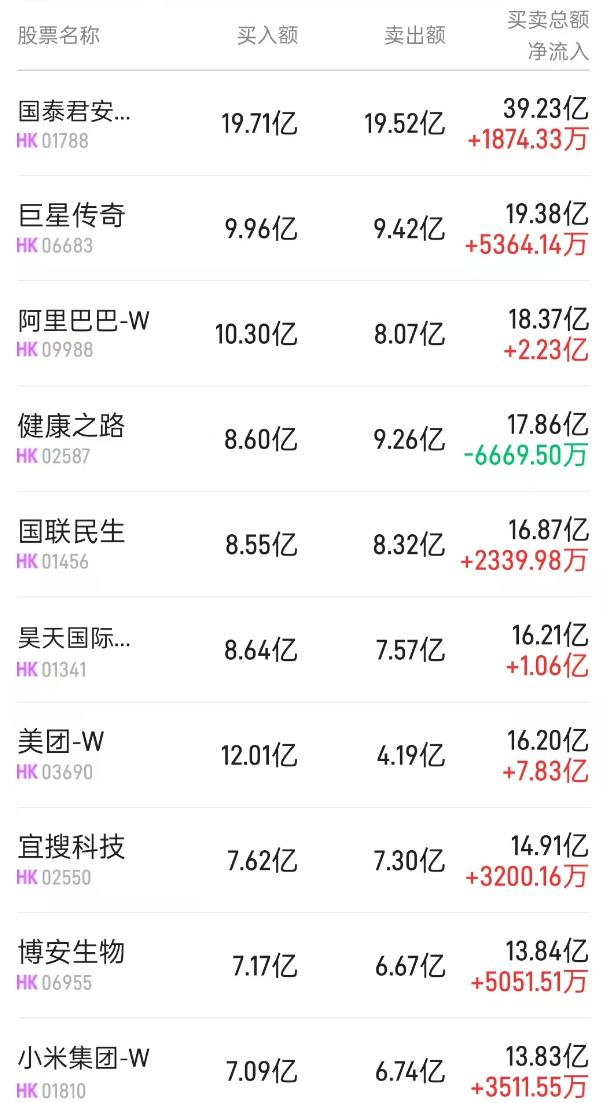
Group 1: Market Overview - Northbound trading recorded a net buy of HKD 82.43 billion, with HK Stock Connect (Shanghai) contributing HKD 31.02 billion and HK Stock Connect (Shenzhen) contributing HKD 51.41 billion [1] - The most net bought stocks included Meituan-W (03690), Alibaba-W (09988), and SMIC (00981) [1] - The most net sold stocks were Laopuhuangjin (06181), Tencent (00700), and Xiaomi Group-W (01810) [1] Group 2: Individual Stock Performance - Meituan-W (03690) received a net buy of HKD 12.22 billion, driven by increased orders due to promotional activities [4] - Alibaba-W (09988) saw a net buy of HKD 10.30 billion, reflecting strong market interest [2] - SMIC (00981) had a net buy of HKD 2.99 billion, supported by a report highlighting the potential for increased market share in China's wafer foundry market [5] - Laopuhuangjin (06181) faced a net sell of HKD 3.64 billion, attributed to profit-taking after a strong performance and concerns over overseas expansion potential [7] - Tencent (00700) and Xiaomi Group-W (01810) experienced net sells of HKD 842.8 million and HKD 657 million, respectively [8] Group 3: Sector Insights - The takeaway from the food delivery sector indicates a competitive landscape with expected order volume growth of 30% year-on-year, driven by increased user engagement and promotional efforts [4] - The healthcare sector is poised for growth, with recent government initiatives aimed at supporting innovative drug development, which may benefit companies like Sinopharm [5] - The entertainment and retail sectors are leveraging celebrity IPs for growth, as seen with Giant Star Legend (06683) benefiting from partnerships with popular figures [6]
去掉0元购水分 ,美团1.5亿订单还剩多少?
3 6 Ke· 2025-07-14 09:29
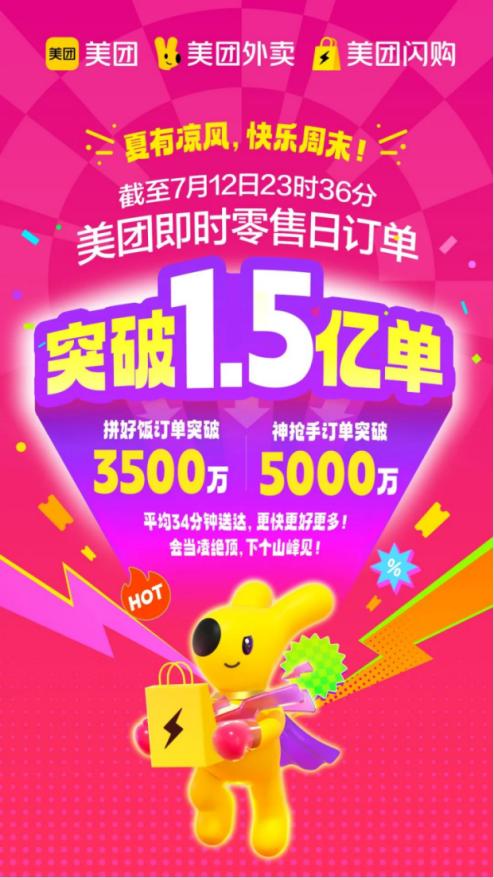
Core Insights - The competition between Meituan and Taobao Flash has intensified, with Meituan reporting a daily order volume of 150 million, a significant increase from 120 million, while Taobao Flash stabilized at 80 million orders, emphasizing that its figures do not include self-pickup or zero-cost purchases [4][11][21] - The analysis suggests that both platforms have reached a similar operational level, as the quality and structure of the order data must be considered alongside the raw numbers [4][11] Group 1: Meituan's Order Volume - Meituan's reported 150 million daily orders include a significant portion of self-pickup and zero-cost orders, which may not reflect true consumer demand [11][12] - The structure of Meituan's orders shows that 50 million came from promotional activities, with a substantial number likely being self-pickup orders [11][15] - The average monthly income for Meituan's delivery riders is reported at 9,793 yuan, which is lower than Taobao Flash's 12,500 yuan, indicating a potential discrepancy in effective order volume between the two platforms [15] Group 2: Taobao Flash's Strategies - Taobao Flash has employed various strategic maneuvers, such as "surrounding the enemy" and "taking advantage of the fire," to capture market share from Meituan [17][18] - The platform's initial launch included significant subsidies that diverted 15% of Meituan's daily orders, showcasing its effective market penetration strategy [17] - Recent tactics include creating a facade of aggressive competition while maintaining a steady approach to subsidies, leading competitors to overextend their resources [18][19] Group 3: Market Dynamics - The current market dynamics suggest a 1:1 competitive stance between Meituan and Taobao Flash, with both platforms vying for consumer attention through aggressive promotional strategies [16][20] - The long-term sustainability of these strategies is uncertain, as Meituan's established market presence poses a significant challenge for Taobao Flash [20] - The focus on short-term order volume through aggressive subsidies may detract from the overall consumer experience, raising concerns about the long-term viability of such strategies [21]
国信证券:维持阿里巴巴推荐评级
news flash· 2025-07-14 08:42
智通财经7月14日电,国信证券就阿里巴巴-W(09988.HK)发布研报称,预计该公司2026财年一季度收入 2478亿元,同比增2%,收入增速放缓。公司短期加大即时零售布局对利润端造成压力,但长期来看有 利于电商用户黏性和购买频次提升,重塑淘宝用户心智。预测公司FY2026-FY2028收入 10623/11490/12174亿元,公司FY2026-FY2028经调整净利预测至1388/1718/1954亿元,维持"推荐"评 级。 国信证券:维持阿里巴巴推荐评级 ...
中国进入大零售时代
3 6 Ke· 2025-07-14 08:40
Core Insights - The Chinese retail sector is undergoing a transformation where "small players" are expected to rescue "big players" and small companies will guide larger corporations in 2024 [2] - The retail industry is currently facing significant challenges, described as the "darkest hour" before dawn, with a need for genuine reform in business practices and consumer engagement [3] - Retail is rapidly dividing into two types: survival-oriented and development-oriented, with the former focusing on cost-cutting and the latter on future growth through investment in infrastructure and technology [4] Retail Challenges - The retail sector is experiencing rising costs alongside sales increases, leading to concerns about the sustainability of these changes [3] - The shift in consumer preferences and the aging population are diminishing the value of physical retail stores, necessitating a reduction in their numbers [5] - Many companies face high costs associated with reforming their operations, leading some to question the viability of such changes compared to opening new stores [5] Government Role - Government reforms are essential to address outdated regulations that hinder the retail sector's modernization, particularly in logistics and distribution [8] - The existing pharmaceutical distribution system is outdated and needs comprehensive reform to meet the demands of an aging population [9][10] Retail Innovations - The rise of instant retail is reshaping the retail landscape, with major players like Meituan and Alibaba expanding their services to meet immediate consumer needs [14][15] - Consumer behavior is shifting towards immediate replenishment rather than waiting for discounts, indicating a need for retailers to adapt to this new demand [15] - The integration of online and offline shopping experiences is becoming crucial, with a focus on enhancing consumer convenience and satisfaction [20] Future of Retail - The future of retail will likely see a balance between experience and efficiency, driven by technological advancements and consumer expectations [19][21] - The retail ecosystem is expected to evolve, with a clear distinction between platform providers and suppliers, each playing a vital role in the market [20] - The ultimate goal of retail innovation is to improve overall efficiency while ensuring a better shopping experience for consumers [21]
阿里巴巴-W(09988):1QFY26前瞻:闪购投入致利润承压,云收入继续加速
Guoxin Securities· 2025-07-14 05:14
Investment Rating - The investment rating for the company is "Outperform the Market" [2][7]. Core Views - The company is expected to report a revenue growth of 2% year-on-year for Q1 FY26, with an adjusted EBITA margin of 16%. The revenue growth is primarily impacted by the divestiture of certain retail operations [4][6]. - The company is increasing its investment in instant retail, which is expected to pressure profits in the short term but may enhance user engagement and purchase frequency in the long term [5][23]. - Revenue forecasts for FY2026 to FY2028 have been slightly adjusted upwards, while net profit forecasts have been adjusted downwards due to increased investment in flash sales [5][23]. Summary by Sections Financial Performance - For Q1 FY26, the company is projected to achieve a revenue of CNY 247.8 billion, reflecting a 2% year-on-year increase. The revenue growth rates for various segments are as follows: Taobao +9%, International Digital Commerce +19%, Cloud Intelligence +22%, Local Services +10%, Cainiao -5%, and Digital Entertainment +5% [4][6]. - The adjusted EBITA for Q1 FY26 is expected to be CNY 39.2 billion, with a year-on-year decline of 13% [6]. Segment Analysis - **Taobao Group**: Projected GMV growth of 6% year-on-year for Q1 FY26, with a CMR increase of 11% driven by site-wide promotions and a 0.6% contribution from service fees. The EBITA for Taobao and Local Services combined is expected to decline by 16% to CNY 40.8 billion due to increased promotional spending [11]. - **Cloud Intelligence**: Anticipated revenue growth of 22% year-on-year for Q1 FY26, driven by rising AI demand. The company continues to advance its AI initiatives, including the launch of the Qwen3 model [15][16]. - **AIDC**: Expected revenue growth of 19% year-on-year, with a slight decline in adjusted EBITA margin due to strategic decisions to enhance profitability [22]. Financial Projections - Revenue forecasts for FY2026, FY2027, and FY2028 are adjusted to CNY 1,062.3 billion, CNY 1,149.0 billion, and CNY 1,217.4 billion respectively, reflecting increases of 1.0%, 2.2%, and 0.8% [5][23]. - Adjusted net profit forecasts for the same period are revised to CNY 138.8 billion, CNY 171.8 billion, and CNY 195.4 billion, with adjustments of -16.8%, -5.7%, and -2.9% respectively [5][23].
外卖补贴大战重启!| 新闻早班车来了
Sou Hu Cai Jing· 2025-07-14 05:11
Key Points - The U.S. has initiated a series of high-intensity tariff actions, putting the global trade system and financial markets under severe pressure, with strong dissatisfaction expressed by Europe and Mexico's commitment to resolving disputes diplomatically [2] - Bank stocks in China have reached historical highs, with Industrial and Commercial Bank of China seeing a peak increase of 3.35%, pushing its market value close to 3 trillion yuan, and the banking sector's cumulative growth for the year reaching 19.58% [6] - The new round of food delivery subsidy wars has reignited, with major players like JD and Meituan heavily investing to capture the instant retail market, indicating a fierce competition for market positioning [6] - The Chinese government is addressing "involution" competition, highlighting that while consumers may benefit from short-term low prices, the long-term effects could lead to reduced quality and choices [6] - The investment heat in the embodied intelligence sector continues to rise, with major tech giants and leading investment institutions like Meituan, Didi, ByteDance, Ant Group, Sequoia, Hillhouse, and JD making comprehensive layouts [7] - The sales of mid-to-high-end liquor in the restaurant channel have declined, with a shift in consumer spending from the 100-300 yuan price range to the 50-100 yuan range [8] - Several banks have introduced business loan products with annual interest rates starting with "2", indicating a competitive lending environment [8] - As the U.S. electric vehicle tax credit policy is set to end, American automakers are ramping up promotional activities for electric vehicles, urging consumers to take advantage of the last window for subsidies [8]
大消费行业观察:头部茶饮品牌迎外卖红利;政策助力家电文旅升级
Sou Hu Cai Jing· 2025-07-14 04:35
Group 1: Trends in the Consumer Sector - The consumer sector is experiencing two major trends: a "subsidy war" among leading food delivery platforms significantly activating the instant retail market, with tea and chain dining brands being the biggest beneficiaries [1] - The subsidy strategies of major platforms like Meituan, Taobao Flash, and JD are differentiated, with Meituan focusing on high-frequency consumption scenarios, Taobao Flash covering all categories with a 50 billion subsidy, and JD targeting high-ticket quality dining [1][2] - Leading brands are capturing traffic benefits, while small and medium-sized businesses face profit pressure due to cost-sharing from platform subsidies and increased operational expenses [1] Group 2: Sustainability of Subsidies and Future Competition - The sustainability of subsidies is questioned, as current strategies rely on short-term platform investments, and long-term user loyalty cannot be built solely on low prices [2] - Experts suggest that the ultimate value of instant retail lies in local resource integration and ecosystem building, emphasizing the need for improved service quality over price competition [2] Group 3: Policy Impact on Home Appliances and Tourism - Beijing's new consumption policy focuses on expanding the "old for new" subsidy for home appliances and digital products, promoting smart and green upgrades [3] - The policy is expected to enhance consumer willingness to replace old appliances, driving technological investment and optimizing product structures in the industry [3] Group 4: Expansion of Cultural and Tourism Consumption - The policy aims to optimize cultural and tourism experiences, promoting themed tourism and rural tourism projects to stimulate consumer demand [4] - The sports sector is set to cultivate a premium event system, with the event economy expected to generate additional market opportunities through ticket sales and related services [4] Group 5: Long-term Development of the Industry - The optimization of the consumption environment through enhanced market regulation and consumer protection is expected to boost consumer confidence and support long-term industry growth [5] - The upgrades in the home appliance and tourism sectors are likely to give rise to new business models, such as "home appliances + smart home ecosystems" and "tourism + digital experiences" [5]