
产能利用率

Search documents
财说丨 扭亏昙花一现,盛新锂能多项偿债能力指标亮红灯
Xin Lang Cai Jing· 2025-10-29 23:36
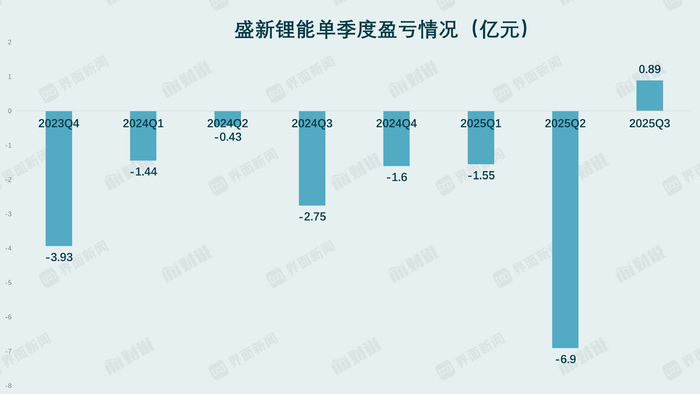
Core Viewpoint - After seven consecutive quarters of losses, Shengxin Lithium Energy (002240.SZ) reported a revenue of 1.481 billion yuan in Q3 2025, a year-on-year increase of 61%, and a net profit of 89 million yuan, marking a turnaround. However, the company still faced significant operational challenges, with a 12% year-on-year decline in revenue for the first three quarters of 2025 and a net loss of 752 million yuan. The company attributed its losses to a "collapse in lithium prices," despite data showing only a 2.26% decline in lithium carbonate prices year-to-date, with a 20% increase in Q3 [1][2][3]. Financial Performance - In the first half of 2025, Shengxin Lithium Energy reported a revenue of 1.614 billion yuan, a year-on-year decline of 37.42%, and a net loss of 841 million yuan, a staggering year-on-year increase in loss of 349.88%. Even with Q3's profit, the net loss for the first three quarters remained at 752 million yuan, a year-on-year decline of 63% [2][3]. - The company's net assets decreased by 13% year-on-year to 10.5 billion yuan as of September 2025, while total assets grew by only 3% to 21.9 billion yuan, indicating deteriorating asset quality [4][6]. Debt and Liquidity Issues - Shengxin Lithium Energy faced a significant short-term debt burden of 6 billion yuan, with liquidity ratios indicating a tight cash flow situation. The current ratio was only 0.83, and the quick ratio was 0.59, both below industry safety lines [7][9]. - The company's short-term borrowings amounted to 4.583 billion yuan, with an additional 1.513 billion yuan in non-current liabilities due within a year, totaling 6.096 billion yuan in short-term debt, while cash and cash equivalents stood at only 2.56 billion yuan [9][10]. Production Capacity Challenges - The company had a lithium salt production capacity of 137,000 tons per year but utilized less than 50% of this capacity in 2024, producing only 67,600 tons. This underutilization was attributed to both market conditions and a lack of orders from downstream battery manufacturers [13][14]. - The core lithium mine project, the Muzhong Lithium Mine, which has a resource capacity of 989,600 tons of Li₂O, has not yet commenced production, further complicating the company's operational challenges [14][15]. Industry Context - The lithium market has been characterized by an oversupply since 2025, with domestic lithium salt production increasing by 14.5% year-on-year. Despite government policies aimed at stabilizing prices, the fundamental oversupply issue remains unresolved [16].


合成橡胶产业日报-20251029
Rui Da Qi Huo· 2025-10-29 09:26
Report Summary 1. Report Industry Investment Rating - No investment rating information is provided in the report 2. Core Viewpoints - The short - term production and capacity utilization of domestic butadiene rubber may decline due to increased maintenance of domestic butadiene rubber units, but considering the weak raw material side, it is expected that production enterprise inventories will decrease and trading enterprise inventories will increase [2] - The overall capacity utilization rate of domestic tire enterprises has increased slightly, with semi - steel tire enterprises maintaining stable production and full - steel tire enterprises keeping production stable. The BR2512 contract is expected to fluctuate in the range of 10,500 - 11,000 yuan/ton in the short term [2] 3. Summary by Directory 3.1 Futures Market - The closing price of the main contract of synthetic rubber is 10,795 yuan/ton, a decrease of 10 yuan/ton; the position volume of the main contract is 52,216, an increase of 3,565; the 12 - 1 spread of synthetic rubber is 25 yuan/ton, an increase of 5 yuan/ton; the total number of warehouse receipts for butadiene rubber is 3,010 tons, unchanged [2] 3.2 Spot Market - The mainstream price of BR9000 from Qilu Petrochemical, Daqing Petrochemical in Shandong and Shanghai is 10,950 yuan/ton, down 50 yuan/ton; the mainstream price of BR9000 from Maoming Petrochemical in Guangdong is 11,150 yuan/ton, down 100 yuan/ton; the basis of synthetic rubber is 195 yuan/ton, down 140 yuan/ton [2] 3.3 Upstream Situation - The current - week production capacity of butadiene is 155,300 tons/week, a decrease of 100 tons/week; the capacity utilization rate is 65.62%, a decrease of 0.17 percentage points; the port inventory is 24,600 tons, a decrease of 6,200 tons; the production capacity utilization rate of butadiene rubber is 73.45%, a decrease of 1.37 percentage points [2] 3.4 Downstream Situation - The production of full - steel tires in the current month is 1.314 million pieces, an increase of 110,000 pieces; the production of semi - steel tires is 6.025 million pieces, an increase of 219,000 pieces; the inventory days of full - steel tires in Shandong is 40.34 days, an increase of 0.39 days; the inventory days of semi - steel tires in Shandong is 45.26 days, an increase of 0.09 days [2] 3.5 Industry News - As of October 23, the capacity utilization rate of Chinese semi - steel tire sample enterprises was 72.84%, a month - on - month increase of 1.77 percentage points and a year - on - year decrease of 6.84 percentage points; the capacity utilization rate of full - steel tire sample enterprises was 65.87%, a month - on - month increase of 1.91 percentage points and a year - on - year increase of 6.95 percentage points [2] - In September 2025, China's heavy - truck market sold about 105,000 vehicles, a month - on - month increase of 15% and a year - on - year increase of about 82%. From January to September, the cumulative sales exceeded 800,000 vehicles, reaching 821,000 vehicles, a year - on - year increase of about 20% [2] - As of October 22, the domestic butadiene rubber inventory was 33,200 tons, an increase of 400 tons from the previous period, a month - on - month increase of 1.25% [2]
Clearwater Paper(CLW) - 2025 Q3 - Earnings Call Transcript
2025-10-28 22:02
Financial Data and Key Metrics Changes - Adjusted EBITDA for Q3 2025 was $18 million, at the high end of the guidance range of $10 million-$20 million, with year-to-date adjusted EBITDA from continuing operations at $87 million, up from $26 million in the same period last year [4][14] - Net sales reached $399 million, a 1% increase year-over-year, driven by a 3% increase in paperboard shipment volumes, partially offset by lower market pricing [13][14] - Net loss from continuing operations was $54 million, or $3.34 per diluted share, primarily due to a $48 million non-cash goodwill impairment [13][14] - The company generated $34 million in cash from operations and approximately $3.5 million in free cash flows during the quarter [15] Business Line Data and Key Metrics Changes - The company successfully completed all three planned major maintenance outages for 2025, with the Lewiston outage costing $24 million and the Augusta outage costing $16 million [4][5] - Fixed cost reduction initiatives are tracking to around $50 million in savings for the year, exceeding the original estimate of $30 million-$40 million [5] Market Data and Key Metrics Changes - The industry is facing margin pressure due to low utilization rates, projected to be in the low 80% range by year-end, significantly below the normalized average of 90%-95% [7] - RISI forecasts a net capacity reduction of approximately 350,000 tons in the first half of 2026, which could drive utilization rates above 90% [8][18] Company Strategy and Development Direction - The company is exploring adding CUK swing capability to one of its SBS machines, with an estimated capital requirement of $50 million and a projected return of over 20% [11][12] - The company aims to maintain its market share and defend its SBS mills while focusing on a strong balance sheet [19] Management's Comments on Operating Environment and Future Outlook - Management remains optimistic about the long-term fundamentals of the paperboard market, citing strong demand for sustainable packaging solutions [19] - The company expects adjusted EBITDA for Q4 2025 to be between $13 million and $23 million, anticipating slightly lower paperboard shipments due to seasonality [16][18] Other Important Information - The company has ample available liquidity of $455 million and a net leverage ratio of 2.7x, indicating a stable debt level despite the current industry down cycle [15] - The company repurchased $2 million of shares, bringing the total to $20 million against a $100 million authorization [15] Q&A Session Summary Question: Decision to hold the CUK swing capacity project - Management confirmed the decision to hold the project is due to prioritizing a strong balance sheet and market conditions, targeting a leverage ratio in the 1%-2% range [23] Question: Market outlook for SBS and import relief - Management noted that while RISI forecasts a capacity reduction, it is uncertain how the industry will respond, but there are signs of reduced European imports [25] Question: Maintenance schedule for 2026 - Management indicated that costs for maintenance in 2026 would be similar to 2025, with schedules to be finalized and shared in February [27] Question: Incremental strength in shipments and product categories - Management observed strong performance in food service and noted that import relief may be contributing to stronger demand [33] Question: Variability in Q4 guidance - Management highlighted that energy costs and production levels would significantly impact Q4 earnings, with production changes having a substantial effect on earnings [36]

三利谱:目前公司合肥新产能处于爬坡阶段,产能利用率持续提升中
Mei Ri Jing Ji Xin Wen· 2025-10-28 10:20
Core Insights - The company is currently in the ramp-up phase for its new production capacity in Hefei, with utilization rates continuously improving [1] - Overall product prices remain stable, with no significant increases reported [1] - The company has not provided detailed statistics on the composition of its product structure, which includes television, mobile, computer and tablet, and automotive products [1]

尿素日报:成交氛围转弱-20251028
Hua Tai Qi Huo· 2025-10-28 07:39
Report Industry Investment Rating - Unilateral: Neutral [3] - Inter - period: Wait - and - see [3] - Inter - variety: None [3] Core Viewpoints - Urea spot trading weakened after the price increase this week following the simultaneous increase in futures and spot last week. It is expected to fluctuate in the short term, waiting for a driving force [2]. - In the medium and long term, urea supply and demand remain relatively loose due to the release of new production capacity. As the weather improves, agricultural demand for urea increases, and the inventory accumulation speed slows down [2]. - Urea is still affected by export sentiment. The export window period is from September to October. The export volume in September was 1.37 million tons, and the cumulative export volume from January to September 2025 was 2.8123 billion tons. Pay attention to subsequent export dynamics [2]. Summary by Directory 1. Urea Basis Structure - Includes charts of Shandong and Henan urea small - particle market prices, Shandong and Henan main - continuous basis, urea main - continuous contract price, and 1 - 5, 5 - 9, 9 - 1 spreads [6][7][8] 2. Urea Output - Comprises charts of urea weekly output and urea plant maintenance loss volume [17][20] 3. Urea Production Profit and Operating Rate - Involves charts of production cost, spot production profit, panel production profit, national capacity utilization rate, coal - based capacity utilization rate, and gas - based capacity utilization rate [23][24][27] 4. Urea Foreign Market Price and Export Profit - Contains charts of urea small - particle FOB in the Baltic Sea, urea large - particle CFR in Southeast Asia, urea small - particle FOB in China, urea large - particle CFR in China, and their price differences, as well as urea export profit and panel export profit [29][31][35] 5. Urea Downstream Operating Rate and Orders - Consists of charts of compound fertilizer operating rate, melamine operating rate, and pending order days [47][48][49] 6. Urea Inventory and Warehouse Receipts - Includes charts of upstream in - plant inventory, port inventory, raw material inventory days of downstream urea manufacturers in Hebei, futures warehouse receipts, main - contract holding volume, and main - contract trading volume [52][53][57]
塑料PP每日早盘观察:塑料L及PP:多单持有-20251028
Yin He Qi Huo· 2025-10-28 00:57
Report Industry Investment Rating No relevant information provided. Core Views of the Report The report comprehensively analyzes the market conditions, important information, logic, and trading strategies of plastics (L) and polypropylene (PP) from September 19 to October 28, 2025. The market prices of L and PP fluctuate, affected by factors such as policy, production capacity, inventory, and international events. The trading strategies include holding long or short positions, trial trading, and waiting and seeing, depending on different market situations and data analysis. Summary by Relevant Catalogs Market Conditions - **L Plastic**: The price of L2601 contract fluctuates, and the LLDPE market price in different regions shows partial increases, decreases, or stable trends. The trading atmosphere in the market is generally cautious, with downstream procurement mainly based on demand [1][4][8]. - **PP Polypropylene**: The price of PP2601 contract also fluctuates, and the PP market price shows large - scale stability with small fluctuations. The impact of futures on the spot market is complex, and downstream procurement is relatively cautious [1][4][8]. Important Information - **Policy**: The Ministry of Industry and Information Technology and other seven departments issued the "Work Plan for Stable Growth of the Petrochemical and Chemical Industry (2025 - 2026)", aiming to achieve an average annual increase of over 5% in industry added value from 2025 to 2026 [4]. - **International Events**: Events such as the US government shutdown, Trump's threat to impose new tariffs on China, and the reorganization plan of chemical companies have an impact on the market [15][18]. - **Industry Development**: Projects such as the successful commissioning of Liaoyang Petrochemical's 100,000 - ton/year nylon 66 project and the release of the group enterprise reorganization plan of Daicel and Polyplastics have implications for the industry [18][21]. Logic Analysis - **Supply - related Factors**: Factors such as changes in domestic PE and PP production capacity utilization rates, registered warehouse receipts, and net imports affect the market. For example, an increase in production capacity utilization rates may lead to an increase in supply and put pressure on prices [2][5][9]. - **Demand - related Factors**: Indicators such as the manufacturing PMI, the US manufacturing PMI, and the logistics industry prosperity index reflect the demand situation and have an impact on the market [16][26][30]. - **External Factors**: Fluctuations in international oil prices, changes in the global economic policy uncertainty index, and changes in the freight index also affect the market [13][16][42]. Trading Strategies - **Single - side Trading**: Strategies include holding long or short positions, trial trading, and waiting and seeing, with specific stop - loss points set according to market conditions [2][5][9]. - **Arbitrage (Long - Short)**: Most of the time, it is recommended to wait and see, and in some cases, hold or intervene in positions with corresponding stop - loss settings [2][5][9]. - **Options**: Generally, it is recommended to wait and see, and in some cases, sell options with stop - loss settings [2][5][9].
合成橡胶产业日报-20251027
Rui Da Qi Huo· 2025-10-27 09:33
产能利用率小幅波动。br2512合约短线预计在10800-11000区间波动。 免责声明 合成橡胶产业日报 2025-10-27 本报告中的信息均来源于公开可获得资料,瑞达期货股份有限公司力求准确可靠,但对这些信息的准确性及完整性不做任 何保证,据此投资,责任自负。本报告不构成个人投资建议,客户应考虑本报告中的任何意见或建议是否符合其特定状况。本 报告版权仅为我公司所有,未经书面许可,任何机构和个人不得以任何形式翻版、复制和发布。如引用、刊发,需注明出处为 瑞达期货股份有限公司研究院,且不得对本报告进行有悖原意的引用、删节和修改。 | 项目类别 | 数据指标 | 最新 | 环比 | 数据指标 | 最新 | 环比 | 主力合约收盘价:合成橡胶(日,元/吨) | -125 主力合约持仓量:合成橡胶(日,元/吨) | 10995 | 49618 | -17076 | | --- | --- | --- | --- | --- | --- | --- | --- | --- | --- | --- | --- | | 期货市场 | 合成橡胶12-1价差(日,元/吨) | 0 仓单数量:丁二烯橡胶:仓库:总计(日,吨) ...
洁雅股份(301108) - 2025年10月27日 投资者关系活动记录表
2025-10-27 09:14
Company Overview - Tongling Jieya Biotechnology Co., Ltd. was established in 1999 and specializes in the research, production, and sales of wet wipes, with over 20 years of industry experience [2]. - The company went public on the Shenzhen Stock Exchange's Growth Enterprise Market on December 3, 2021, and is steadily advancing its fundraising projects [2]. Financial Performance - For the first three quarters of 2025, the company reported a revenue of 565 million yuan and a net profit of 67.9031 million yuan [3]. - The growth in performance is attributed to an increase in orders from overseas clients, the realization of business scale effects, and continuous optimization of product structure [3]. Future Business Drivers - Future growth will primarily rely on two engines: deepening cooperation with existing international brand clients and the new market opportunities and localized supply advantages brought by the upcoming U.S. factory [3]. - The company has maintained stable orders from existing clients and is actively expanding its business with international brand clients in other regional markets [3]. Client Relationships and Pricing Mechanism - The company has strong stability in its relationships with major clients, which are predominantly well-known global enterprises [3]. - A pricing adjustment mechanism is in place to respond to fluctuations in raw material prices and exchange rates [3]. Competitive Advantages - The company has developed significant core competitive advantages in technology research and development, production processes, quality control, customer resources, and product variety through years of focused development in the wet wipes market [3]. U.S. Factory Development - The U.S. factory is currently under construction and is expected to be operational in 2026, primarily serving the North American market [3]. - Key investment risks associated with the U.S. factory include client audit approvals, potential delays in production timelines, and cultural differences impacting production efficiency [3]. Capacity Utilization and Capital Expenditure - The current capacity utilization rate is maintained at over 80%, with new capacity expected to be constructed within 3 to 6 months [4]. - The company’s dividend policy balances shareholder returns with developmental support, adjusting based on actual operating conditions and future funding needs [4].
未来出口面临政策压力 PVC期货仍以低位震荡为主
Jin Tou Wang· 2025-10-27 06:07
Industry Overview - The capacity utilization rate of PVC production enterprises decreased to 76.57%, down 0.12% week-on-week and 0.67% year-on-year. The calcium carbide method utilization was at 74.38%, down 0.34% week-on-week and 1.91% year-on-year, while the ethylene method increased to 81.64%, up 0.38% week-on-week and 1.68% year-on-year [1] - The maintenance loss for PVC production last week was 80,500 tons, an increase of 1,600 tons compared to the previous period [1] - The current PVC industry inventory stands at 1.4249 million tons, showing a slight decrease from last week. The overall inventory (upstream + social) decreased by 1.47% week-on-week [1] Institutional Insights - Zhengxin Futures noted that with maintenance gradually recovering and high absolute inventory levels, the fundamental support is insufficient. However, prices are at relatively low levels, and domestic policy expectations suggest that PVC will mainly experience low-level fluctuations in the short term [2] - Guotou Anxin Futures observed that while pressure from manufacturers and society has decreased, the overall situation remains under high pressure. Production has slightly declined due to maintenance, and domestic demand is stable. Export activities in September continued to show positive trends. Recent stability in calcium carbide prices has not significantly supported costs, indicating a continuation of a weak market environment, with PVC likely operating within a bottom range due to potential policy pressures on exports [3]
博腾股份(300363) - 2025年10月24日投资者关系活动记录表
2025-10-26 13:14
Group 1: Market Demand and Growth - The biotech client segment is experiencing a mild recovery, driven by capital market improvements, technological breakthroughs, and ongoing clinical applications [2] - The Chinese market has seen a year-on-year growth of 21%, significantly faster than the first half of the year, attributed to increased project delivery pace [3] - The overall market demand outlook remains optimistic, with significant contributions from late-stage clinical projects [2] Group 2: Financial Performance and Cost Management - The company has achieved a strong recovery in overall profitability this year, with effective high-value commercialization projects and cost reduction measures [2] - Expenses have decreased by 13% year-on-year in the first three quarters, with further cost reduction potential anticipated [3] - The gross profit margin is expected to continue improving if market demand remains stable and production capacity utilization increases [2] Group 3: Capacity and Production - The main production capacity for small molecule APIs is distributed across several locations, with ongoing improvements in utilization rates in Chongqing and Jiangxi [4] - There are structural differences in capacity utilization, with some facilities operating at saturation while others require optimization [4] - The company is focusing on enhancing existing capacity utilization rather than expanding new capacity [4] Group 4: Strategic Focus and Future Outlook - The company aims to identify key market opportunities amid changing customer demand and supply chain strategies [3] - The cardiovascular, renal, and metabolic (CVRM) sectors are highlighted as areas with significant potential for small molecule demand [3] - Continuous organizational and process reforms are being implemented to enhance operational efficiency and competitiveness [4] Group 5: Talent and Recruitment - The overall employee count has seen a stable increase, with some structural adjustments to meet company needs [4] - The talent supply environment is characterized by a need for suitable candidates that align with the company's requirements [4]
