
产业升级

Search documents
GDP能掺水,发电量不会撒谎!七月中国用电超过1万亿度,人类首次!
Sou Hu Cai Jing· 2025-08-25 10:12
Group 1 - China's electricity consumption reached 1 trillion kilowatt-hours in July 2025, marking a historic milestone for both the country and the world [1] - The increase in electricity usage reflects the real vitality of the economy, with July's first industry electricity consumption growing by 20.2%, driven by modern agricultural technologies [3] - The second industry, particularly high-tech manufacturing and electric vehicle production, accounted for 5,936 billion kilowatt-hours, showing significant industrial upgrades [3] Group 2 - The third industry saw a 10.7% increase in electricity consumption, fueled by the popularity of consumer venues and the demand from digital infrastructure like 5G and cloud computing [5] - Residential electricity consumption surged by 18% in July, with some provinces exceeding 30%, indicating improved living standards and increased use of air conditioning and smart home devices [7][8] Group 3 - Renewable energy sources contributed nearly one-quarter of electricity generation in July, highlighting China's progress towards a greener energy structure [11] - In 2018, renewable energy accounted for 44.4% of electricity in five southern provinces, surpassing the global average, and now the national figure reflects a strong commitment to carbon neutrality [11] Group 4 - In 2022, China's electricity generation exceeded the combined total of the US and Europe, showcasing its significant role in the global economy [12][13] - China contributed 6.9% to the global electricity demand growth of 2.2% in 2023, indicating its economic vitality is a driving force for global growth [15] Group 5 - Future projections suggest that China's annual electricity consumption will exceed 13 trillion kilowatt-hours by 2030, with a focus on quality growth rather than mere volume [17] - The shift towards high-efficiency industries like advanced manufacturing and digital economy will enhance GDP generation per kilowatt-hour, indicating a sustainable development model [17][18]

特种电子布跟踪系列:一线新反馈
2025-08-25 09:13
Summary of Conference Call Records Company and Industry Overview - **Company**: 中材科技 (China National Materials Group Corporation) - **Industry**: Specialty Electronic Fabrics and Glass Fiber Industry Key Points and Arguments Financial Performance - 中材科技 reported a revenue of 13.3 billion yuan for the first half of 2025, representing a year-on-year growth of 26.5% [5] - The net profit attributable to shareholders was 1 billion yuan, up 115% year-on-year, driven by strong performance in fiberglass and blade businesses, as well as rapid growth in specialty electronic fabrics and electronic yarns [5][6] Market Demand and Trends - The demand for CTE (Coefficient of Thermal Expansion) products has significantly increased since Q2, with expectations for demand to double in Q4 and potentially continue to double in 2026 [13][14] - The low dielectric electronic yarn (DJ) market is experiencing strong demand and rising prices, particularly for first-generation fabric products [28] - The wind power industry remains robust, with high demand for high-strength and high-modulus glass yarns, driven by applications in electric vehicles and unmanned aerial vehicles [2][35] Production Capacity and Expansion Plans - 中材科技 plans to expand its production capacity from 300 weaving machines to 400-500 by the end of the year and to 800 by mid-2026, aiming to meet the growing market demand [16] - The company has completed small sample tests for 2.8 mm CTE products, with plans for larger-scale testing in the coming months [14] Export and Market Challenges - The export volume of fiberglass has significantly declined, with a 15% drop in July compared to previous months, although the exit of overseas production capacity may benefit domestic companies [23] - The company anticipates that European tax policies may impact exports in the second half of the year, but the overall effect is expected to be minimal [6] Future Outlook - 中材科技 expects to maintain revenue and profit growth, with projected fiberglass sales of approximately 1.3 million tons for the year [6] - The company is optimistic about the market demand driven by domestic computing power improvements and is actively adjusting supply to meet this growth trend [18] Emerging Technologies and Product Development - The industry is seeing a shift towards new products and technologies, particularly in the fields of AI and renewable energy, which are expected to drive future growth [24][36] - New materials such as quartz fiber and basalt fiber are gaining attention, with potential applications in high-end manufacturing and construction [24] Industry Dynamics - The glass fiber industry is experiencing a trend towards larger production scales and increased automation, which is expected to reduce production costs and improve competitiveness [25] - The market is also witnessing a focus on energy efficiency and environmental compliance, particularly in light of stricter carbon emission regulations [26] Additional Important Insights - The specialty electronic fabric industry is seeing strong performance, particularly with the push from domestic computing power, which is expected to further drive demand in the coming months [3] - The company has achieved significant milestones in the CTE and QBU product lines, being the only domestic company capable of mass delivery in the CTE sector [20] - The overall market sentiment is positive, with expectations for continued growth in emerging sectors such as electronics, wind power, and new energy vehicles [36]

“活力中国调研行”8月25日起走进湖北,解锁荆楚发展活力密码
2 1 Shi Ji Jing Ji Bao Dao· 2025-08-25 08:41
Core Insights - The "Vibrant China Research Tour" in Hubei aims to showcase the province's achievements in high-quality economic and social development during the 14th Five-Year Plan period [1] - Hubei's economy has surpassed significant milestones, achieving a total economic output of over 6 trillion yuan ahead of schedule [1][2] Economic Performance - Hubei's GDP grew by 6.2% in the first half of the year, with fixed asset investment increasing by 6.5% and retail sales of consumer goods rising by 6.9% [2] - The province's total import and export volume surged by 28.4%, solidifying its important position in national development and enhancing its role as a growth engine in Central China [2] Technological Innovation - The total value of technology contracts in Hubei increased from 168.7 billion yuan at the end of the 13th Five-Year Plan to 550 billion yuan, ranking third in the country [2] - The number of high-tech enterprises in Hubei has grown to over 30,000, representing a 2.8-fold increase over five years [2] Industrial Upgrading - From 2021 to 2024, the annual growth rate of industrial added value in Hubei is projected to be 8.7%, exceeding the national average by 2.8 percentage points [2] - Major industries in Hubei are expected to reach a scale of over 1 trillion yuan, with six advantageous industries surpassing 500 billion yuan [2] Consumer Market - In the first seven months of 2025, Hubei's retail sales of consumer goods reached 151.86 billion yuan, growing by 6.2%, which is 1.4 percentage points higher than the national average [3] - The province's tourism revenue for 2024 is projected to be 901.16 billion yuan, marking an 18.8% year-on-year increase [3] Employment and Workforce - Hubei has seen over 900,000 new urban jobs created annually for four consecutive years, with more than 400,000 young graduates choosing to stay in the province [3] - The demand for high-quality jobs in emerging industries such as AI and renewable energy has surged, with some sectors experiencing over 150% year-on-year growth in recruitment needs [3]
21专访|兴业银行首席经济学家鲁政委:经济新动能逐步成型
2 1 Shi Ji Jing Ji Bao Dao· 2025-08-25 07:26
Economic Resilience and Growth - China's exports grew by 8.0% in July despite a 24% tariff pressure from the US, with equipment manufacturing showing a 9.9% growth rate [2][3] - The diversification of exports and industrial upgrades are restructuring the resilience of the Chinese economy, with high-tech industries showing a 9.5% increase in industrial added value [3][4] - The service sector contributed significantly to economic growth, with a 5.5% increase in added value in the first half of the year, accounting for 60.2% of economic growth [4] Export Dynamics - The decline in exports to the US was offset by increases in exports to ASEAN (13.5%), Africa (24.5%), Latin America (7.3%), and the EU (7.0%) [3] - The "rush to export" effect is expected to have a manageable impact, with an estimated 1.7% of 2024's total export amount being pre-empted [5] - Knowledge-intensive service exports, particularly in innovative pharmaceuticals, are anticipated to become new growth points for China's exports [6] Service Consumption Growth - There is significant potential for growth in service consumption, with projections indicating an increase in the share of service consumption from 46% in 2024 to over 10% by 2035 as GDP doubles [7] - Key areas for service consumption growth include health services and cultural entertainment, which are expected to see increased demand as income levels rise [7][9] - The development of service consumption is seen as a long-term growth driver, with less risk of demand overextension compared to durable goods [7] Policy Recommendations - Recommendations include increasing subsidies in the service consumption sector to encourage habit formation and structural upgrades [8] - Enhancing the quality of supply in cultural and entertainment services is suggested to foster new growth in service consumption [9] - Targeted support in areas such as elderly care, childcare, and retraining is recommended to address both immediate and long-term needs [10] Financial and Monetary Policy Coordination - The current "hot fiscal, cold credit" phenomenon is attributed to a shift in credit demand towards high-quality development sectors [11] - Coordination between fiscal and monetary policies is essential, with suggestions for fiscal interest subsidies to lower financing costs for the real economy [12] - The focus should be on quality rather than quantity in credit provision, with expectations that economic growth will meet targets without further interest rate cuts [14]

招商基金首席经济学家李湛:下半年宏观经济形势有望在政策的有力支持下保持稳定增长
Zheng Quan Shi Bao Wang· 2025-08-25 06:35
人民财讯8月25日电,《金融时报》记者近日专访了招商基金研究部首席经济学家李湛博士,深入剖析 宏观经济结构创新背后的深层逻辑,探讨经济增长新动力与可持续发展路径。李湛博士对2025年下半年 宏观经济的整体展望充满信心。尽管面临一定的挑战,但总体来看,2025年下半年宏观经济形势有望在 政策的有力支持下保持稳定增长。政策的协同发力将为经济增长提供坚实的基础,消费和投资的双轨并 行将推动内需市场的持续回暖,产业升级和科技创新将为经济增长注入新的动力。在全球经济格局中, 中国经济将继续发挥引领作用。通过推动产业升级和科技创新,中国经济将不断提升在全球产业链中的 地位,为全球经济复苏提供新的动力。同时,通过扩大内需市场,中国经济将为全球企业提供更多的市 场机会,促进全球经济的协同发展。此外,中国在应对通缩压力、稳定物价水平等方面的政策经验,也 将为其他国家提供有益的借鉴,推动全球经济的稳定发展。 ...
2025下半年:中国经济将在复杂环境中展现韧性——专访招商基金首席经济学家李湛
Jin Rong Shi Bao· 2025-08-25 06:22
Economic Growth and Policy Support - In the first half of 2025, China's GDP grew by 5.3% year-on-year, reflecting strong growth resilience and vitality, supported by effective policy measures and a recovering domestic demand market [1][2] - Fiscal policy saw an increase in the issuance of government bonds, with over 555 billion yuan in special bonds issued in the first half of the year, an 18 percentage point increase compared to the same period last year [1] - Monetary policy maintained ample liquidity, with a decrease in the Loan Prime Rate (LPR), reducing financing costs for enterprises and stimulating market activity [1][2] Domestic Demand and Investment - The continuous recovery of the domestic demand market provided significant support for economic growth, driven by policies such as trade-in programs and upgrades in the service sector [2] - Infrastructure investment countered the downward pressure from the real estate market, while manufacturing investment, particularly in high-tech industries, showed notable growth [2] - Despite external pressures, diversification in market expansion and policy-supported measures to shift to domestic sales helped alleviate export pressures [2] Future Economic Outlook - The overall outlook for the second half of 2025 is optimistic, with expectations of stable growth supported by strong policy measures [3] - The dual-track approach of consumption and investment is anticipated to continue driving the recovery of the domestic market, while industrial upgrades and technological innovation will inject new momentum into economic growth [3] - China's economic role in the global landscape is expected to strengthen, providing new opportunities for global enterprises and contributing to collaborative global economic development [3] Policy Directions - A meeting of the Political Bureau of the Central Committee on July 30, 2025, outlined the direction for economic work in the second half of the year, emphasizing stability in employment, enterprises, markets, and expectations [4] - The coordinated upgrade of fiscal and monetary policies will focus on four key areas: technological innovation, consumption, small and micro enterprises, and foreign trade [4] - The macroeconomic policies for the second half of 2025 will prioritize sustainable development, structural optimization, and high-quality economic growth [4]
半天成交2.1万亿,巨量换手,释放什么信号?
Sou Hu Cai Jing· 2025-08-25 05:29
Market Overview - A-shares exhibited strong performance with major indices collectively rising, including the Shanghai Composite Index up by 0.86% to 3858.59 points, and the Shenzhen Component and ChiNext indices rising by 1.61% and 2.22% respectively [2] - The total market turnover exceeded 2.1 trillion yuan, indicating high participation from investors, with equity ETFs reaching a record high of 4 trillion yuan [2] - The Hong Kong market also saw significant gains, with the Hang Seng Index rising by 2.08% to 25866.49 points, driven by technology and property stocks [2] Industry Highlights and Driving Logic - The A-share market displayed notable sector rotation, with the communication sector leading with a 4.12% increase, supported by digital economy policies [3] - The non-ferrous metals sector rose by 3.72% due to global resource price recovery and economic recovery expectations [3] - The real estate sector rebounded collectively with a 3.47% increase, reflecting positive market response to growth-stabilizing policies [3] - In the Hong Kong market, the raw materials sector surged by 4.29%, and the property sector increased by 4.21%, driven by expectations of global liquidity easing [3] Underperforming Sectors and Driving Logic - The consumer sector in A-shares showed increased internal divergence, with traditional essential consumer areas performing relatively flat [4] - The banking sector lagged behind, aligning with the trend of capital migrating towards high-elasticity stocks [4] - In the Hong Kong market, the healthcare sector faced pressure, with some stocks experiencing volatility due to short-term earnings expectation adjustments [4] Investment Strategy Recommendations - The current market is supported by a positive cycle of policy support and capital inflow, with economic recovery and industrial upgrade logic driving steady market growth [5] - Short-term market characteristics include significant sector rotation, with high-low switching trends within the technology growth sector [5] - It is recommended to strategically invest in quality stocks with policy benefits and technical barriers while being cautious of volatility risks in high-positioned stocks [5]
用电量增长看产业结构的三重变化
Zheng Quan Ri Bao· 2025-08-25 03:32
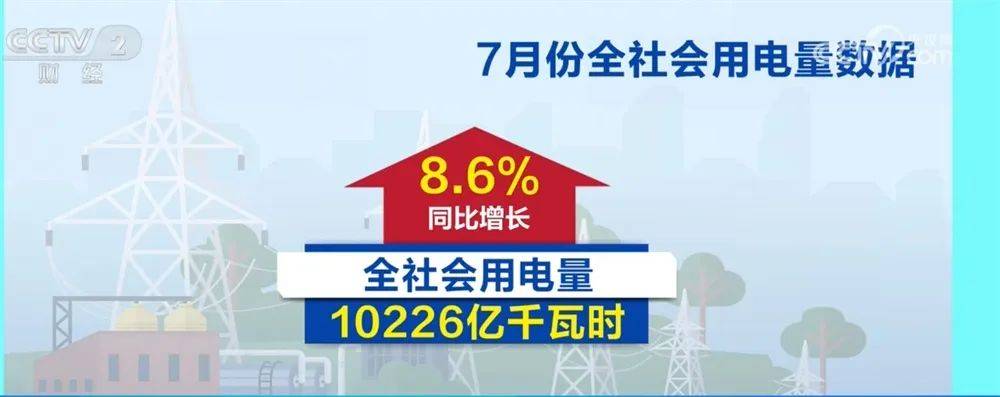
Core Insights - The total electricity consumption in China reached 10,226 billion kWh in July, marking a year-on-year growth of 8.6%, and the cumulative electricity consumption for the first seven months increased by 4.5% [1][5] Group 1: Industrial Sector - The transition from old to new energy sources in the industrial sector is accelerating, with high-tech and equipment manufacturing industries showing a higher growth rate in electricity consumption compared to the four major high-energy-consuming industries (chemicals, building materials, steel, and non-ferrous metals) [1][2] - In July, the electricity consumption of the secondary industry was 5,936 billion kWh, reflecting a year-on-year increase of 4.7%, which is 1.5 percentage points higher than June, indicating a steady improvement in industrial production [1] Group 2: Digital Economy - The electricity consumption of the tertiary industry grew by 7.8% in the first seven months, with the internet and related services sector experiencing a remarkable increase of 28.2% [3] - The rapid development of technologies such as big data, cloud computing, and artificial intelligence has made the digital economy a key variable driving the surge in electricity demand [3] Group 3: Energy Supply Structure - The energy supply structure is undergoing a transformation, with the average temperature in July reaching a historical high since 1961, leading to an 18.0% year-on-year increase in residential electricity consumption [4] - The country effectively managed a historical peak electricity load of 15.08 million kW without implementing orderly electricity consumption measures, showcasing improved energy security capabilities [4] - The installed capacity of renewable energy sources has surpassed that of thermal power, with non-fossil energy accounting for over 60% of the total installed capacity, indicating a significant acceleration in the green energy transition [4] Group 4: Overall Outlook - The historic milestone of surpassing 10 trillion kWh in monthly electricity consumption not only reflects the ability to respond to extreme weather but also illustrates the ongoing industrial upgrade and green transition [5] - The growth of emerging industries is expected to unleash greater potential for the Chinese economy in the future [5]
威海:科技创新支撑高质量发展
Da Zhong Ri Bao· 2025-08-25 01:43
Group 1: Company Innovations - Weihai Del Automation Equipment Co., Ltd. has achieved domestic production of high-end nine-axis five-linkage machine tools, previously monopolized by Japanese and German companies, with an order value exceeding 30 million yuan for the current batch [1] - The company invests 10% of its revenue in R&D annually and has recently overcome over 30 key technologies, expecting an overall output value of 100 million yuan this year, representing a year-on-year growth of over 20% [1] - HeMu (China) Bioengineering Co., Ltd. has developed a brain minimally invasive intervention medical device that significantly reduces surgery time and disability rates, with a market share exceeding 50% in over 300 hospitals nationwide [2] Group 2: Industry Development - Weihai has prioritized the development of advanced equipment and intelligent manufacturing industry clusters, focusing on high-end, intelligent, and clustered production, while establishing multiple national and provincial innovation platforms to support enterprise innovation [1] - The medical device industry chain in Weihai consists of 216 companies, with efforts to build a high-end medical device innovation and transformation hub, resulting in the establishment of 104 innovation platforms and breakthroughs in 88 key technologies [2] - Weihai's high-tech industry output value accounted for 73.5% of the industrial output above designated size last year, maintaining the highest proportion in the province [3]
下半年中国经济:政策托底驱动产业实现升级
Jin Rong Shi Bao· 2025-08-25 01:35
Economic Growth and Resilience - In the first half of 2025, China's GDP grew by 5.3%, reflecting strong growth resilience despite a complex global economic environment [1][2] - The growth was primarily supported by effective policy measures and a recovering domestic demand market [2][3] Policy Support and Domestic Demand - Fiscal and monetary policies worked in tandem to support economic growth, with a record issuance of special government bonds amounting to 555 billion yuan, an 18 percentage point increase from the previous year [2] - The recovery in domestic demand was driven by consumer confidence improvements and infrastructure investments, which countered the downturn in the real estate market [2][3] Consumer Market Dynamics - The consumer market showed signs of recovery, heavily influenced by government subsidies, particularly the "trade-in" policy, which contributed approximately 1.3 trillion yuan to consumer spending in 2024 [4][5] - Future consumer market growth will depend on stable income growth and enhanced consumer confidence, with a focus on optimizing the consumption environment [5][6] Investment Focus - Investment priorities for the second half of 2025 will center on high-quality infrastructure projects and strategic initiatives, particularly in new infrastructure sectors like 5G and renewable energy [8][14] - Policies will encourage private investment through improved business environments and market access [8][14] Export Market Challenges - The export landscape is expected to face increased pressure due to tariffs and global economic uncertainties, despite previous resilience [9][10] - Diversification of export markets has been a strategic focus, with ASEAN's share increasing while the U.S. share has decreased to 11.9% [9] Technological Innovation and Industry Upgrading - Policies will support technological innovation and industry upgrading, particularly in high-tech sectors like semiconductors and AI, through financial incentives and regulatory support [11][12] - The government aims to enhance the competitiveness of export products through innovation and improved trade structures [10][11] Employment Strategies - Employment stability is a priority, with measures to support entrepreneurship and job creation, particularly for youth [13][14] - The government will enhance vocational training and employment services to improve labor market outcomes [13] Macroeconomic Policy Outlook - The macroeconomic outlook for the second half of 2025 is optimistic, with coordinated policies expected to sustain growth [14][15] - Emphasis will be placed on balancing employment stability, economic growth, and risk management, with a focus on long-term sustainable development [15][16]