
通胀

Search documents
重磅数据!美国11月CPI来袭,如何扰动美联储降息预期
Di Yi Cai Jing· 2025-12-17 23:31
Core Viewpoint - The article discusses the rising dissatisfaction among the American public regarding high inflation and increasing living costs, with the upcoming November Consumer Price Index (CPI) report expected to provide insights into future economic policies for Wall Street and the Federal Reserve [1]. Data Outlook - The CPI saw a year-on-year increase of 2.3% in April, the lowest in nearly four years, but has since risen to 3% by September due to tariffs imposed by the Trump administration, which are at their highest levels in decades [2]. - The upcoming CPI report is anticipated to show a slight increase in overall CPI from 3.0% to 3.1%, while core CPI is expected to remain stable at 3% [3]. - Service prices have increased by 3.5% year-on-year, marking the smallest rise since the pandemic, indicating a potential slowdown in inflation if this trend continues [3]. Federal Reserve Discrepancies - Recent surveys indicate that U.S. economic growth is facing obstacles, with rising prices due to tariffs suppressing consumer demand and leading to tighter hiring policies by businesses [4]. - Retail sales showed no growth in October, particularly affecting low-income households, while high-income households continue to drive non-essential spending, highlighting a widening economic gap [4]. - The Federal Reserve has cut interest rates three times, now at a range of 3.50%-3.75%, but Chairman Powell indicated that further cuts are unlikely until labor market and inflation trends are clearer [4]. Internal Divisions within the Federal Reserve - Recent comments from Federal Reserve officials reveal internal divisions regarding the outlook for inflation and interest rates [5]. - Atlanta Fed President Bostic warned against complacency regarding inflation, suggesting that the economy may see upward pressure from tax reforms and a rebound from the government shutdown [6]. - In contrast, Fed officials Miran and Waller maintain a dovish stance, believing inflation will ease in the coming months, with Waller suggesting the possibility of significant rate cuts [6]. Future Rate Expectations - The updated Federal Reserve dot plot indicates only one potential rate cut this year, while futures markets suggest an 80% probability of a cut by June [7]. - The complexity of future rate cuts will depend on employment and inflation performance, with the labor market showing signs of stability [7]. - The impact of a new Federal Reserve chair remains uncertain, with potential rate cuts likely only in response to rising recession fears, which could negatively affect the Republican midterm election outlook [7].
特朗普将向全国发表电视讲话
Huan Qiu Shi Bao· 2025-12-17 22:45
Group 1 - President Trump will deliver a televised address on the evening of the 17th, focusing on the government's "historic achievements" over the past 11 months and outlining his policy plans for the next three years, potentially covering border security and economic issues [1] - Recent polling indicates that Trump's approval rating has declined to 39%, down from 41% in early December, nearing the lowest level of his current term [3] - Only 33% of Americans approve of Trump's handling of economic issues, marking the lowest support rate for him on this topic this year, while approval regarding the cost of living has dropped from 31% to 27% [3] Group 2 - The recent government shutdown has disrupted the collection of economic data, contributing to concerns about economic performance [3] - Economic analysts have noted that Trump's tariffs on imported goods have negatively impacted the economy, with inflation remaining close to 3%, above the generally accepted healthy level of 2% [3] - The unemployment rate in the U.S. rose to 4.6% in November, the highest level since October 2021, with the Labor Statistics Bureau unable to release the October unemployment rate due to the government shutdown [3]

日本加息会引爆全球流动性冲击吗?
2025-12-17 15:50
摘要 日本加息会引爆全球流动性冲击吗?20251217 日本央行加息对全球流动性的影响为何相对有限? 有四个主要原因:第一,这是日本央行第四次加息,此前已有三次加息,即便 存在流动性冲击或套息、套汇平仓压力,这些压力基本上已经释放。第二,大 日本央行可能于 12 月 19 日加息,主要由于日本 CPI 持续高于 2%的通 胀目标,失业率维持在 3%以下,以及高市早苗推出的 21.3 万亿日元财 政政策带来的通胀压力。 日本央行加息对全球流动性的影响有限,原因包括:此前已有三次加息 压力已部分释放,投机性日元空头已基本平仓,美国无衰退交易缓解平 仓压力,以及美联储每月购买至少 400 亿美元短债释放流动性。 若日本央行加息引发全球流动性冲击,建议多看少动,市场通常会快速 修复。如美国市场连续出现 2-3 次股债汇三杀,则卖出所有资产,待美 联储宽松政策出台后再买入,以获取反弹收益。 当前环境下,建议继续看好黄金和人民币资产。黄金受益于全球流动性 泛滥,人民币资产受益于中国出口顺差扩张及美联储降息预期带来的跨 境资本回流。 中国各类要素价格系统性走出通缩、走向通胀,将使制造和消费顺周期 迎来盈利和估值双重提升,利 ...
摩根士丹利:2026年美国经济展望:走出政策不确定性
摩根· 2025-12-17 15:50
Investment Rating - The report does not explicitly provide an investment rating for the industry Core Insights - The Trump administration's tariffs, effective from Spring 2025, have raised the effective tax rate to approximately 16%, contributing to a 30 basis point increase in commodity prices, with an expected total transmission of 70 basis points by Q1 2026, exerting upward pressure on inflation [1][3][4] - PCE inflation is projected to peak at around 3% in Q1 2026, declining to 2.6% by Q4 2026, primarily driven by tariff-affected commodity price increases, with no significant second-round effects anticipated [1][5] - The labor market is expected to remain weak, with a peak unemployment rate of 4.7% in Q2 2026, as companies respond to higher tariffs by reducing labor costs and profit margins, leading to a slowdown in job growth [1][6] - The "Beautiful Bill" is estimated to contribute approximately 40 basis points to economic growth, with actual impacts potentially ranging from 0 to 1 percentage point depending on fiscal multiplier assumptions [1][7][8] - Artificial intelligence (AI) capital expenditure is expected to contribute about 30% to GDP growth, with AI projected to account for approximately 40% of U.S. economic growth in 2026 and 2027, translating to about 20% of total growth [1][11][12] Summary by Sections Economic Outlook - The U.S. economy is anticipated to emerge from a period of high uncertainty, achieving moderate growth of around 2% over the next few years, although inflation may remain above the 2% target until 2027 [2][12] Tariff Impact - The tariffs implemented by the Trump administration have significantly increased commodity prices, with expectations that this upward pressure will peak in Q1 2026 [3][4] Inflation Projections - PCE inflation is expected to peak at 3% in Q1 2026 and decrease to 2.6% by Q4 2026, largely due to the impact of tariffs on commodity prices [5] Labor Market and Federal Reserve Policy - The labor market is projected to remain weak, with a peak unemployment rate of 4.7% in Q2 2026, leading to a cumulative 75 basis point rate cut by the Federal Reserve between September and December [6] Legislative Impact - The "Beautiful Bill" is expected to have a growth effect of about 40 basis points, with potential variations based on fiscal multiplier assumptions [7][8] AI Contribution - AI is projected to significantly enhance productivity, contributing approximately 25-35 basis points to productivity improvements by 2027, with a potential for 40-50 basis points in a supply-driven scenario [11]
黄金拉升,有色爆发!美联储,降息大消息!中概股纷纷飘红
Xin Lang Cai Jing· 2025-12-17 15:26
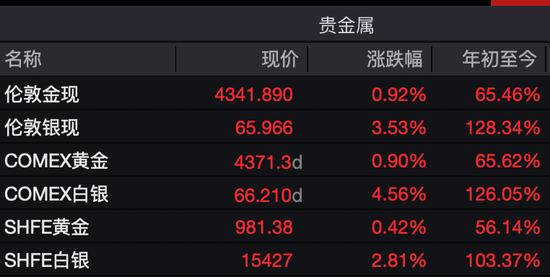
Group 1: Federal Reserve and Economic Outlook - Federal Reserve officials express support for moderate interest rate cuts, indicating potential room for easing due to concerns over a weak job market [1][7][13] - Fed Governor Waller suggests that the neutral interest rate may still be 50 to 100 basis points away, advocating for a gradual approach to lowering rates in a potentially stable inflation environment [7][13] - Waller anticipates inflation rates to decline in the coming months, maintaining confidence in stable inflation expectations despite current rates being above target levels [7][13] Group 2: Precious Metals Market - Gold prices continue to rise, with London gold quoted at $4,341.890 per ounce, reflecting a 0.92% increase, and a year-to-date increase of 65.46% [2][8] - Silver prices also show significant gains, with London silver up 3.53% and COMEX silver increasing by 4.56%, marking year-to-date increases of 128.34% and 126.05% respectively [2][8] - The overall precious metals market is experiencing a bullish trend, driven by the Fed's stance on interest rates [1][2] Group 3: Base Metals Market - Base metals are witnessing a broad rally, with domestic futures showing significant increases; Shanghai tin futures rose over 3%, while international copper, zinc, lead, and nickel all increased by more than 1% [2][8] - Specific futures contracts such as Shanghai copper and aluminum also reported gains of 0.47% and 0.71% respectively, indicating a positive trend in the base metals sector [9][10] Group 4: Stock Market Performance - U.S. stock indices opened mixed, with the Dow Jones rising while the Nasdaq and S&P 500 indices declined [10] - Chinese concept stocks are performing well, with the Nasdaq Golden Dragon China Index rising over 1%, led by sectors such as solar energy, retail, and semiconductors [10][11] - Notable individual stock movements include Dingdong Maicai surging over 17% and Canadian Solar increasing by over 9% [11]
铂金年内飙涨113%,三大因素曝光
21世纪经济报道· 2025-12-17 14:34
Core Viewpoint - Precious metals have experienced a significant rally towards the end of the year, with platinum now joining the surge following substantial increases in gold and silver prices [1][4]. Price Performance Summary - As of December 17, silver leads the precious metals sector with a 128% increase year-to-date, followed by platinum with a 113% rise [4]. - On December 17, domestic platinum futures reached a new high, with prices hitting 527.55 yuan per gram, marking the second instance of a price limit increase since its listing [4]. - NYMEX platinum futures prices surpassed $1933 per ounce, with a year-to-date increase of 113%, second only to silver's 127% [6]. Factors Driving Platinum Price Increase - The recent surge in platinum prices is attributed to three main factors: tightening supply, awakening investment demand, and long-term growth expectations [7]. - The first phase of platinum's price increase occurred from May to July due to extreme weather, aging mines, and power restrictions in South Africa, leading to a 13% year-on-year decline in platinum group metal production [6]. - The second phase, from late August to mid-October, was driven by the Federal Reserve's interest rate cuts and geopolitical tensions, which heightened market risk aversion and boosted platinum's appeal as a safe-haven asset [6]. Future Market Outlook - The global platinum market is expected to face a shortage of 26.4 tons by 2025, despite a projected 4% decline in total demand to 244.8 tons [9]. - Factors contributing to this shortage include structural supply constraints and increased demand from the Chinese market for physical platinum [9]. - The introduction of platinum futures and options in China is expected to bolster demand, alongside European regulatory changes that may support automotive demand for platinum [10]. Analyst Perspectives - Analysts from TD Securities predict that while there may be concerns about reduced demand for automotive catalysts, strong growth in North American automotive demand could lead to significant fluctuations in platinum and palladium demand [11]. - The potential for tariffs on platinum group metals in the U.S. is considered higher than for silver, which could lead to market dynamics similar to the recent silver squeeze [11]. - In contrast, Heraeus Group expresses caution, suggesting that after significant price increases, precious metals may need to undergo a period of consolidation, with industrial demand and recession risks posing downward pressure on platinum prices [12].

每日投行/机构观点梳理(2025-12-17)
Jin Shi Shu Ju· 2025-12-17 14:27
Group 1 - If the AI hype continues to fade, the Chinese stock market may outperform the US stock market [1] - Concerns about US tech stocks have resurfaced, with the S&P 500 index down nearly 2% from its recent peak [1] Group 2 - Goldman Sachs predicts that the Federal Reserve may be more willing to cut interest rates next year than previously assumed [2] - The upcoming employment reports will be crucial in determining whether the Fed will resume easing policies, with a focus on the unemployment rate rather than overall non-farm payroll growth [2] - Goldman expects the easing cycle to extend into 2026, with the federal funds target rate potentially dropping to 3% or lower [2] Group 3 - Morgan Stanley forecasts that the price increase of gold will slow down by 2026 due to reduced purchases by central banks and ETFs [3] - By Q4 2026, gold prices are expected to reach $4,800 per ounce, driven by stronger retail demand in China and increased central bank buying [3] - Silver is anticipated to underperform gold, with a peak shortage expected in 2025 due to declining solar equipment installations [3] Group 4 - A Bank of America survey indicates that 53% of investors believe the dollar is overvalued, up from 45% in November [4] - Investors are currently underweight in the dollar compared to historical levels, with short positions in the dollar considered the third most crowded trade [4] Group 5 - Concerns about the AI bubble have eased slightly but remain high, with 38% of investors identifying it as the biggest tail risk [5] - Private credit has emerged as a new risk factor, with 14% of fund managers considering it the largest tail risk for the coming year [5] Group 6 - The likelihood of a rate hike by the Bank of Japan has increased due to strong export performance, but the governor is not expected to signal a hawkish stance [6] - November exports grew for the third consecutive month, indicating a recovery from previous economic contraction [6] Group 7 - The Canadian Imperial Bank of Commerce notes that softening US employment data may prompt the Fed to consider earlier rate cuts in 2026 [8] - The labor market's cooling is expected to weaken the Fed's resolve to maintain current rates, increasing the likelihood of policy easing [8] Group 8 - China International Capital Corporation remains optimistic about bank stocks' absolute and relative performance, highlighting their high dividend yields and quality development phase [9] - The focus is on dividend yield and certainty, which depend on valuation and profit growth [9] Group 9 - Tianfeng Securities anticipates a more pronounced credit front-loading trend in 2026, with a positive outlook for early-year loans [10] - The bank sector may face challenges from high-interest term deposits and stock market fluctuations impacting general deposits [10] Group 10 - Tianfeng Securities expects a non-symmetric principle for deposit rate cuts in 2026, with a higher probability of implementation in the second quarter [11] - The report suggests a potential need for a rate cut before the Spring Festival, with a range of 25-50 basis points [11] Group 11 - China Galaxy Securities indicates that leading real estate companies are demonstrating strong operational management capabilities, which may enhance their market share [12]
美联储沃勒:美联储的利率水平比中性利率高出50至100个基点
Sou Hu Cai Jing· 2025-12-17 13:40
据报道,美联储理事沃勒表示,美国就业增长接近于零;不认为通胀会再度加速上行;美联储的利率水 平比中性利率高出50-100个基点;美联储无需对劳动力市场采取剧烈行动。 ...
美联储理事沃勒:美联储的利率水平比中性利率高出50到100个基点
Mei Ri Jing Ji Xin Wen· 2025-12-17 13:33
每经AI快讯,美联储理事沃勒表示,就业市场表明美联储应继续降息,美联储的利率水平比中性利率 高出50到100个基点。沃勒不认为通胀会再度加速上行。 ...
2026年配置策略展望:中美宏观经济预期与资产配置策略
Guo Tai Jun An Qi Huo· 2025-12-17 13:03
Report Industry Investment Rating No relevant information provided. Core Viewpoints of the Report - In 2026, as the Fed cuts interest rates (market expects a cut to 3.0 - 3.25% by the end of 2026), commodities may bottom out and present allocation opportunities [1]. - The 10 - year Chinese Treasury bond interest rate is expected to oscillate in the range of 1.5 - 2.0%. Slow fiscal spending and inflation recovery will limit the downside space of Treasury bond futures [1]. - The Shanghai Composite Index will oscillate at a high level. It is recommended to be cautiously bullish, appropriately reduce positions, and pay attention to the Fed's subsequent interest - rate cut process and specific measures to expand terminal consumption in China [1]. Summary by Related Catalogs 2025 Review - In 2025, there was a divergence in Sino - US commodities, with US commodities being stronger and Chinese commodities being weaker. The overall view at the end of 2024 for 2025 was that Treasury bonds would oscillate, stock indices would be slightly bullish, and commodities would be bearish, which was generally correct, except that US commodities were stronger than expected [5]. - In the US, with the Fed's interest - rate cuts, Trump's policies of adding tariffs externally, cutting taxes internally, and restricting immigration, the US economy may face stagflation risks. In China, the real estate market still faced pressure in recovery, private fixed - asset investment decreased year - on - year, and demand was weak. Although a more proactive fiscal policy brought short - term impacts on the stock, bond, and commodity markets, commodities then trended towards reality [5]. - Overseas, on April 2, Trump issued a more - than - expected reciprocal tariff policy, causing commodity prices to plummet. Subsequently, commodity and energy prices continued to weaken. The Fed cut interest rates twice in September and October to address weak employment. The US economy showed stagflation characteristics [5]. - Domestically, after a rebound at the beginning of the year, commercial housing sales continued to weaken, and domestic demand remained weak. In October, China's PPI was - 2.1% and CPI was 0.2%, the first positive CPI growth in Q2 2025 but still at a low level. The prices of domestic - priced black commodities slightly rebounded due to anti - involution meetings and production - cut plans but weakened again as anti - involution expectations cooled. The 10 - year Treasury bond interest rate strengthened and oscillated at a high level [6]. 2026 Outlook US - The US economic growth is expected to slow down moderately, presenting a pattern of "slowing employment and consumption - high inflation and deficits". The high deficit rate of nearly 6% makes government debt unsustainable. The contradiction between high interest rates and fiscal deficit sustainability is becoming more prominent, posing potential risks to the US economy [8]. - It is estimated that the real GDP growth rate in the US will be about 1.8% in 2026, showing a moderately slowing trend. Consumption and import growth are expected to slow down as fiscal deficits decline; private - sector construction investment growth is expected to continue to slow down due to trade - friction uncertainties, the decline of investment tax credits, and doubts about the sustainability of AI capital expenditure; the consumption and inventory cycles face certain downward pressure [10]. - The labor market shows weak signals. In 2025, the number of new jobs in the US was consistently below 200,000, and the unemployment rate continued to rise. In September 2025, the number of new non - farm jobs was 119,000, and the unemployment rate was 4.4%. It is expected that the US will still face high unemployment in 2026, and solving labor - market weakness may be the primary goal of monetary and fiscal policies [12]. - The US CPI growth rate is expected to be in the range of 2.2 - 2.9% in 2026, maintaining a relatively high inflation level. Factors contributing to inflation resilience include high salaries and personal consumption expenditures, Trump's policies with inflation - promoting attributes, and the "dovish" stance of the new Fed chairman, which may push up inflation through interest - rate cut expectations [16]. - In 2026, the US will still be in an interest - rate cut cycle, but the path is not smooth. The market expects the federal funds rate to be reduced to the 3.0 - 3.25% range. If inflation does not decline as expected, it will make the interest - rate cut space volatile and increase market fluctuations [18]. - The sustainability of the US fiscal deficit is being tested. The US national debt exceeded 38 trillion US dollars in October 2025. The "Big and Beautiful Act" is expected to add about 3.4 trillion US dollars in fiscal deficits in the next decade, on top of the debt accumulated by the "Tax Cuts and Jobs Act". To reduce the fiscal deficit rate to 3%, a combination of reducing fiscal spending, increasing fiscal revenue, and cutting interest rates is required [19]. China - China's inflation data was weak in 2025. With the support of policies such as the 14th Five - Year Plan and anti - involution, inflation is expected to bottom out in 2026. In October 2025, China's PPI was - 2.1% year - on - year, and CPI was 0.2% year - on - year. After an increase in commercial housing sales within the year, it declined again, and the year - on - year increase in M1 was significant [24]. - In the short term, it is still difficult to see an obvious upward trend in inflation. The Fed's high - interest - rate policy in H1 2025 pressured China's exports; the decline in commercial housing prices led to continuous negative growth in new household credit and real - estate investment, and it is difficult to reverse the weakening trend of housing prices under the "housing is for living in, not for speculation" principle; there is over - capacity in some industries, and the aging population has depressed private - sector demand. The implementation of anti - involution policies and production cuts due to processing losses are expected to increase bottom - level fluctuations in commodities in 2026 [26]. - Monetary policy will maintain a supportive stance, with reserve - requirement ratio cuts and interest - rate cuts to ensure sufficient market liquidity, and new structural monetary policy tools to support the development of small and micro enterprises. The reasons for strengthening supportive monetary policy include high real interest rates due to slow inflation and the need to create a more liquid environment for economic development and local - government leverage management [27]. - To boost inflation and economic growth, China needs a combination of fiscal, stock - market, real - estate, and consumption - subsidy policies. In 2025, the central bank only adjusted the LPR once in May. The weakening real - estate market has weakened the wealth effect, consumer confidence, and domestic demand, and strengthened residents' savings motivation. In October 2025, China's household deposit balance exceeded 160 trillion yuan, almost double the level at the end of 2019 before the pandemic [28]. - The bull market in the Chinese stock market in 2025 led to a deposit - transfer effect, but it has not been transmitted to the consumption end. The number of new stock - market accounts increased with the rise of the CSI 300, but may decline in November and December. In 2025, new RMB loans were at a five - year low, while new government bonds increased, indicating an expansionary fiscal policy. The M1 - M2 gap narrowed significantly, but consumption data did not improve significantly. To transmit the deposit - transfer effect to consumption in 2026, the stock - market bull market needs to continue, and policies need to boost consumption [30]. 2026 Allocation Outlook - In the US, with a downward - shifting interest - rate center and high inflation, the US economic resilience is expected to decline, consumption and imports will fall, and employment may be poor. Expansionary fiscal policies may cause debt - sustainability issues. The yield of US Treasury bonds will oscillate at a high level between 3.5 - 4.5%, the US dollar will oscillate between 95 - 100 (±3), gold prices are high, and non - ferrous metals should be over - allocated. Attention should be paid to trading opportunities arising from the oscillation of US consumption and imports [33]. - In China, with a more proactive fiscal policy and a moderately loose monetary policy, inflation is expected to bottom out in 2026, and PPI will rise to - 0.5 - - 1%. There is room for interest - rate cuts in the monetary - policy end. With liquidity support, A - shares are expected to remain active in trading, and Treasury bond yields present allocation opportunities. The implementation of the 14th Five - Year Plan and anti - involution policies may support commodity prices at the bottom, and prices may bottom out in H2 2026 [33]. - In asset allocation, non - ferrous metals and Treasury bonds should be over - allocated, and equities should be neutrally allocated: - The yield of 10 - year US Treasury bonds will oscillate widely between 3.5% - 4.5% and is expected to decline [33]. - The US dollar is expected to oscillate between 95 - 100 (±3). Attention should be paid to improvements in the US fiscal and trade deficits, which will affect the Fed's interest - rate cuts and the US dollar's downward trend [34]. - Gold is expected to oscillate at a high level between 4400 - 4500. It is relatively expensive, and some non - ferrous rare - earth metals should be allocated. Global central - bank gold purchases and the Fed's interest - rate cut cycle will push up the gold - price center [34]. - The target of the CSI 300 is 4300 - 5200 points. Attention should be paid to the boost of policies in the 14th Five - Year Plan to the technology and energy sectors, and the continuation of the structural bull market in H2 2025. Also, pay attention to the re - balance between stocks and bonds [34]. - The yield of 10 - year Chinese Treasury bonds is expected to oscillate between 1.5 - 2.0%, and there will be good allocation opportunities when the interest rate rises to 2.0% [34]. - Commodities are expected to present bottom - level allocation opportunities in 2026. Attention should be paid to phased opportunities in H2 2026, such as crude oil, coking coal, live pigs, and some chemical products [34][35].