
中央经济工作会议

Search documents
拼搏的足迹又满一程 奋进的篇章接续书写
Xin Lang Cai Jing· 2026-01-01 07:30
Group 1 - The core message emphasizes the achievements of the past year and sets a hopeful tone for 2026, highlighting the importance of a strong start for the "14th Five-Year Plan" [1] - The year 2026 is identified as a crucial year for initiating the "14th Five-Year Plan," which will guide future development and consolidate collective efforts for progress [1] - The article reflects on various accomplishments, including advancements in national defense, space exploration, and economic policies, showcasing a spirit of resilience and determination [1] Group 2 - The new year brings renewed expectations from the public, with aspirations for better education, economic growth, and improved healthcare services [2] - The Central Economic Work Conference has set the tone for economic work in 2026, providing direction for achieving new milestones and addressing challenges [2] - The article calls for a collective effort to transform visions into reality, emphasizing the importance of steady progress and practical actions in the coming year [2]
广发宏观:PMI年末超季节性反弹的可能原因
GF SECURITIES· 2025-12-31 06:53
Group 1: PMI Overview - December PMI overall rebounded, with manufacturing PMI rising 0.9 points to 50.1 and non-manufacturing PMI increasing 0.7 points to 50.2[4] - Composite PMI for December was 50.7, up 1.0 points from previous values, marking a rebound after consecutive declines in October and November[4] - Manufacturing PMI in December is notably higher than the ten-year average decline of 0.3 points for the same period, indicating a seasonal anomaly[4] Group 2: Sector Performance - Large enterprises saw a PMI rebound of 1.5 points, while small enterprises experienced a contraction of 0.5 points, reflecting a divergence in business conditions[5] - December BCI was 49.8, down from 51.6, and EPMI was 49.1, down from 52.7, indicating a significant seasonal decline[6] - Construction PMI surged to 52.8 in December from below 50 for four consecutive months, influenced by favorable weather and policy-driven infrastructure investments[10] Group 3: Demand and Supply Indicators - Supply and demand indicators showed synchronized rebounds, with production and procurement indices rising 1.7 and 1.6 points respectively[6] - New orders and new export orders increased by 1.6 points and 1.4 points, respectively, indicating improved business activity expectations[6] - The business activity expectation index rose to 56.5, up from 56.2, suggesting positive sentiment among businesses[8] Group 4: Price Indices - The raw material procurement price index slightly decreased to 53.1 from 53.6, while the factory price index increased to 48.9 from 48.2, indicating a mixed price environment[10] - The ongoing "anti-involution" measures are expected to continue influencing price dynamics positively[9] Group 5: Risks and Outlook - Risks include unexpected changes in the external economic and financial environment, geopolitical risks, and potential underperformance in construction activity in Q1[12] - The report suggests that domestic policy benefits and improvements in fundamentals may create favorable conditions for Q1 data[12]
50.1%!时隔8个月,重回扩张区间
证券时报· 2025-12-31 05:55
Core Viewpoint - The overall economic sentiment in China is improving, as indicated by the rise in manufacturing PMI, non-manufacturing business activity index, and comprehensive PMI output index, all entering the expansion zone in December [1][3]. Manufacturing PMI - In December, the manufacturing PMI reached 50.1%, an increase of 0.9 percentage points from the previous month, marking its first rise above 50% after eight consecutive months [3]. - Among the 13 sub-indices, production index, new orders index, new export orders index, backlog orders index, finished goods inventory index, purchasing volume index, ex-factory price index, raw materials inventory index, supplier delivery time index, and production and business activity expectation index all showed increases ranging from 0.1 to 2.4 percentage points [3]. - The new orders index rose above the critical point for the first time since the second half of the year, indicating a positive trend in market expectations [3]. Key Industries - High-tech manufacturing PMI was 52.5%, up 2.4 percentage points, indicating a favorable growth trend [4]. - Equipment manufacturing and consumer goods industries both recorded PMIs of 50.4%, rising by 0.6 and 1.0 percentage points respectively, also entering the expansion zone [4]. - High-energy-consuming industries had a PMI of 48.9%, up 0.5 percentage points, continuing to show recovery [4]. Financial Sector Activity - The financial sector's business activity index and new orders index both rose for two consecutive months, exceeding 60%, indicating enhanced financial support for the real economy [6]. - The construction industry business activity index increased to 52.8%, up 3.2 percentage points, ending a four-month period below 50% [6]. Business Expectations - The manufacturing production and business activity expectation index reached 55.5%, up 2.4 percentage points, the highest since April 2024 [8]. - The service industry business activity expectation index rose to 56.4%, up 0.5 percentage points, while construction firms maintained optimistic market expectations with their index above 57% for two consecutive months [8]. Economic Outlook - The manufacturing PMI is expected to average 49.6% in 2025, remaining stable compared to 2024, with December's rise indicating a positive end to the year and a solid foundation for the new year [9]. - The "14th Five-Year Plan" provides strategic direction for economic and social development, with recent policy signals and the Central Economic Work Conference outlining clear deployments for 2026, which are expected to inject momentum into macroeconomic development [9].


奋力实现“十五五”良好开局 ——中国经济圆桌会共话贯彻落实中央经济工作会议精神
Ren Min Ri Bao· 2025-12-30 22:04
Core Insights - The Central Economic Work Conference held on December 10-11 in Beijing is a significant meeting marking the transition from the "14th Five-Year Plan" to the "15th Five-Year Plan" [1] Group 1: Economic Achievements and Goals - The conference highlighted major achievements in China's economic and social development over the past five years, with the economy expected to reach approximately 140 trillion yuan this year, averaging over 5% growth annually, surpassing the global average [2][3] - The meeting emphasized the importance of policy stability in fostering market vitality and business confidence, particularly for private enterprises [3] Group 2: Policy Directions and Strategies - The conference outlined eight key tasks for the upcoming year, including prioritizing domestic demand, driving innovation, and promoting coordinated development [12] - Emphasis was placed on the need for a combination of policy support and reform innovation to address complex challenges and uncertainties in the current economic environment [8][14] Group 3: Investment and Consumption - The meeting stressed the importance of combining investment in physical assets with investment in human capital, focusing on enhancing people's well-being and capabilities [4] - There is a strong push to stimulate domestic consumption and investment, with plans to optimize policies to boost consumer spending in sectors like culture, tourism, and childcare [12] Group 4: Regional Development and Employment - The conference called for promoting urban-rural integration and regional coordination, with a focus on new urbanization and enhancing public service levels [13] - Employment stability was highlighted as a key aspect of improving people's livelihoods, with initiatives aimed at supporting job creation for specific groups such as college graduates and migrant workers [13] Group 5: Innovation and Digital Transformation - The conference recognized the role of enterprises as the main drivers of innovation, encouraging them to leverage digitalization and smart technologies for transformation [9] - Policies were introduced to guide enterprises in achieving upgrades through technological and industrial innovation [8]
中国经济圆桌会·新华全媒头条|奋力实现“十五五”良好开局——中国经济圆桌会共话贯彻落实中央经济工作会议精神
Xin Hua She· 2025-12-30 12:08
Core Insights - The Central Economic Work Conference held on December 10-11 in Beijing marks a significant historical moment as the "14th Five-Year Plan" concludes and the "15th Five-Year Plan" begins [2] - The conference emphasizes the importance of achieving a good start for the "15th Five-Year Plan" by implementing the decisions made during the meeting [2][13] Economic Achievements and Goals - China has successfully navigated various challenges over the past five years, with the economy expected to reach approximately 140 trillion yuan this year, averaging over 5% growth, surpassing the global average [3][4] - The conference highlighted the need to recognize and build upon these achievements while addressing ongoing challenges [7][16] Policy Directions and Strategies - The meeting outlined key tasks for the upcoming year, including prioritizing domestic demand, driving innovation, and promoting reform and opening up [14] - Emphasis was placed on the need for a balanced approach that combines policy support with reform innovation to navigate complex economic conditions [10][12] Focus on Private Sector and Investment - Policies aimed at fostering the growth of the private sector and encouraging long-term investments were discussed, with a focus on digital transformation and expanding domestic demand [4][14] - The importance of integrating investment in physical assets with human capital was highlighted, reflecting a shift towards a service-oriented economy [5] Risk Management and Economic Stability - The conference acknowledged existing risks and challenges in the economy, emphasizing the need for continued efforts to mitigate these risks while maintaining a stable growth trajectory [7][12] - A call for coordinated efforts to enhance employment opportunities and support vulnerable groups was made, recognizing the role of emerging sectors like AI and new energy vehicles in job creation [15][16] Implementation and Future Outlook - The conference underscored the necessity of translating policy decisions into actionable results, with a focus on leveraging local resources and comparative advantages [17] - Participants expressed confidence in achieving a strong start for the "15th Five-Year Plan" and advancing China's modernization goals through collective efforts [17]
碳酸锂:库存偏紧格局延续,区间高位运行,成材:重心下移偏弱运行
Hua Bao Qi Huo· 2025-12-29 03:16
Report Industry Investment Rating No relevant information provided. Core Viewpoints - The finished product is expected to move in a range with a downward shift in the center of gravity, showing a weak operation. The lithium carbonate is expected to remain in a state of tight inventory and operate at a high level within the range. The finished product is expected to move in a volatile and consolidating manner, while the lithium carbonate is expected to operate at a high level, and investors should avoid chasing up and focus on the marginal changes in supply and demand [2][3][4] Summary by Related Catalogs Finished Products - The short - process construction steel enterprises in the Yunnan - Guizhou region stopped production for maintenance during the Spring Festival from mid - to late January, with an expected resumption of production between the 11th and 16th day of the first lunar month, and the total output of construction steel is expected to be affected by 741,000 tons during the shutdown. In Anhui Province, 6 short - process steel mills, 1 has stopped production on January 5, and most of the rest plan to stop production around mid - January, with a daily output impact of about 16,200 tons during the shutdown [2] - From December 30, 2024, to January 5, 2025, the total contracted area of newly built commercial housing in 10 key cities was 2.234 million square meters, a 40.3% decrease from the previous period and a 43.2% increase year - on - year [3] - The finished product continued to decline in a volatile manner yesterday, reaching a new low in the recent period. In the context of weak supply and demand, the market sentiment is also pessimistic, leading to a continuous downward shift in the price center of gravity. The winter storage this year is sluggish and provides little support for prices. The future outlook is for volatile and consolidating operation, and the focus should be on macro - policies and downstream demand [2][3] Lithium Carbonate - Last week, the main contract of lithium carbonate closed at 130,520 yuan/ton, with trading volume significantly reduced to 429,000 lots and open interest reduced to 577,000 lots. The net short position in the main contract continued, and the registered warehouse receipts continued to increase. The average price of electric carbon in the spot market was 111,900 yuan/ton, showing an upward trend, and the basis of the main contract was - 18,620 yuan/ton, indicating that the futures market has higher expectations than the spot market [2] - In the market transaction, most upstream lithium salt producers focus on long - term contracts, with few spot sales. Downstream material producers are cautiously waiting and watching. Some lithium iron phosphate manufacturers have stopped production for maintenance, and some enterprises are forced to accept high - priced goods to maintain production due to rigid demand, continuously pushing up the spot price center. The trading volume of traders is light [2] - In terms of fundamentals, on the supply side, the raw material prices continued to rise last week, further strengthening the cost support. The weekly operating rate and weekly output of SMM lithium carbonate both increased by 0.53% from the previous period, with a steady but slowing supply growth. On the demand side, the short - term demand decreased slightly, while the long - term demand was firmly supported. The output of ternary and lithium iron batteries decreased by 0.67% and 1.42% respectively from the previous period, and the inventory decreased by 0.49% and 1.36% respectively, continuing the destocking trend. The output of power cells decreased by 0.41% from the previous period and increased by 39.1% year - on - year. The sales volume of new energy vehicles increased by 7.22% from the previous period, and the penetration rate increased by 7.47% from the previous period, showing a high year - on - year growth [3] - In terms of inventory, the total weekly inventory of the SMM sample decreased by 0.59% from the previous period and increased by 1.97% year - on - year, with a slowing destocking slope. The total inventory days decreased by 0.38% from the previous period and decreased by 27.30% year - on - year. The inventory structure shifted from the production and consumption ends to the trading end. The social inventory in four places increased by 3.30% from the previous period, showing a phased accumulation, and decreased by 48.79% year - on - year. The tight inventory pattern remains unchanged, but the support of inventory for prices is weakening at the margin [3] - In terms of policy, the short - term supervision tightening is clear. The Guangzhou Futures Exchange has taken measures such as trading limits to deal with price fluctuations. The Fed's interest rate cut, the Qinghai Salt Lake Industry Plan, and the series of arrangements of the Central Economic Work Conference form a coordinated positive impact. Coupled with the key points of energy storage in the 14th Five - Year Plan and the continuation of the new energy vehicle trade - in subsidy, they support the long - term supply and demand. The market sentiment forms a positive cycle of "expectation - price - sentiment", which is strong but fragile, and risks such as the commissioning of new production lines, insufficient downstream acceptance, and over - bought correction should be vigilant. The future outlook is for operating at a high level, and investors should avoid chasing up and focus on the marginal changes in supply and demand. The focus should be on the implementation of macro - policies, the progress of production capacity release, the resilience of downstream demand and acceptance of high prices, the destocking slope of sample inventory, and capital and sentiment [4]
杨伟民:化解供强需弱主要矛盾的症结在于分配
Sou Hu Cai Jing· 2025-12-27 05:11
Core Viewpoint - The key issue in resolving the contradiction between strong supply and weak demand during the "14th Five-Year Plan" period lies in distribution, necessitating significant breakthroughs in optimizing the distribution structure [2] Group 1: Distribution and Economic Growth - The supply structure is a function of the demand structure, which in turn is a function of the income structure; a low proportion of resident income in national income leads to low consumption rates [2] - Optimizing the distribution structure is crucial for comprehensive development and common prosperity, as well as for increasing the resident consumption rate and maintaining economic growth within a reasonable range [2] - The "14th Five-Year Plan" suggests implementing a plan to increase income for urban and rural residents, effectively raising the income of low-income groups and steadily expanding the middle-income group [3] Group 2: Policy Recommendations - Policies should gradually shift from stimulating consumption to adjusting income distribution, including raising minimum wage standards and increasing ordinary employees' wages [3] - The focus of redistribution should be on enhancing the income of low-income groups through increased taxation, social security, and transfer payments, aiming for a faster growth rate of per capita disposable income than economic growth [3] Group 3: Economic Growth Targets - Economic growth should maintain an average annual growth rate of 4.17% from 2025 to 2035, with a target of achieving per capita GDP at the level of moderately developed countries by 2035 [3] - The expected growth rate for the "14th Five-Year Plan" period is around 4.5%, while the "15th Five-Year Plan" period is projected at 4%, leading to an average of approximately 4.2% over the decade [4] Group 4: Challenges and Considerations - The nominal growth rate must remain above 4.5%, as nominal growth has been lower than actual growth since 2023, with a negative GDP deflator index [4] - The growth of urban resident income, corporate profits, and fiscal revenue has been lower than economic growth, exacerbating the issue of insufficient domestic demand [4] - The macroeconomic regulation during the "14th Five-Year Plan" period must prioritize promoting price recovery as a key objective [4]
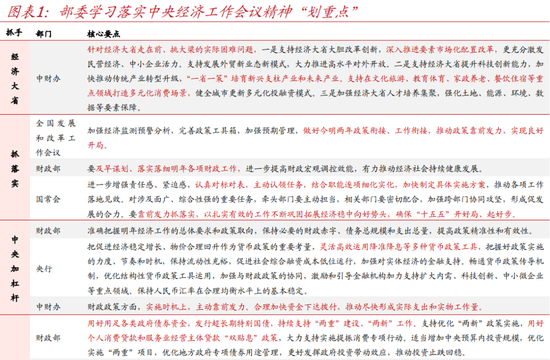
国盛宏观熊园:各部委各地学习中央经济工作会议“划重点”
Xin Lang Cai Jing· 2025-12-25 02:28
Core Viewpoint - The recent learning and communication of the Central Economic Work Conference's spirit by various departments and regions is an important window for tracking the implementation of the conference's spirit, revealing more details and actionable measures [2] Group 1: Policy Implementation - Various departments are focusing on the "stability while seeking progress, improving quality and efficiency" principle, with clear directions and highlighted priorities such as expanding domestic demand, strengthening technology, promoting reform, and stabilizing real estate [3][5] - The central government is expected to continue "leveraging" with specific scales to be determined at the 2026 National Two Sessions, emphasizing proactive measures and reasonable acceleration of fund disbursement [4][6] - Departments are prioritizing support for expanding domestic demand, utilizing various funds, and continuing to support "two new" and "two heavy" initiatives, including fostering trillion-level new consumption growth points [6][7] Group 2: Financial and Monetary Policies - The Ministry of Finance and the central bank are maintaining a "more proactive fiscal policy" and "moderately loose monetary policy," with a focus on maintaining necessary fiscal deficits and debt levels [6][8] - The central bank may consider lowering reserve requirements and interest rates in the first quarter of 2026, along with introducing more structural tools [2][4] - There is an emphasis on accelerating fiscal spending and issuing special bonds to support consumption and investment [6][7] Group 3: Industry and Innovation - There is a strong focus on industrial transformation, self-control, and innovation leadership, with initiatives to promote technology finance and the construction of international technology innovation centers in key regions [7][8] - The government is pushing for reforms to create a unified market, enhance the development of the private economy, and deepen state-owned enterprise reforms [8][9] Group 4: Risk Management - The financial system is focused on preventing risks, particularly in the real estate sector, while ensuring support for both residents and real estate companies [9][10] - Measures are being taken to stabilize the stock market and promote long-term investments, including accelerating reforms in the Sci-Tech Innovation Board and piloting commercial real estate REITs [10][11] Group 5: Local Implementation - Various regions are adapting the central economic work conference's spirit to their local contexts, emphasizing proactive measures and specific actionable tasks, with a focus on ensuring a good start for the 14th Five-Year Plan [13][14] - Local governments are expected to detail their plans and measures in the upcoming local two sessions in January 2026, with a strong emphasis on innovation and openness [13][14]
各部委各地学习中央经济工作会议“划重点”【国盛宏观熊园团队】
Xin Lang Cai Jing· 2025-12-24 16:47
Core Viewpoint - The recent learning and dissemination of the Central Economic Work Conference's spirit by various departments and regions is a crucial window for tracking the implementation of the conference's directives, revealing more details and actionable measures. There are several highlights and new proposals, including a focus on proactive measures, accelerating fund disbursement, supporting new consumption growth points, and emphasizing real and substantial growth without exaggeration [2][3][11]. Group 1: Overall Direction - All parties are refining their deployment around the Central Economic Work Conference's principle of "seeking progress while maintaining stability and improving quality and efficiency," with clear directions and highlighted priorities such as expanding domestic demand, strengthening technology, promoting reform, and stabilizing real estate [3][11]. - The emphasis is on policies that "act proactively" to ensure a good start to the year [3][11]. Group 2: Departmental Deployment - Each department has made detailed deployments based on their functional positioning, with the Central Financial Office providing the most comprehensive interpretation of the conference's spirit, revealing specific tasks and details [4][12]. - Signal 1: The continuation of "central leverage" is confirmed, with specific scales to be determined at the 2026 National Two Sessions, emphasizing proactive measures and reasonable acceleration of fund disbursement [4][12]. - Signal 2: Multiple departments will prioritize expanding domestic demand, utilizing various funds, and supporting "two new" and "two heavy" projects, with new focuses on cultivating trillion-level new consumption growth points and increasing investment in consumption infrastructure and livelihood projects [4][12][13]. Group 3: Industry Focus - Signal 3: There is a strong focus on industrial transformation, self-control, and innovation leadership, promoting the expansion and efficiency of technology finance, particularly in the Beijing-Tianjin-Hebei and Yangtze River Delta regions [5][14]. - Signal 4: The emphasis on reform includes advancing a unified market, combating "involution," and stabilizing the private sector, with more details on fiscal and tax reforms to be discussed in the upcoming National Fiscal Work Conference [6][15]. Group 4: Risk Management and Market Stability - Signal 6: There is a strict adherence to the "no explosion" bottom line for risk prevention, balancing the needs of residents and real estate companies, and reiterating the principles for debt resolution while increasing financial and fiscal support [8][17]. - Signal 7: Efforts to stabilize the stock market will continue, promoting the narrative of the Chinese stock market and accelerating reforms in the Sci-Tech Innovation Board and commercial real estate REITs [9][18]. Group 5: Local Implementation - Many regions have begun to learn and convey the spirit of the Central Economic Work Conference, tailoring key tasks to local conditions, with a focus on proactive measures and concrete actions, particularly in the lead-up to the January 2026 local two sessions [10][23]. - Localities like Zhejiang and Hainan are emphasizing innovation and openness, respectively, while ensuring that actionable measures are taken to support economic growth [10][23][24].
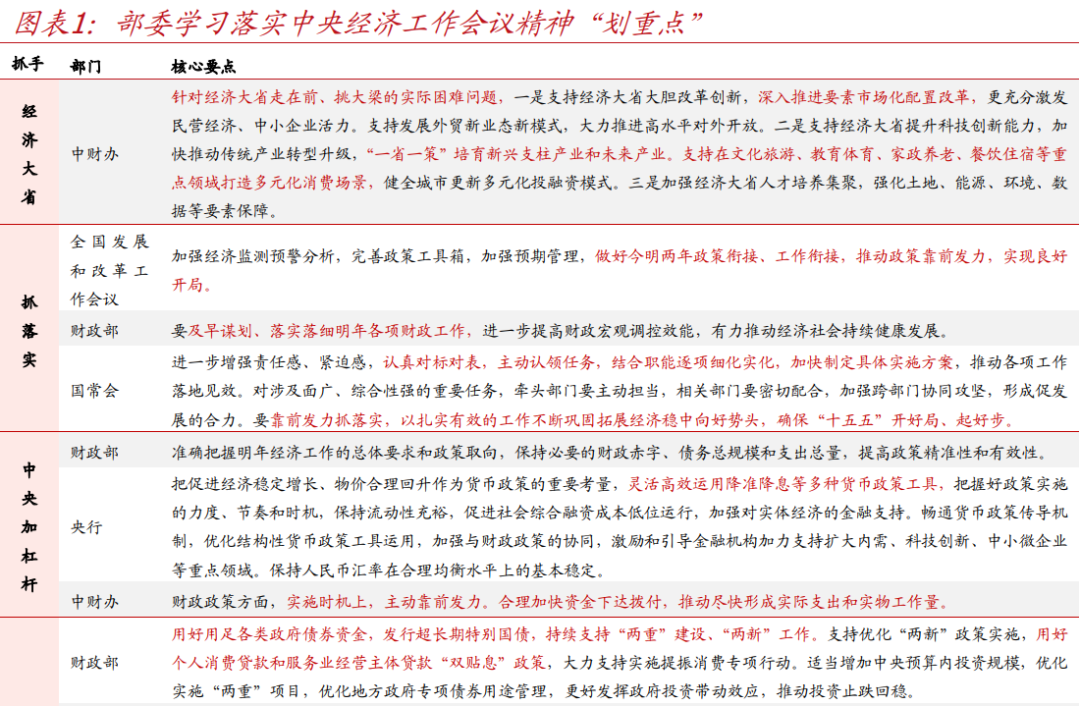
各部委各地学习中央经济工作会议“划重点”
GOLDEN SUN SECURITIES· 2025-12-24 14:18
Group 1: Policy Implementation - Various departments are refining their implementation of the Central Economic Work Conference's spirit, focusing on "stability while seeking progress" and "quality improvement" as the main themes[3] - Emphasis on accelerating the disbursement of funds and implementing major projects ahead of schedule to ensure a strong start in 2026[2] - The central government plans to maintain a necessary fiscal deficit and debt scale, with the overall fiscal deficit expected to be similar to that of 2025[4] Group 2: Economic Growth Strategies - Aiming to cultivate new consumption growth points worth trillions, with increased investment in consumer infrastructure and social welfare projects[6] - The government is focusing on expanding domestic demand, supporting "two new" and "two heavy" projects, and implementing the "15th Five-Year Plan" major projects[6] - The central bank may consider lowering reserve requirements and interest rates in the first quarter of 2026 to stimulate economic activity[2] Group 3: Risk Management and Market Stability - A commitment to prevent financial risks, ensuring that no major defaults occur, particularly in the real estate sector[10] - The government is taking measures to stabilize the real estate market while balancing the needs of residents and property companies[10] - Continuous efforts to promote the stock market narrative and attract long-term investments, including reforms in the Sci-Tech Innovation Board and commercial real estate REITs pilot programs[10]